Alexander vs. History: Oliver Stone's Epic Gets the Conquests Right - But the Man Wrong
Auditing the Alexander historical accuracy of Oliver Stone's epic: what the film gets right and spectacularly wrong about the greatest conqueror of the ancient world.
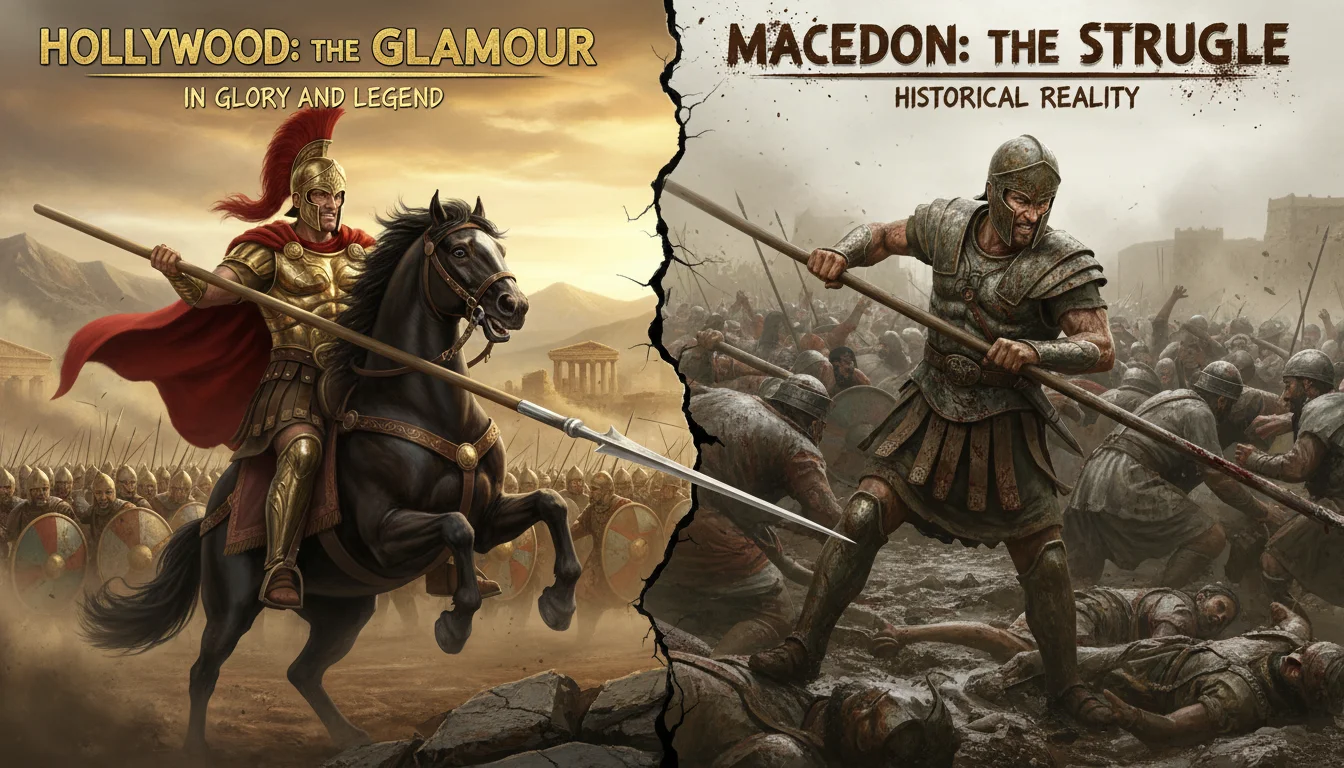
Oliver Stone's Alexander (2004) was supposed to be the definitive epic about history's greatest conqueror. Instead, it became one of Hollywood's most notorious flops - $155 million budget, mediocre reviews, endless director's cuts trying to "fix" it.
But forget the box office disaster. The real question: How accurate is it?
Stone consulted historians, shot on location, and clearly did his homework. Yet the film stumbles badly on Alexander's character, sexuality, and motivations. Let's break down what the movie got right, what it got spectacularly wrong, and what we'll never know for sure.
What Hollywood Got RIGHT
1. The Scale of Conquest Was Real
The film shows Alexander conquering from Greece to India in just 13 years. That actually happened.
- 334 BC: Crosses into Asia with 40,000 men
- 333 BC: Defeats Darius III at Issus
- 331 BC: Destroys the Persian Empire at Gaugamela
- 327 BC: Reaches India, fights King Porus
- 323 BC: Dies in Babylon at age 32
The movie compresses timelines and skips battles (no Granicus River, minimal Gaugamela), but the impossible scope of his achievement is accurate. Alexander covered 22,000 miles in a decade. For context, that's nearly the circumference of Earth.
2. Alexander's Companions Were Elite Warriors
The film depicts the Companion Cavalry as Alexander's shock troops - and that's spot-on.
These weren't just friends; they were Macedonia's aristocratic heavy cavalry, armed with 12-foot lances called xyston. At Gaugamela, Alexander personally led the Companions in a wedge formation that shattered Darius's center.
Hephaestion, Ptolemy, Cleitus, Cassander - all real generals who fought beside Alexander and later carved up his empire after his death.
3. The Battle of Gaugamela Tactics Are Legit
The film's centerpiece battle shows Alexander using the hammer and anvil tactic:
- Phalanx (infantry) pins the enemy
- Companion Cavalry (hammer) smashes the weak point
- Enemy routs
This is exactly how Alexander fought. Ancient sources (Arrian, Plutarch) describe the same maneuver. The movie even gets the sarissa (18-foot pike) right - Macedonian infantry could outreach everyone.
What's missing: the scale. Gaugamela had 250,000 Persians vs. 47,000 Macedonians (ancient estimates). The film makes it look like a skirmish.
4. The Gordian Knot Scene Happened
The film shows Alexander "solving" the Gordian Knot by slicing it with his sword. Ancient sources confirm this.
Legend said whoever untied the knot would rule Asia. Alexander allegedly said, "It makes no difference how it's undone," and cut it. Classic Alexander - impatient, brilliant, theatrical.
5. He Did Get Wounded - A Lot
Colin Farrell's Alexander takes an arrow to the chest in India. That happened at Multan (326 BC).
The arrow pierced his lung. His men thought he was dead. He survived, but the wound may have weakened him fatally. Ancient sources say he was wounded eight times during his campaigns - broken shoulder, slashed thigh, arrow to the ankle. The movie actually underplays how reckless he was.
What Hollywood Got WRONG
1. Alexander's Sexuality Is Oversimplified
The film portrays Alexander as bisexual, with romantic relationships with both Hephaestion (Jared Leto) and Roxana (Rosario Dawson).
The truth is murkier. Ancient sources hint at a relationship with Hephaestion but never explicitly state it. Roxana was a political marriage - Alexander married three women to cement alliances. Ancient Greece had different sexual norms than today; emotional bonds between men were celebrated, but labeling Alexander with modern terms is anachronistic.
Stone's version isn't wrong, but it's presented through a 21st-century lens, not a 4th-century BC one.
2. Olympias (Angelina Jolie) Is a Cartoon Villain
Jolie's Olympias is a snake-handling, incestuous, manipulative witch who poisons Philip II.
The real Olympias was ruthless - but not this cartoonish.
- She probably did participate in ecstatic Dionysian rituals (snakes included)
- She probably did hate Philip's other wives
- She probably did influence Alexander's upbringing
But the film ignores her political brilliance. After Alexander's death, Olympias fought wars to secure her grandson's throne. She wasn't just a jealous mother - she was a power player.
The "she poisoned Philip" theory? Speculative. Ancient sources don't confirm it.
3. Cleitus's Murder Is Misplaced and Sanitized
The film shows Alexander killing his friend Cleitus the Black in a drunken rage. This happened - but the movie softens it.
Real version:
- 328 BC, Samarkand (not Babylon, as the film suggests)
- Alexander was drunk at a banquet
- Cleitus mocked Alexander's growing megalomania ("Your father Philip was the real hero")
- Alexander grabbed a spear and ran him through
The movie makes it a tragic accident. The truth? Alexander deliberately murdered the man who had saved his life at the Battle of Granicus. He regretted it instantly (locked himself in his tent for three days), but the act exposed his dark side.
4. The Indian Campaign Is Rushed
The film shows Alexander's army mutinying at the Beas River, refusing to march farther east. That's true.
But the movie skips the Battle of the Hydaspes (326 BC) - one of Alexander's greatest tactical victories. He fought King Porus in a monsoon, crossed a flooding river at night, and defeated war elephants for the first time.
The film gives us a brief glimpse of Porus (in the director's cut), but it's nowhere near the epic clash it should be.
5. The Death Scene Is Pure Fiction
The movie shows Alexander dying peacefully in Babylon, surrounded by friends, with Hephaestion already dead.
The real death is far stranger.
- June 10, 323 BC: Alexander falls ill after a banquet
- For 12 days, he suffers fever, chills, and paralysis
- He dies unable to speak, his companions filing past his bed
Was it poison? Malaria? Typhoid? A complication from his lung wound?
We don't know. Ancient sources hint at foul play (Cassander's family had motive). Modern theories range from West Nile virus to alcohol poisoning. The film picks the "natural causes" version and ignores the mystery.
What We'll NEVER Know for Sure
1. Did Alexander Believe He Was a God?
The film shows Alexander visiting the Oracle of Siwa (Libya), where he's proclaimed "son of Zeus."
This happened. But did he believe it?
Some sources say yes - by the end, he demanded divine honors. Others say it was political theater to legitimize rule over Persians (who expected god-kings). The movie leans into the "deluded megalomaniac" angle, but we'll never know his inner thoughts.
2. Why Did His Men Stop at India?
The film blames exhaustion and homesickness. Partly true.
But ancient sources suggest the army feared the Ganges kingdoms - rumors of massive armies and more war elephants. They'd been campaigning for 10 years. They wanted to go home.
The movie simplifies this to "they were tired."
3. What Killed Him?
No one knows. The film picks natural causes. Modern scholars debate:
- Typhoid fever
- Malaria
- Poisoning (Cassander? Ptolemy?)
- Complications from the Multan arrow wound
- Chronic alcoholism
The mystery endures.
Historical Accuracy Score: 6/10
What Alexander Gets Right:
- The scale of conquest is accurate
- Battle tactics are solid (when shown)
- Key events (Gordian Knot, Cleitus murder, Beas mutiny) happened
- Alexander's wounds and recklessness are real
What It Gets Wrong:
- Olympias is a caricature
- Cleitus's murder is sanitized
- The Indian campaign is rushed
- The death scene ignores the poison mystery
- Alexander's inner life is speculative, presented as fact
The Verdict:
Oliver Stone clearly did his research - the film is dense with historical detail. But he prioritized psychological drama over historical accuracy. The result is a movie that gets the what right but stumbles on the why.
Alexander isn't a bad history lesson. It's a speculative character study dressed in period armor.
If you want to understand Alexander's campaigns, read Arrian. If you want to imagine what haunted him at night, watch Stone's film.
Just don't confuse the two.
Further Reading:
- The Campaigns of Alexander by Arrian (primary source, pro-Alexander)
- Alexander the Great by Philip Freeman (modern biography)
- The Persian Empire by Lindsay Allen (Persian perspective on the conquest)
Watch Next: Want more ancient epics? Check our breakdown of Troy and Gladiator.

Debate the Accuracy with the Real Figures
Ask the real people what Hollywood got wrong about their lives.
Chat with HistoryJoin the HistorIQly Club
Get smarter about the past.
Weekly stories, deep dives, and exclusive content straight to your inbox.