The Chosen vs History: What the TV Series Gets Right and Wrong
The Chosen vs history: fact-checking Dallas Jenkins's series for biblical and historical accuracy. What it gets right and what it invents about first-century Judea.
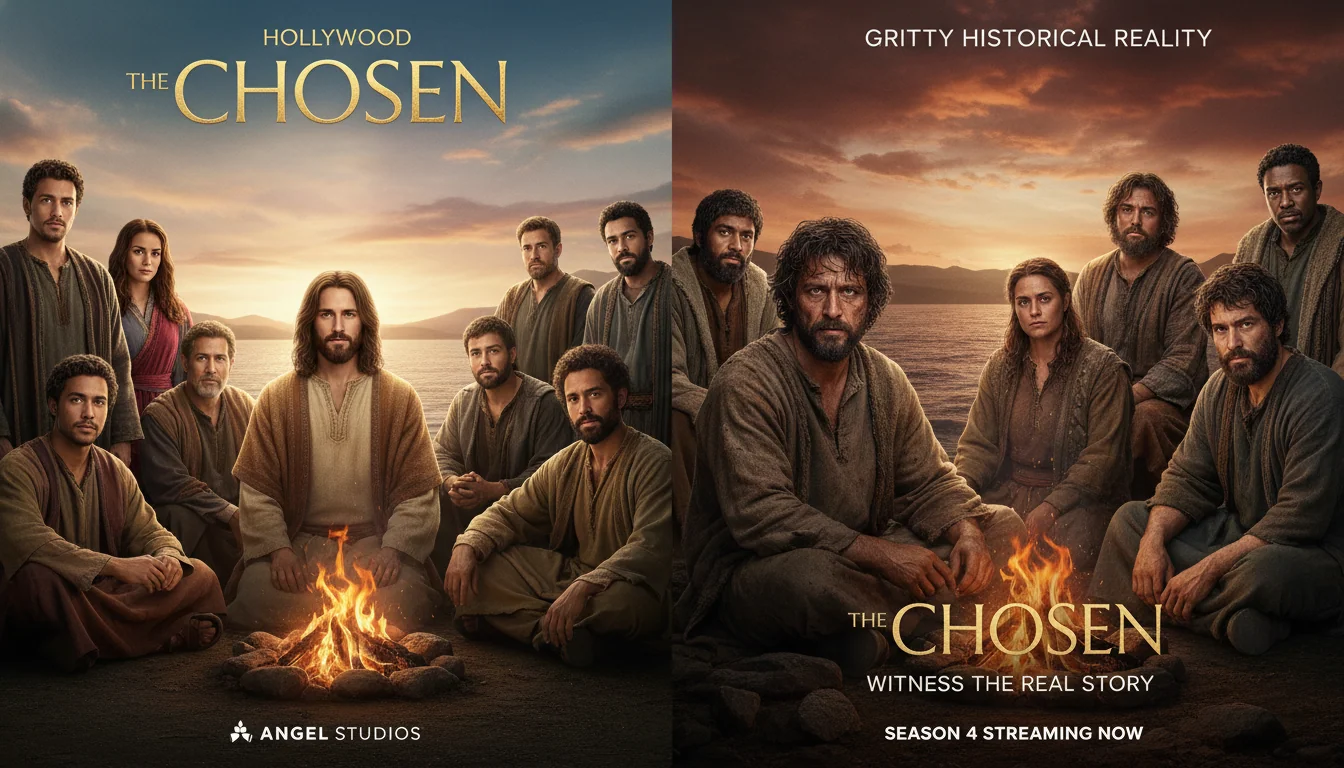
When The Chosen launched its first full season in 2019, it arrived with two unusual claims attached. First, it was the largest crowdfunded media project in history, with more than 16,000 backers contributing over $10 million to get it made. Second, it was a multi-season television series about Jesus of Nazareth, a subject that Hollywood had spent decades treating as either a single-film prestige project or a Sunday school cartoon.
Dallas Jenkins, the writer-director, partnered with Angel Studios for distribution and made the entire series free to stream. Jonathan Roumie plays Jesus across what is now planned as a seven-season arc covering the public ministry, the passion, and the resurrection. The show consults Jewish, Catholic, and evangelical advisors, and it has been watched, by various estimates, by more than 200 million viewers worldwide. So how does it hold up as history?
What The Show Gets RIGHT
First-century setting and costume detail
The production design is one of the show's strongest assets. Costumes use natural fibers, plausible dye palettes, and the layered tunic-and-mantle silhouettes that appear in surviving frescoes and sculptural reliefs from the period. The fishing boats, nets, and ropes used by Simon Peter and Andrew are based on the so-called "Jesus boat" recovered from the Sea of Galilee in 1986, a first-century vessel that gave archaeologists their clearest physical reference for Galilean fishing craft.
Houses are built with the rough basalt and limestone construction typical of the Galilean village layer at sites like Capernaum and Magdala. Roofs are flat and packed with mud, which is why the show's depiction of friends lowering a paralytic through one (Mark 2) actually makes physical sense rather than looking like a cartoon.
Jewish religious context
The show is unusually careful about sabbath practices, prayer rhythms, mezuzot on doorposts, ritual handwashing, and the cadence of synagogue worship. Jesus and his disciples are clearly observant Jews rather than proto-Christians in robes. The shema is recited. Festivals are kept. The show consistently reminds viewers that Jesus's arguments were intra-Jewish disputes, not attacks on Judaism from the outside.
Even the Pharisees are handled with more nuance than most screen treatments. The show portrays Pharisees as a diverse movement with internal disagreements, including sympathetic figures like Nicodemus and harsher antagonists like Shmuel. This matches what historians know about the period: the Pharisaic movement included multiple schools (Hillel and Shammai being the most famous), and "Pharisee" was not a synonym for hypocrite.
Social outcasts
Tax collectors, Samaritans, and the chronically ill are all rendered with reasonable historical texture. Matthew's profession as a publican really would have made him collaborator-class in Capernaum, despised by his neighbors and protected by Roman authority. The show captures the genuine social cost of his position, including his isolation from his own family.
The Samaritan woman at the well (John 4) is given context that explains why the encounter shocked the disciples: Jewish-Samaritan tensions were centuries old and rooted in disputes over the proper temple site, mixed ancestry, and competing scriptural canons. Most film adaptations skip this background. The Chosen makes it central.
Aramaic and Hebrew sprinkled in
Characters greet each other with "shalom," use "abba" and "ima" for parents, and occasionally drop into Aramaic phrases like "talitha koum" (Mark 5:41) when scripture preserves the original wording. This is small but meaningful texture. First-century Galilean Jews spoke Aramaic in daily life, knew Hebrew for liturgy, and would have encountered Greek and Latin in commercial and Roman contexts. The show's multilingual layer is approximately right.
Geographic accuracy
The show distinguishes Capernaum, Bethsaida, Nazareth, Jerusalem, and Caesarea Philippi as distinct places with different characters, economies, and political conditions. Capernaum as a fishing-and-trade hub on the Sea of Galilee, Jerusalem as the temple city under Roman occupation, and Nazareth as a small agricultural village are all rendered with reasonable fidelity. The travel times implied between locations also roughly match what a walking party could cover.
The show also takes care to portray the temple in Jerusalem as a vast, busy, and politically charged complex rather than a quiet shrine. This matches what historians know about Herod's temple, which was one of the largest religious structures in the ancient world and which functioned as the economic and judicial center of Jewish life under Roman occupation.
What The Show Invents
Pre-call backstories for the disciples
This is the largest category of invention. The Gospels tell us almost nothing about the disciples before Jesus calls them. The show fills the silence with elaborate personal histories. Matthew is portrayed as autistic, a characterization with no scriptural basis, though the show's handling has been praised by some autistic viewers and criticized by others. Simon Peter is given a tax-debt arc and a deal with the Roman authorities to spy on his fellow fishermen. James and John have a sibling rivalry. Thaddaeus and Little James are given trade backgrounds.
None of this is in the Gospels. It is not necessarily wrong, since the Gospels do not say it didn't happen, but it is invented to give actors something to play.
Dialogue and scenes between Jesus and the disciples
The conversational scenes that fill most of each episode (Jesus chatting around a campfire, joking with the disciples, comforting Mary his mother, debating with Judas about budgets) are nearly all written by the show's writers. The Gospels record sermons, parables, miracles, and a handful of brief exchanges. They do not record the daily texture of life with Jesus. The Chosen invents that texture wholesale.
This is dramatically necessary for a multi-season series. There is simply not enough Gospel material to sustain seventy hours of television. But viewers should know that when Jesus cracks a joke, comforts a disciple about their childhood, or explains his strategy for the next town, those words are Dallas Jenkins's, not Matthew's, Mark's, Luke's, or John's.
Nicodemus expanded far beyond John 3
Nicodemus appears in the Gospel of John in three short passages: a nighttime conversation with Jesus (John 3), a brief defense of Jesus before the Sanhedrin (John 7), and a role in Jesus's burial (John 19). The show builds him into a major recurring character with a wife, an academic career, an inner crisis, and ongoing involvement with Jesus's ministry. This is a creative expansion, not a historical one.
The Roman Quintus character
Quintus, the abrasive Roman magistrate of Capernaum, is entirely fictional. There is no scriptural or historical record of him. The show uses him as a way to dramatize Roman occupation pressure on Galilean Jews and to give Matthew a complicated employer. Useful storytelling, no historical basis.
A modern, therapeutic Jesus tone
This is the subtlest invention. Roumie's Jesus speaks in a warm, emotionally available, almost twenty-first-century pastoral register, with hugs, encouraging eye contact, and frequent reassurances about each disciple's individual worth. The historical Jesus of the Gospels is sharper, more enigmatic, and considerably less interested in individual emotional validation. He calls people "you of little faith," tells would-be followers to let the dead bury their dead, and speaks in parables that listeners often do not understand.
The show's emotional Jesus is theologically defensible and dramatically effective, but it reflects modern American Christian sensibilities more than first-century Galilean rabbinic style.
Want to know which of his on-screen words Jesus actually stands by? Chat with him on HistorIQly → - the AI history platform with 144+ historical figures, from $9/month.
Historical Accuracy Score: 7/10
The Chosen is one of the more historically grounded screen treatments of Jesus that Hollywood (or its crowdfunded equivalent) has produced. The setting, costumes, religious context, and social texture of first-century Galilee are rendered with care and consultation. The major Gospel events are preserved. Where the show invents, it usually invents to fill silences in the historical record rather than to contradict it. But viewers should recognize that the disciples' personalities, the daily dialogue, the Nicodemus arc, the Mary Magdalene backstory, and the warmly therapeutic tone of Jesus himself are creative choices, not biblical or historical reportage. It is a thoughtful dramatization, not a documentary, and it works best when watched as exactly that.
For cinematic treatments of the Passion narrative itself, see our fact-check of The Passion of the Christ vs history. For the 1977 miniseries that took a more literal approach to the same material, see Jesus of Nazareth (1977) vs history.
Quick Answers
Common questions about this topic
Is The Chosen biblically accurate?
Partially. The show preserves the major Gospel events, the named disciples, and the broad theological identity of Jesus, but it invents extensive backstories, personalities, and dialogue that the Gospels do not record. Dallas Jenkins has been transparent that the series is a dramatization built on biblical foundations rather than a strict adaptation of the four Gospels.
Are the dialogues in The Chosen from the Gospels?
Most are not. When Jesus delivers a sermon or a known parable, the show typically pulls the language directly from scripture. The conversational scenes between Jesus and the disciples, the disciples' arguments with each other, and almost every domestic moment are written by the show's writers and have no scriptural source.
Is Mary Magdalene's storyline accurate?
The Gospels mention that Jesus cast seven demons out of Mary Magdalene (Luke 8:2) and that she became a follower, but they say nothing about her prior life, her name being Lilith, or the trauma backstory the show invents. The series builds an emotional arc that is dramatically powerful but largely extra-biblical.
How is The Chosen funded if it's free to watch?
The series began as the largest crowdfunded media project in history, raising over $10 million from more than 16,000 backers for its first season. Subsequent seasons have been financed through Angel Studios' distribution and pay-it-forward model, in which viewers donate to fund future episodes for new audiences.

Debate the Accuracy with the Real Figures
Ask the real people what Hollywood got wrong about their lives.
Chat with HistoryJoin the HistorIQly Club
Get smarter about the past.
Weekly stories, deep dives, and exclusive content straight to your inbox.