Darkest Hour vs. History: How Accurate Is Gary Oldman's Churchill Epic?
Darkest Hour historical accuracy check: Gary Oldman won an Oscar for becoming Winston Churchill in May 1940, but how much of the film is real history?
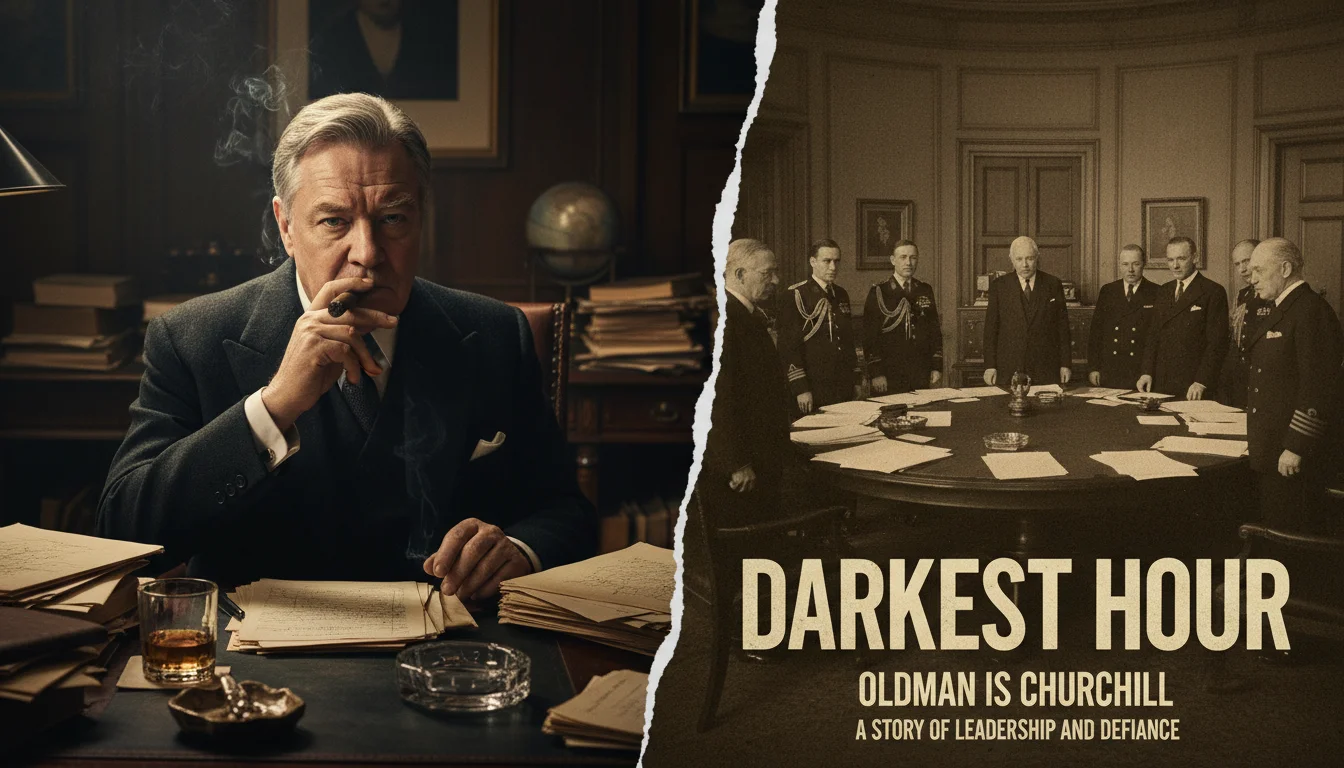
Gary Oldman disappeared into prosthetics and history to deliver one of cinema's most celebrated transformations. His portrayal of Winston Churchill in Joe Wright's 2017 film Darkest Hour earned him the Academy Award for Best Actor, capturing Britain's new Prime Minister during the terrifying weeks of May 1940 when Nazi Germany seemed unstoppable and evacuation from Dunkirk was the nation's only hope.
The film focuses on Churchill's first month in office - his battles with appeasement-minded colleagues, his relationship with King George VI, and the desperate decisions that shaped Britain's survival. But how much of this gripping political drama actually happened? Let's separate the bulldog spirit from the Hollywood polish.
What Hollywood Got RIGHT
The Political Crisis Was Real
The film accurately depicts the genuine political turmoil Churchill faced upon becoming Prime Minister on May 10, 1940. He was not the establishment choice. Many Conservative MPs distrusted him for his party-switching past and his disastrous Gallipoli campaign in World War I. Lord Halifax and Neville Chamberlain did indeed represent a faction that considered negotiating with Hitler through Mussolini.
The War Cabinet debates shown in the film reflect real discussions that took place between May 26-28, 1940. Halifax genuinely pushed for exploring peace terms with Germany, arguing that Britain might secure better conditions before France's inevitable collapse rather than after. Churchill opposed this fiercely, and the internal government struggle was as tense as the film portrays.
Churchill's Rhetorical Genius
The great speeches are real, and the film captures their power magnificently. "We shall fight on the beaches" was delivered to Parliament on June 4, 1940. "Blood, toil, tears and sweat" came on May 13. These words genuinely galvanized a nation facing potential invasion, and Oldman's delivery honors their historical impact.
The film also correctly shows that Churchill was a master of the written word who labored intensively over his speeches. He didn't speak off the cuff - his apparently spontaneous eloquence was the product of careful crafting and rehearsal.
The Relationship with King George VI
The initial awkwardness between Churchill and King George VI was real. The King had preferred Halifax for Prime Minister and was deeply loyal to Chamberlain, who had supported him during the abdication crisis. Their relationship did warm considerably over time, eventually becoming one of genuine mutual respect and even friendship.
Dunkirk's Desperation
The film accurately conveys the catastrophic military situation. By late May 1940, the British Expeditionary Force was trapped at Dunkirk with German forces closing in. The evacuation (Operation Dynamo) was a genuine race against time, and the possibility that 300,000 British soldiers might be captured or killed was very real. This was Britain's darkest hour in a quite literal sense. For the soldiers' side of the same week, see our Dunkirk fact check.
What Hollywood Got WRONG
The Tube Scene Never Happened
The film's most emotionally powerful sequence - Churchill riding the London Underground and polling ordinary citizens about whether to fight on - is complete fiction. There is no historical evidence Churchill ever took such a journey, and given his security detail and the realities of wartime, such a spontaneous interaction would have been extraordinarily unlikely.
Screenwriter Anthony McCarten admitted this was a dramatic invention designed to show Churchill reconnecting with the British people's fighting spirit. While it makes for compelling cinema, it transforms Churchill from a leader who made a difficult decision based on his own conviction into one who needed permission from the public. The real Churchill didn't need to ask.
Elizabeth Layton's Timeline
Lily James plays Elizabeth Layton, Churchill's personal secretary, as if she were present during May 1940. In reality, Layton didn't begin working for Churchill until May 1941 - a full year after the events depicted. Her role was compressed for narrative convenience, giving audiences a sympathetic viewpoint character to guide them through Churchill's world.
Halifax's Villainy Was Exaggerated
Stephen Dillane's Lord Halifax comes across as almost villainous in his advocacy for peace negotiations. While Halifax did push for exploring terms with Germany, the film oversimplifies his position. Halifax was not a Nazi sympathizer or a coward - he was a deeply principled man who genuinely believed negotiation might spare British lives and preserve the Empire.
More importantly, Halifax's position was not unreasonable given the information available in May 1940. France was collapsing, America was neutral, and Britain faced potential invasion with a badly equipped army. Halifax's advocacy for exploring options, while ultimately wrong, was a legitimate strategic position that many intelligent people shared.
The Cabinet Confrontation Was Less Dramatic
The film depicts Churchill rallying the Outer Cabinet with a rousing speech that essentially ends the peace negotiation debate. While Churchill did address the Outer Cabinet on May 28, 1940, and his words were stirring, the political battle with Halifax was more complex and less conclusively decided than the film suggests.
The reality is that Halifax gradually accepted Churchill's position rather than being dramatically defeated. There was no single knockout moment - it was a process of persuasion and events that unfolded over days.
Churchill's Depression and Drinking
The film hints at Churchill's depression (his "black dog") and shows his famous drinking habits, but actually understates both. Churchill was a serious drinker throughout his life - whisky with breakfast was not unusual for him - and his struggles with depression were more profound than the film indicates. The movie sanitizes these aspects, perhaps to keep its hero sympathetic.
The Accuracy Verdict
Historical Accuracy Score: 6/10
Darkest Hour captures the essence of Britain's crisis in May 1940 and the genuine political battles Churchill faced within his own government. The speeches are real, the military situation accurate, and the broader strokes of history faithfully painted. Gary Oldman's transformation into Churchill goes beyond mere impersonation to capture something of the man's spirit and contradictions.
However, the film's most memorable scene - the Tube journey - is pure invention, and several characters and events are compressed or altered for dramatic effect. The portrayal of Halifax borders on character assassination of a complex historical figure, and the neat resolution of the War Cabinet debate simplifies a messier political reality.
The Bigger Picture
What Darkest Hour gets fundamentally right is the stakes. In May 1940, Britain's survival as an independent nation genuinely hung in the balance. Churchill's refusal to negotiate with Hitler - a decision that seemed reckless to many at the time - proved to be one of history's most consequential choices. Had Britain sought terms with Germany, the world we live in would be unrecognizably different.
The film also captures something true about Churchill himself: his combination of aristocratic eccentricity, rhetorical brilliance, and stubborn determination. He was not a simple hero - he was a complex, often difficult man who happened to be exactly what Britain needed at its most desperate moment.
Whether he needed a ride on the Tube to find his courage is another matter entirely. The real Churchill knew his own mind, for better and worse. That's what made him both great and dangerous - and what made those weeks in May 1940 such a genuine turning point in human history.

Debate the Accuracy with the Real Figures
Ask the real people what Hollywood got wrong about their lives.
Chat with HistoryJoin the HistorIQly Club
Get smarter about the past.
Weekly stories, deep dives, and exclusive content straight to your inbox.