The Devil's Footprints of Devon: A Single Night of Cloven Tracks Across Southern England
The Devil's Footprints of Devon: on February 9, 1855, cloven hoofprints appeared across rooftops and frozen fields for over 100 miles. No explanation has ever held up.
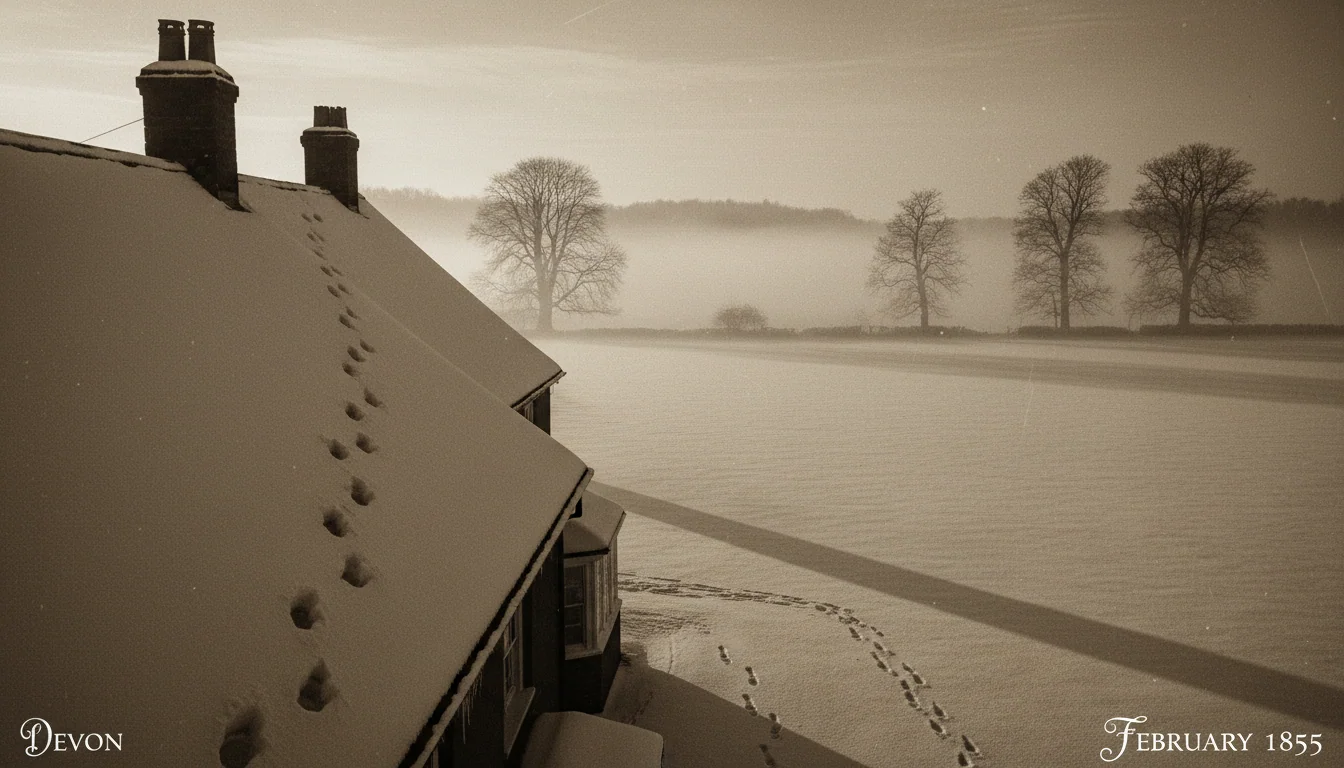
In the early hours of Friday, February 9, 1855, a fresh layer of snow lay over the south coast of Devon. By breakfast that morning, people across an arc of villages and small towns were stepping outside and finding the same thing in their gardens, on their walls, and on their roofs: a single, unbroken line of small cloven hoofprints, evenly spaced, marching in a straight line as if a creature had walked the entire night without ever pausing or hesitating.
No one knew what had made them. Nearly 170 years later, no one has ever produced an explanation that satisfies the full range of evidence. The Devon Devil's Footprints remain one of the strangest documented mysteries in Victorian Britain.
A morning of unease
The snow had fallen the previous evening, with temperatures dropping sharply overnight. The ground was firm by dawn. Across an estimated 100-mile arc that included Exmouth, Lympstone, Topsham, Bicton, Powderham, Dawlish, Teignmouth, and several smaller hamlets, residents found tracks beginning, in some cases, in the middle of a field with no entry point and ending, in some cases, against a brick wall as if the creature had walked through it.
The prints were almost identical wherever they appeared. About four inches long, three inches wide, U-shaped or cloven, eight inches apart, in a single line. The line did not deviate around obstacles. It went over hayricks, over tiled rooftops, across the iced surface of the Exe Estuary, through orchards with closed gates. In Dawlish, witnesses traced the line along the top of a 14-foot wall. In Lympstone, the tracks ran straight up the side of a haystack and continued from the top.
Local clergy were among the first to leave their houses with measuring sticks. The Reverend G. M. Musgrave of Exmouth examined the prints in his garden and church grounds and made careful sketches. So did the Reverend H. T. Ellacombe of nearby Clyst St George. Their accounts were corroborated by farmers, tradesmen, and ordinary householders.
By midmorning, half of southern Devon had stepped outside to find some version of the same line crossing some part of its property.
The press takes hold
The story reached the regional papers within days. The Western Times of February 16 ran the first detailed account, and the Illustrated London News picked it up on February 17. By February 24, The Times of London had reported on it, treating the affair with measured skepticism but quoting eyewitnesses at length. Scientific journals and church publications joined in. Letters poured into editors with theories, drawings, and rival eyewitness accounts.
The phrase "Devil's Footprints" was adopted within the first week. It was not entirely a joke. Rural Devon in 1855 was deeply religious and steeped in older traditions about night-walkers, witches, and infernal visitors. The local children were said to have refused to go to school for several days. Several pastors organized morning prayers. At least one farmer reportedly slept with a loaded fowling piece next to his bed for the rest of the month.
The Illustrated London News printed a careful drawing of the prints based on Musgrave's measurements, and that drawing has been the basis for almost every subsequent reconstruction.
Why the conventional explanations fail
Theories began circulating immediately, and they have never stopped.
A kangaroo or wallaby
A widely circulated suggestion, published in the Illustrated London News, was that an escaped kangaroo from the private menagerie of a Mr. Fische of Sidmouth had wandered the countryside overnight. This was popular for a week and then quietly dropped when it became clear that kangaroos do not leave cloven tracks, do not walk in single straight lines, and do not climb haystacks. There was also no evidence such an escape had ever occurred.
Hopping rodents or birds
Some early naturalists proposed that wood mice, leaping in the snow with their hind feet together, could produce a pattern that resembled cloven prints. Birds with banded feet, hopping rather than walking, were also suggested. Both theories explain the shape of individual prints reasonably well. Neither explains how the same animal walked over a 14-foot wall, across a tiled roof, or onto the surface of a tidal estuary. They also do not explain the consistency of stride length over miles.
Hot-air balloon dragline
A modern theory, often repeated in tabloids, claims that an experimental hot-air balloon trailing a chain or rope might have left a uniform pattern as it drifted. There is no record of any balloon flight from Devon on the night of February 8. Balloons cannot drag a rope through 14-foot walls and continue, and a drifting line cannot produce evenly spaced individual impressions.
A hoax
The hoax theory is the most plausible single explanation: that local pranksters used some kind of stamp or shoe-shaped die to leave the impressions in the snow overnight. The problem is the geographic scale. To produce the recorded line, a coordinated team would have to have walked at least 60 to 100 miles in subfreezing conditions on a single winter night, climbing buildings and crossing icy water in absolute silence, leaving no other footprints around the impressions. The Reverend Musgrave noted in his account that the snow around the prints was undisturbed, with no human boot marks anywhere near them.
Ice formations or thermal phenomena
Some 20th-century writers have suggested that thawing icicles or droplets falling from rooftops might create lines of impressions in soft snow. This works for one short stretch under one eave. It does not explain a uniform line across thousands of yards of open field.
Multiple animals, exaggerated reporting
The most common modern position, taken by writers such as Mike Dash in his careful 1994 review of the case, is that several different small animals, each leaving its own short trail in the new snow, were misread by frightened residents as a single continuous track. Newspapers then conflated separate sightings into one spectacular line. This is probably part of the story. It does not, however, account for the rooftop and high-wall sightings reported by clergy who were not prone to invention.
The figures who recorded the case
Two clergymen are responsible for most of what we know. The Reverend G. M. Musgrave of Exmouth published his observations in the Illustrated London News and corresponded with several London naturalists. He measured prints in multiple locations himself and noted the absence of human disturbance around them. He also recorded, somewhat reluctantly, that several of his parishioners openly believed the Devil had walked the county overnight.
The Reverend H. T. Ellacombe of Clyst St George kept a private journal of the incident, much of which was later published. Ellacombe was a serious naturalist and geologist by avocation, and his frustration at being unable to identify the source of the tracks is recorded in some detail. He examined them on multiple properties, sketched several, and concluded that no known animal in the British Isles could have produced the line.
Charles Dickens, then editing the journal Household Words, briefly considered a feature on the affair and wrote privately that the case "passes all common explanation." He never published on it.
Echoes and parallels
The Devon prints are not entirely without precedent. Reports of similar single-line cloven tracks in fresh snow appear in folklore from medieval Europe, where they were almost always interpreted as the passage of a demon. In May 1840, a similar phenomenon was reported on the Kerguelen Islands by Captain James Clark Ross, who saw "in the snow the tracks of an animal, apparently of the ass kind," in a remote area where no quadruped was known to exist. In 2009 a smaller incident in Woolsery, Devon, briefly revived popular interest, with locals finding cloven tracks in fresh snow that experts later attributed to a hopping hare.
None of these matches the scale or geographic spread of February 1855.
Why the case still bothers people
The Devon Devil's Footprints are a peculiar kind of mystery because they sit at the intersection of three uncomfortable facts.
First, the eyewitnesses were not credulous fantasists. They included educated parish clergy, respected farmers, schoolteachers, and a number of professional naturalists. Their measurements agreed across miles of countryside.
Second, the simplest explanations do not cover the simplest evidence. No conventional animal explains the rooftops. No hoax theory explains the absence of supporting footprints. No combination of natural phenomena explains the geographic span.
Third, the case has never been solved, and it has now been studied for nearly two centuries by skeptical investigators, naturalists, and folklorists alike.
What probably happened is that a hard freeze, a single night of windless snowfall, and a swarm of small animals collaborated with collective fear and Victorian newspaper culture to produce a story that, in its most extreme form, no longer accurately reflects whatever actually happened. But what probably happened is not what was reported, and what was reported is what we are left with.
On the morning of February 9, 1855, in a county not yet electrified, ordinary people walked out into the snow and saw something they could not name. They measured it. They drew it. They told one another. And then, by the next snowfall, it was gone, and it has not come back since.
The Devil, if it was the Devil, came once and never returned. The mystery of why has lasted longer than anyone in Devon could have imagined.
For other historical mysteries that have resisted every explanation, see our investigations of the Green Children of Woolpit and the Hinterkaifeck Murders.
Quick Answers
Common questions about this topic
Where did the Devil's Footprints appear?
The tracks appeared in a roughly 100-mile arc across southern Devon, England, in towns including Exmouth, Topsham, Lympstone, Powderham, Dawlish, and Teignmouth. They reportedly crossed the Exe Estuary, ran along rooftops, traced over haystacks, and continued across walled gardens that should have been impassable to a single creature on the ground.
When did the Devil's Footprints incident happen?
The tracks were discovered on the morning of February 9, 1855, after a heavy overnight snowfall. Most accounts suggest the prints were laid down between roughly midnight and dawn. The story dominated the local press through February and reached The Times of London by mid-month.
What did the Devil's Footprints look like?
Eyewitnesses described U-shaped or cloven-hoof-shaped impressions about four inches long and three inches wide, spaced eight inches apart in a single straight line. The tracks looked as though they had been made by a small biped walking heel-to-toe, not a four-legged animal in the conventional sense.
Has the Devil's Footprints mystery ever been solved?
No, not satisfactorily. Theories have ranged from a kangaroo escaped from a private menagerie, to wood mice, to leaping rodents, to atmospheric ice formations, to a deliberate hoax, to the literal Devil. None of them account for the full reported pattern, the distance covered, or the route across rooftops and walls. Modern researchers tend to favor a combination of multiple animals plus exaggerated reporting, but it remains officially unexplained.

Want to Interrogate the Suspects?
Chat with historical figures and uncover the truth behind history's greatest mysteries.
Start Your InvestigationJoin the HistorIQly Club
Get smarter about the past.
Weekly stories, deep dives, and exclusive content straight to your inbox.