Downfall Accuracy: Hitler's Last Days, Fact vs. Film
How accurate is Downfall? We fact-check the 2004 film against Fuhrerbunker eyewitness accounts, from Bruno Ganz's Hitler to the final days in Berlin.
Read Wikipedia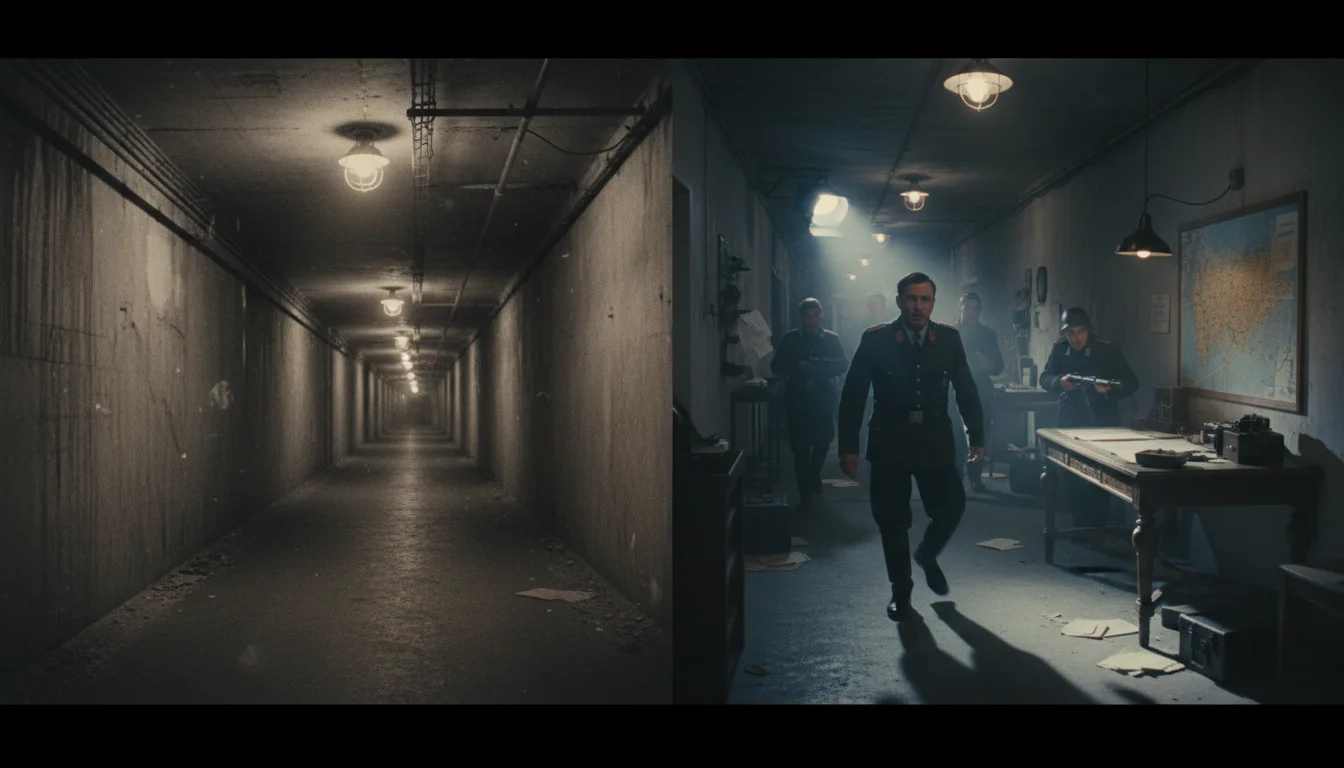
In 2004, German director Oliver Hirschbiegel dared to do what Hollywood had long avoided: portray Adolf Hitler not as a screaming caricature, but as a human being in his final days. Downfall (Der Untergang) remains one of the most acclaimed and controversial WWII films ever made - and arguably the most accurate depiction of the Führerbunker's final hours.
But how much of what we see on screen actually happened?
The Source Material
Downfall draws primarily from two sources: historian Joachim Fest's book Inside Hitler's Bunker and the memoirs of Traudl Junge, Hitler's personal secretary who was with him until the end. The film even features documentary footage of the real Junge, filmed shortly before her death in 2002, bookending the narrative with her haunting confession about youthful ignorance being no excuse for complicity.
This is crucial context. Unlike most Hollywood productions that dramatize history from a distance, Downfall had access to first-hand testimony from people who were physically present in those claustrophobic corridors.
What Hollywood Got RIGHT
Bruno Ganz's Hitler (8/10)
Historians have praised Bruno Ganz's performance as perhaps the most accurate portrayal of Hitler ever filmed. The Swiss actor spent four months studying Hitler's voice recordings, mannerisms, and medical records. The trembling left hand from Parkinson's disease, the stooped posture, the vegetarian diet, the strange mix of paternal warmth and explosive rage - all documented by eyewitnesses.
When historian Ian Kershaw, author of the definitive Hitler biography, watched the film, he was struck by how closely it matched his research. The actual rant on April 22, 1945, when Hitler learned that Steiner's counterattack had failed to materialize, reportedly "thundered through the bunker for the next half an hour" according to Kershaw's sources. Director Hirschbiegel later revealed that Ganz nailed the infamous scene in a single take.
The Bunker Atmosphere (9/10)
The cramped, oppressive atmosphere of the Führerbunker is strikingly accurate. The bunker was indeed a maze of small rooms with low ceilings, ventilated by diesel generators that created a constant hum. The mixture of bizarre normalcy - secretaries typing, officers playing cards - alongside mounting hysteria is well-documented.
Rochus Misch, Hitler's bodyguard and telephone operator who was one of the last survivors of the bunker (he died in 2013), confirmed that the physical recreation was remarkably faithful, calling it a "concrete coffin" - the exact term used in his later interviews.
The Wedding and Suicide (8/10)
Hitler's marriage to Eva Braun in the early hours of April 29, 1945, is depicted accurately in its essential details. The ceremony was performed by a city official named Walter Wagner, witnessed by Goebbels and Bormann. Eva did stumble signing the marriage certificate, starting to write "Eva B..." before correcting to "Eva Hitler" - a detail the film captures.
Hitler's suicide on April 30 follows the most widely accepted historical account: he shot himself while simultaneously biting a cyanide capsule, with Eva taking only poison. Traudl Junge recalled being with the Goebbels children when she heard the gunshot.
The Goebbels Children (10/10)
The most harrowing sequence - Magda Goebbels murdering her six children rather than have them live in a world without National Socialism - is historically accurate in its horror, if not its exact method. The children were drugged and then killed with cyanide. Magda's cold resolve, depicted chillingly by Corinna Harfouch, matches witness accounts of her behavior in those final days.
What Hollywood Got WRONG
The Famous Rant Scene (6/10)
Ironically, the film's most iconic moment - Hitler's explosive breakdown that launched a thousand internet memes - may be exaggerated. Rochus Misch, when asked about the film's accuracy in 2005, said it was "Americanized," claiming that "Hitler never screamed in the bunker" and that "the bunker was generally quiet."
More significantly, the key eyewitnesses featured in the film - Traudl Junge and Rochus Misch - were not actually present in the April 22 briefing room. They heard about it secondhand. The screaming may have happened, but we're relying on accounts from generals who had their own reasons to portray Hitler as unhinged.
Traudl Junge's Escape (4/10)
The film shows Junge escaping Berlin with a young Hitler Youth member named Peter, eventually bicycling past Soviet lines to freedom in a somewhat hopeful ending. This is largely invented. Peter is a composite character. The real Junge's escape was far grimmer - she was captured by Soviet soldiers and, according to her own account, subjected to repeated sexual assault before eventually being released.
The filmmakers made a deliberate choice to soften this ending, perhaps to avoid overshadowing the main narrative with a different horror.
Magda Goebbels at the Goodbye (3/10)
The film shows Magda Goebbels present when Hitler says his final farewells before his suicide. According to Junge's memoirs and other sources, Magda had locked herself in her room at this time, too distraught to face the moment. It's a minor detail, but one that adds dramatic convenience at the expense of accuracy.
The Penicillin Request (2/10)
When Dr. Ernst-Günther Schenck is asked to gather medical supplies, the list includes penicillin. This is anachronistic - penicillin was not available in Nazi Germany in 1945. The Allies had it; the Germans did not.
Small Anachronisms
Eagle-eyed viewers have spotted post-war teleprinters, modern soap dispensers (invented in France in 1950), and a world map showing post-war borders. Eva Braun wears her wedding ring on her left hand - German custom would place it on the right.
The Controversy
Downfall sparked intense debate when released. Critics worried that humanizing Hitler risked generating sympathy for him. But this misses the film's point. By showing the banality within the bunker - the secretaries worried about their hair, the generals jockeying for position, the officers getting drunk - the film reveals how ordinary people enabled extraordinary evil.
The real Traudl Junge spent her final years grappling with this very question. Her documentary footage, used in the film, shows an elderly woman still tormented by how she could have served a monster and claimed ignorance. "It was no excuse," she says. "It would have been possible to find out."
Historical Accuracy Score: 8/10
Downfall stands as one of the most historically accurate major films about World War II, and almost certainly the most accurate depiction of Hitler's final days. Its errors are mostly technical anachronisms and minor dramatic compressions rather than wholesale fabrication.
The film's greatest achievement is not accuracy for its own sake, but using that accuracy to force viewers to confront uncomfortable questions. By refusing to make Hitler a cartoon villain, it makes us ask how people become complicit in atrocities - a question with relevance far beyond 1945.
The bunker scenes feel authentic because they largely were. The claustrophobia, the denial, the petty feuds amid apocalyptic collapse - this is how the end really looked.
Downfall doesn't ask us to sympathize with Hitler. It asks us to understand how humanity failed so catastrophically, and to recognize the warning signs for next time. For other 1945-era fact checks, see our breakdowns of All Quiet on the Western Front (2022) and Bonhoeffer.
Quick Answers
Common questions about this topic
Is Downfall based on a true story?
Yes. Downfall is based largely on eyewitness accounts from the Fuhrerbunker, especially Traudl Junge's memoirs and Joachim Fest's historical work.
How accurate is Downfall overall?
Downfall is widely regarded as one of the most accurate major films about Hitler's final days, though a few scenes are dramatized and some technical details are anachronistic.
Did Hitler really have the bunker breakdown shown in Downfall?
A furious breakdown after Steiner's failed counterattack is historically plausible, but the exact tone, wording, and who witnessed it are less certain than the film suggests.

Debate the Accuracy with the Real Figures
Ask the real people what Hollywood got wrong about their lives.
Create your free account →No card required. Some figures and features require a paid plan.
Join the HistorIQly Club
Get smarter about the past.
Weekly stories, deep dives, and exclusive content straight to your inbox.