Dunkirk vs. History: How Accurate Is Christopher Nolan's War Epic?
Dunkirk historical accuracy review: Nolan captures the terror of the beaches but omits the French rearguard, Hitler's halt order, and the RAF's actual scale of operations.
Read Wikipedia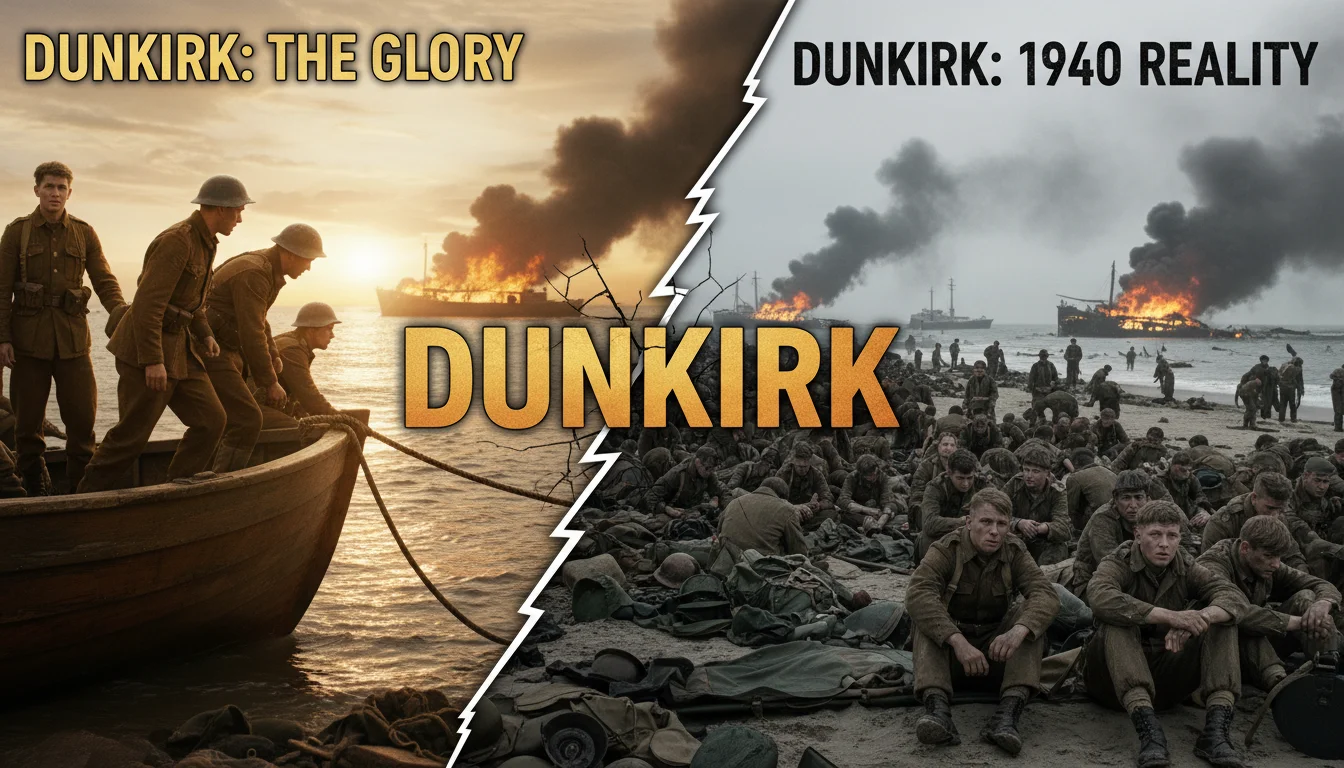
In May 1940, the British Expeditionary Force found itself trapped on the beaches of Dunkirk, France, with the German army closing in from all sides. What followed was one of the most remarkable evacuations in military history - Operation Dynamo, which rescued over 338,000 Allied soldiers across nine days.
Christopher Nolan's 2017 film Dunkirk strips away typical war movie conventions. There's minimal dialogue, no backstory, no love interest waiting at home. Instead, Nolan drops you into the chaos across three timelines: one week on the beach (The Mole), one day on the sea (The Sea), and one hour in the air (The Air). The result is less a traditional war film and more a survival thriller set against real events.
But how faithfully does it capture what actually happened?
What Hollywood Got RIGHT
The Sheer Terror of the Beaches
Nolan nails the psychological horror of Dunkirk. Soldiers standing in orderly queues on the beach while Stukas dive-bombed them is historically accurate. The real soldiers described the same surreal experience: waiting patiently in lines that stretched into the sea while bombs fell around them. British discipline held even under impossible conditions.
The Little Ships
The flotilla of civilian boats crossing the English Channel is not Hollywood invention. Around 700 "little ships" - fishing boats, pleasure yachts, lifeboats, even a paddle steamer - made the crossing to ferry soldiers from the shallow beaches to larger naval vessels offshore. Many were crewed by their civilian owners, exactly as shown in the film through Mark Rylance's character Mr. Dawson. The Admiralty requisitioned boats, but numerous owners volunteered to sail them personally.
The Spitfire Fuel Problem
Tom Hardy's storyline of running dangerously low on fuel while providing air cover is grounded in reality. Spitfires operating from southern England had roughly 80 minutes of flight time, and much of that was consumed just crossing the Channel. Pilots frequently pushed their fuel to the absolute limit. Some did indeed glide in after running dry, and several landed on the beach rather than ditch in the sea.
The Mole as Lifeline
The long wooden breakwater (the mole) at Dunkirk's eastern harbor was never designed for large ships. But Captain William Tennant, the Senior Naval Officer at Dunkirk, made the critical decision to use it as an improvised pier. This is faithfully depicted in the film. The mole became the primary embarkation point, with destroyers tying up alongside it despite the risk of bombing.
Soldiers Hiding in Beached Vessels
The sequence where soldiers hide inside a grounded trawler, waiting for the tide, reflects real accounts. Troops sheltered in any available cover - wrecked ships, dunes, cellars in the town - while awaiting rescue.
What Hollywood Got WRONG
Where Was the French Army?
This is the film's most significant omission. French forces played a massive role at Dunkirk, yet they're nearly invisible in Nolan's version. Around 100,000 French soldiers were evacuated alongside the British, and crucially, French troops formed the rearguard that held the perimeter while others escaped. Without the French 12th Motorized Infantry Division and other units fighting desperate delaying actions, the evacuation would have been far smaller. The film reduces this to a single French soldier trying to pass as British.
The Halt Order Myth
The film implies the Germans were relentlessly pressing the attack. In reality, Hitler issued a controversial halt order on May 24, stopping his Panzer divisions for nearly three days when they were within striking distance of Dunkirk. This pause - still debated by historians - gave the Allies critical time to organize defenses and begin the evacuation. Whether it was Goering's boast that the Luftwaffe alone could finish the job, concern about tank losses in marshy terrain, or a political calculation, the halt order was arguably what made Dunkirk possible.
The RAF Was There in Force
The film shows very few aircraft, which reinforced the real soldiers' bitter complaint that the RAF was absent. But this is misleading. Fighter Command flew 2,739 sorties over Dunkirk and lost 145 aircraft. The problem was that much of the air combat happened inland, out of sight of the beaches. Soldiers saw German planes but not the Spitfires and Hurricanes intercepting formations before they reached the coast. Nolan's decision to show just three Spitfires, while cinematically powerful, dramatically understates the RAF's actual contribution.
The Timeline Compression
Nolan's three-timeline structure is brilliant filmmaking but creates a misleading impression of the evacuation's pace. Operation Dynamo lasted nine days (May 26 to June 4), not the compressed timeframe the film suggests. The early days saw relatively small numbers rescued, with the operation building to its peak. The film's intensity makes it feel like a single desperate day rather than a prolonged operation with varying conditions.
The Beaches Were Far More Crowded and Chaotic
The film shows disciplined queues, which did exist. But the real beaches also featured significant disorder, especially early on. Abandoned vehicles, equipment, and supplies littered the sand. Dead horses, burning oil, and the wreckage of bombed ships created a hellish landscape that the film only partially captures. At peak crowding, an estimated 50,000 to 60,000 men were on the beaches simultaneously.
No Mention of the Wounded Left Behind
The film glosses over one of Dunkirk's hardest truths. Thousands of wounded soldiers were left behind because there was no room for stretchers on the small boats. Medical staff volunteered to stay with the wounded, knowing they would become prisoners of war. Around 40,000 Allied troops were captured when the perimeter finally collapsed.
Dunkirk Historical Accuracy Score: 7/10
Dunkirk is one of the more honest war films in recent memory, largely because Nolan chose to focus on the experiential truth of being trapped on that beach rather than inventing fictional heroics. The things it shows are mostly accurate. The problem is what it leaves out: the French contribution, the halt order that made rescue possible, and the full scale of RAF operations.
As a piece of immersive filmmaking, it's exceptional. As a complete picture of the Dunkirk evacuation, it tells about 60% of the story - the British 60%. For the full picture, pair it with a good book. Walter Lord's The Miracle of Dunkirk remains one of the best.
Nolan himself has said he made a survival film, not a war film. On those terms, it succeeds brilliantly. Just don't mistake it for the whole story.
For more WWII films put to the historical test, see our 1917 vs. History breakdown, and read how The Great Escape vs. History compares to the real Operation Escape.

Debate the Accuracy with the Real Figures
Ask the real people what Hollywood got wrong about their lives.
Create your free account →No card required. Some figures and features require a paid plan.
Join the HistorIQly Club
Get smarter about the past.
Weekly stories, deep dives, and exclusive content straight to your inbox.