Oppenheimer vs. History: How Accurate Is Nolan's Nuclear Epic?
Oppenheimer historical accuracy: Nolan's nuclear epic nails the Trinity test but invents the psychology. We separate Hollywood drama from documented history.
Read Wikipedia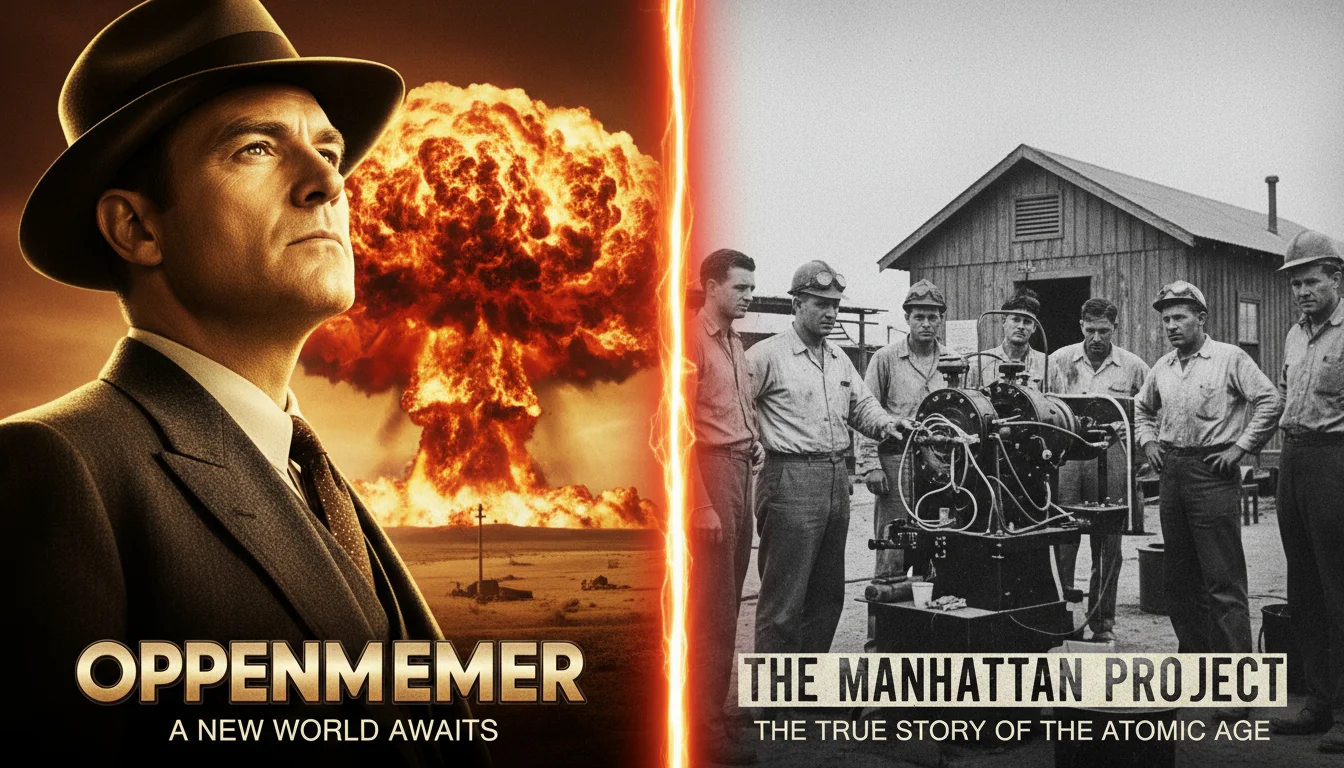
Christopher Nolan's 2023 epic Oppenheimer brought the story of the atomic bomb to IMAX screens worldwide, earning universal acclaim and multiple Academy Awards. Cillian Murphy's haunting portrayal of J. Robert Oppenheimer captivated audiences, but how faithful is the film to what actually happened? Let's break it down.
What Hollywood Got RIGHT
The Trinity Test
The film's depiction of the July 16, 1945 Trinity test is remarkably accurate. The scientists genuinely feared the bomb might ignite the atmosphere, and physicist Edward Teller did calculate the odds (finding them negligible but not zero). The famous bet among scientists about the bomb's yield actually happened, with I.I. Rabi winning by guessing closest to the actual 21-kiloton explosion. The tense countdown, the blinding flash, and the shockwave delay are all faithfully recreated.
The Oppenheimer-Strauss Feud
The bitter rivalry between Oppenheimer and Lewis Strauss, chairman of the Atomic Energy Commission, is one of the film's central threads, and it's grounded in fact. Strauss genuinely believed Oppenheimer had humiliated him during a 1949 congressional hearing about radioisotope exports. This perceived slight festered for years and drove Strauss to orchestrate the 1954 security hearing that stripped Oppenheimer of his clearance. Robert Downey Jr.'s portrayal of Strauss as a man consumed by petty grudges is well supported by historical accounts.
The Security Hearing
The 1954 security hearing scenes are among the film's most accurate sequences. Nolan drew heavily from the actual transcripts, and many lines of dialogue are taken verbatim from the record. The cramped room, the hostile questioning by Roger Robb, the parade of witnesses both supporting and betraying Oppenheimer - all of this happened. The hearing was widely seen as a political kangaroo court even at the time, and the film captures that atmosphere effectively.
Jean Tatlock and the Communist Connections
Oppenheimer's relationship with Jean Tatlock and his broader connections to Communist Party members are handled with reasonable accuracy. Tatlock was indeed a psychiatrist, a Communist Party member, and Oppenheimer's on-and-off lover. His brother Frank and sister-in-law Jackie were party members. The FBI surveillance of Oppenheimer, including bugging his home and following him to Tatlock's apartment, is documented fact.
The "Now I Am Become Death" Moment
While the film dramatizes when Oppenheimer recalled this line from the Bhagavad Gita, the quote itself is genuine. Oppenheimer referenced it multiple times throughout his life when discussing the Trinity test, most famously in a 1965 television interview. Whether the exact moment of recollection happened as shown is unknowable, but the association is historically authentic.
What Hollywood Got WRONG
The Chevalier Incident Timeline
The film compresses and slightly rearranges the Haakon Chevalier incident. In reality, the kitchen conversation where Chevalier relayed a Soviet contact's interest in sharing scientific information happened in late 1942 or early 1943, and Oppenheimer's evolving, contradictory accounts of it to security officials played out over months, not in the rapid sequence the film suggests. Oppenheimer initially claimed three scientists had been approached before eventually admitting it was only him. This inconsistency haunted him for over a decade.
Jean Tatlock's Nude Scene During the Hearing
One of the film's most controversial creative liberties has Tatlock appearing nude during the security hearing, visualizing how Oppenheimer felt his private life was being exposed. This is purely a Nolan invention. Tatlock had died by suicide in January 1944, a full decade before the hearing. While her relationship with Oppenheimer was discussed in the proceedings, this surreal visualization is dramatic license, not history.
Simplifying the Scientific Debate
The film presents the decision to build the hydrogen bomb as primarily a moral clash between Oppenheimer (against) and Teller (for). Reality was messier. Many scientists had nuanced positions that shifted over time. Oppenheimer's opposition to the "Super" was partly technical - he doubted it was feasible with existing designs - not purely moral. When Stanislaw Ulam and Teller found a workable design in 1951, some of Oppenheimer's technical objections evaporated, complicating the simple hero-vs-villain framing.
General Groves as Comic Relief
Matt Damon's Leslie Groves is portrayed as a blunt, somewhat bumbling military man who defers to Oppenheimer's genius. The real Groves was far more formidable. He was the engineer who had just overseen construction of the Pentagon, he managed the entire Manhattan Project with an iron fist, and he chose Oppenheimer precisely because he believed he could control him. Their relationship involved more genuine tension and power struggles than the film shows.
The Emotional Truman Meeting
The film depicts Oppenheimer telling President Truman "I feel I have blood on my hands," prompting Truman to dismiss him as a "crybaby." This exchange is based on accounts that vary in their details. Some historians question whether Oppenheimer used those exact words. What's documented is that Truman was indeed irritated by the meeting and made disparaging comments about Oppenheimer afterward, but the theatrical intensity of the scene is amplified for dramatic effect.
Missing Perspectives
Perhaps the film's biggest historical omission is any meaningful Japanese perspective. The bombings of Hiroshima and Nagasaki, which killed over 200,000 people, are presented almost entirely through the lens of American scientists and politicians. The victims remain abstract. While this reflects Oppenheimer's own limited perspective, it's a significant gap in telling the full story of the atomic bomb.
Historical Accuracy Score: 8/10
On the Oppenheimer historical accuracy scale, this is one of the most faithful biographical films in recent memory. Nolan and his team clearly studied Kai Bird and Martin J. Sherwin's Pulitzer-winning biography American Prometheus extensively, and it shows. The security hearing scenes in particular are almost documentary-like in their accuracy. Where the film takes liberties, it's mostly through compression, emphasis, and visual metaphor rather than outright invention. The main criticism is what it leaves out - particularly Japanese perspectives and the full complexity of the scientific debates - rather than what it gets wrong. For a three-hour Hollywood epic, that's an impressive achievement.
For related historical film fact-checks, see Saving Private Ryan vs. History and 1917 vs. History.
Quick Answers
Common questions about this topic
Did the Trinity test really happen as shown in Oppenheimer?
Yes. The July 16, 1945 Trinity test is depicted with remarkable accuracy. Scientists genuinely feared the bomb might ignite the atmosphere, and Edward Teller did calculate the odds. The famous bet among scientists about the bomb's yield did happen, with I.I. Rabi winning by guessing closest to the actual 21-kiloton explosion. The countdown, blinding flash, and shockwave delay are faithfully recreated.
Did Lewis Strauss really orchestrate Oppenheimer's downfall?
Yes. Strauss believed Oppenheimer humiliated him during a 1949 congressional hearing about radioisotope exports. This perceived slight festered for years and drove Strauss to orchestrate the 1954 security hearing that stripped Oppenheimer of his clearance. Robert Downey Jr.'s portrayal of Strauss as consumed by petty grudges is well supported by the historical record.
How accurate is the 1954 security hearing in the film?
The 1954 hearing scenes are among the film's most accurate. Nolan drew heavily from actual transcripts, with many lines of dialogue taken verbatim from the record. The hostile questioning by Roger Robb, the parade of supporting and betraying witnesses, and the kangaroo-court atmosphere all happened. The hearing was widely viewed as unjust even at the time.
Did Oppenheimer really say 'Now I am become Death'?
Yes. Oppenheimer referenced the line from the Bhagavad Gita multiple times when discussing the Trinity test, most famously in a 1965 NBC television interview. Whether he thought it at the precise moment of detonation, as the film dramatizes, is unknowable - but the association with the Trinity test is historically authentic.

Debate the Accuracy with the Real Figures
Ask the real people what Hollywood got wrong about their lives.
Create your free account →No card required. Some figures and features require a paid plan.
Join the HistorIQly Club
Get smarter about the past.
Weekly stories, deep dives, and exclusive content straight to your inbox.