The Death of Edgar Allan Poe: Literature's Greatest Unsolved Mystery
Edgar Allan Poe's death in 1849 remains literature's greatest unsolved mystery - a missing week, strange clothes, and a name cried out in delirium that no one has ever explained.
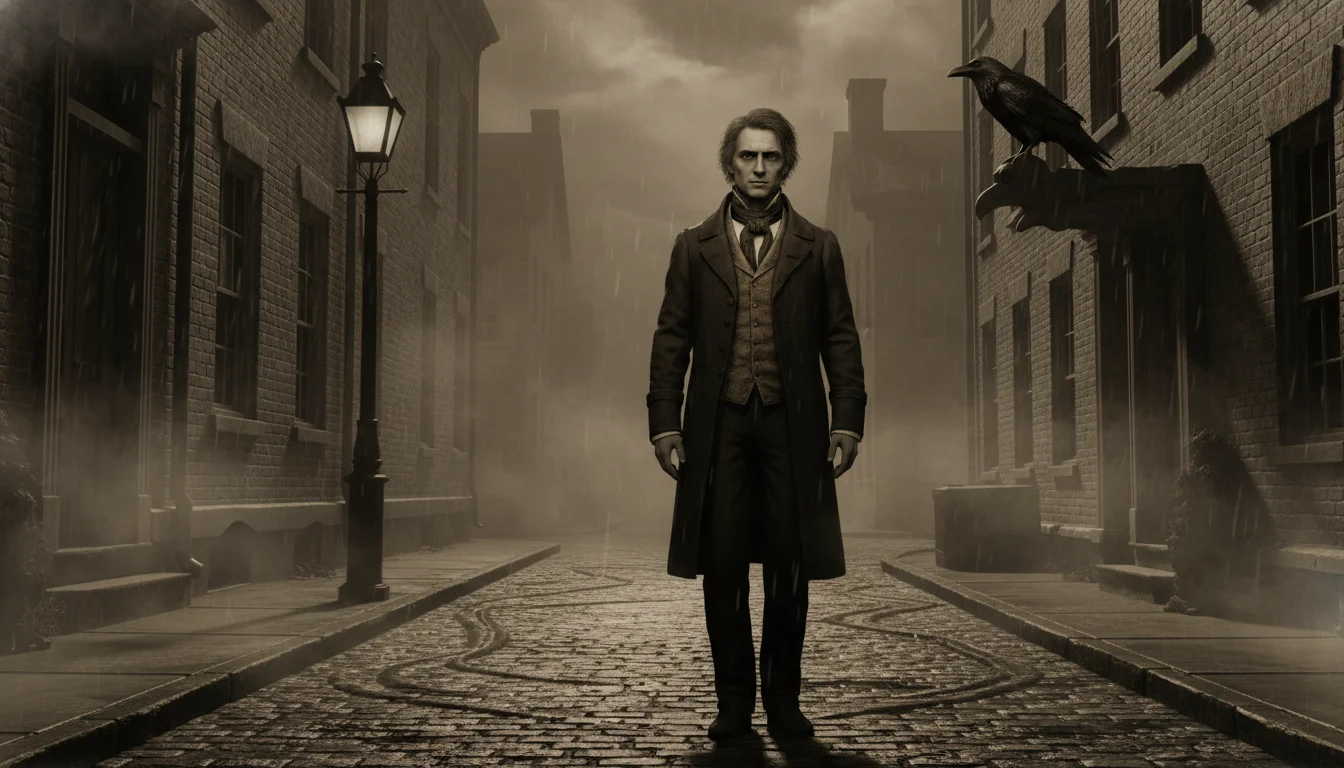
The man who invented detective fiction died in a mystery no detective has ever solved.
On October 3, 1849, a printer named Joseph W. Walker found a man in "great distress" outside Ryan's Tavern in Baltimore. The man was delirious, disheveled, and wearing clothes that didn't belong to him. He could barely speak. When asked who might help him, he managed one name - Joseph E. Snodgrass, a magazine editor.
The man was Edgar Allan Poe. He was 40 years old. Four days later, he would be dead.
The Lost Week
Six days earlier, Poe had been in fine spirits. On September 27, 1849, he boarded a ferry in Richmond, Virginia, heading to New York City. He had recently become engaged to his childhood sweetheart, Sarah Elmira Royster. He had joined the Sons of Temperance and sworn off alcohol. He was planning to launch a new literary magazine. Things were looking up for the perpetually struggling author.
But Poe never made it to New York.
What happened between September 27 and October 3 remains one of literature's most enduring mysteries. No reliable evidence exists about Poe's whereabouts during those missing days. He simply vanished from the historical record - until he materialized, half-dead, at a Baltimore tavern.
A Stranger in Strange Clothes
When Snodgrass arrived at Ryan's Tavern, he barely recognized his friend. Poe's hair was unkempt. His face was haggard and unwashed. His eyes were "lusterless and vacant." Most puzzling of all: the clothes Poe was wearing weren't his.
Instead of his usual immaculate black wool suit, Poe wore a cheap, ill-fitting outfit and a straw hat. For a man who prided himself on his appearance - acquaintances noted he was always impeccably dressed - this was deeply strange. Where were his clothes? And whose were these?
Poe was taken to Washington College Hospital, where Dr. John Joseph Moran became his attending physician. He was placed in a section reserved for drunk patients, confined in a room with barred windows. He was denied visitors.
"Reynolds... Reynolds..."
Over the next four days, Poe drifted in and out of consciousness, plagued by hallucinations and tremors. He seemed to improve briefly, then deteriorated again. He spoke of a wife in Richmond - perhaps thinking of Virginia, who had died two years earlier, or perhaps Sarah Elmira.
On the night of October 6, Poe began calling out a name repeatedly: "Reynolds." He cried it over and over through the night. No one has ever definitively identified who Reynolds was. Some speculate it was Jeremiah N. Reynolds, an explorer who may have inspired Poe's novel The Narrative of Arthur Gordon Pym. Others suggest Henry R. Reynolds, an election judge at the tavern where Poe was found. The mystery of Reynolds has never been solved.
On October 7, 1849, at 5:00 a.m., Edgar Allan Poe spoke his last words: "Lord, help my poor soul."
Then the master of the macabre was gone.
The Theories
In the 175 years since Poe's death, dozens of theories have emerged. None have proven definitive.
Alcoholism was the first and most enduring explanation. J.E. Snodgrass, who became a temperance advocate, spent years promoting the idea that Poe had died from a drinking binge. But Dr. Moran insisted Poe showed no signs of recent alcohol consumption - no smell of liquor, no symptoms consistent with intoxication. And Poe had just joined a temperance society, with witnesses confirming he hadn't violated his pledge in Richmond.
Cooping offers perhaps the most intriguing explanation. In 19th-century America, political gangs would kidnap random people off the street, force them to vote multiple times for a particular candidate, and disguise them between votes. Victims were often beaten and plied with alcohol to make them compliant. Ryan's Tavern was being used as a polling place on October 3 - it was Election Day in Baltimore. The strange clothes Poe was wearing, which didn't belong to him, suddenly made sense. Had the father of detective fiction been a victim of electoral fraud?
Rabies emerged as a theory in 1996 when Dr. R. Michael Benitez, a cardiologist, presented Poe's case to a clinical conference. Poe's symptoms - the alternating lucidity and delirium, the hallucinations, his apparent difficulty drinking water (a classic symptom called hydrophobia) - matched late-stage rabies almost perfectly. Rabies can incubate for months after a bite, and victims often don't remember being bitten. The theory is elegant but unprovable: there was no autopsy.
Other theories include brain tumor, tuberculosis, hypoglycemia, cholera, and carbon monoxide poisoning. Some have even suggested murder - Poe had enemies, and the brothers of his fiancée Sarah Elmira were known to oppose the marriage.
The Missing Evidence
Part of what makes Poe's death so frustrating is the complete absence of documentation. All medical records from Washington College Hospital have been lost - if they ever existed. There is no death certificate. There was no autopsy.
The only detailed accounts come from Dr. Moran, whose credibility has been thoroughly demolished. Over the years, Moran's story changed repeatedly. He gave different dates for when Poe arrived at the hospital. He claimed to have contacted Poe's family immediately, but records show he didn't write to Poe's aunt Maria Clemm until she contacted him more than a month later. He even invented elaborate deathbed speeches that no one believes Poe actually gave.
The Final Irony
There's a dark poetry to the fact that Edgar Allan Poe - the man who created C. Auguste Dupin, literature's first fictional detective - died in circumstances that no detective has ever solved.
Poe invented the locked-room mystery. He pioneered the tale of ratiocination, where a brilliant mind pieces together scattered clues to reveal hidden truth. His detective stories established the template that every mystery writer from Arthur Conan Doyle to Agatha Christie would follow.
And yet his own death remains an open case.
We don't know where Poe was for six days. We don't know whose clothes he was wearing. We don't know why he was calling for Reynolds. We don't know if he was poisoned, beaten, cooped, infected, or simply destroyed by his own demons.
The master of mystery took his greatest secret to the grave.
His body lies beneath a monument in Baltimore's Westminster Hall, just blocks from where he was found dying. Every year on January 19 - Poe's birthday - a mysterious figure known as the "Poe Toaster" used to leave cognac and roses at the grave. But even that tradition ended mysteriously in 2009.
Some mysteries, it seems, prefer to stay unsolved.
For other historical cold cases that have resisted every explanation, see our investigations of the Hinterkaifeck Murders and the Dyatlov Pass Incident.

Want to Interrogate the Suspects?
Chat with historical figures and uncover the truth behind history's greatest mysteries.
Start Your InvestigationJoin the HistorIQly Club
Get smarter about the past.
Weekly stories, deep dives, and exclusive content straight to your inbox.