First Man vs. History: How Accurate Is the Neil Armstrong Movie?
First Man movie accuracy: Chazelle's Neil Armstrong biopic stays close to NASA records and Armstrong's biography, with one major invention - Karen's bracelet on the Moon.
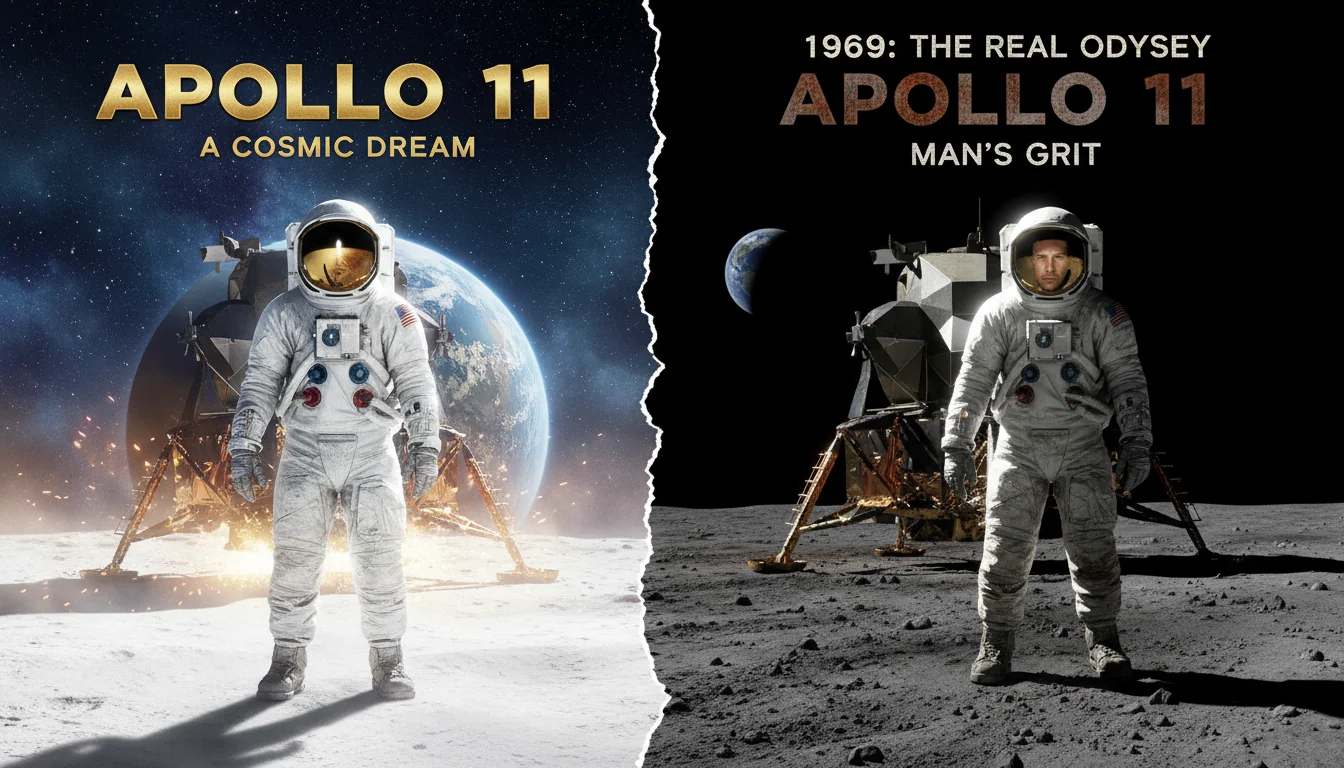
When First Man opened in October 2018, it was both Damien Chazelle's first film after his Best Director Oscar for La La Land and one of the most technically ambitious historical dramas of the decade. Adapted from James R. Hansen's authorized biography of Neil Armstrong, the film traced the first man on the Moon from a fatal test flight in 1961 through the Apollo 11 landing on July 20, 1969.
It is also one of the most quietly accurate space films Hollywood has produced. Working closely with Hansen, Chazelle and screenwriter Josh Singer chose to lean into restraint, lingering on the loss of Armstrong's daughter, the deafening physical reality of early spaceflight, and the strange interior life of a man who was famously private even with his own family.
So how close to the historical record does it stay? First Man movie accuracy is higher than most viewers realize. Some specific scenes are dramatized. The overall picture is unusually honest.
What Hollywood Got RIGHT
The X-15 sequence
The film opens with Armstrong piloting an X-15 rocket plane to the edge of space and bouncing off the upper atmosphere on reentry. The flight depicted is based on a real April 1962 incident in which Armstrong, then a NACA and later NASA test pilot at Edwards Air Force Base, allowed his X-15 to drift higher than expected and then struggled to descend through the upper atmosphere.
The radio transmissions, the flight characteristics, the rivet-rattling vibration of high-altitude reentry, and the eventual successful recovery are based on documented flight records. The sense that test piloting was a profession of constant near-misses is also accurate. Armstrong narrowly avoided several disasters during his Edwards career, including engine failures, dust-up landings on dry lakebeds, and his own incident with the X-15.
Karen Armstrong's death
One of the film's emotional anchors is the death of Armstrong's two-year-old daughter Karen from a malignant brain tumor in January 1962. This is real. Karen was diagnosed in mid-1961, treated unsuccessfully, and died at home. The grief shaped Armstrong's family life for years afterwards.
His ability to compartmentalize the loss and continue his work, depicted in the film as both his strength and his estrangement from his wife Janet, is consistent with how those who knew him have described his temperament. Armstrong was famously reserved and uncomfortable with public emotion, even by the standards of test pilots and astronauts of his generation.
The Gemini 8 emergency
On March 16, 1966, Gemini 8, with Armstrong as command pilot and David Scott as pilot, became the first spacecraft to dock with another vehicle, the Agena target. Soon afterward, the docked spacecraft began rolling. Armstrong undocked from the Agena, expecting that to stop the motion, but the roll continued and accelerated to nearly one revolution per second.
The cause was a stuck thruster on the Gemini capsule. Armstrong, fighting against rapidly building g-forces and the threat of unconsciousness, made the decision to use the reentry control system, which stabilized the capsule but committed the mission to immediate emergency reentry. He and Scott landed safely in the western Pacific.
The film's depiction is faithful to the recorded flight data, including the warning light pattern, the sequence of failed corrective actions, and the narrowness of the margin. NASA test pilots who reviewed the footage have confirmed that Chazelle's reproduction is accurate down to the cabin acoustics.
The Apollo 1 fire
The film treats the death of Gus Grissom, Ed White, and Roger Chaffee on January 27, 1967, with appropriate weight. The three astronauts were killed when a flash fire swept through the Apollo 1 command module during a ground test at Cape Kennedy. Armstrong was in Houston when the news arrived, and his reaction in the film is consistent with how he later described that day.
The fire was caused by an electrical spark in the pressurized pure-oxygen atmosphere of the command module, exacerbated by flammable materials in the cabin and a hatch design that could not be opened quickly from inside. The disaster led to a complete redesign of the Apollo command module and a 21-month suspension of crewed launches.
The lunar landing sequence
The film's reconstruction of the Apollo 11 lunar landing is one of the most technically faithful in cinema. The audio, including Armstrong and Buzz Aldrin's actual voice patterns, the alarm tones, and the famous 1202 program alarm, is based on the recorded mission audio. The Eagle's nearly catastrophic approach over a boulder field, with Armstrong taking manual control in the final minutes, is real.
Armstrong's actual fuel margin at touchdown was approximately 17 seconds before he would have had to abort. The film's tension during the descent is not exaggerated. Mission Control briefly considered calling an abort but did not, on the recommendation of guidance officer Steve Bales.
The famous line "Houston, Tranquility Base here. The Eagle has landed" is delivered as it was recorded. So is "That's one small step for man, one giant leap for mankind." The audio of the actual transmission can still be retrieved from NASA archives.
What Hollywood Got WRONG
Karen's bracelet on the Moon
The most contested scene in the film shows Armstrong, in a moment of private grief during the moonwalk, dropping a bracelet belonging to Karen into a small crater. This scene is the film's most powerful invention, and it is invention. There is no evidence in NASA records, Armstrong's interviews, his sons' memories, or Hansen's research that he carried such an item to the lunar surface.
Hansen has said that he and the filmmakers discussed the scene at length and chose to use it as an emotional symbol of the grief Armstrong carried throughout the program. Both Hansen and the Armstrong family have defended the choice. Critics have argued that it manufactures a tearjerker moment that the actual man would have rejected.
Compressed timelines
The film compresses several years of training, mission preparation, and family life. Armstrong's selection for Apollo 11 is shown more abruptly than the actual decision-making process, which involved months of complex internal NASA discussion about mission rotations. The relative roles of Aldrin and Michael Collins are also slightly minimized, as the film keeps its focus tightly on Armstrong.
The flag controversy
The decision not to show the planting of the American flag during the lunar surface sequence was a directorial choice, not a historical inaccuracy. The flag was planted, the film acknowledges this, and the flag is visible in subsequent shots. The omission of the planting moment was politically controversial in 2018, with some commentators arguing that it diminished the Apollo program's national meaning. Chazelle has consistently said that the choice was about emotional intimacy, not politics.
Janet Armstrong's portrayal
Claire Foy's depiction of Janet Armstrong as a frustrated, frightened, sometimes furious wife is broadly true to her real personality but compresses years of strain into a few cinematic confrontations. Janet and Neil Armstrong eventually divorced in 1994. The marriage's quiet difficulties, his emotional distance, the trauma of Karen's death, and the constant possibility that Neil would not return from a mission, are real. The film makes them more visible than they were in their own time.
Edwards camaraderie
The film's depiction of the test pilot community at Edwards is somewhat romanticized, partly because it relies on the conventions of The Right Stuff. Armstrong was, in fact, less integrated into the swaggering Edwards culture than the film suggests. He was respected as a quiet, methodical pilot who did not drink heavily, did not chase women, and preferred reading and engineering work to barroom storytelling.
What the film captures that documentaries do not
First Man gets one specific thing exactly right that almost no other space film has captured: the bone-rattling, head-jarring, ear-shredding physical reality of early space travel. The capsules of Gemini and Apollo were not the calm, well-lit interiors of Star Trek. They were noisy, vibrating, claustrophobic metal boxes filled with switches, and Chazelle's sound design preserves that.
The film also captures the surprising emotional flatness of Armstrong's public persona. He was not a hero in the chest-thumping sense. He was a precise engineer who had been chosen, partly for his quietness, to go to the Moon and come back without saying anything embarrassing. The film honors that, and in doing so, gets closer to the man than most biographies do.
Historical Accuracy Score: 8.5/10
First Man is one of the most carefully researched space films Hollywood has produced. It is faithful to mission records, accurate about the deaths of the early astronauts, and honest about Armstrong's personality and family life. Its biggest invention, the bracelet on the Moon, is a sentimental flourish that the family has endorsed but that has no documentary basis.
What the film gets most right: the noise, vibration, and danger of early spaceflight, and the quiet, controlled grief of Armstrong himself.
What it gets most wrong: inventing the bracelet moment and slightly intensifying the friction in the Armstrong marriage.
The bottom line is that First Man is one of the best fact-based films about the Space Age. If you want to understand what it actually felt like to fly Gemini 8 or land the Eagle, this is the film to watch, and you will not need to do much fact-checking afterward.
For other NASA mission films put to the fact-check, see Apollo 13 vs. History and The Post vs. History.
Quick Answers
Common questions about this topic
Is First Man based on a true story?
Yes. The 2018 film directed by Damien Chazelle is based on James R. Hansen's authorized biography First Man: The Life of Neil A. Armstrong, published in 2005. Hansen had access to Armstrong, his family, and NASA archives. The film tracks Armstrong's career from 1961 to the Apollo 11 mission in July 1969.
Did Armstrong really leave a memento of his daughter on the Moon?
The film shows Armstrong leaving his daughter Karen's bracelet in a small crater on the lunar surface. This is dramatized. There is no documentary evidence that Armstrong actually left such an item on the Moon. Hansen's biography mentions Armstrong's grief over Karen's death from a brain tumor in 1962, but the bracelet scene is the screenwriter's invention.
Was the Gemini 8 emergency really that close to disaster?
Yes. On March 16, 1966, Gemini 8 began spinning at almost one revolution per second after a stuck thruster, threatening to incapacitate Armstrong and David Scott. Armstrong's decision to use the reentry control system to stabilize the spacecraft saved the mission, though it forced an emergency landing. The film's depiction is faithful to the actual flight data.
Why did First Man not show the planting of the American flag?
Director Damien Chazelle chose not to show the moment of flag planting in the lunar surface sequence, focusing instead on Armstrong's interior experience. The flag is visible in subsequent shots. The decision was criticized politically when the film opened, but Chazelle has said it was an artistic choice to keep the moonwalk intimate rather than triumphalist.

Debate the Accuracy with the Real Figures
Ask the real people what Hollywood got wrong about their lives.
Chat with HistoryJoin the HistorIQly Club
Get smarter about the past.
Weekly stories, deep dives, and exclusive content straight to your inbox.