Frost/Nixon vs. History: How Accurate Is the 2008 Movie?
On Frost/Nixon accuracy: Ron Howard's film gets Nixon's partial Watergate admission right but invents its most dramatic moment. We fact-check the 1977 interviews.
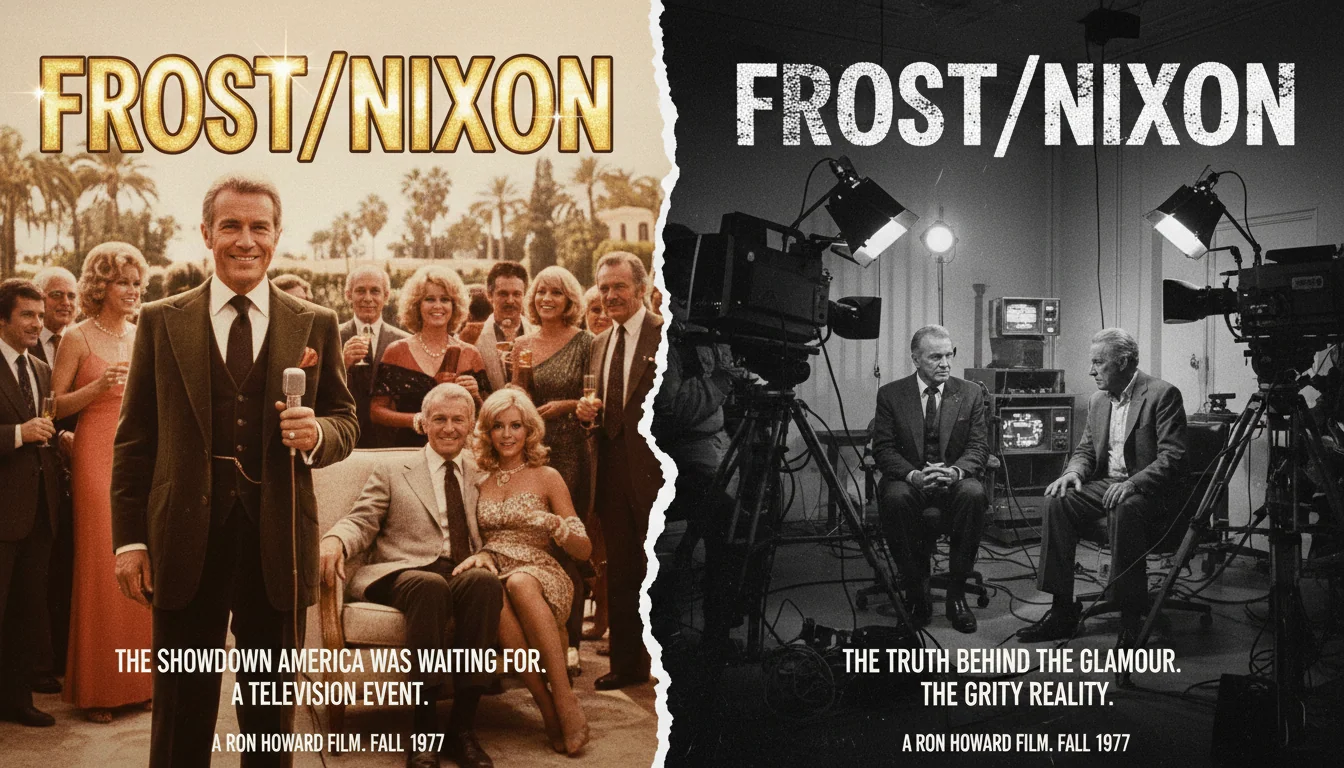
Questions about Frost/Nixon accuracy have followed the film since its release, particularly around one invented scene that became its dramatic centerpiece. When Ron Howard's Frost/Nixon opened in December 2008, it adapted Peter Morgan's hit play about one of the most consequential pieces of television journalism in modern American history: the four interviews British presenter David Frost conducted with former President Richard Nixon between March 23 and April 22, 1977. For nearly 29 hours of taped conversation, Nixon faced the only sustained public questioning he ever submitted to about Watergate, the resignation, and the abuses of his presidency.
The film is taut, entertaining, and largely faithful to the spirit of the events. It also takes substantial dramatic liberties, particularly in inventing a late-night drunken phone call and in compressing the interview structure into a sharper duel than the original tapes actually show.
So how accurate is Frost/Nixon? More accurate than most political dramas. Less accurate than the play and the film sometimes claim.
What Hollywood Got RIGHT
Frost was an unlikely choice
The film's setup, that David Frost was widely dismissed as a lightweight British entertainer who could not possibly extract serious answers from Nixon, is essentially correct. Frost in the mid-1970s had a successful Australian morning show and a reputation as a charming, often soft interviewer. The American press greeted his announcement of the Nixon interviews with skepticism. Major American networks declined to underwrite the project, forcing Frost to syndicate the broadcasts himself.
Nixon, for his part, agreed to the interviews in part because he viewed Frost as a manageable opponent who would be impressed by access. The film captures the calculated condescension on Nixon's side and the financial gamble on Frost's side accurately.
The financial pressure
Frost personally invested in the production and faced significant financial risk if the interviews failed to attract advertisers and audiences. The film's depiction of Frost's emotional and financial strain during the long preparation and taping schedule is broadly accurate. He came close to losing personal assets if the broadcasts had flopped.
Frank Mankiewicz and Robert Zelnick, real members of Frost's research team played in the film by Oliver Platt and Sam Rockwell, were genuinely worried about whether their boss could deliver under pressure. The team's improvised intensity is faithful to the period.
The structure of the interviews
The film correctly shows that Nixon spent most of the early sessions winning. He filibustered, redirected questions, and presented his presidency in legacy terms while Frost struggled to keep him on subject. Reviewers of the original broadcasts at the time noted that the first three sessions, on foreign policy, the economy, and the early Nixon presidency, did not produce significant news.
The Watergate session, taped over two days in April 1977 and aired as the third broadcast on May 4, 1977, was the breakthrough. Frost arrived with new material that his team had unearthed about a memo Charles Colson had written, and pressed Nixon harder than he had been pressed in any previous interview. The result was Nixon's most direct public engagement with the scandal.
The "when the president does it" line
The film's pivotal moment, in which Nixon tells Frost that "when the president does it, that means it is not illegal," is taken directly from the actual interview. The exchange occurred on tape and was broadcast nationally. It became one of the most widely quoted statements of Nixon's post-presidency. Critics still debate exactly what he meant, since he qualified the statement, but the line is real.
Nixon's apology
Nixon's eventual half-acknowledgment that he had let down the country, the moment the film treats as the climactic admission, is also real. He said, on tape: "I let down my friends. I let down the country. I let down our system of government." Whether this constituted a confession depends on how generously one reads it, but the admission was made.
Frost considered the interview a successful confrontation. Critics and viewers at the time were divided. Some saw it as the closest thing to accountability Nixon ever offered. Others saw it as another carefully managed performance.
What Hollywood Got WRONG
The drunken phone call
The most dramatic invention in the film, and the one Peter Morgan has openly acknowledged as fiction, is the late-night phone call in which a drunk Nixon, played by Frank Langella, telephones Frost the night before the Watergate session and rambles about losers, success, and resentment. The call did not happen.
Morgan has said the scene was designed to externalize Nixon's psychological state and provide a dramatic engine for the next day's confrontation. The film keeps it because it works as theater. As history, it is fabrication.
The relationship between Frost and Nixon
The film presents the encounter as a tightly structured duel between two evenly matched antagonists. The historical reality was looser. Frost and Nixon's interactions outside the formal sessions were polite, businesslike, and sometimes warm. Nixon enjoyed the staffing and travel arrangements, ate well, and made small talk that the film mostly omits.
The cinematic structure of "underdog versus villain" is dramatically effective but does not match the actual social texture of the meetings.
The team dynamics
The film has Reston, Zelnick, and Mankiewicz delivering speeches and confrontations that compress weeks of research into a few cinematic exchanges. Zelnick has said in interviews that the basic dynamic is captured correctly but that specific scenes, including a famous one in which the team yells at Frost for being unprepared, are dramatized rather than literal.
The scope of the broadcasts
The film slightly oversells the immediate political impact of the interviews. Nixon was watched by approximately 45 million American viewers for the Watergate broadcast, a substantial audience, but the broadcasts did not produce a major shift in his public reputation. He was already disgraced. The interviews crystallized public memory of him but did not transform it.
His memoir RN: The Memoirs of Richard Nixon, published in 1978, was probably more consequential for his legacy than the Frost interviews. The film's treatment of the interviews as a culminating reckoning is somewhat overstated.
Frost's preparation
The film implies that Frost's late breakthrough on the Watergate session came largely from a single evening of cramming after his team threatened to walk out. The reality was more disciplined. Frost spent months working with his team on the questions, traveled to Washington multiple times, and consulted historians, journalists, and former Nixon staff. The "all-nighter" framing is dramatic shorthand for a much longer process.
What the film captures even when it bends facts
Frost/Nixon gets something specific exactly right that few political dramas manage: the texture of long-form television interviewing as a battle of stamina, preparation, and self-control. Nixon's habit of running out the clock on hard questions, Frost's habit of pivoting to the next opening, and the way both men adjusted to the camera and the editing process, are all captured authentically.
The film also captures the strangeness of Nixon's situation in 1977. He was 64 years old, in disgrace, financially strained, eager to rebuild his reputation, and operating from a leased estate in San Clemente, California. The interviews were partly a financial necessity for him. They were also one of his last chances to shape his own historical memory before his eventual rehabilitation through foreign policy commentary in the 1980s and 1990s.
Historical Accuracy Score: 7/10
Frost/Nixon is faithful to the broad facts: the deal, the structure of the interviews, the Watergate breakthrough, and Nixon's partial admission. It significantly fictionalizes the dramatic engine, particularly the drunken phone call, and compresses the rhythm of the actual broadcasts into a tighter cinematic duel.
What the film gets most right: the texture of long-form television interviewing and Nixon's calculated public performance.
What it gets most wrong: inventing the phone call, oversimplifying the team dynamics, and overstating the political impact of the broadcasts.
The bottom line is that Frost/Nixon is one of the better Hollywood treatments of a real event. The actual interviews are still available in their original form, and watching them is the best way to see how the historical Nixon, as opposed to Frank Langella's brilliant but stylized Nixon, actually answered for himself.
For more on how Hollywood handles Watergate-era Washington, see All the President's Men vs. History and The Post vs. History, which covers The Washington Post's role in the Pentagon Papers.
Quick Answers
Common questions about this topic
Is Frost/Nixon based on a true story?
Yes. The 2008 film, directed by Ron Howard and adapted by Peter Morgan from his 2006 stage play, is based on the four televised interviews David Frost conducted with former President Richard Nixon in March and April 1977. Frost paid Nixon $600,000 plus a percentage of profits for the interviews, the first major interviews Nixon gave after his 1974 resignation.
Did Nixon really confess to Watergate during the interviews?
Nixon's actual statements during the interviews stopped short of a full confession but came closer than he had ever come publicly. He acknowledged that he had 'let down' the country, said he had been 'brought down by my friends as well as by my enemies,' and admitted that 'when the president does it, that means it is not illegal.' His responses produced what many viewers regarded as the closest thing to admission he ever offered.
Did Nixon make a late-night drunk phone call to Frost?
No. The film's most dramatic invented scene shows Nixon calling Frost late at night, drunk and rambling, before the climactic Watergate session. This phone call did not happen. Peter Morgan has acknowledged that he wrote it as a dramatic device to externalize Nixon's interior pressure during the long interview process.
How much did the interviews really cost?
Frost paid Nixon $600,000 in cash plus 20 percent of profits from the broadcasts. The deal was negotiated in 1975. Adjusted for inflation, the upfront payment is roughly $3.5 million in 2026 dollars. Frost financed much of the production privately because the major American networks declined to fund or air the interviews.

Debate the Accuracy with the Real Figures
Ask the real people what Hollywood got wrong about their lives.
Chat with HistoryJoin the HistorIQly Club
Get smarter about the past.
Weekly stories, deep dives, and exclusive content straight to your inbox.