Gandhi vs. History: How Accurate Is Richard Attenborough's Epic Biopic?
Gandhi historical accuracy examined: Kingsley's Oscar-winning performance is remarkable, but the film takes significant liberties with India's complex independence story.
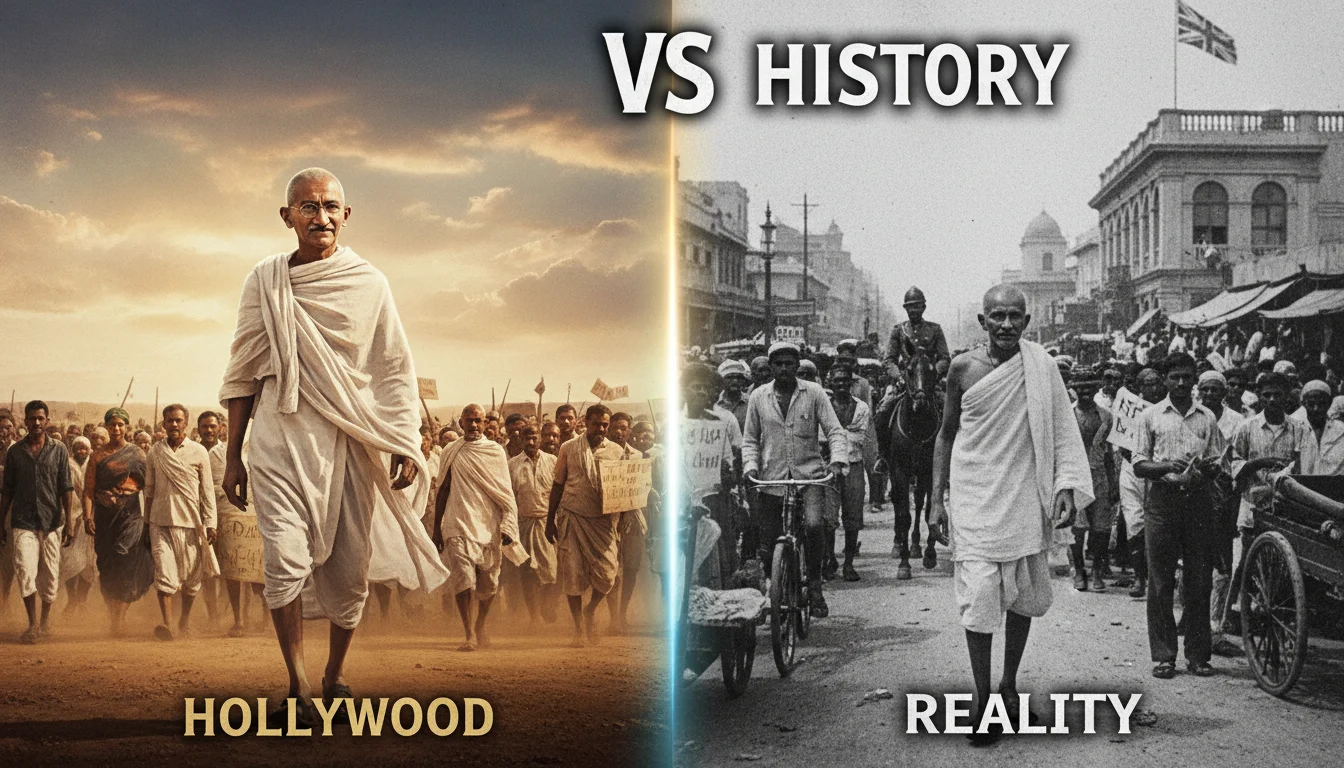
Richard Attenborough spent twenty years trying to get Gandhi made. The result was a three-hour epic that swept the 1983 Academy Awards, winning eight Oscars including Best Picture, Best Director, and Best Actor for Ben Kingsley's transformative performance. The film introduced millions of Western viewers to the story of Indian independence - but in condensing one of history's most complex political movements into a single narrative, how much did Hollywood sacrifice for dramatic clarity?
What Hollywood Got RIGHT
Ben Kingsley's Physical and Spiritual Transformation
Kingsley's portrayal of Gandhi remains one of cinema's greatest biographical performances, and for good reason - he got the essence right. The film accurately captures Gandhi's evolution from a well-dressed London-trained barrister into an ascetic leader who wore homespun cloth (khadi) as a political statement. Gandhi really did give up Western clothing after the non-cooperation movement of the 1920s, and he genuinely lived in ashrams where residents performed their own labor, including cleaning latrines - a revolutionary act in caste-conscious India.
The film's depiction of Gandhi's personal practices is largely accurate. He did conduct numerous fasts as political weapons, including the famous fast that ended the Poona Pact negotiations in 1932. He maintained correspondence with thousands of people, often writing letters while walking (his "walking desk" was real). His daily routine of prayer meetings, spinning cloth, and consultations was authentically portrayed.
The Amritsar Massacre
The film's depiction of the Jallianwala Bagh massacre of April 13, 1919, is chillingly accurate in its essentials. General Reginald Dyer really did order his troops to fire on a peaceful crowd trapped in an enclosed garden, and they really did continue firing until their ammunition was nearly exhausted. The official death toll was 379, though Indian estimates have always been higher - possibly over 1,000.
The film captures the cold-blooded nature of the massacre: Dyer deliberately chose to use rifles rather than disperse the crowd with less lethal means, later testifying that his intention was to create a "moral effect" through terror. The crawling order shown in the film - where Indians were forced to crawl on their stomachs down a street where a British woman had been attacked - was also real, though it occurred in a different location (Kucha Kurrichhan).
The Salt March
The 1930 Salt March, Gandhi's masterpiece of non-violent resistance, is portrayed with reasonable accuracy. Gandhi really did walk 240 miles from Sabarmati Ashram to the coastal village of Dandi over 24 days, gathering followers as he went. The symbolism was perfect - the British salt tax affected every Indian, from the poorest peasant to the wealthiest merchant, making salt a unifying issue.
The film's depiction of the Dharasana Salt Works raid, where non-violent protesters walked into police beatings without raising their hands in defense, is based on Webb Miller's famous eyewitness account, which helped turn global opinion against British rule. Miller's reporting, which the film essentially dramatizes, was instrumental in showing the world the moral bankruptcy of responding to peaceful protest with violence.
Churchill's Opposition
The film's portrayal of Winston Churchill as a fierce opponent of Indian independence is historically accurate. Churchill really did refer to Gandhi as a "seditious Middle Temple lawyer, now posing as a fakir" and consistently opposed any moves toward Indian self-governance. The film's depiction of British establishment hostility toward the independence movement captures the genuine racism and imperial arrogance that characterized much British thinking about India.
What Hollywood Got WRONG
The Missing History of South Africa
The film compresses Gandhi's 21 years in South Africa (1893-1914) into a brief opening section, missing crucial context about how Gandhi developed his philosophy. More problematically, the film sanitizes Gandhi's early views on race. The historical Gandhi initially sought rights for Indians specifically, not for all non-whites, and made numerous statements distinguishing Indians from Africans that would be considered racist today. He referred to Black Africans using the derogatory term "Kaffirs" and initially accepted racial segregation as long as Indians were classified separately from Africans.
Gandhi evolved over time, and by the end of his life he championed universal human dignity. But the film presents him as a fully-formed apostle of equality from the start, erasing a more complicated history of personal growth.
The Sidelining of Other Independence Leaders
To create a clear narrative centered on Gandhi, the film dramatically minimizes the roles of other crucial independence figures. Jawaharlal Nehru and Sardar Patel appear as supporting characters, but their independent political contributions are largely invisible. Subhas Chandra Bose, who led the Indian National Army and took a radically different approach to independence, is absent entirely.
Most significantly, the film virtually erases Muhammad Ali Jinnah's political journey. In reality, Jinnah was once a prominent Congress Party leader who believed in Hindu-Muslim unity before becoming the architect of Pakistan. The film portrays him only as an adversary, missing the tragedy of how British divide-and-rule policies and Congress Party decisions helped create the conditions for partition.
The Complexity of Partition
The film presents the 1947 partition as a tragedy that Gandhi opposed but couldn't prevent - which is true as far as it goes. But it vastly oversimplifies the causes and Gandhi's role. The decision to partition India involved complex negotiations, competing nationalisms, and failures of leadership on all sides. Gandhi's approach to Hindu-Muslim relations, while sincere, was not uniformly successful. His use of Hindu religious symbolism and imagery, while meaningful to him spiritually, sometimes alienated Muslims who felt the independence movement was becoming a Hindu national project.
The film also understates the scale of partition violence. Perhaps one to two million people died, and 10-20 million were displaced in one of the largest mass migrations in human history. While the film shows some violence, the true horror is difficult to convey - trains arriving at stations filled with corpses, wells poisoned with bodies, villages entirely wiped out.
Gandhi's Complicated Personal Life
The film presents Gandhi as a saintly figure, but omits aspects of his personal life that biographers have found troubling. His treatment of his wife Kasturba could be domineering, and his insistence that she participate in ashram labor regardless of her wishes has been criticized. His relationship with his eldest son Harilal was deeply troubled - Harilal became an alcoholic who eventually converted to Islam partly to embarrass his father, and their estrangement lasted until Gandhi's death.
Most controversially, the film omits Gandhi's practice in his later years of sleeping naked with young women, including his grandniece Manu, as part of what he called "brahmacharya experiments" to test his vow of celibacy. Whatever Gandhi's intentions, modern observers have found these practices deeply problematic, and they caused controversy even among his followers at the time.
The Portrayal of Lord Mountbatten
The film presents Lord Mountbatten, the last Viceroy of India, in a relatively favorable light - as a well-meaning British official trying to navigate an impossible situation. In reality, Mountbatten's rushed timeline for partition (moved forward from June 1948 to August 1947) is considered by many historians to have worsened the violence. His close relationship with Nehru and apparent favoritism toward India over Pakistan in key decisions (particularly regarding Kashmir) helped create conflicts that persist today.
Historical Accuracy Score: 6/10
Gandhi is a noble film with real educational value - it introduced the philosophy of non-violent resistance to millions of viewers and gets the broad strokes of India's independence struggle right. Ben Kingsley's performance captures something essential about Gandhi's charisma and moral force.
But as history, it's more hagiography than biography. By presenting Gandhi as a secular saint rather than a complex human being who evolved over time and made mistakes, the film actually diminishes his achievement. The real Gandhi's journey from a prejudiced young man to a moral leader is more inspiring than the film's portrait of someone who seemingly arrived fully formed.
The film also simplifies India's independence movement into one man's story, erasing the contributions of countless others - from the revolutionaries who chose armed resistance to the Muslim leaders who felt marginalized by a Hindu-dominated Congress. History is never one person's story, and the creation of the world's largest democracy involved millions of people with competing visions.
Attenborough made a beautiful, moving film that serves as an introduction to a crucial historical period. But viewers who want to understand the real Gandhi and the real story of Indian independence will need to read further - where they'll find a story that's messier, more tragic, and ultimately more human than Hollywood's version.
The truth about Gandhi is that he was neither the saint the film presents nor the flawed figure his critics describe - he was both, simultaneously, like all human beings. That complexity is harder to fit into three hours, but it's the real story worth telling.
For other biopics that tackle similarly complex historical figures, see our accuracy reviews of The Last King of Scotland and Darkest Hour.

Debate the Accuracy with the Real Figures
Ask the real people what Hollywood got wrong about their lives.
Chat with HistoryJoin the HistorIQly Club
Get smarter about the past.
Weekly stories, deep dives, and exclusive content straight to your inbox.