Gangs of New York vs. History: How Accurate Is Scorsese's Epic?
Gangs of New York historical accuracy: Scorsese captures Five Points atmosphere and the 1863 Draft Riots but fictionalizes key figures and compresses the timeline.
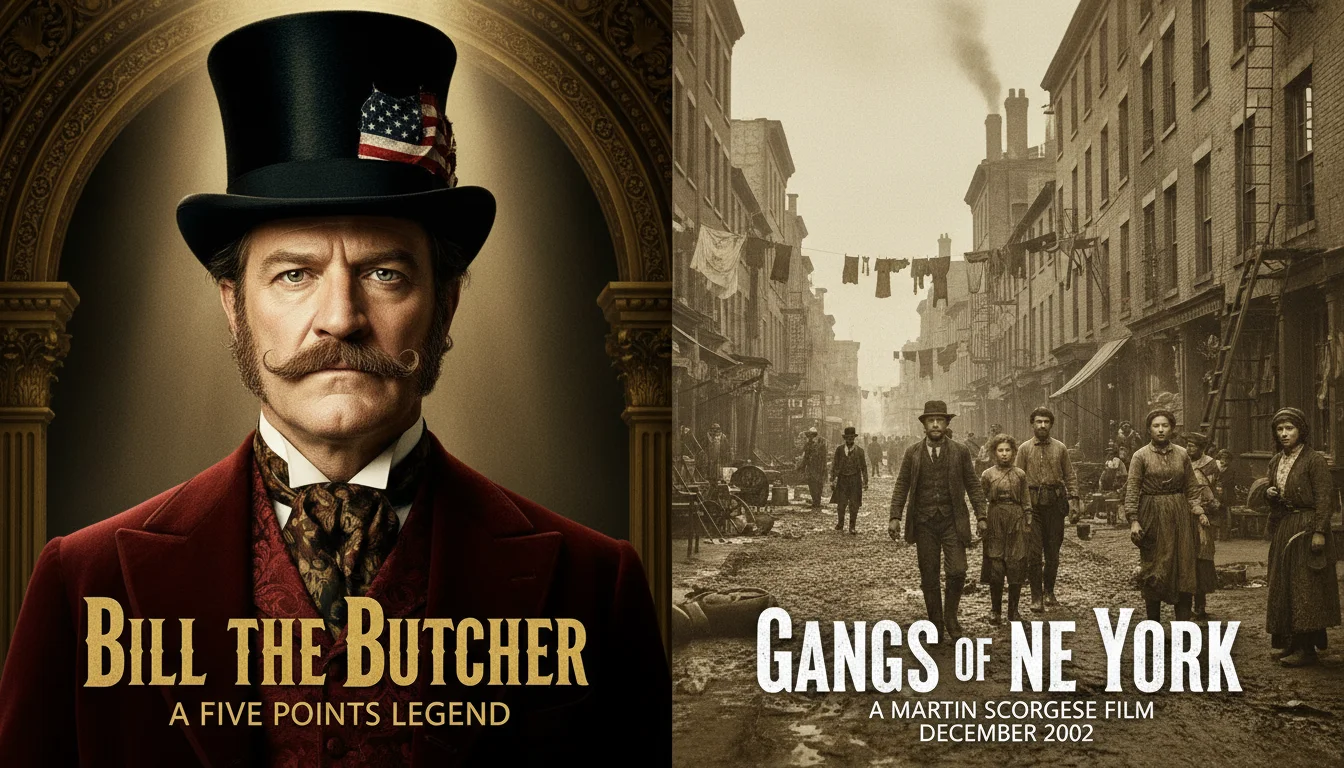
Martin Scorsese spent over two decades trying to bring Gangs of New York to the screen. When it finally arrived in 2002, audiences were treated to a visceral, blood-soaked portrait of mid-19th century Manhattan - a world of warring street gangs, corrupt politicians, and a melting pot boiling over with violence. Daniel Day-Lewis delivered one of cinema's most mesmerizing villains as Bill "The Butcher" Cutting, while Leonardo DiCaprio played Amsterdam Vallon, a young Irish immigrant seeking revenge.
But how much of this brutal world actually existed? Let's dig into the Gangs of New York historical accuracy and separate Five Points fact from Hollywood fiction.
What Hollywood Got RIGHT
The Five Points Was Real - and Really That Bad
Scorsese wasn't exaggerating the squalor. The Five Points neighborhood in lower Manhattan was, by most contemporary accounts, one of the most dangerous and disease-ridden slums in the Western world. Charles Dickens visited in 1842 and described it as a place where "all that is loathsome, drooping, and decayed is here." The overcrowding was staggering - tenement buildings designed for a dozen people housed over a hundred. Cholera, typhus, and violence were constant companions. The film's grimy, chaotic atmosphere captures the spirit of the place remarkably well.
Gang Warfare Was Real
The movie's central premise - that organized gangs controlled territory in lower Manhattan - is absolutely grounded in fact. The real Five Points was carved up between rival gangs with colorful names: the Dead Rabbits, the Bowery Boys, the Plug Uglies, the Shirt Tails, and the Forty Thieves. These gangs fought pitched battles in the streets, sometimes involving hundreds of combatants. The Dead Rabbits Riot of 1857 was a real event that saw Irish gangs clash with nativist gangs over two days, requiring police and eventually militia intervention.
Bill "The Butcher" Was Based on a Real Person
Bill the Butcher is based on William Poole, a genuine figure in New York's underworld. Poole was indeed a butcher by trade, a bare-knuckle fighter, and a leader of the nativist Know-Nothing movement. He was known for his violence and his hatred of Irish immigrants. His real death was dramatic - he was shot in a saloon in 1855 and reportedly lingered for days before dying, supposedly declaring, "I die a true American." The film captures his larger-than-life persona, even if it dramatically reshapes his story.
Tammany Hall and Boss Tweed
The film's depiction of Tammany Hall as a corrupt political machine that manipulated immigrant votes is historically solid. William "Boss" Tweed really did build a political empire by courting immigrant communities, particularly the Irish, offering them jobs, housing, and naturalization papers in exchange for votes. The film correctly shows how politicians weaponized gangs for political muscle - hiring them as election-day enforcers, ballot-box stuffers, and repeat voters.
The Draft Riots of 1863
The climactic Draft Riots are among the most accurate elements of the film. When the Union introduced conscription in July 1863 - with a $300 exemption that let the wealthy buy their way out - working-class New Yorkers exploded. What began as an anti-draft protest devolved into a race riot. Rioters lynched Black residents, burned the Colored Orphan Asylum, and battled police for four days. The Army was called in, and estimates of the death toll range from 120 to over 1,000. It remains the deadliest civil disturbance in American history.
What Hollywood Got WRONG
The Timeline Is Compressed and Mangled
The film's biggest historical sin is its timeline. The movie begins with a gang battle in 1846, then jumps to 1862-1863. But the real Bill Poole died in 1855, years before the events of the main story. The film places him alive during the Draft Riots, which is impossible. The Dead Rabbits' heyday was in the 1850s, not the 1860s. Scorsese essentially compressed three decades of history into a single narrative, creating the impression that all these events happened simultaneously. They didn't.
Amsterdam Vallon Is Entirely Fictional
While Bill the Butcher has a real-world counterpart, Amsterdam Vallon does not. There was no Irish gang leader's son who infiltrated the nativist gangs to avenge his father. The character of Priest Vallon is also invented. The revenge plot that drives the entire film is pure Hollywood storytelling grafted onto a historical backdrop.
The Gangs Weren't That Organized
The movie portrays the gangs as almost military organizations with clear leaders, territories, and codes of honor. Reality was messier. Most Five Points gangs were loosely organized, with shifting membership and allegiances. The ceremonial, almost ritualistic battle that opens the film - with two gangs lining up like armies - is theatrical invention. Real gang fights were chaotic street brawls, ambushes, and tavern stabbings, not choreographed melees.
Bill the Butcher's Glass Eye and Personality
Daniel Day-Lewis's Bill the Butcher is one of cinema's great creations, but he's significantly different from the real William Poole. The real Poole didn't have a glass eye with an American eagle painted on it - that's pure Scorsese flair. Poole was actually more of a political enforcer than a neighborhood warlord. He didn't rule Five Points; he operated mainly in the Bowery. And while he was certainly violent, the almost Shakespearean villainy of the film character is a dramatic amplification.
The Naval Bombardment Never Happened
In the film's climax, Union Navy ships shell Manhattan to put down the Draft Riots. This makes for spectacular cinema, but it didn't happen. While there were warships in the harbor and the Army did deploy troops with artillery, the Navy never bombarded the city. Cannons were fired as warnings, and grapeshot was used against rioters in the streets, but there was no naval shelling of civilian neighborhoods. Scorsese admitted he added this for dramatic effect.
The Ethnic Dynamics Were More Complex
The film presents a fairly simple Irish vs. Nativist conflict. The reality was far more complicated. Five Points was home to Irish, Italian, Chinese, Jewish, German, and Black communities, all jostling for space and resources. The Chinese population, which would eventually create Chinatown nearby, is completely absent from the film. And the relationship between Irish immigrants and Black New Yorkers - who competed for the same jobs and housing - was far more fraught than the movie suggests.
The Verdict
Gangs of New York succeeds brilliantly as atmosphere. The feel of the place - the danger, the poverty, the raw energy of a city being built by people who had nothing - is powerfully conveyed. Scorsese did extensive research, drawing heavily from Herbert Asbury's 1928 book The Gangs of New York, which itself blended fact with legend.
But as a historical document, it's a patchwork. Real people are displaced in time, fictional characters drive the plot, and events are compressed and embellished for drama. It's a film that captures the spirit of an era while taking enormous liberties with its facts.
Historical Accuracy Score: 5/10
Scorsese applied the same blend of atmospheric authenticity and dramatic invention to Casino (1995) and The Departed, both of which ground Hollywood storytelling in genuinely researched underworlds.
The bones are real - the gangs, the squalor, the politics, the riots. But the flesh Scorsese puts on those bones is largely invented. It's a masterpiece of filmmaking and a passionate love letter to old New York, but don't use it as a textbook.

Debate the Accuracy with the Real Figures
Ask the real people what Hollywood got wrong about their lives.
Chat with HistoryJoin the HistorIQly Club
Get smarter about the past.
Weekly stories, deep dives, and exclusive content straight to your inbox.