Goodfellas vs. History: How Accurate Is Scorsese's Mob Masterpiece?
How does Goodfellas accuracy hold up? Scorsese's mob masterpiece is remarkably faithful to Henry Hill's story, the Lufthansa heist, and the Lucchese crime family.
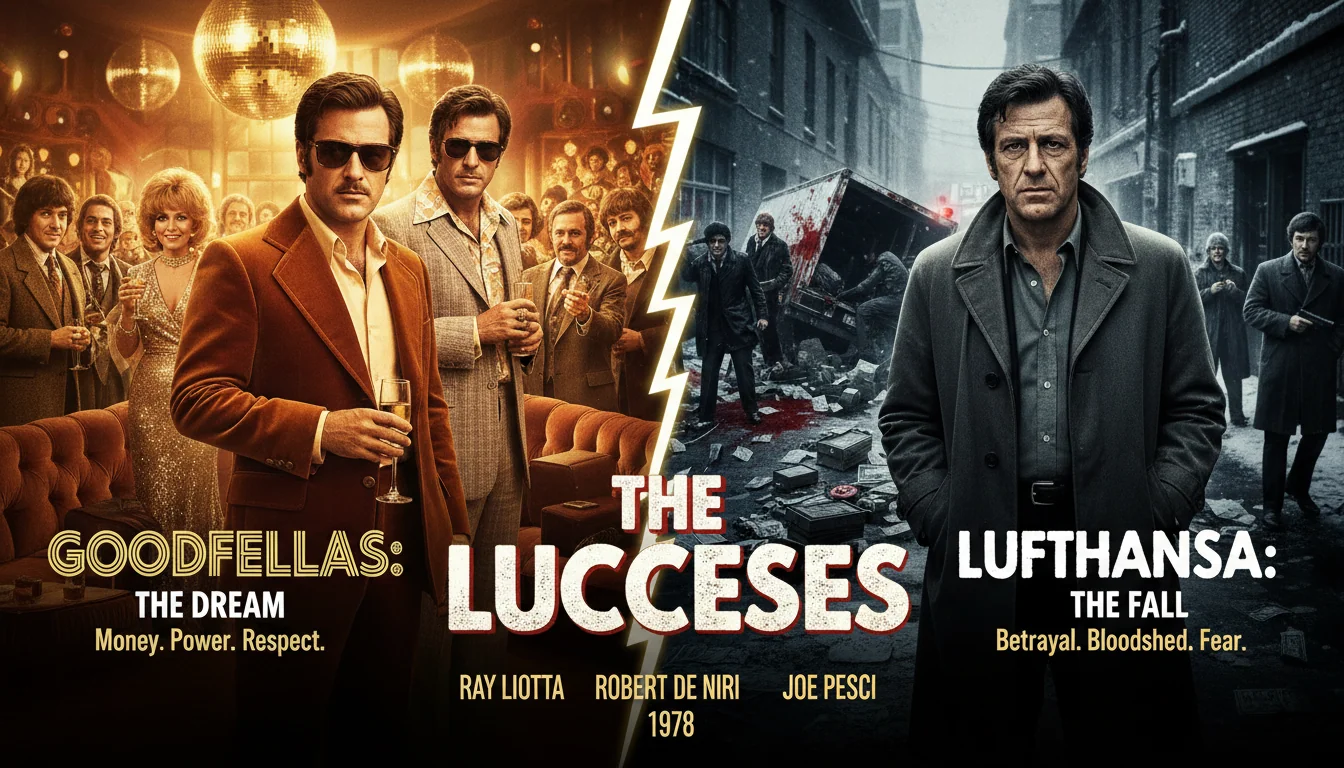
When Goodfellas opened in September 1990, it changed the gangster movie permanently. Martin Scorsese had made Mean Streets and Francis Ford Coppola had made The Godfather, but no one had ever shown the actual texture of organized crime, the boredom, the bickering, the petty errands, the dinners, the paranoia, with the brutal intimacy of Goodfellas. It became one of the most quoted, imitated, and admired films of its era, and over time it has come to feel almost like a documentary.
So how accurate is it really?
Scorsese's film is remarkably faithful to the source material, Nicholas Pileggi's 1985 book Wiseguy: Life in a Mafia Family, and the source material is itself based on years of interviews with Henry Hill, who became one of the most consequential mafia informants of the 20th century. As mob biographies go, Goodfellas is one of the cleanest pieces of nonfiction Hollywood has ever produced. It is not perfect, and some of the most cinematic moments are rearranged or compressed for storytelling, but the bones of the story are real.
What Hollywood Got RIGHT
Henry Hill was a real associate of the Lucchese family
The film's narrator, Henry Hill, played by Ray Liotta, was a real person born in Brooklyn in 1943. From around age 11 he ran errands for the cab stand operated by Paul Vario, a capo in the Lucchese crime family, played in the film by Paul Sorvino as Paul Cicero. Hill was never a made man, because his father was Irish, and the Italian-only blood-membership rule of Cosa Nostra is depicted accurately in the film.
Hill spent the next two decades robbing, hijacking, fencing, and dealing inside the orbit of the Lucchese organization. The film's careful attention to the relationship between associates and made men, who could not be killed without permission and who occupied a different rung in the hierarchy, mirrors the real structure of the New York Five Families.
Jimmy Burke and the Lufthansa heist
The most famous real-world event in the film is the December 11, 1978 robbery at the Lufthansa cargo terminal at JFK Airport. The crew, led in real life by Jimmy Burke, called Jimmy Conway in the film and played by Robert De Niro, escaped with around $5.875 million in cash and nearly $900,000 in jewelry. At the time it was the largest cash robbery in American history.
The film's portrayal of Burke as the operational mastermind, of his subsequent paranoia, and of the gradual elimination of his accomplices, is almost entirely accurate. Several Lufthansa associates including Tommy DeSimone, Stacks Edwards, and Frenchy McMahon were murdered in the months following the heist. The vivid montage in the film, set to "Layla," in which bodies turn up in trucks and freezers, condenses real events.
Tommy DeSimone's violence and his death
Joe Pesci's Oscar-winning portrayal of Tommy DeVito is rooted in Tommy DeSimone, a Lucchese associate who really was, by all accounts, casually murderous. The killings of Billy Batts in 1970, the bar argument turned beating, and the disposal of the body, are all real. So is the killing of Spider, an unfortunate young man whom DeSimone shot during a card game.
DeSimone's own end is also accurately captured. The film shows Tommy being lured to what he believes is his ceremony to be made, only to be murdered upon arrival. In real life, DeSimone disappeared on January 14, 1979. His body was never found. The leading theory, supported by Henry Hill's later testimony, is that he was killed in revenge for the murder of Billy Batts, who had been a member of the Gambino family.
The mood and texture of mob life
Almost everything ambient in Goodfellas, the long Sunday lunches, the wives gathering separately from the men, the social codes about respect, betting, hijacking trucks, and the steady drift toward cocaine in the late 1970s, is drawn from the testimony of Henry Hill and others. The film's uncanny accuracy about what life was actually like inside a New York crew is one reason it has aged so well.
The famous Copacabana tracking shot, the one that follows Henry and Karen through the kitchen and into the club, is dramatized but conveys an accurate truth: Lucchese associates received this kind of red-carpet treatment because the crew used the venue and intimidated its staff.
What Hollywood Got WRONG
Jimmy Burke was even worse than the film suggests
The film softens Jimmy Burke. While De Niro's Conway is dangerous and prone to murderous calculation, the real Jimmy Burke was, by the testimony of those around him, even more violent. He was suspected of more than 50 murders during his career, although he was only convicted of one, the killing of Richard Eaton. He died in prison in 1996.
Karen Hill is partially smoothed
The film's Karen, played by Lorraine Bracco, is one of its most memorable characters, and her real-life basis was indeed an active participant in Henry's criminal life, including hiding evidence and laundering money. But the film de-emphasizes some of the more painful details from Pileggi's book: Henry's chronic infidelity, the violence in the marriage, and Karen's own struggles. The film makes their relationship more wryly companionable than it actually was.
The timeline is compressed
Several events are moved or compressed for clarity. Hill's drug-dealing arc, his arrest, and his decision to cooperate are all real, but the cinematic crescendo of the film's final act, the day in the kitchen with the helicopter, the cocaine, the sauce, and the call from his brother, is a stylized reconstruction. The actual sequence of events in May 1980 was less neatly choreographed.
Henry Hill's character is partially rehabilitated
The film keeps Henry as the audience's narrator and gives him a kind of bittersweet status as the man who chose survival. The real Henry Hill was a far more compromised figure. He was abusive, repeatedly drug-addicted, and was thrown out of the Witness Protection Program in 1987 for committing further crimes. He spent the rest of his life in and out of trouble until his death from heart failure in 2012.
The film's last line, in which Henry laments that he now has to live like everyone else, is accurate to Pileggi's book and to interviews Henry gave. It is the most truthful single moment in the script.
Historical Accuracy Score: 8.5/10
Goodfellas gets the New York mob right in the way few films ever have. The hierarchy, the language, the daily life, the way associates lived and died, the codes about respect and earning, the texture of a Brooklyn cab stand becoming a satellite of organized crime, all of it is real, much of it transcribed almost directly from Pileggi's interviews.
What the film gets most right: the texture and rhythm of mafia life and the genuine character of Jimmy Burke, Tommy DeSimone, and Paul Vario.
What it gets most wrong: softening Karen Hill's life and slightly rehabilitating Henry himself.
The bottom line is that Goodfellas is closer to a documentary than almost any other gangster film. It dramatizes. It compresses. It edits. But the world it shows existed, and the people in it walked the same streets that Scorsese filmed. If you want to understand what life inside a real American Cosa Nostra crew looked like in the 1970s, this is still the best place to start.
For another mob-world accuracy check, see our review of Casino (1995), which covers the Las Vegas side of the same organized crime network. The Departed (2006) offers Scorsese's fictional take on the Boston Irish mob that overlapped with the world Henry Hill inhabited.
Quick Answers
Common questions about this topic
Is Goodfellas based on a true story?
Yes. Goodfellas is based on Nicholas Pileggi's 1985 nonfiction book Wiseguy, which drew on extensive interviews with Henry Hill, a former associate of New York's Lucchese crime family who entered witness protection in 1980. The film tracks Hill's life in the mob from the late 1950s to his testimony in 1980.
How accurate is Goodfellas?
Goodfellas is widely considered one of the most accurate mafia films ever made, particularly in its depictions of daily life, hierarchy, and code. Scorsese hired Pileggi as co-screenwriter and consulted Henry Hill directly. Most major events depicted, including the Lufthansa heist and the murders that followed, are drawn from real incidents.
Was Tommy DeVito a real person?
Tommy DeVito is closely based on Tommy DeSimone, a notoriously violent Lucchese associate. The film's portrayal, including the murder of Billy Batts, the killing of Spider, and DeSimone's own death after his made-man ceremony was actually a setup, are all rooted in fact.
Did Henry Hill go into witness protection?
Yes. Henry Hill entered the U.S. Federal Witness Protection Program in 1980 after being arrested on drug charges. His testimony helped convict Paul Vario and Jimmy Burke. He was eventually expelled from the program for committing further crimes and lived openly under his real name until his death in 2012.

Debate the Accuracy with the Real Figures
Ask the real people what Hollywood got wrong about their lives.
Chat with HistoryJoin the HistorIQly Club
Get smarter about the past.
Weekly stories, deep dives, and exclusive content straight to your inbox.