The Greatest Showman vs. History: How Real Was P.T. Barnum?
Our greatest showman accuracy verdict: the 2017 musical made Barnum a champion of inclusion. The real Barnum was sharper, sleazier, and morally far more complicated.
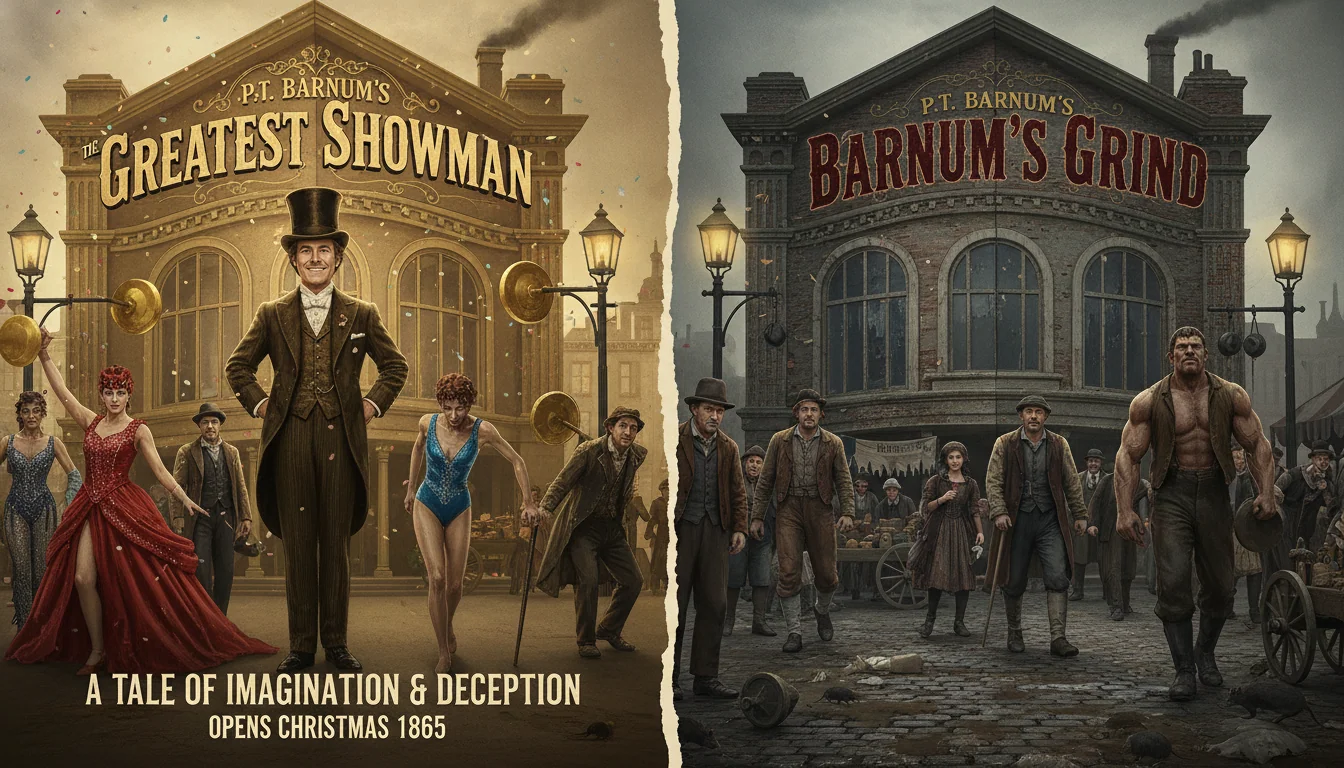
When The Greatest Showman opened in December 2017, it became a global musical hit, eventually grossing over $435 million on a $84 million budget. Hugh Jackman's Phineas Taylor Barnum was charming, ambitious, and ultimately devoted to family and inclusion. The film celebrated outsiders, sang against bigotry, and presented Barnum as a flawed but lovable American visionary.
The historical Barnum was a far more complicated figure. He was a showman, a marketer, a politician, a temperance advocate, an early opponent of slavery in his later life, and a man who built his early fortune on the exhibition of human beings, including an enslaved woman, as curiosities. He was also a businessman of genuine inventiveness, a writer of best-selling memoirs, and one of the most influential figures in 19th-century American popular culture.
So how accurate is The Greatest Showman? In a few details, it tracks history. In most respects, it is a fantasy that uses Barnum's name to tell a different and more comfortable story.
What Hollywood Got RIGHT
Barnum's modest origins
Phineas Taylor Barnum was indeed born into modest circumstances. His father Philo, a tailor and shopkeeper in Bethel, Connecticut, died when Phineas was 15, leaving the family in difficult financial circumstances. The young Barnum worked as a store clerk, lottery agent, and newspaper editor in Connecticut before moving to New York City in 1834.
The film's portrayal of Barnum as a hungry, self-made entrepreneur from a poor background is generally accurate, even if the cinematic version is more romantic and tidier than the historical record.
His marriage to Charity Hallett
Barnum married Charity Hallett in 1829, when both were young. Their marriage lasted until her death in 1873, and produced four children. The film's depiction of Charity as a long-term partner who tolerated Barnum's grandiose ambitions and supported his family is broadly accurate.
She was, however, not the wealthy upper-class girl the film implies. Charity was a tailor's daughter from a similar social background to Barnum's. The film's reframing of her as a wealthy heiress whose family disapproved of Barnum is fictional.
The American Museum
Barnum did purchase Scudder's American Museum at Broadway and Ann Street in New York City in 1841. He transformed it into one of the most popular attractions in 19th-century America, eventually drawing tens of thousands of visitors per week. He filled it with curiosities, taxidermy, theatrical performances, magic shows, automatons, dioramas, exotic animals, and human performers.
The museum genuinely was the cultural sensation the film depicts, and Barnum's marketing innovations, the use of newspaper teasers, public stunts, fabricated controversies, and celebrity tours, did revolutionize American advertising.
The Jenny Lind tour
Barnum's tour of Swedish operatic soprano Jenny Lind through the United States in 1850-1852 was a real and extraordinarily successful event. Barnum guaranteed Lind $1,000 per night for 150 performances, an unprecedented sum, and the tour grossed over $700,000 (more than $20 million in 2026 dollars). Lind was already a star in Europe, but the American tour transformed her into a phenomenon.
The film's depiction of the tour's commercial success and the American public's enthusiasm is accurate. The romantic subplot between Barnum and Lind, however, is fabricated.
Charles Stratton (General Tom Thumb)
Charles Stratton, who performed under the stage name General Tom Thumb, was a real performer with proportionate dwarfism whom Barnum first exhibited in 1842, when Stratton was four years old. Their long professional relationship made both of them wealthy. Stratton became one of the most famous performers in the world and was received by Queen Victoria, President Lincoln, and various European royalty.
The film's portrayal of Stratton as a successful, dignified performer with a long career under Barnum's promotion is broadly accurate. Barnum's relationship with Stratton's family was unusually genuine for the era.
What Hollywood Got WRONG
Joice Heth and Barnum's beginning
The film entirely omits the figure who launched Barnum's career: Joice Heth. In 1835, Barnum bought (or, more accurately, leased) Heth, an enslaved Black woman in her seventies, and exhibited her across the Northeast as the alleged 161-year-old former nurse of George Washington. The exhibition was a fabrication. Heth was probably around 80 years old, blind, partially paralyzed, and unable to consent to the arrangement.
When Heth died in February 1836, Barnum charged audiences 50 cents apiece to attend a public autopsy that he hoped would confirm her age. The autopsy did not. The episode became a national scandal at the time, although Barnum recovered his reputation through subsequent ventures.
This is the foundation of the Barnum business empire. The film's complete omission of Heth is its most serious historical distortion. Barnum did not begin as a struggling showman who suddenly opened a museum. He began as a man who exhibited an enslaved woman for profit until she died.
The freak show and the exploitation
The film transforms Barnum's human curiosities into a found family of empowered performers who fight prejudice through showmanship. The historical record is more troubling. Many of Barnum's exhibited performers were paid, and some achieved real fame, but others were exhibited under conditions ranging from coerced to deeply exploitative.
Barnum exhibited Anna Swan, the Lucasie family of albinos, Chang and Eng Bunker (the original "Siamese twins"), and many others. Some of these performers, like Stratton, were genuinely well-treated by the standards of the era. Others were not. The film's blanket presentation of Barnum's enterprise as inclusive empowerment is a substantial misrepresentation.
The romance with Jenny Lind
Jenny Lind in 1850 was 30 years old, a deeply religious Lutheran from Sweden, and a strict practitioner who insisted on philanthropic donations of much of her tour earnings. Barnum was 40, married, and engaged in the most demanding business venture of his life.
Their professional relationship was significant. Their personal relationship was not romantic. Lind's biographers and Barnum's own memoirs describe a working relationship that was generally cordial but eventually strained when Lind, frustrated by Barnum's relentless promotional stunts, broke her contract early and continued the tour under her own management.
The romance the film depicts, including a public kiss that supposedly destroys Barnum's marriage, is invention.
The timeline
The film compresses roughly 35 years of Barnum's career into what feels like a few cinematic seasons. Barnum did not open the museum in his thirties, take Jenny Lind on tour in his thirties, and watch the museum burn in his thirties. The American Museum opened in 1841 (Barnum was 30), the Jenny Lind tour was 1850-1852 (Barnum was 40-42), and the museum fires were 1865 and 1868 (Barnum was 55-58).
The film's compression makes for clean drama but produces a Barnum who never aged, never made political mistakes, and never went bankrupt. The historical Barnum did all of those things.
Barnum the politician and reformer
The film leaves out Barnum's substantial political career. He served in the Connecticut legislature from 1865 to 1869, where he was a vocal advocate for the abolition of slavery and the expansion of Black suffrage. He served as mayor of Bridgeport, Connecticut, in 1875. He wrote temperance lectures and pamphlets. He published one of the most successful self-help books of the 19th century, The Art of Money Getting (1880).
This more substantive Barnum is much harder to fit into a musical, but he is also a more genuinely interesting historical figure than the simplified showman the film presents.
What the film captures even when it bends facts
The Greatest Showman gets one specific thing right: the cultural significance of 19th-century popular spectacle as a place where ordinary Americans encountered the strange, the foreign, the marvelous, and the disturbing. Barnum's American Museum was a kind of mass-market cultural laboratory, and its mixture of educational ambition, theatrical fakery, and genuine wonder shaped American popular culture for generations.
The film also captures the energy of mid-19th-century New York, the hunger for new entertainments, and the speed at which Barnum could turn rumor into ticket sales. These textures are accurate, even when the specific events are not.
Historical Accuracy Score: 4/10
The Greatest Showman is closer to a Barnum-themed fantasy than a Barnum biography. It correctly identifies several real people, places, and events, and it captures the broad arc of his rise from poverty to celebrity. It seriously misrepresents the racial and ethical dimensions of his early career, invents a romance that never happened, and presents him as a champion of inclusion in ways the historical record does not support.
What the film gets most right: the cultural impact of mid-19th-century popular spectacle.
What it gets most wrong: completely omitting Joice Heth, sanitizing the exploitation in his exhibitions, and inventing the Jenny Lind romance.
The bottom line is that The Greatest Showman is a beautifully made musical that uses Barnum's name without telling his story. If you want the songs and the choreography, watch the film. If you want to understand the man who actually built American popular spectacle, you need to read past the credits. For how Hollywood handles another morally complicated showman, see our Wolf of Wall Street vs. History review, or explore the period New York Barnum inhabited in Gangs of New York vs. History.
Quick Answers
Common questions about this topic
Is The Greatest Showman based on a true story?
It is loosely based on the life of Phineas Taylor Barnum (1810-1891), the American showman who founded what became the Barnum and Bailey Circus. The film takes enormous liberties with the historical record, inventing characters, compressing decades into a few cinematic months, and softening many of the more troubling elements of Barnum's actual career.
Was Barnum really a champion of his performers?
The historical record is mixed. Barnum did pay performers more reliably than many contemporaries and gave several of them substantial public profile. He also exhibited human beings as curiosities, including most infamously Joice Heth, an enslaved Black woman whom he bought and exhibited as a 161-year-old former nurse of George Washington. The film completely omits Heth and softens nearly all of his exploitation.
Did Barnum and Jenny Lind really have a romantic relationship?
Almost certainly not. Barnum's tour of Swedish soprano Jenny Lind in 1850-1852 was a financial and cultural triumph, but no credible biographical source supports the romantic affair the film depicts. Both Barnum and Lind were married, and the surviving correspondence between them is professional. The romance is screenwriter invention.
Was the American Museum really destroyed by fire?
Yes. Barnum's American Museum on Broadway in New York City burned down in July 1865. He rebuilt as the New American Museum, which also burned in 1868. After two devastating fires, Barnum largely transitioned away from museums into the traveling circus business that would make his name internationally.

Debate the Accuracy with the Real Figures
Ask the real people what Hollywood got wrong about their lives.
Chat with HistoryJoin the HistorIQly Club
Get smarter about the past.
Weekly stories, deep dives, and exclusive content straight to your inbox.