The Honolulu Strangler: Hawaii's Unsolved Serial Case
The Honolulu Strangler killed five women across 1985-86, then stopped cold. The killer was never identified, and the case remains open forty years later.
Read Wikipedia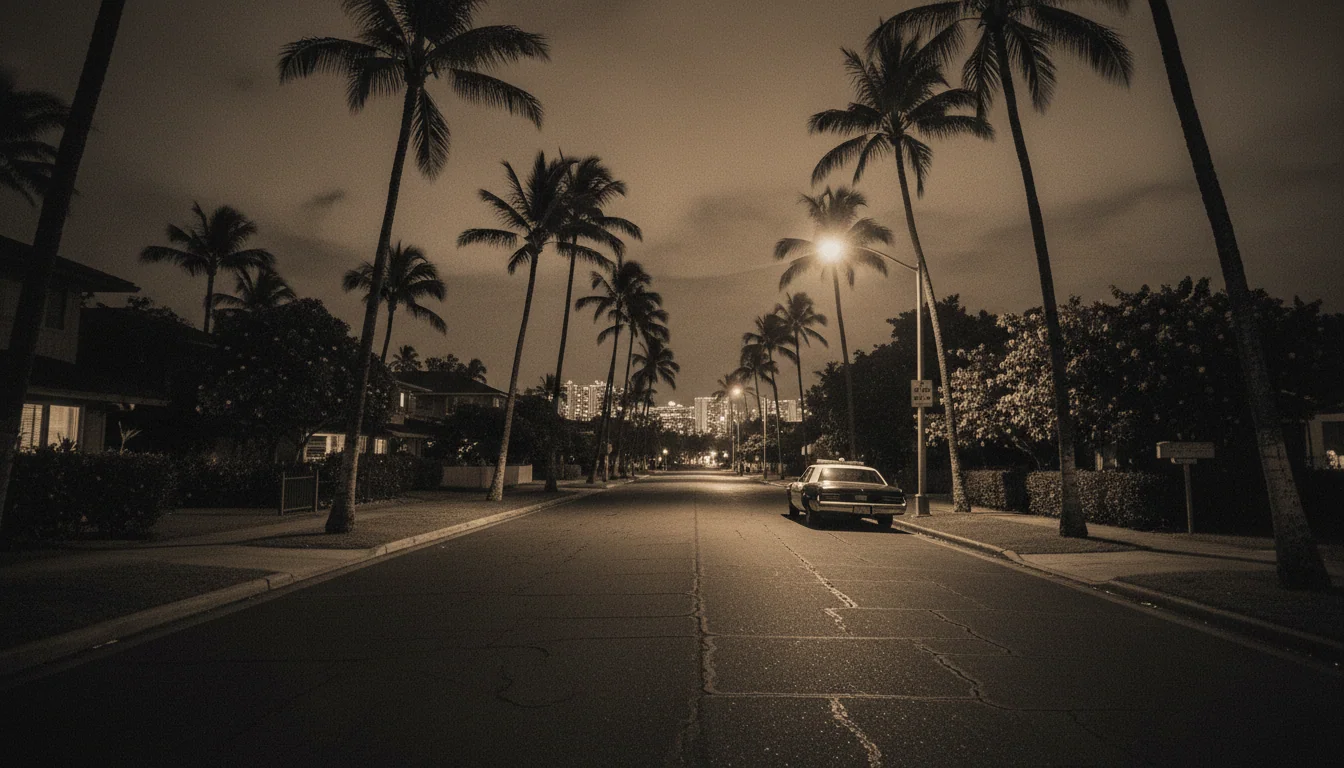
In a city famous for sunshine and salt air, five women were strangled over the course of roughly twelve months. The killer chose victims across different neighborhoods, left no consistent signature pointing to a single obvious motive, and then stopped. No one was ever arrested. No one has been convicted. The case sits in the files of the Honolulu Police Department, technically open, practically cold.
The Honolulu Strangler case is not as famous as some mainland cases from the same era, and that relative obscurity is part of what makes it worth examining. A metropolitan serial murder investigation that produced no resolution and then simply ended - without a dramatic suspect, without a confession, without a forensic breakthrough - is a rarer outcome than true crime coverage generally acknowledges.
The victims and the pattern
The series appears to have begun in May 1985 with the death of Vicki Purdy, a 25-year-old woman found strangled in Honolulu. After several months of quiet, the pace accelerated. In January 1986, two more women were found within weeks of each other: Regina Sakamoto, 17, and Denise Hughes, 21. In April 1986, Louise Medeiros, 25, and Linda Pesce, 36, were found within roughly three weeks of each other.
All five were strangled. Several showed signs of sexual assault. The victims ranged in age from their late teens to their mid-thirties, lived in different parts of the city, and appear to have had no obvious connection to each other. The spread across neighborhoods and the absence of a single common milieu made the investigative work considerably harder than in cases where victims share a clear environment.
The victim demographics suggested an opportunistic rather than a rigidly type-specific killer. He was not targeting a single profession, a single neighborhood, or a single narrow physical profile. Whatever drew him to each woman, it was not a pattern that investigators could use to predict the next victim or narrow a geographic search.
The investigation
The Honolulu Police Department treated the murders as connected based on the method of death, the geographic cluster, and the compressed time frame. The department assembled a task force. Investigators developed a list of persons of interest over the following years, questioned and polygraphed several of them, and charged none.
The geographic isolation of Hawaii complicated the investigation in ways that differ from mainland cases. In a continental state, a killer who stops killing might have crossed a state line and begun again in another jurisdiction, leaving a chain of linked cases that eventually draws federal attention. In Hawaii, the most plausible explanations for a sudden stop were contained within the islands: death on the island, incarceration for something unrelated, or departure by air or sea. None of these could be verified through the evidence available.
DNA analysis became available in the years after the murders, and investigators were able to develop a genetic profile of the suspect from material collected at some of the crime scenes. When run against available databases, the profile returned no match. This means the suspect either had no prior criminal record requiring DNA collection, had died before his DNA entered any system, or had never been sampled in connection with any other investigation.
The timing problem
The cluster pattern - five murders between May 1985 and April 1986 - tells investigators something about the killer's circumstances. Serial killers who operate within a tight geographic area and then stop entirely tend to fall into a small number of categories: they move, they are incarcerated, they die, or they achieve some kind of stabilizing change in their circumstances that removes the compulsion that drove the killing.
The murders stopping cold in the spring of 1986 prompted speculation across all four possibilities. At least one person of interest was later incarcerated on unrelated charges, which would correspond to the most commonly documented explanation for abrupt series endings. But a correspondence between timing and incarceration is not evidence. Hawaii's investigators have been appropriately careful about what they can claim publicly.
What the geography suggests
The distribution of the murders across Honolulu suggests the killer had access to transportation and was comfortable across different parts of the island. He was not operating from a single fixed radius.
Honolulu in the mid-1980s was a city of roughly 370,000 people, dense in some areas and spread across a narrow coastal plain backed by the Ko'olau range in others. The tourist zones of Waikiki and the residential neighborhoods of the valleys and hillsides coexisted within short driving distances. A killer who moved between those zones without attracting suspicion was either a resident with ordinary reasons to be in all of them, or someone whose work or habits placed him across multiple contexts.
The absence of witnesses capable of placing a consistent description at any of the crime scenes suggests someone who moved through these areas without standing out. That is a different kind of invisibility than a stranger passing through. It is the invisibility of someone already expected to be there.
The unsatisfying stop
What distinguishes the Honolulu Stranglings from many serial cases is the absence of escalation. In the arc that criminologists most frequently describe, a serial killer operates with cooling-off periods that shorten as the compulsion intensifies. The Honolulu cases show a gap of several months after the first murder, then a tight cluster across the first four months of 1986. Then silence.
Some investigators have raised the possibility of a longer series with earlier or later murders not successfully linked - crimes that might look isolated in individual case files but share enough forensic or behavioral signature to belong to the same perpetrator. That is speculation. The officially connected cases remain five.
The abruptness of the ending - five murders across roughly twelve months and then nothing - is one of the defining features of the case. It denies the kind of narrative closure that most investigations eventually produce, one way or another. There was no dramatic arrest, no deathbed confession, no dying statement from someone who claimed to know. The killer stopped, and in stopping, became harder to find.
DNA and the limits of modern forensics
Forensic science in Hawaii, as elsewhere, has advanced considerably since the 1980s. The Honolulu Police Department has revisited the case with updated techniques on more than one occasion. DNA familial searching, which can identify close relatives of a suspect even without a direct database match, has resolved cold cases older than this one in other jurisdictions.
The absence of a resolution despite available DNA evidence points toward one of several scenarios: the suspect has no close relatives who entered a genealogy database or a criminal DNA collection system, the profile was built from a partial sample that limits familial searching options, or the suspect died or left Hawaii before modern DNA collection systems were established broadly enough to capture a likely match.
None of these possibilities close the case. They reduce the set of likely explanations without eliminating any.
What we may never know
The Honolulu Stranglings have attracted less national attention than comparable cases from the same decade. The killings stopped before producing the kind of extended public fear that drives sustained media coverage. Hawaii sits geographically and culturally outside the mainland media ecosystem that defines true crime attention. And the case, unlike several high-profile cold cases reopened through genealogical DNA matching in the past decade, has not yet produced a breakthrough that brings it back into public view.
The five women who were killed - Vicki Purdy, Regina Sakamoto, Denise Hughes, Louise Medeiros, and Linda Pesce - deserve the attention the case has not fully received. They were not famous. They were not connected to public figures or prominent institutions. They were women living ordinary lives in Honolulu who were murdered by someone the police have not identified.
Forty years on, the HPD cold case unit keeps the files active. The DNA profile sits in the database. Advances in familial DNA searching have resolved cases older than this one in states with fewer resources. Whether the Honolulu Strangler is alive, whether he is in Hawaii, whether he ever touched the genealogy databases that have cracked other cold cases, remains unknown.
The case is as open as it has ever been. That, more than the identity of the killer, may be the most important thing to understand about it. For other serial cases from the same era that were similarly defined by what investigators could not establish, see the Long Island Serial Killer and the Cleveland Torso Murders.
Quick Answers
Common questions about this topic
Who was the Honolulu Strangler?
The Honolulu Strangler is the name given to an unidentified killer who murdered at least five women in Honolulu, Hawaii between May 1985 and April 1986. All victims were found strangled. The case has never been solved and remains open with the Honolulu Police Department.
How many victims did the Honolulu Strangler have?
Five murders are officially linked to the Honolulu Strangler: Vicki Purdy in May 1985, and Regina Sakamoto, Denise Hughes, Louise Medeiros, and Linda Pesce in the first months of 1986. Some investigators have suggested a wider victim pool, but only these five cases are formally connected.
Was anyone ever charged in the Honolulu Strangler case?
No one was ever charged or convicted in the connected murders. Over the years investigators developed several persons of interest and collected DNA evidence from crime scenes, but no arrest followed. The case remains unsolved.
Why did the murders stop?
The killings stopped abruptly after April 1986, which investigators have attributed to several possible explanations: the killer may have died, been imprisoned for an unrelated crime, left Hawaii, or been deterred by increased police pressure and public awareness. No confirmed explanation exists.

Want to Interrogate the Suspects?
Chat with historical figures and uncover the truth behind history's greatest mysteries.
Create your free account →No card required. Some figures and features require a paid plan.
Join the HistorIQly Club
Get smarter about the past.
Weekly stories, deep dives, and exclusive content straight to your inbox.