If Pythagoras Lived Today: The Math Cult Leader Who'd Break Silicon Valley
If Pythagoras lived today, he would run a residential institute in Oregon, write real mathematics, and surround himself with an NDA-backed bean prohibition.
Read Wikipedia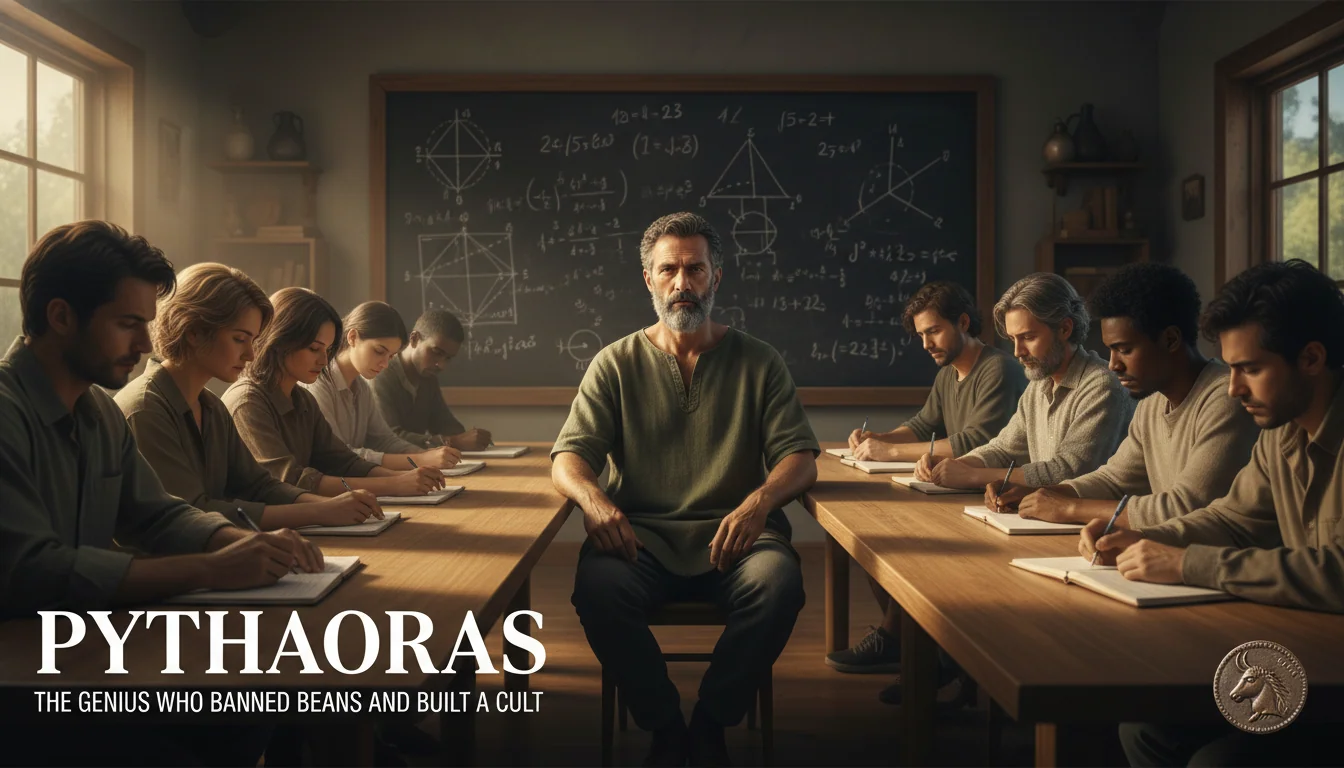
The building that was not quite a university and not quite a monastery and not quite a commune sat on the edge of Croton, a Greek colonial city on the toe of the Italian boot, and its founder had rules. No beans. No eating the hearts of animals. Do not stir a fire with an iron poker. Do not urinate facing the sun. Do not step over a yoke. The inner circle of members, the mathematikoi, could ask questions and debate. The outer circle, the akousmatikoi, could only listen. No one could speak of what was discussed inside to anyone outside. The penalty for violation was expulsion, social death in a community where all property was held collectively.
This was the Pythagorean Brotherhood, founded around 530 BCE, and its founder was simultaneously the most advanced mathematical thinker of the Greek world and a man who believed that a human soul could transmigrate into a bean.
Drop Pythagoras into 2026 and the specific details update but the essential architecture does not. The commune becomes a campus. The akousmatikoi become the general subscriber tier. The bean prohibition becomes a proprietary dietary protocol with an NDA attached. The mathematics, however, is still real. That is the problem, and also the draw.
The historical figure
Pythagoras was born around 570 BCE on the island of Samos off the coast of Asia Minor. By ancient accounts he traveled extensively in Egypt and possibly Babylon, acquiring mathematical and astronomical knowledge before settling in Croton around 530 BCE and founding his community. The details of his early life are unreliable because he wrote nothing down and his followers had a strong incentive to mythologize him, which they did enthusiastically.
What is recoverable is the intellectual substance. The Pythagoreans were serious mathematicians who worked on the properties of numbers, the theory of proportions, and early forms of number theory. They discovered that musical intervals could be expressed as simple numerical ratios, which was a genuine insight: the octave corresponds to a 2:1 string-length ratio, the perfect fifth to 3:2. This led to the doctrine that the cosmos itself was organized by mathematical proportion, a claim that sounded mystical but contained an accurate intuition that would take another two thousand years to fully cash out.
The Pythagorean theorem, the relationship between the sides of a right triangle, had been known empirically to Babylonian scribes since at least 1800 BCE. What the Pythagoreans contributed was a general proof, demonstrating that the relationship held for any right triangle, not just the specific ones that previous cultures had catalogued. The difference between knowing a rule and proving why it is always true is significant. The Pythagoreans understood that distinction.
Politically, Pythagoras and his Brotherhood accumulated influence in Croton that eventually provoked a backlash. Around 500 BCE a citizen named Cylon, whom Pythagoras had refused admission to the Brotherhood, led a factional attack. The meeting house was burned, members were killed, and Pythagoras fled. He died, probably in Metapontum, shortly afterward.
The modern role
If Pythagoras lived today, he would not run a university department. That is not grandiose enough. He would not run a hedge fund. He is not interested in mere money.
He runs Monad Institute, a residential research community and educational foundation based outside Ashland, Oregon, with a second location he prefers not to publicize in the hills above Thessaloniki. The institute has roughly 300 resident members, several thousand remote subscribers who pay a monthly fee for access to his recorded lectures and a weekly livestream, and a waiting list for residential admission that has been closed for three years.
The public-facing work is legitimate and impressive. Pythagoras, in this life, has a genuine background in mathematical logic and computational theory. His papers on the structural relationship between harmonic series and network topology have been cited extensively. His popular lectures on mathematical structure in biological systems have several million views. He does not have a doctorate, a fact that both irritates him and feeds the cult of personality around his self-taught genius, and he is careful not to let it go unmentioned.
The residential community is where things get complicated.
The rules
New members arrive for a two-year silent listening period. During this time they attend lectures but do not speak in group settings, submit questions only in writing, and live communally with shared meals and shared schedules. They are not prisoners. They can leave. Very few do, partly because leaving means returning a portion of the substantial enrollment fee, and partly because the community is, genuinely, intellectually stimulating in a way that normal life in 2026 is not.
After two years, qualifying members are admitted to the inner circle and can participate in discussions. This is presented as an honor. It is also the point at which the community's doctrines, including the specific dietary protocols, the views on the eternal structure of mathematical reality, and the increasingly elaborate cosmological system he has spent three decades building, become an ordinary part of conversation rather than a background hum.
The dietary rules are presented as health protocols. No meat, because Pythagoras in 2026 has absorbed the language of environmental ethics without abandoning the transmigration-of-souls argument he considers more fundamental. No legumes of a specific type, for reasons the official materials describe as concerning gut biome integrity and which the inner circle understands differently. No consumption of food grown in countries with what the institute's documentation calls "epistemically hostile" agricultural practices. The rules expand over time. Long-term members notice this without finding it remarkable.
The NDA is standard. Every member, residential or remote, signs a confidentiality agreement covering the specific content of Monad Institute's educational materials, which are described as proprietary. Pythagoras enforces it. Two former members who discussed their experience publicly in 2023 were sued and settled.
The skills that translate
What keeps the operation coherent is that Pythagoras is not faking the mathematics. This is not a charismatic vacuum charging for access to nothing. The weekly livestream sessions are genuinely intellectually demanding, and a meaningful percentage of Monad Institute's residential members are working mathematicians, physicists, and engineers who came for the intellectual community and stayed for reasons they find difficult to explain to their former colleagues.
The insight that numerical relationships underlie physical structure, which the historical Pythagoras grasped in the 6th century BCE and which turned out to be more literally true than even he imagined, is something he communicates with a clarity that most academic mathematicians cannot match. He is a teacher of unusual quality in the specific sense that matters: he can make you feel the reality of abstract structure, not just manipulate symbols that represent it.
This is the hook. Once someone has had the experience of mathematical reality feeling genuinely real under his instruction, the distance between that experience and the other things he claims is shorter than it looks from outside.
The family
He has never married, consistent with the historical record, though the ancient rumors about his relationship with his eventual partner Theano have been updated. In 2026, Theano is the institute's co-director and head of educational programming, a woman of formidable organizational intelligence whom Pythagoras consistently describes as his equal and who is, in practice, the person who makes the institute function. She is also the only person whose judgment he reliably accepts. Without her, the community would have fractured years ago. She knows this. He pretends not to.
He has no children, which members understand to reflect a considered philosophical position on family and which is, more practically, a function of his total absorption in the work.
What goes wrong
The historical Brotherhood ended when Cylon burned the house. The 2026 version has its Cylon, a former inner-circle member and mathematician of serious standing who left the institute in 2022 after a dispute about attribution of a significant theoretical result. The question of whether the work was Pythagoras's or the member's is contested. The published paper credits Pythagoras. The former member has said otherwise publicly, stopped short of a lawsuit, and has been making his case through academic channels.
The problem is not that Pythagoras steals credit, exactly. The problem is that within Monad Institute, all intellectual output is considered collective and attributed to the community as a whole, with Pythagoras as its representative. This is coherent as a philosophy. As an intellectual property arrangement, it is a mechanism for Pythagoras to own everything everyone in the community produces.
The legal exposure is accumulating. The NDA enforcement creates its own backlash. The diet protocols have generated one hospitalisation that was publicly reported and probably others that were not. At some point a state attorney general or a determined former member with a documented grievance will apply sufficient pressure, and the house in Oregon will burn in its own way.
Why it matters
The reason Pythagoras is interesting in any century is not the bean prohibition or the community rules. It is the combination of genuine intellectual power and totalizing personal authority. He is one of the founders of mathematical reasoning as a discipline, and also the founder of one of antiquity's most controlling religious communities. Those two things are not in tension in his own mind.
What 2026 offers the 2026 Pythagoras is an audience that has been trained, by decades of tech-founder mythology, to accept that exceptional intellectual ability confers unusual moral authority. A man who can prove the Pythagorean theorem gets extra latitude on the bean rule. A man who can publish in serious mathematical journals gets significant latitude on the NDA and the dietary protocols and the property arrangements.
He will push that latitude until it runs out. He always has. The pairing of mathematical genius with authoritarian community is not unique to him: Archimedes in the same thought experiment manages his genius without the commune, and Aristotle builds institutions rather than cults.
Quick Answers
Common questions about this topic
Who was Pythagoras?
Pythagoras of Samos (c. 570-495 BCE) was a Greek philosopher and mathematician who founded a religious-philosophical community at Croton in southern Italy. He is credited with the Pythagorean theorem (though earlier cultures knew the relationship), with foundational work in music theory and astronomy, and with establishing one of the ancient world's most influential esoteric brotherhoods. His followers believed in the transmigration of souls, the mystical significance of numbers, and strict dietary and ritual rules.
What were the Pythagorean Brotherhood's rules?
The Pythagorean community had elaborate regulations. Members were vegetarian, believing in the transmigration of souls through both humans and animals. They were forbidden from eating beans, for reasons still debated (religious taboo, perceived resemblance to human embryos, or possibly toxicity to people with G6PD deficiency). Members were divided into inner initiates who could ask questions and outer adherents who could only listen. Sharing the community's secret doctrines with outsiders was prohibited.
Did Pythagoras invent the Pythagorean theorem?
Probably not in the sense of first discovery. Babylonian and Indian mathematicians had known the relationship between the sides of a right triangle centuries before Pythagoras. What the Pythagoreans contributed was a general proof of the theorem, and the formalization of it as part of a broader mathematical philosophy. Attribution of the theorem to Pythagoras personally is ancient but cannot be verified, since Pythagoras himself wrote nothing down. His followers attributed their collective discoveries to him by convention.
How did the Pythagorean Brotherhood end?
The Brotherhood was violently suppressed, probably around 500 BCE, by a political faction in Croton led by a wealthy citizen named Cylon whom Pythagoras had rejected for membership. The Pythagorean meeting house was burned, many members were killed, and Pythagoras fled. He died shortly afterward, possibly in Metapontum in southern Italy. Secondary communities survived his death and kept Pythagorean ideas alive for another century.

Meet Them in Person
Chat with the historical figures behind these modern reimaginings.
Create your free account →No card required. Some figures and features require a paid plan.
Join the HistorIQly Club
Get smarter about the past.
Weekly stories, deep dives, and exclusive content straight to your inbox.