If Thomas Edison Lived Today: The Patent Troll Who Would Have Conquered Silicon Valley
What would happen if Thomas Edison lived today? The 1,093-patent inventor becomes 2026's most recognizable tech CEO: brilliant, ruthless, and impossible to audit.
Read Wikipedia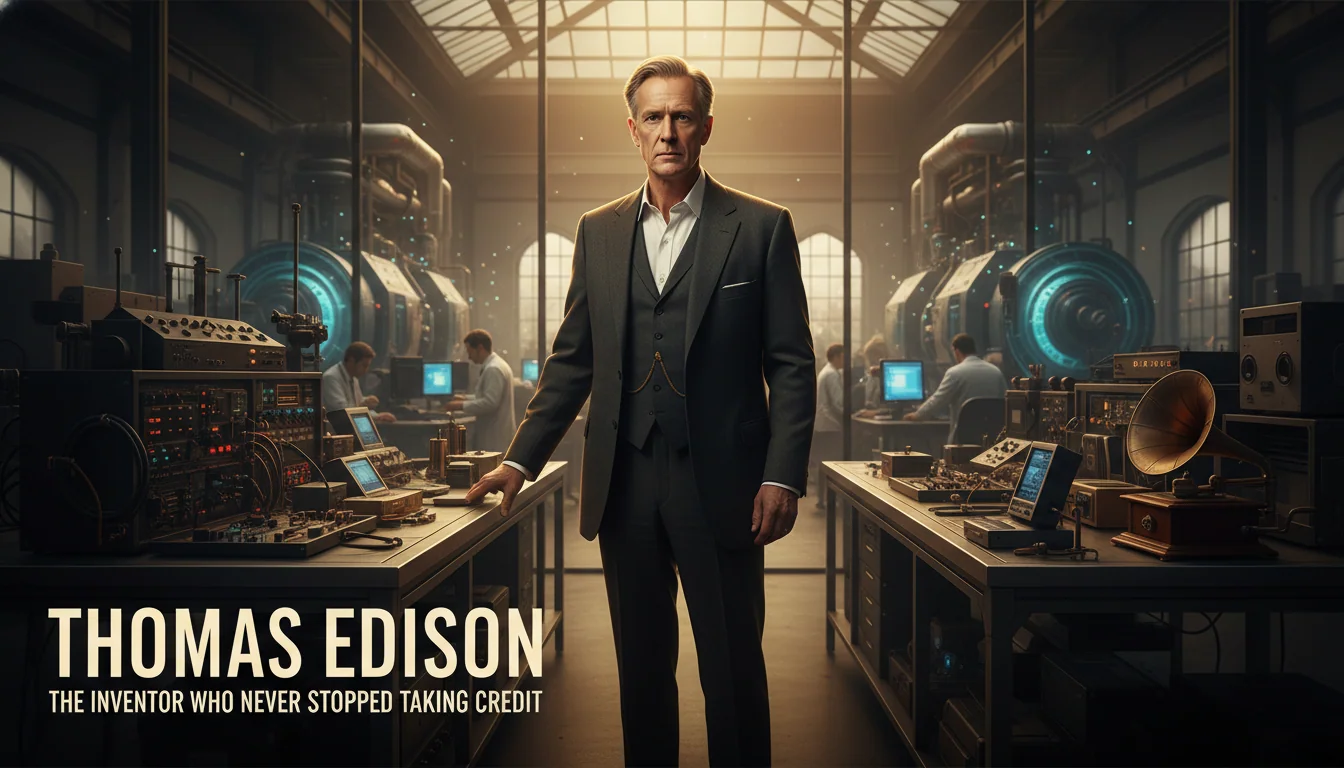
Thomas Edison was a genuinely brilliant man who systematically underplayed how many other brilliant people were doing the actual work. He ran the world's first industrial research laboratory, held 1,093 patents across a span of decades, built an electrical grid from scratch, invented the recorded music industry, and made himself one of the most famous men in America by being both relentlessly productive and relentlessly good at claiming credit for what his employees produced.
He was also a ruthless competitor who electrocuted animals in public to discredit a rival's technology, forced employees to sign over their inventions as a condition of employment, and maintained a public image of genial, hardworking American genius while operating with the strategic aggression of an industrial monopolist.
If Thomas Edison lived today, he would not become a different person. He becomes the most recognizable kind of tech CEO on the planet.
The historical figure
Edison was born on February 11, 1847, in Milan, Ohio, the seventh and last child of Samuel and Nancy Edison. He was largely self-educated - schooling was brief and he was taught primarily by his mother at home after teachers found him difficult to instruct - and spent his teenage years working as a telegraph operator across the Midwest, a job that gave him both practical electrical knowledge and the habit of working through the night.
By his late twenties he had established himself as a professional inventor for hire in Newark, New Jersey, improving existing telegraph technology and selling the patents. In 1876 he opened the Menlo Park laboratory in rural New Jersey, explicitly designed as a facility for systematic invention - an "invention factory" that could turn out a significant technical advance every few weeks and a major one every six months, on schedule, on demand.
The phonograph came in 1877, the practical incandescent light bulb in 1879, and with the light bulb came the entire Edison electrical system: generating stations, underground cables, meters, switches, and the infrastructure of centralized electrical power delivery. The Pearl Street Station in lower Manhattan, opened in September 1882, was the first central power station in the United States and the operational proof that Edison's system worked at commercial scale.
He was partially deaf from early adolescence, possibly from a childhood illness and possibly from an incident on a railway car, and he used the deafness as a filter: he could hear what he wanted to hear, literally, and ignored the rest. He slept on laboratory floors, ate irregularly, and drove his employees with the same energy he applied to himself.
He was also not always right. The War of Currents, his fight against Nikola Tesla's alternating current and George Westinghouse's system that commercialized it, was one of the more spectacular wrong calls in the history of technology. Edison's direct-current system was limited in how far it could transmit power without significant loss. AC could travel hundreds of miles. Edison argued for DC with a public-relations campaign that included electrical demonstrations in which animals - dogs, calves, and eventually Topsy, a circus elephant - were killed with AC current to demonstrate its danger. The campaign did not work. Westinghouse's AC became the standard. Edison lost the technical argument and eventually the commercial one.
The modern role
In 2026, the title on his business card reads: Founder and Executive Chairman, Menlo Systems, Inc. - a Delaware-incorporated technology company with operational subsidiaries in energy storage, advanced materials, media technology, and something called "ambient intelligence infrastructure" that nobody outside the building can fully explain.
The company's headquarters are in Menlo Park, California, because of course they are, and there is a campus in West Orange, New Jersey, maintained specifically as a research facility because Edison has a documented thing about New Jersey.
He does not call himself a CEO. He calls himself an inventor. The distinction matters to him in the way distinctions about titles matter to men who have spent decades building organizations where the title on the card is less important than whose name is on the patents. All 2,400 of his company's U.S. patents are assigned to Menlo Systems or to Edison personally.
The lab, still running
The Menlo Park campus has 3,500 employees. About 400 of them are researchers. The rest build, test, iterate, file paperwork, and manage the commercial relationships that turn laboratory results into revenue streams.
The organizational model is recognizable to anyone who has studied his 1876 original. Edison provides the direction, the commercial vision, and the public face. The researchers provide the technical work. The employment contracts include an invention assignment clause that is twelve pages long and covers everything the employee touches, thinks about, or accidentally solves in the shower. This is standard practice in the technology industry. Edison did not invent it in 2026; he invented it in 1876. Everyone else copied him and now does not give him credit.
He gives weekly briefings to the research teams that are equal parts inspiring and terrifying. He assigns tasks at 11 p.m. by voice message. He remembers the name of every researcher who has ever produced something interesting and exactly what they produced and when. He does not remember the names of the people in accounting.
The lab does genuine science. This is important to understand about Edison: the caricature of him as a pure IP operator misses that his labs, in both centuries, actually solve hard problems. The energy storage subsidiary holds a defensible position in solid-state battery architecture. The advanced materials group has filed work on carbide composites that is being tracked by three major aerospace contractors. He did not get to 1,093 patents by being dishonest about whether the underlying technology worked.
The War of Currents, 2026 edition
The rivalry with Tesla is now structural and permanent.
In this century, "Tesla" means a different company, which is not lost on anyone, least of all Edison, who brings it up at every opportunity and has given interviews suggesting that Elon Musk naming his electric-vehicle company after Nikola Tesla was a deliberate personal provocation. There is no evidence this is true. Edison has made it personally meaningful regardless.
Menlo Systems holds a competing position in electric-vehicle charging infrastructure and has filed multiple patent claims against Tesla, Inc. over fast-charging connector design. None of the cases have produced significant judgments. All of them have generated significant legal fees and press attention, which is most of the point.
He has a podcast. It is called "The Workshop" and releases episodes at random intervals at 2 a.m. The title card reads: "If you can't beat them, outlast them." His guest list consists almost entirely of working engineers and materials scientists. He refuses to have any guest who is primarily known for having opinions about technology rather than for building it. The podcast has 4.2 million subscribers. He does not understand why this is considered a large number.
The social media presence
He posts on three platforms. The posts are always about things he has made or is making, never about his personal life, and never in response to attacks. He believes, correctly, that responding to attacks implies they are worth responding to.
His most-shared post in 2024 was a photograph of a failed battery prototype on a laboratory bench with the caption: "Attempt 847. Still learning." It received 14 million views. He did not follow up on what Attempt 848 produced.
He is aware that many people find him intimidating and uses this strategically, which is the same thing he did in the 1880s. He is also genuinely funny in person in a dry, slightly cruel way that does not translate well to written form.
The contemporary peer
The most precise 2026 parallel is Elon Musk, and not just because of the Tesla irony. Both men build vertically integrated systems - power generation to delivery to consumer product - that compete with incumbent industries rather than adjacent to them. Both maintain large personal myth-making operations around the idea of the lone genius surrounded by capable subordinates who exist to execute the genius's vision. Both are genuinely brilliant in certain domains and catastrophically confident in others.
The differences are instructive. Edison was more methodical about the laboratory work itself, less interested in scale for its own sake, and fundamentally more focused on making specific technology work than on announcing what he was going to build. He was also more comfortable losing the argument as long as he won the revenue. He lost the War of Currents on the technical merits and continued building profitable DC systems for specific applications for another two decades.
He shares something with Jeff Bezos in the willingness to use vertical integration as a competitive weapon: owning the power plant, the wire, the meter, and the bulb so that competitors have to deal with him at every stage. He shares something with Peter Thiel in the belief that monopoly is the goal rather than the regrettable outcome of competition.
What goes wrong
The historical Edison was wrong about DC versus AC and wrong about the talking motion picture format he promoted and wrong about the iron ore concentrating scheme he poured years of energy and money into in the early 1890s, a project that consumed resources and produced no commercial return.
In 2026, the version of this failure is the patent-licensing subsidiary, which by 2024 is involved in 340 active litigation matters and has begun to function less as a defensive protection for Menlo Systems' genuine IP and more as a revenue-generating operation that targets companies using technology Edison's researchers may have worked on tangentially. Three of Menlo's senior researchers have left quietly in the past eighteen months citing discomfort with how their work was being used in litigation.
Edison is aware of this and considers it an acceptable cost. He has read his own history carefully enough to know that James Watt and Richard Arkwright and Andrew Carnegie all did the same thing and are remembered for the inventions, not the litigation.
He is probably right about how he will be remembered. He has always been better at the long view than the immediate accounting.
For a similar thought experiment with a different kind of world-changer, see If Alexander the Great Lived Today and If Houdini Lived Today.
Quick Answers
Common questions about this topic
Who was Thomas Edison?
Thomas Edison (1847-1931) was an American inventor and businessman who held 1,093 U.S. patents and is credited with major contributions to the development of the phonograph (1877), the practical incandescent light bulb (1879), and the motion picture camera. He founded the first industrial research laboratory in Menlo Park, New Jersey, and built vertically integrated companies that connected invention to power generation to consumer product.
What was the War of Currents?
The War of Currents was a late-1880s commercial and public-relations conflict between Edison's direct-current (DC) electrical system and the alternating-current (AC) system developed by Nikola Tesla and commercialized by George Westinghouse. Edison lobbied publicly against AC power, arguing it was too dangerous, and arranged demonstrations in which animals were electrocuted with AC current to discredit the competing technology. Westinghouse's AC system ultimately prevailed as the standard.
Did Edison really invent everything credited to him?
Many of the inventions credited to Edison were developed by teams working in his Menlo Park and West Orange laboratories, with Edison providing direction, funding, and the organizational structure that turned ideas into products. Edison was a systematic organizer of talent as much as an individual inventor, and his 1,093 patents included work done by employees whose contributions were assigned to him as a condition of employment.
Who is Thomas Edison's closest modern equivalent?
The closest 2026 parallel is Elon Musk - the relentless self-mythologizer who builds vertically integrated industrial systems, takes credit for work done by large teams, feuds publicly with rivals, and treats the future as a personal project. Edison also shares traits with Amazon's Jeff Bezos in vertical integration strategy and with the patent-holding entities that currently wage IP litigation campaigns across the technology sector.

Meet Them in Person
Chat with the historical figures behind these modern reimaginings.
Create your free account →No card required. Some figures and features require a paid plan.
Join the HistorIQly Club
Get smarter about the past.
Weekly stories, deep dives, and exclusive content straight to your inbox.