Jesus of Nazareth (1977) vs History: How Accurate Is Zeffirelli's Miniseries?
Jesus of Nazareth 1977 remains the gold standard of reverent Jesus films. We fact-check what Franco Zeffirelli and his biblical-scholar consultants actually got right.
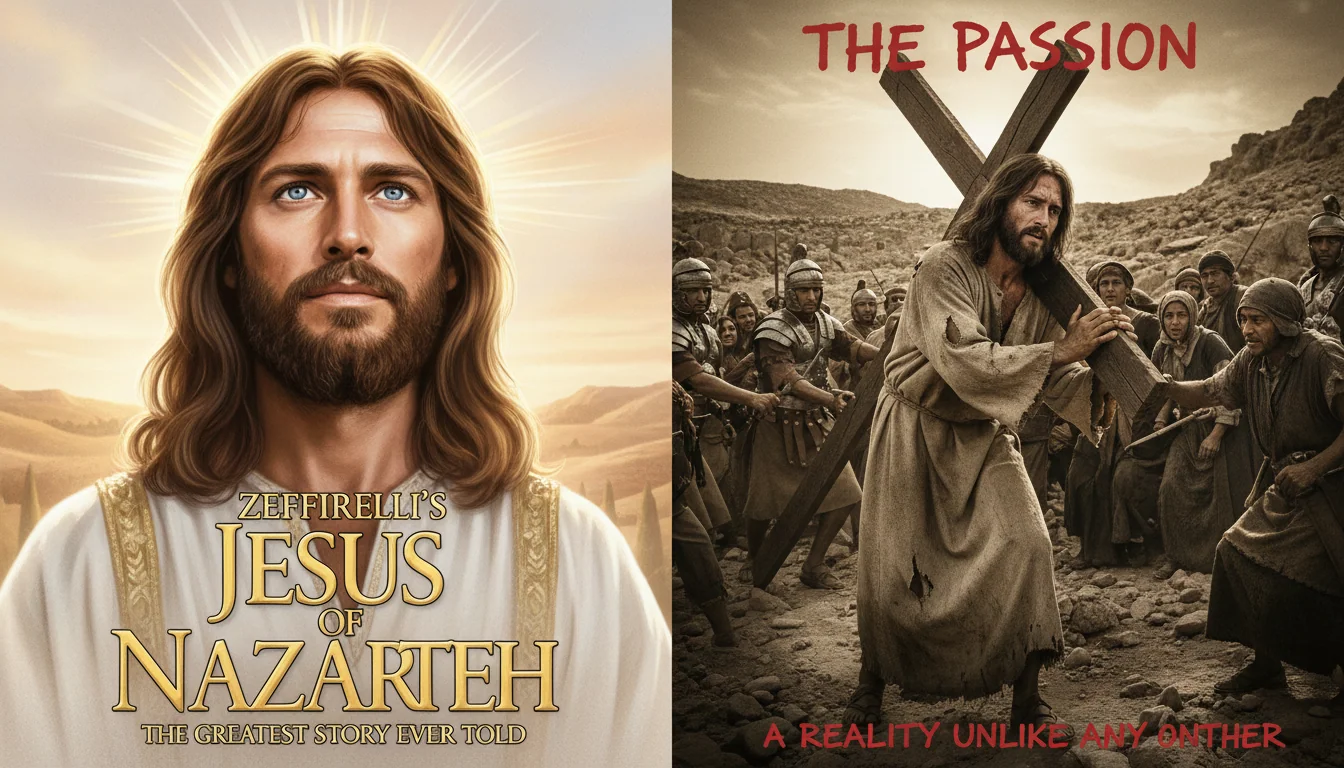
In 1977, a six-and-a-half hour Easter-week television event aired across Britain on ITV and across Italy on RAI, and an estimated 91 million Americans watched it on NBC the same year. It was bankrolled by Lew Grade, the British television impresario who had previously brought the world The Muppet Show, and directed by Franco Zeffirelli, the Italian filmmaker best known for romantic stagings of Shakespeare. The script came from Zeffirelli, the novelist Anthony Burgess, and the screenwriter Suso Cecchi d'Amico. The cast included Olivia Hussey as Mary, Anne Bancroft as Mary Magdalene, Laurence Olivier as Nicodemus, Ian McShane as Judas, James Earl Jones as Balthazar, and a then-unknown 32-year-old Englishman named Robert Powell as Jesus.
Almost fifty years later, Jesus of Nazareth (1977) is still the version most clergy show their congregations and most teachers play in religious-education classrooms. It is widely treated as the gold standard of reverent Jesus films. So how much of it is historical, how much is biblical, and how much is just very good television.
What Zeffirelli Got RIGHT
The consultant lineup was unusually serious
Anthony Burgess, who co-wrote the script, was a former Catholic with a working knowledge of koine Greek and a literary scholar's instinct for narrative weight. He took the project seriously enough to publish a separate novel, Man of Nazareth, drawing on the same research. Beyond Burgess, Zeffirelli openly assembled a panel that included Catholic theologians and Jewish religious advisors. The Vatican was kept informed throughout production, which is why Pope Paul VI publicly endorsed the film. Less reported, and more historically valuable, was the input of Jewish scholars who corrected synagogue scenes, prayer language, and rabbinic exchanges that earlier Hollywood Jesus films had handled with vague Christian generality.
The first-century synagogue scenes
The synagogue sequences in Jesus of Nazareth are the most carefully staged in any major Jesus film. Worshippers face Jerusalem, men and women are correctly separated, the Torah scroll is handled with appropriate reverence, and the readings are conducted in something resembling the first-century pattern of haftarah and parashah. When Jesus reads from Isaiah in his hometown synagogue at Nazareth, the staging follows what we know about first-century synagogue practice rather than later medieval church practice. This is exactly the sort of detail earlier biblical epics, including the 1965 The Greatest Story Ever Told, simply skipped.
Jewish religious practice is treated as Jewish
The film consistently presents Jesus as a first-century Jew arguing with other first-century Jews about the Torah, not as a proto-Christian rebelling against Judaism. The Pharisees are not cartoon villains. The temple is not a symbol of evil. Sabbath observance, kosher practice, ritual washing, and Passover are all shown with reasonable accuracy. The film's depiction of the Last Supper as a Passover seder, with the bitter herbs, unleavened bread, and four cups, is rendered as a Jewish religious meal rather than an embryonic Christian Eucharist. That single editorial choice puts the film ahead of perhaps 90 percent of Hollywood Jesus films.
Costume and set realism
The costume designer Marcel Escoffier and the production designer Gianni Quaranta worked from museum sources and contemporary archaeological reconstructions. Linen and wool tunics, simple leather sandals, head coverings for women, and tassels on the corners of male garments (the tzitzit prescribed in Numbers 15) all appear in the film. The architecture of Capernaum, Jerusalem, and the temple courts is rendered with reasonable fidelity to what we know from sites like Sepphoris and from Josephus's descriptions. The temple courts in particular are scaled to feel like a working religious-political institution, not a stage set.
Restrained miracle staging
One of the film's quieter virtues is how it handles miracles. There are no booming choruses, no white light, no special-effects fireworks. Lazarus is raised in a long, slow, unsettling sequence rather than a cinematic flourish. The healing of the blind man at Bethesda is staged as a private moment between two people. Even the resurrection appearances are filmed with a stillness that resembles iconography rather than spectacle. This is closer to how the Gospels themselves narrate these events than the more theatrical treatments in other adaptations.
What Zeffirelli Got WRONG
Robert Powell as a Galilean Jew
Robert Powell, in 1977, had blue eyes, fine Northern European features, light brown hair, and a willowy English frame. First-century Galilean Jews almost certainly looked nothing like that. Skeletal evidence and forensic reconstructions of first-century Judean and Galilean remains, including the much-cited 2001 Richard Neave reconstruction, suggest a man with olive-brown skin, dark brown or black hair, brown eyes, and a stocky working build of around five-foot-one. Powell's Jesus is the European devotional Jesus of medieval and Renaissance painting, not the historical Jewish Jesus. Zeffirelli was working in a long visual tradition, but it is the single largest concession the film makes to artistic convention over historical likelihood.
The "Powell didn't blink" myth
The internet has spent decades insisting that Robert Powell never blinks throughout the entire six-hour miniseries. He does. Powell himself has gently corrected this in interviews, explaining that he deliberately trained his gaze to be unusually still in close-ups, particularly during the Sermon on the Mount and the trial scenes. He blinked normally in wider shots and in dialogue. The legend grew because the close-ups are striking, not because Powell underwent some sort of ophthalmological feat. It is a charming piece of trivia and almost entirely apocryphal.
Synoptic and Johannine timelines are blended
The four canonical Gospels disagree about the order, location, and timing of many events in Jesus's ministry. The Synoptic Gospels (Matthew, Mark, Luke) describe a one-year ministry centered in Galilee. The Gospel of John describes a three-year ministry with multiple Jerusalem visits. Jesus of Nazareth quietly merges both into a single coherent narrative, which is good drama but bad source criticism. The cleansing of the temple, for instance, happens once in the film, near the end, even though John places it at the beginning of the ministry and the Synoptics place it at the end. This is a standard problem for any Jesus film, but it is still a problem.
A romanticized Mary Magdalene
The film's Mary Magdalene, played by Anne Bancroft, is essentially the medieval composite Mary: prostitute, penitent, devoted follower. The Gospels themselves never describe Mary Magdalene as a prostitute. That association is a sixth-century invention, traditionally traced to a sermon by Pope Gregory I in 591 AD that conflated several unnamed women with Mary of Magdala. Modern biblical scholarship has reversed this conflation, but Zeffirelli kept the older composite for dramatic resonance. The Vatican itself formally clarified Mary Magdalene's separate identity in 1969, eight years before the film aired.
The manufactured pre-broadcast controversy
This is not a question of accuracy in the film itself, but of accuracy in how the film is remembered. In late 1976, the American evangelist Bob Jones III publicly attacked the not-yet-aired miniseries on the basis of a single magazine interview in which Zeffirelli described his Jesus as a fully human figure. A boycott campaign followed. General Motors, which had agreed to sponsor the NBC broadcast, withdrew its sponsorship. Procter and Gamble stepped in and the broadcast went ahead. The "controversy" was based on a misreading of an interview, not on the film, which when actually shown was praised by most evangelical leaders, including Billy Graham. The episode is regularly cited as evidence that the film was theologically daring. It was not. It was almost aggressively orthodox.
Want to ask Jesus how Robert Powell did? Chat with him on HistorIQly - the AI history platform with 144+ historical figures, from $9/month.
Historical Accuracy Score: 8/10
Jesus of Nazareth remains the gold standard among reverential Jesus films and earns its score through the seriousness of its consultants, the care of its first-century Jewish texture, and the restraint of its miracle staging. Where it falls short is mostly where every Jesus film falls short: a European-looking lead actor, a smoothed-over composite of contradictory Gospel timelines, and a Mary Magdalene who carries fifteen centuries of conflated tradition. Within the constraints of adapting four sometimes-contradictory texts about a figure for whom the historical record is thin outside those texts, Zeffirelli and Burgess produced something that holds up. Almost fifty years later, no other Jesus film has matched it for first-century atmosphere, and only The Passion of the Christ has matched it for cultural reach. The blink myth, like the medieval European Jesus, is the price of a piece of television that otherwise tried genuinely hard to get the rest of it right.
For other fact-checks of historical epics, see our reviews of Gladiator and The Passion of the Christ.
Quick Answers
Common questions about this topic
Is Jesus of Nazareth (1977) historically accurate?
Within the genre of reverential gospel adaptations, it is unusually careful. Franco Zeffirelli hired biblical scholars and Jewish religious advisors to vet first-century synagogue practice, prayer, costume, and language. The events themselves still follow the four canonical Gospels rather than independent historical sources, so accuracy is bounded by what the New Testament itself says happened.
Did Robert Powell really not blink during scenes as Jesus?
This is the most famous myth about the film, and it is exaggerated. Powell himself has said in interviews over the years that he did blink, and that the legend of unblinking eyes grew out of his deliberate effort to keep an unusually steady, calm gaze in close-ups. He trained his stare to be stiller than normal, but he did not literally hold his eyes open for hours.
Which historians and scholars consulted on the film?
Anthony Burgess co-wrote the script and brought a literary scholar's familiarity with the Gospels and koine Greek. Zeffirelli also consulted Catholic theologians and Jewish religious advisors to ensure synagogue scenes, Sabbath observance, and rabbinic exchanges resembled first-century Judean and Galilean practice rather than later Christian tradition. The novelist William Barclay's commentaries are widely cited as influences on the script's dialogue choices.
How does Jesus of Nazareth compare to The Passion of the Christ?
Mel Gibson's 2004 film is far more focused on the final 12 hours of Jesus's life and on graphic physical suffering. Zeffirelli's miniseries covers the full ministry, takes a calmer, less violent tone, and is closer to the Gospels' actual narrative pacing. Most scholars rate Zeffirelli higher for everyday first-century texture and Gibson higher for raw visceral impact.

Debate the Accuracy with the Real Figures
Ask the real people what Hollywood got wrong about their lives.
Chat with HistoryJoin the HistorIQly Club
Get smarter about the past.
Weekly stories, deep dives, and exclusive content straight to your inbox.