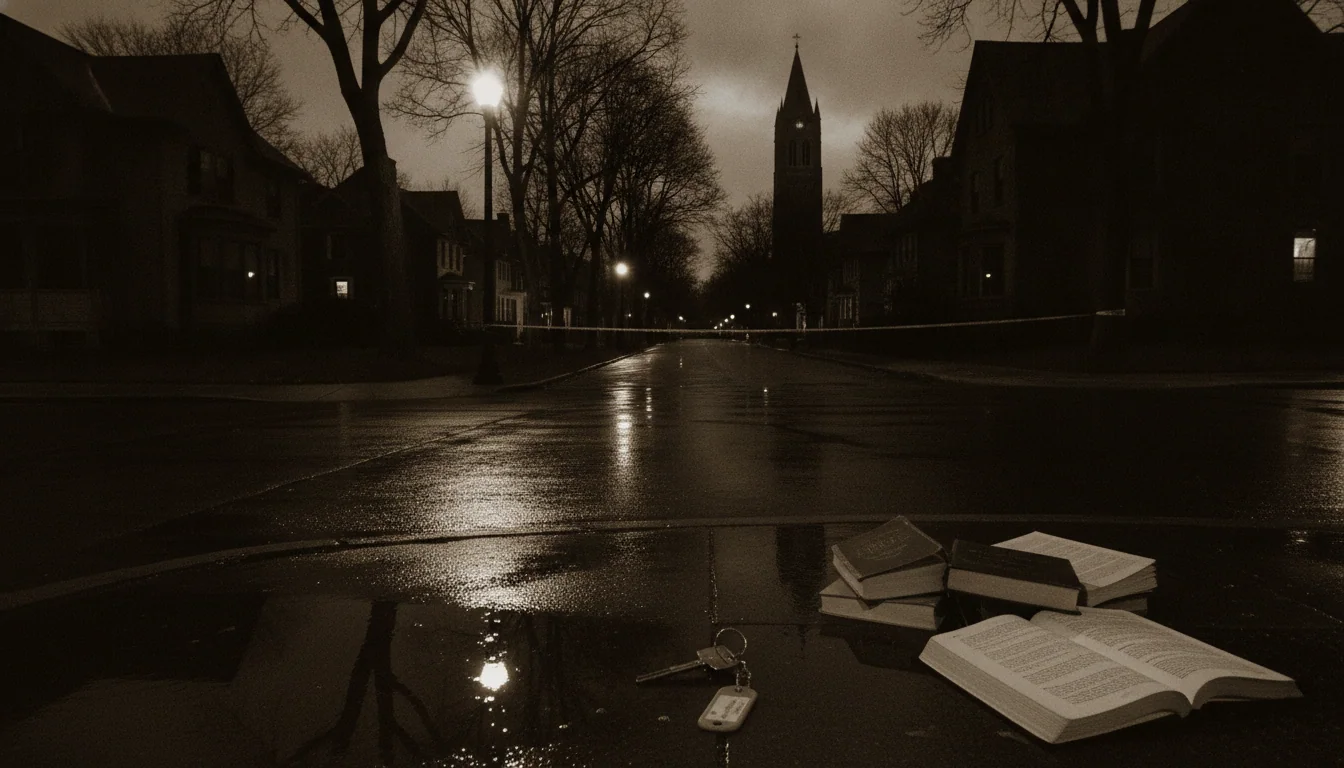
The Julia Wallace Murder: Liverpool's Perfect Crime
The Julia Wallace murder of 1931 remains one of Britain's unsolvable crimes. An insurance agent, a fake address, and a battered wife - no one has ever been proven guilty.
The detective story has rules. There is a body, a weapon, a circle of suspects, and at the end a satisfying click as the parts fit together. The Julia Wallace case offers all the parts, in unusual abundance, and refuses to assemble. For nearly a hundred years it has been picked over by police officers, barristers, novelists, criminologists, and amateur sleuths. None of them has produced a solution that survives the next reading. Raymond Chandler, who knew something about murder mysteries, called it "the impossible murder." It is also one of the best-documented unsolved crimes in British history.
The Wallaces of Wolverton Street
William Herbert Wallace was an insurance agent for the Prudential Assurance Company in the Anfield district of Liverpool. He was 52 years old in January 1931, a mild, methodical man who collected weekly premiums on a fixed walking route. He played chess at the City Café club on Tuesday evenings. He read about chemistry, kept a diary, and by every neighbour's account was the dullest man on his street.
His wife Julia was something more interesting and more obscure. She was, depending on which source you trust, somewhere between 53 and 69 years old at the time of her death. She had told her husband that she was younger than the parish records suggested, and she had told the parish that she was younger than she actually was. She played the piano, taught a little French, and seems to have given Wallace a more polished idea of his own marriage than the reality justified. Their home at 29 Wolverton Street was a small terrace house on a quiet street near Anfield Cemetery. They had been married 17 years. They had no children.
To outsiders, they were the kind of couple whose lives produced almost no incident at all.
The phone call
On the evening of Monday, January 19, 1931, William Wallace left his house just before 7:15 p.m., walked through the cold to the City Café on North John Street, and took his usual place at the chess club. A few minutes before he arrived, the café's telephone rang. The caller asked for Mr. Wallace. The captain of the chess club, Samuel Beattie, took the message.
The caller introduced himself as R. M. Qualtrough. He said he wanted Wallace to call on him at 25 Menlove Gardens East, in the suburb of Mossley Hill, the following evening at 7:30 to discuss insurance business. He said he was sorry he could not give more notice. He left no telephone number. Beattie wrote the message down, gave it to Wallace when he arrived, and the matter was, as far as the chess club was concerned, ordinary.
Two facts about that telephone call would later become enormous. First, Menlove Gardens East does not exist. Liverpool has a Menlove Gardens North, a Menlove Gardens South, and a Menlove Gardens West, but no East. Second, the call was placed from a public telephone kiosk on Anfield Road, a few hundred yards from Wolverton Street, at exactly the time Wallace was on his way to the chess club. Records from the operator who connected the call show it took place at 7:15 p.m.
No one has ever identified R. M. Qualtrough. No business under that name existed in Liverpool. No insurance applicant of that name had ever contacted Wallace.
The errand and the body
The next evening, Tuesday, January 20, William Wallace told his wife that he had a business appointment in Mossley Hill, ate his tea, and left the house at about 6:45 p.m. He took two trams and arrived in the Menlove Gardens area shortly after 7:20 p.m. He spent the next 45 minutes walking, asking residents and a tram conductor, looking for an address that did not exist. He spoke to at least four named witnesses, including a police constable who confirmed he had told them the same story.
Defeated, he returned home. He arrived at 29 Wolverton Street at about 8:45 p.m. He could not get in. The front and back doors were both locked. He met his neighbours, the Johnstons, on the back entry, and asked them to wait while he tried again. The back door opened on his second attempt. Wallace, with the Johnstons just behind him, walked through the kitchen, saw the parlour door ajar, and turned on the gas.
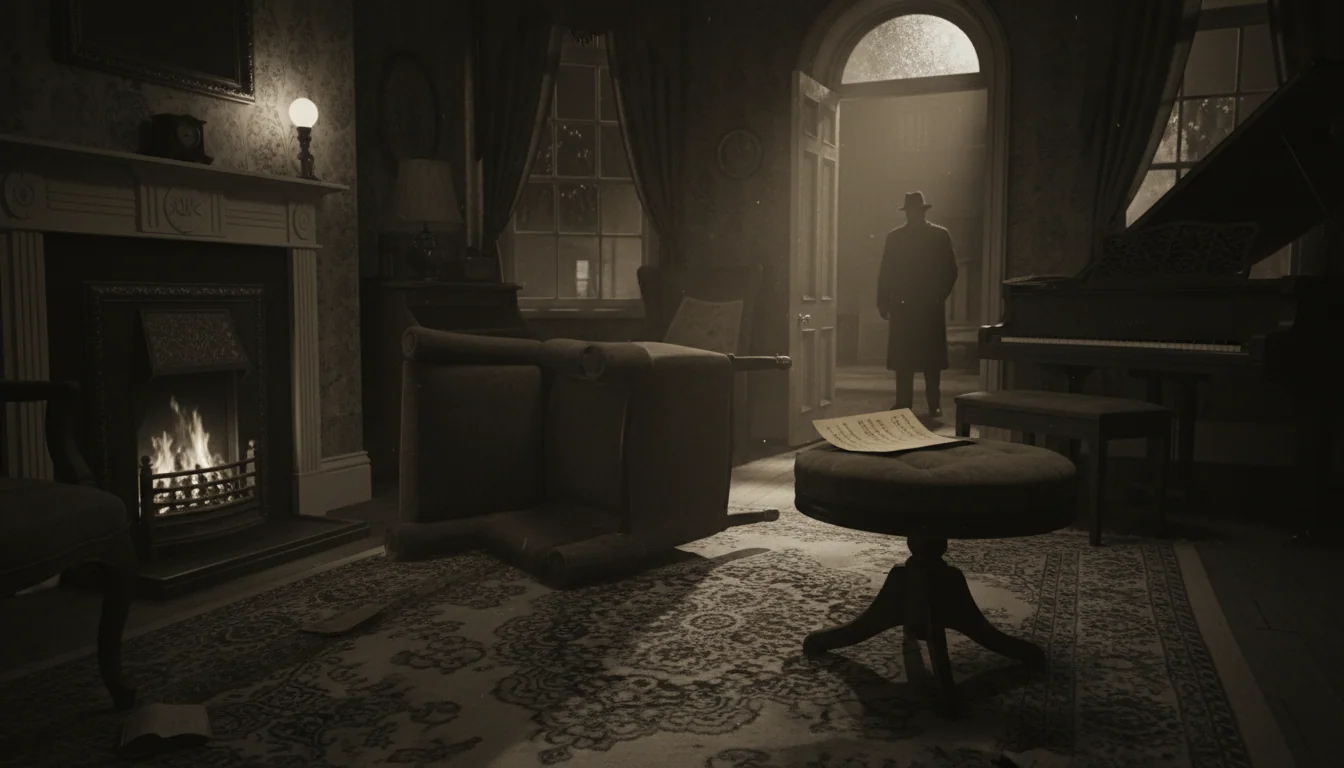
Julia Wallace was lying on the parlour rug in front of the fire. She had been beaten about the head with a heavy weapon. There was blood on the walls and ceiling, a singed mackintosh under her body, and almost no other disturbance to the room. The killer had taken about four pounds in cash from a small cabinet but had ignored more valuable items in plain sight. The murder weapon was never recovered.
Wallace, by every account of the witnesses present, did not weep, scream, or collapse. He stood in the parlour, looking at his wife, and said: "They've finished her."
The trial
The Liverpool City Police investigation under Superintendent Hubert Moore zeroed in on Wallace within hours. The theory was simple. Wallace had made the Qualtrough call himself, given himself a public appointment elsewhere, killed his wife in the small window between her last sighting at 6:30 p.m. and his departure for the trams, and then constructed a chain of witnesses who could verify his late evening movements. The mackintosh under the body was Wallace's. The cleanliness of the scene suggested someone who had time to wash and tidy. The cool reaction at the discovery suggested guilt.
The trial opened at Liverpool Assizes in April 1931. The prosecution had no fingerprints, no eyewitness, no confession, no clear motive, and a timetable that almost did not work for the husband. The defence, led by Roland Oliver KC, attacked every link of the prosecution case. The judge, Mr. Justice Wright, summed up clearly in Wallace's favour. The jury, after deliberating for an hour and five minutes, returned a verdict of guilty. Wallace was sentenced to death.
Then, for the first time in English legal history, the Court of Criminal Appeal overturned a murder conviction on the grounds that it was unsafe given the evidence. The court did not declare Wallace innocent. It declared, in effect, that no jury could properly have reached the verdict the Liverpool jury had reached. Wallace walked out of Pentonville Prison in May 1931, returned to Liverpool, and to the house on Wolverton Street.
He survived 23 more months. The Prudential moved him to a desk job. Neighbours crossed the street to avoid him. His health collapsed. He died of kidney disease in February 1933, aged 54. In his last years, he privately accused a former Prudential colleague named Richard Gordon Parry of the murder, but the police refused to reopen the investigation.
The candidate killers
Three theories have survived almost a century of argument.
The first is that Wallace himself was the killer. The Liverpool jury believed it, several biographers believe it, and the timetable can be made to work, just barely, if one assumes Wallace bicycled rather than walked between key points. Against this stands the absence of any plausible motive, the lack of bloodstains on his clothing, and the fact that two careful witnesses, including a milk delivery boy, placed Julia alive at 6:30 p.m., leaving Wallace less than 15 minutes to commit, clean up, and depart.
The second is that Richard Gordon Parry, a former Prudential agent fired for embezzlement and known to both Wallaces, killed her, possibly while attempting a botched theft of insurance receipts. Parry had a thin alibi for the time of the murder and was overheard, decades later, making remarks that several relatives interpreted as confessions. He died in 1980 without ever being charged. In 2001, retired police officer Jonathan Goodman publicly named Parry as the killer based on extensive interviews; the Liverpool City Police never reopened the file.
The third is that an unidentified third party, perhaps an acquaintance Julia let into the house herself, killed her in a robbery that escalated. This theory leaves the question of why such a person would also have made the Qualtrough call, since the call was clearly designed to remove Wallace from the house, which a stranger thief would not need to do.
Each theory dissolves the moment it is examined closely. Each leaves a residue of evidence the others cannot explain. Raymond Chandler, who wrote in 1948 that the case was "the unbeatable," meant exactly that. No one has produced an account of the evening of January 20, 1931 that fits all of the timetable, all of the witnesses, the phone call, the mackintosh, the missing weapon, and the absence of motive.
What the case left behind
The Wallace case became, very quickly, the textbook British murder mystery. It generated more printed words in the 1930s than almost any other contemporary crime. P. D. James cited it as the model unsolved case. Dorothy L. Sayers wrote about it. Crime historians return to it every generation, each producing a fresh definitive theory that the next generation overturns.
It also exposed something quiet about police work. The Liverpool City Police, faced with a husband whose composure they did not understand, decided he must have done it because his reaction was unnatural. The Court of Criminal Appeal, in setting aside the conviction, said the police had made him guilty in the absence of proof. That distinction remains the most important thing the case teaches.
Julia Wallace is buried in Anfield Cemetery, a few streets from where she died. The grave was unmarked for decades. William Wallace is buried beside her. The terrace house at 29 Wolverton Street still stands. Whoever raised the heavy weapon and brought it down, in a small parlour on a cold Tuesday evening in 1931, has long since taken the answer with them.
Some murders are solved late. Some are never solved at all. The Wallace case has come to feel less like an unsolved crime than like a permanent part of the British imagination, a closed door behind which the truth has been quieting for nearly a century.
The Wallace case belongs to a tradition of murders that resist explanation - alongside Jack the Ripper and the Hinterkaifeck murders, it is one of the few cases that can be studied indefinitely without producing certainty.
Quick Answers
Common questions about this topic
Who was Julia Wallace?
Julia Wallace was a 53-year-old Liverpool housewife (or possibly 69, since her real age was disputed after her death) who was murdered in the parlour of her home at 29 Wolverton Street on the evening of January 20, 1931. Her husband, William Herbert Wallace, was a quiet insurance agent for the Prudential Assurance Company. Their domestic life was, by every account, modest and unremarkable until the day she died.
Who is Qualtrough?
R. M. Qualtrough is the name given by an anonymous caller who left a message for William Wallace at his chess club on the evening of January 19, 1931. The caller asked Wallace to come to a business address the next evening, an address that turned out not to exist. No one has ever identified Qualtrough. The phone call was traced to a public telephone a few hundred yards from the Wallace house, made at the time Wallace himself was walking to the chess club.
Why is it called the perfect murder?
The crime writer Raymond Chandler called the Wallace case unbeatable, meaning no theory ever proposed (including the husband's guilt, an acquaintance's guilt, or a stranger's guilt) survives close examination of the timetable, the evidence, and the witnesses. Whoever killed Julia Wallace either had extraordinary luck or constructed an alibi puzzle so well that British justice could not solve it in 1931 and historians still cannot solve it now.
Was William Wallace ever convicted?
Yes, briefly. William Wallace was convicted of his wife's murder at Liverpool Assizes in April 1931 and sentenced to death. The Court of Criminal Appeal quashed the conviction in May 1931, the first time in English legal history a murder conviction had been overturned on the grounds that it was unsafe given the evidence. Wallace returned to Liverpool but died of kidney disease in 1933, still publicly protesting his innocence and naming a former colleague as the real killer.

Want to Interrogate the Suspects?
Chat with historical figures and uncover the truth behind history's greatest mysteries.
Start Your InvestigationJoin the HistorIQly Club
Get smarter about the past.
Weekly stories, deep dives, and exclusive content straight to your inbox.