The Lost Years of Jesus: Where Was He From Age 12 to 30?
The lost years of Jesus cover 18 silent years in the Gospels. We investigate the carpenter theory, Essene connection, and claims he travelled to India or Britain.
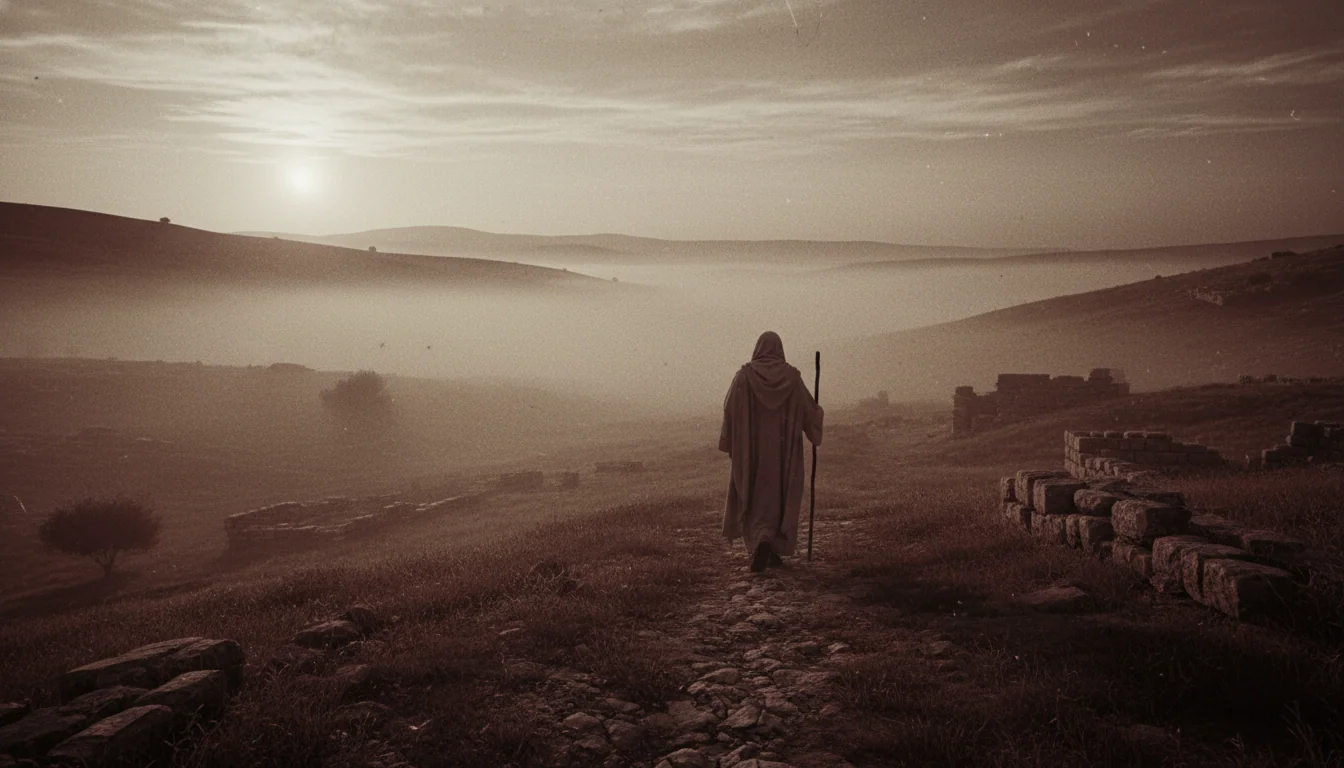
The lost years of Jesus - the roughly 18-year gap between his temple visit at 12 and his baptism at 30 - are one of history's most debated silences. In the second chapter of Luke, a 12-year-old boy is found in the Jerusalem Temple sitting with the teachers, "both listening to them and asking them questions." His parents had spent three days searching for him. The scene closes with a single line: "And Jesus grew in wisdom and stature, and in favour with God and man." Then the curtain drops. It does not rise again until he is roughly 30 years old, walking down to the Jordan to be baptised by John.
In between is a silence of about 18 years. The most consequential figure in Western history vanishes at the age of his bar mitzvah and reappears as a grown man with a public mission. No traveller mentions him. No tax record names him. No Gospel writer fills in the gap. Where was he?
This is, in cold-case terms, a textbook missing-person interval: a verified last sighting, a verified return, and a long blank in between. That blank has attracted every kind of theory, from the dull and probable to the extravagant and unsupported. We will work through them.
The disappearance
The four canonical Gospels were not written as biographies. Mark, the earliest, opens with Jesus already an adult. John begins with a hymn about the Word and skips the childhood entirely. Matthew gives an infancy narrative and then jumps to the ministry. Only Luke offers any childhood material, and his contribution is the Temple incident at age 12 plus that single sentence about growing in wisdom.
The non-canonical Infancy Gospels of Thomas and James, written in the second century or later, fill the vacuum with stories of the young Jesus animating clay birds and cursing playmates. Historians treat these as legendary embellishment, not evidence. The silence is the case file. Everything else is reconstruction.
Theory 1: The Carpenter at Nazareth
The dullest theory is also the one most historians take seriously.
In Mark 6:3, the people of Nazareth dismiss Jesus's preaching with the question, "Is not this the carpenter, the son of Mary?" The Greek word translated as "carpenter" is tekton, broader than the English word: a builder or craftsman in wood and stone. In rural Galilee, that meant houses, doors, roof beams, ploughs, and farm equipment. Joseph is also called a tekton in Matthew 13:55. The trade passed from father to son.
Geza Vermes, who reframed Jesus studies with his 1973 book Jesus the Jew, argued for exactly this picture: a Galilean tekton steeped in rural piety, with no exotic foreign training. E.P. Sanders, in The Historical Figure of Jesus, takes the same line. Bart Ehrman agrees that the evidence points toward an ordinary working life.
About four miles from Nazareth lies Sepphoris, a Galilean city that Herod Antipas was rebuilding throughout the early first century. The reconstruction would have employed every available tekton in the surrounding villages. A young man from Nazareth with a builder's training would have been in the natural labour pool. We cannot prove Jesus worked there, but the geography, the timing, and the trade line up.
Theory 2: The Essene at Qumran
The Dead Sea Scrolls, discovered in caves near Qumran between 1947 and 1956, opened up a world of first-century Jewish sectarianism the Gospels barely hint at. The community at Qumran, generally identified with the Essenes described by Josephus and Philo, practised ritual washing, communal meals, apocalyptic expectation, and ascetic discipline.
Some of that overlaps with the Gospel material. John the Baptist, with his desert location, ritual immersion, and apocalyptic preaching, has long been suspected of Essene connections. Robert Eisenman pushed hardest for a closer link between Qumran and the early Jesus movement than the consensus accepts.
The trouble is that there is no direct evidence Jesus ever went to Qumran. The scrolls do not name him. His teaching, with its inclusive table fellowship and engagement with tax collectors and prostitutes, sits awkwardly against Essene exclusivism. Most scholars treat the Essene theory as suggestive context rather than biographical evidence. The case remains thin.
Theory 3: The Traveller to India
In 1894, a Russian aristocrat named Nicolas Notovitch published La Vie inconnue de Jésus-Christ. He claimed that in 1887, while travelling in Ladakh, he had broken his leg, been treated at Hemis Monastery, and been read a Tibetan manuscript called the Life of Saint Issa, which described Jesus studying with Brahmins and Buddhists in India between roughly 13 and 29. The book was a sensation in fin-de-siècle Europe. It was also almost certainly fabricated.
The Oxford Sanskritist Max Müller dismantled Notovitch's claims in The Nineteenth Century in 1894. The text described did not match any known Tibetan or Pali genre. Three years later, J. Archibald Douglas, a professor at Government College in Agra, travelled to Hemis and interviewed the head lama, who flatly denied that any such manuscript existed and that any European matching Notovitch's description had ever been treated there.
Later claims, including the Roza Bal tomb in Srinagar said to contain Jesus's body, and the writings of Holger Kersten and Elizabeth Clare Prophet, all trace back to Notovitch or his imitators. No independent first-century source places Jesus anywhere near India. The India theory is a hoax with a long afterlife.
Theory 4: The Egyptian Years
Matthew alone tells the story of the Holy Family fleeing to Egypt to escape Herod's massacre of the infants. Historians generally read the episode as a theological echo of Moses, casting Jesus as a new Israelite leader called out of Egypt, rather than as straightforward biography. Luke, who tells a different infancy narrative, knows nothing of an Egyptian sojourn.
A more provocative thread runs through later Jewish tradition. The Babylonian Talmud, in tractate Sanhedrin 107b, contains a polemical passage about a "Yeshu" who learned magic in Egypt. Some readers have taken this as a memory of Jesus picking up Egyptian or Hellenistic magical practice during a hidden period in Alexandria. The mainstream view is sceptical. The Talmudic references are late, hostile, and not securely identified with the Jesus of the Gospels. Bart Ehrman and Peter Schäfer, who wrote the standard study of Jesus in the Talmud, both treat the Egyptian-magic tradition as polemical invention rather than evidence of a real journey.
Theory 5: The British Legend
The strangest theory is also the most quintessentially English. According to a medieval tradition that crystallised at Glastonbury Abbey, Joseph of Arimathea, the wealthy disciple who provided Jesus's tomb, had been a tin merchant trading with Cornwall, and had brought the young Jesus with him on a trip to Britain. He is supposed to have planted his staff in the ground at Glastonbury, where it grew into the famous Holy Thorn.
William Blake versified the speculation in 1804 with the lines "And did those feet in ancient time / Walk upon England's mountains green?" After Hubert Parry set the poem to music in 1916 as the hymn "Jerusalem," the tradition acquired a cultural respectability it had never earned historically.
There is no evidence for any of it. The Glastonbury Joseph legend was concocted in the 12th and 13th centuries by the abbey's monks to bolster their pilgrimage credentials. The tin trade between the eastern Mediterranean and Cornwall was real, but no document links Jesus or Joseph to it. The Victorian revival simply gave the legend a second life. It is folklore.
Want to just ask him where he was? Chat with Jesus on HistorIQly → - the AI history platform with 144+ historical figures, from $9/month.
What we actually know
Strip the exotic theories away and what remains is the boring answer, which is also the best-supported one.
The Gospels' silence is itself evidence. If Jesus had spent 18 years in India, in Egypt, at Qumran, or in Britain, the early communities that produced the Gospels would have had a strong incentive to mention it. A foreign training would have explained his teaching authority, and the writers of Matthew and John, not shy about importing exotic context, would have used it. They did not, because there was nothing to use.
The positive evidence points to Galilee. His family is rooted there: his brothers James, Joses, Judas, and Simon and his sisters are mentioned in Mark 6:3 as still living locally. His Aramaic carries a Galilean accent recognisable enough for a servant girl in Jerusalem to identify Peter by it in Matthew 26:73. His parables are saturated with the everyday detail of Galilean village life: sowing seed, mending nets, finding lost coins, hiring day labourers at the marketplace. None of that reads as foreign import. It reads as lived experience.
The reconstruction that fits the evidence is mundane. Jesus grew up in Nazareth, learned the tekton trade from Joseph, and worked in the surrounding villages and possibly at Sepphoris through his late teens and twenties. He was steeped in synagogue Judaism, fluent in the rural piety of Galilee, and almost certainly familiar with John the Baptist's preaching by the time he walked to the Jordan around age 30.
The lost years are not lost because something extraordinary happened in them. They are lost because nothing extraordinary happened in them. For the Jerusalem of his adult ministry, our time-travel guide to Jerusalem, 33 AD walks you through the city as he would have known it. The silence is exactly what we would expect from a Galilean craftsman who became famous only later. That is the cold-case verdict. The exotic theories collapse on examination. The dull theory survives because it is the one the evidence supports. Jesus was, for those 18 missing years, almost certainly doing what nearly every other young man in first-century Nazareth was doing: working with his hands, attending synagogue, and waiting for whatever came next.
Quick Answers
Common questions about this topic
What are the lost years of Jesus?
The lost years are the roughly 18-year gap in the Gospel record between Luke's account of a 12-year-old Jesus debating teachers in the Jerusalem Temple and his baptism by John in the Jordan around age 30. No canonical text describes what he did during this period, and the silence has fueled centuries of speculation.
Did Jesus go to India during his missing years?
Almost certainly not. The claim rests on Nicolas Notovitch's 1894 book about a manuscript he said he saw at Hemis Monastery in Ladakh, but his account was investigated and rejected by Max Müller and J. Archibald Douglas, who found that the monks denied any such document existed. Mainstream historians treat the India theory as a 19th-century invention.
Did Jesus visit Britain with Joseph of Arimathea?
There is no historical evidence that Jesus ever travelled to Britain. The Glastonbury legend, immortalised by William Blake's hymn 'Jerusalem,' is a medieval tradition built up centuries after the events it describes and revived by Victorian romantics. Tin trade between the Levant and Cornwall existed, but no record links a young Jesus to it.
What's the most likely explanation for Jesus's missing years?
Most historians, including Geza Vermes and E.P. Sanders, conclude that Jesus simply worked as a tekton, a builder or craftsman, in or near Nazareth, possibly on Antipas's reconstruction of nearby Sepphoris. The Gospels are silent because there was nothing remarkable to record. He lived an ordinary Galilean working life until he walked to the Jordan around age 30.

Want to Interrogate the Suspects?
Chat with historical figures and uncover the truth behind history's greatest mysteries.
Start Your InvestigationJoin the HistorIQly Club
Get smarter about the past.
Weekly stories, deep dives, and exclusive content straight to your inbox.