Spring-Heeled Jack: The Victorian Phantom Who Terrorized London for 70 Years
Spring-Heeled Jack terrorized Britain for 70 years: between 1837 and 1904, hundreds reported a leaping, fire-breathing attacker who was never caught or identified.
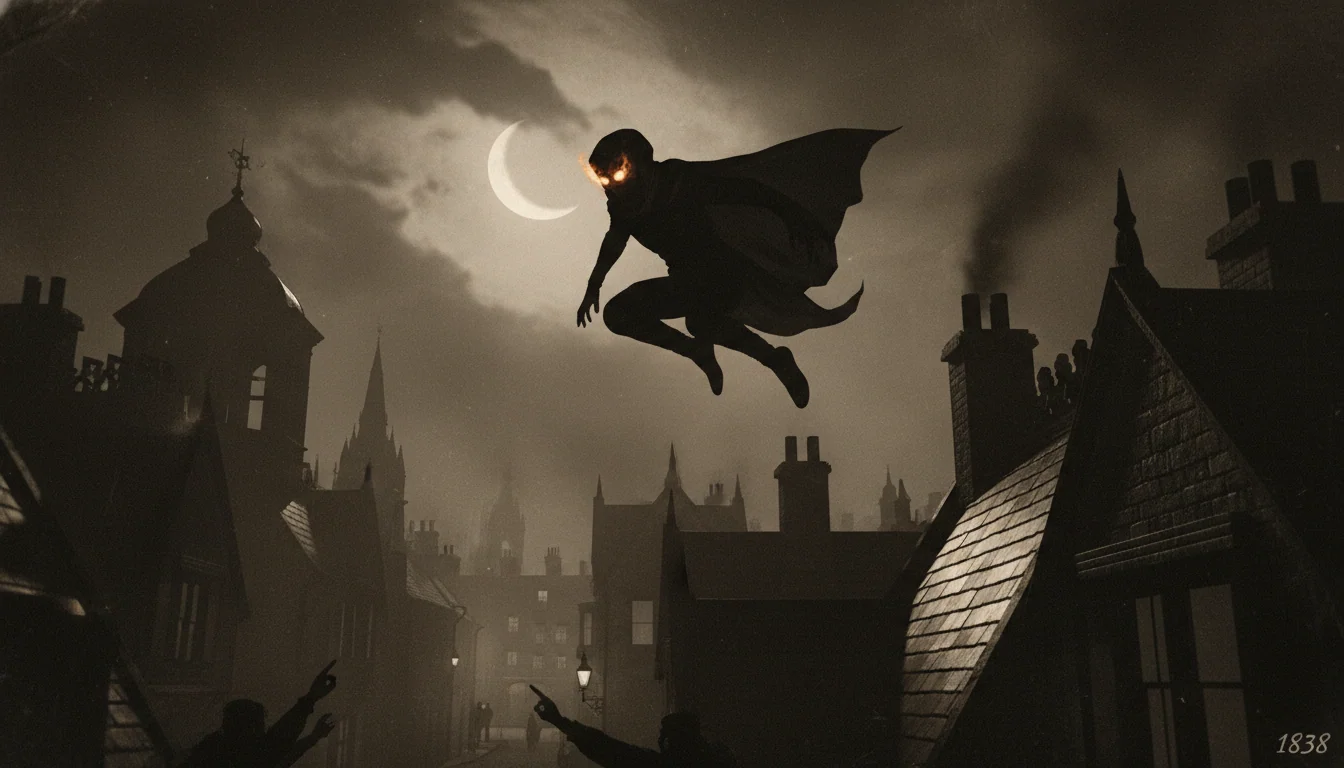
For seventy years, Britain reported attacks by a creature called Spring-Heeled Jack. From the first widely covered 1837 incidents in southwest London through scattered sightings as late as 1904 in Liverpool, hundreds of witnesses described a tall thin figure with extraordinary leaping ability, sometimes wearing a tight black suit, sometimes breathing blue or white flames, often armed with metallic claws. He approached women on dark streets, slashed at their faces, and disappeared with leaps that witnesses described as covering ten or more feet at a time.
He was never caught. He was never identified. The case sits at the precise intersection of Victorian moral panic, urban folklore, and possibly real criminal activity by one or more elite pranksters who exploited the anonymity of the era to terrorize the public.
The first reported attack
The earliest widely cited attack occurred in October 1837 in the Barnes area of southwest London. A milkmaid named Mary Stevens was returning home along Cut-Throat Lane (now Burdett Road) when a tall figure leapt from a hedge, grabbed her tightly, and began clawing at her clothing and face. Her screams brought help, and the attacker fled with a series of long jumps.
The next morning, in nearby neighborhoods, there were reports of a strange leaping figure causing horses and carriages to swerve. A coachman was reportedly knocked unconscious in one such incident.
Through the autumn of 1837 and winter of 1838, similar reports multiplied across the southern fringes of London. By January 1838, the figure had a name. The Times of London received letters describing him as "Spring-Heeled Jack" or "Steel-Sprung Jack," names that suggested either a mechanical apparatus or supernatural agility.
The Lord Mayor's intervention
In January 1838, the Lord Mayor of London, Sir John Cowan, formally addressed the matter. He had received numerous letters from across the city describing attacks by a fearsome leaping figure. He announced that he was investigating and would coordinate with police forces in different jurisdictions.
This formal recognition transformed a local rumor into a national story. The London press, including The Times, the Morning Post, and various Sunday papers, ran extensive coverage through February 1838. The figure was described in increasingly elaborate terms: he was tall and thin, dressed in tight-fitting white or black clothing, sometimes wore a helmet, sometimes had pointed ears, breathed blue or white flames, possessed metallic claws, and could leap astonishing distances.
Some accounts proposed supernatural origins. Others suggested a vicious aristocratic prankster. A third group proposed an organized gang of confederates using mechanical jumping devices, possibly assisted by costumes and incendiary devices.
The Alsop and Scales attacks
The two best-documented incidents both occurred in February 1838 and produced detailed witness statements that were subsequently investigated by police.
On February 19, 1838, eighteen-year-old Jane Alsop was at home in Bearbinder Lane, Bow, when a man at the front gate called out "I am a policeman, for God's sake bring me a light, for we have caught Spring-Heeled Jack here in the lane." Alsop took a candle to the gate. The man immediately threw off a long black cloak, revealing what she described as a tight-fitting white oilskin suit, an enormous helmet, and metallic claws. He breathed blue and white flames at her face, then attacked her with the claws, ripping her dress and hair. Her sister Mary, alerted by her screams, drove the attacker off. He left with several long leaps over the garden fence.
The Alsop case was investigated by Lambeth Police and was reported extensively in the press. Multiple witnesses, including the family doctor who treated Jane's wounds, gave consistent statements.
Less than a week later, on February 28, 1838, two young women named Lucy and Margaret Scales were attacked in Green Dragon Alley, Limehouse, by a tall figure who breathed blue flame and disappeared into the night. Lucy fainted. Margaret was knocked down. The attacker fled with a series of long jumps. The Scales case was reported separately and produced corroborating testimony from neighbors.
These two cases are the strongest documented incidents in the Spring-Heeled Jack file. They are also the closest in time and geography, and the descriptions match in numerous specific details.
The aristocratic prankster theory
The most widely proposed identification of Spring-Heeled Jack was Henry de la Poer Beresford, the 3rd Marquess of Waterford. Waterford was a famously eccentric Anglo-Irish nobleman known for outrageous public stunts. He had a documented record of bored aristocratic mischief, including, in 1837, the destruction of toll-gates and the painting of a Melton Mowbray hotel red (the origin of the phrase "painting the town red"). He was repeatedly fined for various offenses involving fistfights, vandalism, and impersonation.
Waterford had a thin athletic build, was known for cruelty to women on at least one documented occasion, and had a clear pattern of using disguise and rapid escape in his pranks. Several Victorian commentators, including the journalist Peter Haining in his 1977 book on the case, argued that Waterford was the most likely candidate for the original 1837-1838 attacks.
The challenge with the Waterford theory is that Spring-Heeled Jack reports continued long after Waterford's death in March 1859, when he was killed in a hunting accident at age 47. Either the Waterford theory accounts only for the first wave of attacks, with later incidents being copycats or genuine pranksters, or Waterford was never actually involved.
The mechanical springs theory
A second theory holds that Spring-Heeled Jack used some kind of mechanical jumping apparatus, possibly leather boots with concealed springs. This theory was advanced as early as 1838 and has been periodically revived.
The challenge is mechanical. Even modern engineering can produce only modest mechanical jumping enhancement. Leather boots with practical springs cannot produce the 15-foot vertical leaps witnesses sometimes described. The most charitable interpretation is that the leaps were exaggerated by frightened witnesses, particularly at night, and that the attacker actually accomplished only modest jumps.
The flame-breathing question
Multiple witnesses described Spring-Heeled Jack as breathing colored flames, blue or white, directly at their faces. This is the strangest feature of the descriptions and the hardest to reconcile with prankster theories.
A possible explanation is that the attacker carried a small pyrotechnic device, possibly a hidden flask of phosphorus dissolved in alcohol or a similar compound, capable of producing brief flares. Such devices were available in the early Victorian era through chemistry suppliers and stage magicians. The blue color in particular is consistent with certain copper-based pyrotechnic compounds.
The flame-breathing element has been one of the strongest reasons that researchers consider the case to involve real human criminal activity rather than purely folkloric distortion. Witnesses across decades and locations consistently describe the same unusual capability, suggesting either a single perpetrator with a specific apparatus or a pattern that was deliberately copied.
The later sightings
Spring-Heeled Jack reports continued sporadically across the British Isles for decades. In 1843, attacks were reported in Northamptonshire and Hampshire. In the 1850s and 1860s, sightings occurred in East London, Sheffield, and the Midlands. In 1872, multiple soldiers at the Aldershot Garrison reported attacks by a leaping figure. In 1877, similar incidents were reported at the Aldershot North Camp and at Caistor in Lincolnshire.
The last widely reported incidents occurred in Liverpool in 1904, where multiple witnesses described a tall figure leaping along the rooftops of William Henry Street and disappearing without trace. Local newspapers covered the story but the figure was never caught.
The geographic spread and the seventy-year duration of the reports make a single-perpetrator theory implausible. The most likely explanation is that the original 1837-1838 attacks involved a real prankster (or small group), that those attacks generated a cultural template, and that subsequent reports involved a mixture of copycats, genuine criminal activity by other individuals, and folkloric exaggeration.
What the case actually shows
Spring-Heeled Jack sits at the intersection of Victorian moral panic and possibly real elite criminal behavior. The attacks occurred in a period of intense urbanization, anxiety about the working classes, and growing newspaper readership. The figure's terrifying physicality, his ability to leap walls and vanish, played to deep Victorian fears about urban anonymity and the limits of police authority.
He also exposed the practical limits of early 19th-century law enforcement. Crimes that crossed parish boundaries were difficult to investigate. Witness testimony was often poorly preserved. Pranksters with money and connections, like Waterford and his circle, could easily escape consequences.
The case has become, over time, one of Britain's first urban cryptids. Spring-Heeled Jack appears in penny dreadfuls of the 1860s, in the Strand magazine of the 1890s, and in modern fiction including comic books and television. He has become a cultural figure in his own right, separate from whatever individual or individuals may have actually committed the original attacks.
What Spring-Heeled Jack actually was remains uncertain. He was probably some combination of an aristocratic prankster, a series of copycats, a mechanical apparatus or two, and the inevitable distortions of decades of frightened witness testimony. He was probably not literally a single immortal demonic figure leaping across Victorian England for seventy years.
But that is, in many ways, what he became. And in the absence of any conclusive identification, what he became is what survives.
For other Victorian-era mysteries that resist clean resolution, see the cases of the Hinterkaifeck murders and the Dark Countess of Hildburghausen.
Quick Answers
Common questions about this topic
What was Spring-Heeled Jack?
Spring-Heeled Jack was a creature, or possibly multiple individuals, reported in hundreds of attacks across England between 1837 and 1904. Witnesses consistently described a tall thin figure capable of extraordinary leaps, sometimes wearing a tight-fitting suit, sometimes breathing blue or white flames, and frequently armed with metallic claws. The phenomenon was never definitively identified or caught.
When did the Spring-Heeled Jack sightings start?
The earliest widely reported attacks date to October 1837 in southwest London, when a milkmaid was assaulted near Cut-Throat Lane in Barnes. Reports rapidly multiplied. By February 1838, the Lord Mayor of London announced that he had received numerous letters describing similar attacks, and the figure became national news through the early 1838 newspaper coverage.
Was Spring-Heeled Jack ever caught?
No one was ever convicted of being Spring-Heeled Jack. Several individuals were proposed as suspects, including the Marquess of Waterford (Henry Beresford), an aristocratic prankster known for outrageous public stunts. Some attacks may have been the work of copycats. The figure is officially unsolved.
What were the most credible Spring-Heeled Jack incidents?
The February 1838 attacks on Jane Alsop in Bearbinder Lane and Lucy Scales in Limehouse are the best-documented incidents. Both involved detailed witness statements, immediate police reports, and consistent descriptions of a tall thin male figure breathing flames and using metallic claws. The Alsop case in particular was investigated by Lambeth Police and produced extensive testimony.

Want to Interrogate the Suspects?
Chat with historical figures and uncover the truth behind history's greatest mysteries.
Start Your InvestigationJoin the HistorIQly Club
Get smarter about the past.
Weekly stories, deep dives, and exclusive content straight to your inbox.