Origins of the Alphabet: How Writing Came to the World
The origins of the alphabet trace back to Semitic mine workers in 1850 BC Sinai, who borrowed Egyptian hieroglyphs to create a writing system the whole world now uses.
Read Wikipedia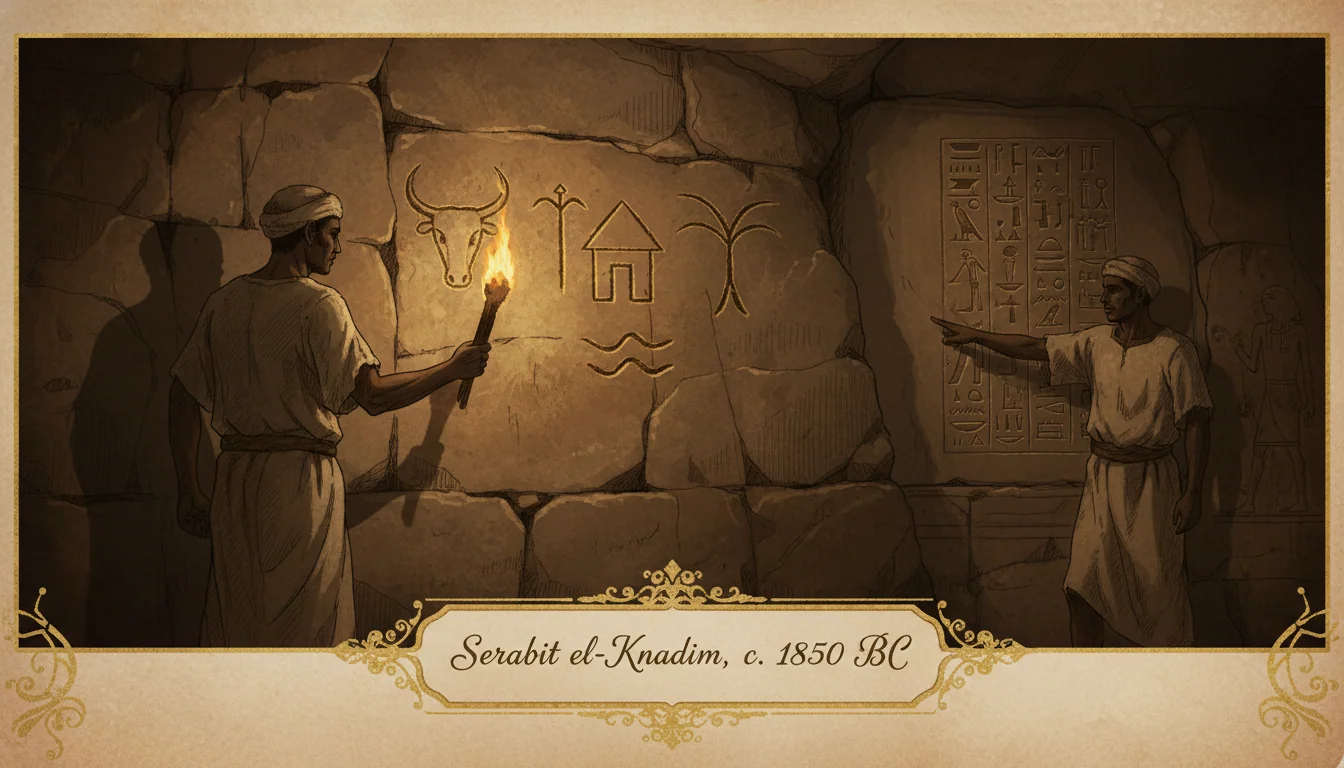
The story most people absorb goes something like this: the Greeks invented the alphabet, the Romans adapted it, and that system became the writing of the Western world. This is true in roughly the same way that "Columbus discovered America" is true - it contains a fact about a significant event while omitting about 3,000 years of prior history.
The alphabet was not invented by the Greeks. It was not invented in Europe. The earliest known alphabetic writing appears in a turquoise mining district on the Sinai Peninsula, scratched into limestone walls around 1850 to 1550 BC by workers who were, in all probability, Semitic-speaking laborers employed by Egyptian mining operations. These workers could not read Egyptian hieroglyphs in any sophisticated way. They borrowed the shapes and invented their own system - simpler, more radical, and ultimately more consequential than anything Egyptian scribes had produced in three thousand years of hieroglyphic tradition.
Writing before the alphabet
By 1850 BC, the world already had writing. Mesopotamian cuneiform had been in use for more than a thousand years. Egyptian hieroglyphics were equally ancient. Both systems worked, after a fashion, but both required years of specialized training to master.
Egyptian hieroglyphics combined ideograms representing whole words or concepts, phonetic signs representing syllables or consonant pairs, and determinatives used to clarify meaning. A trained Egyptian scribe mastered hundreds of signs and their combinations across years of apprenticeship under institutional supervision. Cuneiform, developed independently in Mesopotamia for Sumerian and later adapted for Akkadian, Hittite, and other languages, was similarly complex.
Both systems were tools of a scribal class. They existed because temples, palaces, and trade empires needed records, and literacy was a professional qualification like metalworking or surgery. It was not a general social condition. It was a specialized one.
The alphabet changed that - though not immediately, and not through the efforts of any court or palace.
Serabit el-Khadim and the turquoise mines
The Sinai Peninsula in the Middle Bronze Age was Egyptian territory at its edges. The pharaohs sent periodic mining expeditions to extract turquoise from deposits in the southwestern Sinai, at a site known today as Serabit el-Khadim. These expeditions included Egyptian administrators and also large numbers of Semitic-speaking workers - people from the Canaanite regions of the Levant who spoke a language related to later Hebrew and Phoenician, and who had no formal scribal training.
In 1905, the British archaeologist Flinders Petrie discovered inscriptions at Serabit el-Khadim that matched no known script. They consisted of about 30 distinctive signs, some clearly borrowing the shapes of Egyptian hieroglyphic signs, but used in a completely different way. Later analysis by Egyptologists and linguists identified these as Proto-Sinaitic script - the earliest known ancestor of the Phoenician alphabet and, through it, of nearly every writing system in use in the Western world today.
The discovery was not immediately understood. Serious scholarly consensus on the Proto-Sinaitic connection developed over decades following Petrie's find, and some specific decipherments remain contested. What is broadly agreed is that these signs represent a pivotal technological moment: the point at which a small group of literate outsiders borrowed the visual forms of a complex scribal tradition and converted them into something far simpler.
The acrophonic key
The intellectual move that made the alphabet possible is called acrophony: using a sign to represent not the thing it depicts, but the first sound of the word for that thing in your own language.
Egyptian hieroglyphics already incorporated some phonetic signs, but they were embedded in a complex system alongside ideograms and determinatives, and were calibrated to the Egyptian language. The Semitic workers at Serabit el-Khadim - or whoever among them first had the idea - stripped this to its essentials. Take the Egyptian sign for an ox head. In their Semitic language, the word for ox was something like "aleph." So the ox-head sign stood for the sound "a," the first sound of "aleph." Take the sign for a house. Their word for house was "bet." The house sign stood for "b." Take the sign for water. Their word was "mem." The water sign stood for "m."
The result was a system of about 27 to 30 signs, each representing a single consonant sound, that could be combined to write any word in their language without memorizing hundreds of symbols. The learning curve was weeks or months rather than a decade. Anyone who learned the 30 signs could read and write - not beautifully, not elaborately, but functionally.
The system as initially developed wrote only consonants. Vowels were left to the reader's knowledge of the language. This works reasonably well for Semitic languages, where the consonantal root carries most meaning and vowels shift with grammatical context. The word "ktb" in ancient Semitic is recognizable as the root for writing in any context, and the specific vowel pattern tells you whether it means "he wrote," "he is writing," or "a writer." For a Semitic speaker, this was not a limitation. It was a design choice.
The Phoenician refinement
By the early first millennium BC, the alphabet had been adopted by the Phoenicians - the maritime trading civilization of the eastern Mediterranean coast, whose cities included Tyre, Sidon, and Byblos. The Phoenician alphabet consisted of 22 consonant signs, written right to left, without vowels. It was compact, learnable, and carried by Phoenician merchant ships across the Mediterranean.
The Phoenicians were not, primarily, writing literature or philosophy. They were writing trade records: quantities of goods, names of debtors, prices, shipping manifests. The alphabet was, from its earliest documented commercial applications, a business technology. Its spread followed trade routes in the same way that currency, weights, and measurement systems did.
Phoenician inscriptions have been found at sites across the Mediterranean basin, from the Levantine homeland to Cyprus, Malta, Sardinia, North Africa, and Spain. Everywhere the Phoenicians traded, the alphabet followed. The local adaptations that developed from Phoenician - Aramaic, Hebrew, and eventually Arabic on one branch; Greek and its descendants on another - all preserved the essential architecture of 22 to 30 consonant signs, each representing a single sound.
Greece adds vowels
The Greeks encountered the Phoenician alphabet somewhere around 800 to 750 BC, most likely through trading contacts in the eastern Mediterranean. The adaptation they made was simple in execution and transformative in consequence. The Phoenician alphabet contained several signs representing consonant sounds that Greek did not have. Rather than discard those signs, Greek adapters repurposed them to represent vowel sounds - sounds that Phoenician had left to inference.
This created the first complete phonetic alphabet in the historical record: a system in which every sound in the language has a corresponding symbol, and any word can be written without ambiguity. The addition of vowel signs made the Greek alphabet usable across a much wider range of languages and language families than any purely consonantal system could be. It also made the Greek alphabet the direct ancestor of the Latin alphabet used to write English, French, Spanish, German, and dozens of other languages, and the indirect ancestor of many more.
What spread it
The alphabet survived and spread because it was useful to people who were not professional scribes. The Phoenician merchant writing down a ship's cargo could learn the system in weeks. The early Greek poet recording oral tradition did not need years of institutional apprenticeship. When Alexander the Great's campaigns spread Greek across the eastern Mediterranean and into Central Asia in the late 4th century BC, the alphabet traveled with soldiers, administrators, and merchants who needed to correspond.
The competing systems did not survive in the same way. Egyptian hieroglyphics were still being used by temple priests as late as the 4th century AD, but they required an institutional continuity - scribal schools, organized papyrus supply, a supported learned class - that late antique upheaval disrupted. The last hieroglyphic inscription is dated to 394 AD. A system that had functioned for more than 3,500 years died when the institutions that maintained it could no longer do so.
The alphabet did not need institutions in the same way. It was small enough to carry in memory, simple enough to teach informally, and flexible enough to be adapted for new languages by people who had never met the original inventors. That is why it is still here.
The workers who started it
The most important thing about Petrie's discovery at Serabit el-Khadim is the least discussed. The people who invented the alphabet were not Egyptian court scribes. They were not kings, priests, or philosophers. They were mine workers - Semitic-speaking laborers living and working at the edge of the Egyptian world, borrowing the prestigious visual forms of a writing system they did not fully understand, and converting those borrowed shapes into something their own language could use.
The academic narrative tends to dwell on what happened next: the Phoenician standardization, the Greek addition of vowels, the Roman adaptation, the explosion of literacy in late antiquity and the medieval period. Those are the chapters that appear in textbooks, because they involve civilizations that left abundant records.
The chapter that should come first is a turquoise mine in the Sinai, some 3,800 years ago, where someone looked at an Egyptian ox-head hieroglyph and made a connection: that shape could stand for the sound my language makes at the start of the word for ox. They scratched it on a wall beside several dozen other borrowed shapes, each mapped to its own sound.
They almost certainly did not know they had invented something. The signs they were scratching were practical tools - a way to mark ownership, record a count, leave a name. The fact that those practical tools would eventually become the writing system of half the world's population was not part of the plan.
It rarely is.
For other deep dives into how foundational technologies began, see The Origins of Glass and The Origins of the Calendar.
Quick Answers
Common questions about this topic
Who invented the alphabet?
The alphabet was most likely invented by Semitic-speaking workers, probably Canaanites, in the turquoise mines of the Sinai Peninsula around 1850 to 1550 BC. They adapted Egyptian hieroglyphs into a simplified system using the acrophonic principle: each sign represents the first sound of the object it depicts in their own language.
Did the Greeks invent the alphabet?
No. The Greeks adapted the Phoenician alphabet around 800 to 750 BC, making the crucial addition of vowel signs. The Phoenician alphabet itself descended from the Proto-Sinaitic script developed roughly a thousand years earlier. The Greeks refined and disseminated the system but did not originate it.
What is the acrophonic principle?
Acrophony means each sign in a writing system represents the first sound of the word for the object depicted. The sign for 'ox head' (aleph in Semitic) stands for the sound 'a' because 'aleph' begins with that sound. This allowed the inventors of the alphabet to reduce hundreds of Egyptian hieroglyphs down to about 30 simple sound signs.
Why did the alphabet spread so successfully?
The alphabet reduced the number of symbols needed to write any language from hundreds or thousands - as in Egyptian hieroglyphics or Mesopotamian cuneiform - to about 20 to 30. A merchant or craftsman could learn to use it in weeks rather than the years required to master cuneiform or hieroglyphics. This made literacy practical for people who were not professional scribes.

Ask the Inventors Themselves
Chat with the people who were there when familiar things began.
Create your free account →No card required. Some figures and features require a paid plan.
Join the HistorIQly Club
Get smarter about the past.
Weekly stories, deep dives, and exclusive content straight to your inbox.