Origins: Who Really Invented the Wheel
Who invented the wheel? Not a lone genius - but woodworkers on the Eurasian steppe around 3400 BCE, solving a friction problem that took millennia to crack.
Read Wikipedia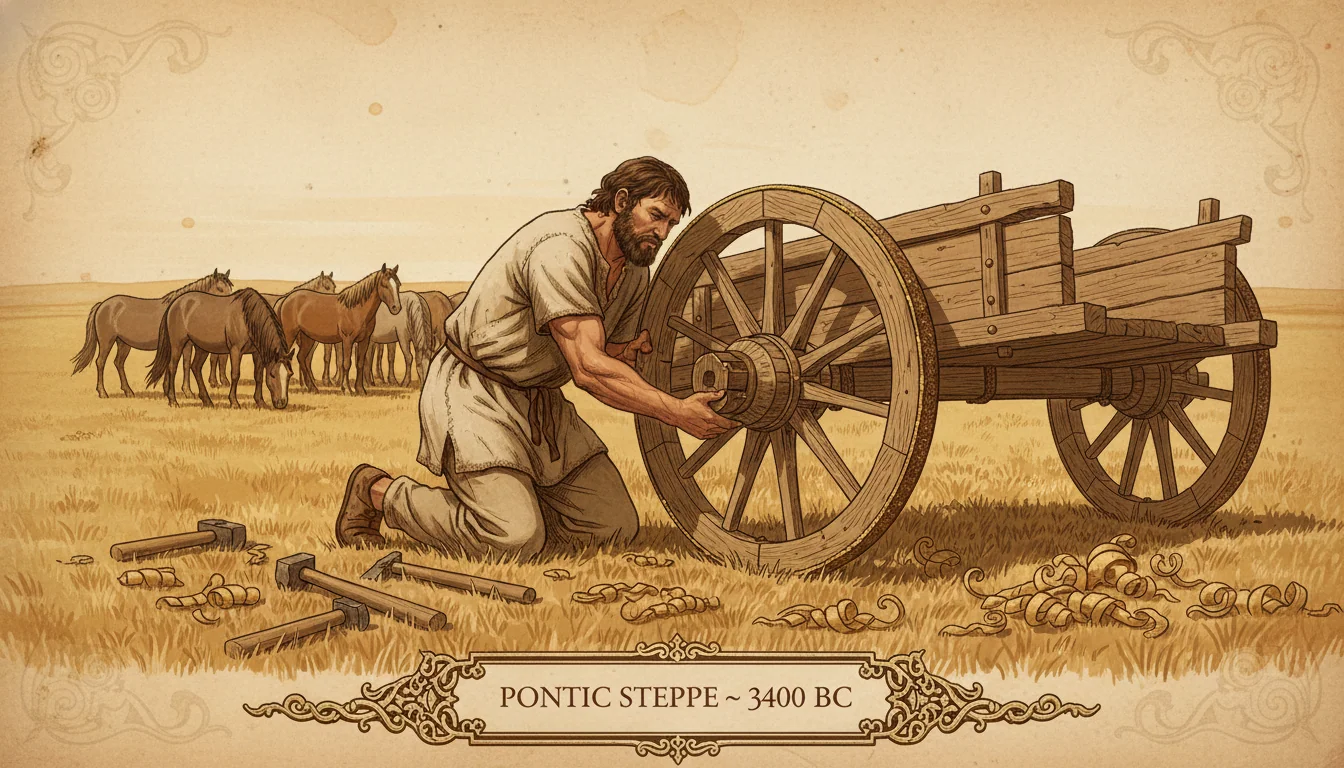
The question of who invented the wheel has a more complicated answer than any popular image suggests. The popular image involves a solitary caveman watching a boulder roll downhill and experiencing a flash of inspiration. This is wrong in almost every particular. The people who invented the wheel were not cave-dwellers. They were experienced woodworkers, probably potters and wagon-makers, working in a highly developed material culture. They already understood rotation. What they invented was not the idea of a circle moving - they had waterwheels and spindle whorls and hand drills before the transport wheel - but the specific engineering solution that made a heavy wheel useful: the rotating axle assembly.
That distinction, which sounds trivial, was the breakthrough that took five thousand years to arrive and then transformed the movement of goods, armies, and eventually ideas across the entire Old World.
What came before
To understand the wheel, you have to understand what existed before it.
Logs used as rollers appear in ancient Egyptian paintings associated with moving large stones. A log rolled under a sled reduces friction dramatically; a crew of workers can move a multi-ton object with rollers that they could never lift. This technique was in use in Mesopotamia and Egypt well before the wheeled vehicle appears in the archaeological record. The conceptual step from roller to wheel is not as large as it seems.
The potter's wheel is older than the transport wheel. Mesopotamian pottery from the late Ubaid period, around 4500-4000 BC, shows evidence of wheel-throwing techniques, meaning clay was shaped on a rotating platform. By 3500 BC the fast wheel - a heavy flywheel that a potter spins and then shapes using both hands - was established in Mesopotamian workshops. The potter's wheel requires the same conceptual element as the transport wheel: a heavy rotating object mounted on a fixed central axis. The potter's wheel is not an intermediate step toward the transport wheel; it is a parallel application of the same mechanical principle.
The spindle whorl - a small weighted disk that spins on a stick to twist fiber into thread - is older still, possibly going back to the Neolithic in multiple regions. Rotational motion for a mechanical purpose was not a new idea. What was new in the transport wheel was the scale, the weight, and the engineering demands of that combination.
The invention
The oldest confirmed wheeled vehicles appear in two regions almost simultaneously: the Mesopotamian lowlands and the Pontic steppe, the grassland region north of the Black Sea that corresponds to modern Ukraine and southern Russia.
In Mesopotamia, pictographic tablets from the Uruk period, around 3500 BC, show vehicles with four small circles - what appear to be schematic depictions of wheeled carts or sledges. Whether these are actual wheels or symbolic representations is debated, but the pictographic evidence is consistent with the physical evidence that follows it.
On the Pontic steppe, burial mounds of the Yamnaya culture, dated from around 3400-2800 BC, have yielded remains of wheeled wagons buried with their owners. These were working vehicles, not ceremonial objects: practical four-wheeled wagons with solid wooden wheels and fixed axles, used to carry the household goods of pastoral people moving with their herds across vast grasslands.
The Ljubljana Marshes Wheel, found in Slovenia in 2002 and dated to approximately 3100-3350 BC, is the oldest complete wheel-and-axle assembly yet recovered. It is a disk of ash wood attached to an oak axle, with a hole through the center of the wheel fitted to the axle. The axle rotated with the wheel - a different technical solution than a wheel rotating around a fixed axle, but achieving the same result.
The engineering problem nobody mentions
What made the transport wheel difficult was not the circle. It was the friction.
A wheel spinning on a fixed wooden axle generates heat through friction. A vehicle carrying several hundred kilograms will not travel far before the friction either seizes the axle or causes the bearing surfaces to wear away. Reducing this friction requires one of two solutions: very precise fitting of the wheel to the axle, using the hardest available hardwoods for the bearing surfaces, combined with a lubricant such as animal fat; or a design in which the axle rotates with the wheel inside a fixed housing, distributing the friction across a longer bearing surface.
Both solutions require skilled carpentry, reliable lubricants, and a social context in which wheel-equipped vehicles are worth the maintenance they demand. This is why the wheel does not appear in every culture simultaneously. It is not a simple observation. It is an engineering challenge that requires a specific combination of material culture, workshop skill, and economic need.
The Yamnaya pastoral economy provided all three. Moving families, food stores, and portable structures across the steppe was precisely the kind of heavy transport that made wheeled wagons economically rational rather than technically clever.
Was it invented once?
The question of independent invention versus single origin is genuinely contested, but the weight of evidence leans toward a single invention or cluster of closely related inventions.
The argument for a single origin is partly linguistic. Proto-Indo-European, the reconstructed ancestral language of most European and several Asian language families, has a clear root word for wheel: *kwékwlos or a related form, from which come the Sanskrit chakra, Greek kuklos, Latin rota (from a different root, but with cognates for wheel elsewhere in Latin), and the Germanic forms that give English its word wheel. The presence of this term in languages that diverged from a common ancestor before 3000 BC suggests that wheeled vehicles were part of the culture of the people who spoke that ancestor language, and that they spread with the Yamnaya or closely related groups as those populations expanded westward and eastward across Eurasia.
The counterargument is that Mesopotamian evidence is equally early and shows no obvious link to the steppe cultures. Two independent inventions in the same broad timeframe, within a region with active trade connections, is not implausible. Most specialists in prehistoric technology currently favor the view that even if the physical invention happened in two places, the rapid spread owed everything to contact between those cultures rather than to multiple independent transmission chains.
The exception that proves the rule
Mesoamerican cultures had wheeled toys but not wheeled vehicles. Small ceramic dogs and jaguars on axles and wheels, pulled by strings, have been found in Veracruz and neighboring regions in sites dated to the Classic period. The toys are charming and the engineering is sound. The wheels turn on real axles. The technology was demonstrably available.
The reason these cultures never scaled up to wheeled transport has nothing to do with intelligence or observation. It has to do with draft animals. The wheel is only useful for moving heavy loads if something strong enough can pull the vehicle. In Mesoamerica, the available domesticated animals were dogs, turkeys, and llamas (in South America). None of these could pull a loaded cart. The horse, the ox, and the donkey - the animals that made wheeled transport transformative across Eurasia - were absent from the Americas until Spanish ships arrived in the 16th century. Within decades of contact, wheeled vehicles were in use across Mexico and Peru.
The Mesoamerican example is not evidence that the wheel was independently invented and then not applied. It is evidence that the wheel's utility is conditional on the existence of large domesticated draft animals, and that the people of the Americas were solving the same transport problems with the tools their environment actually provided.
What it changed
The wheeled vehicle transformed Eurasian civilization across three overlapping revolutions.
The first was agricultural. A two-wheeled cart pulled by an ox can move a harvest in a single morning that would have taken a pack animal team two days. Grain surpluses became possible at scales that supported larger, denser populations. Cities grew.
The second was military. The spoked wheel, which appears in the archaeological record around 2000 BC on the Eurasian steppe, was lighter and stronger than the solid disk. Spoked wheels made the war chariot possible: a fast two-wheeled vehicle pulled by horses that changed the nature of Bronze Age battle from infantry confrontation to mobile, ranged combat. The chariot armies of the Hittites, the Egyptians, and the Mycenaeans reshaped the eastern Mediterranean world within a few centuries of the spoked wheel's appearance.
The third revolution was industrial, and it happened much later. The wheel principle - rotational motion transferred through a fixed center - underlies the gear, the water wheel, the windmill, the spinning wheel, and eventually the steam engine. The machine age is built on the axle.
The person who drove the first wheeled vehicle across the Pontic steppe around 3400 BC did not know any of this. They were trying to move the household from one pasture to the next without killing the oxen. They solved an immediate practical problem with the best technology their culture had produced.
That is how most revolutions start.
For related origins stories, see Origins: The Invention of the Printing Press and Origins: The History of the Alphabet.
Quick Answers
Common questions about this topic
When was the wheel invented?
The earliest evidence for wheeled vehicles dates to around 3500 BC in Mesopotamia (modern Iraq) and in the Pontic steppe region (modern Ukraine and Russia). The Ljubljana Marshes Wheel found in Slovenia, dated to approximately 3100-3350 BC, is the oldest well-preserved wooden wheel and axle yet found. The potter's wheel, which predates transport use, appears in Mesopotamian records from around 3500 BC or slightly earlier.
Was the wheel invented independently in different places?
The scholarly consensus leans toward a single invention, or at most a cluster of closely related inventions within the same broad cultural network. The technical complexity of a rotating axle makes independent parallel invention far less likely than for simpler technologies like fire or stone tools. The linguistic evidence is also suggestive: the Proto-Indo-European root for wheel appears in Sanskrit, Greek, Latin, and Germanic languages, implying a single source that spread with those language families.
Did the Aztecs or Maya have the wheel?
Mesoamerican cultures had wheeled toys - small ceramic animals on wheels have been found in Veracruz and other sites dated to the Classic period, roughly 200-900 AD. They did not use wheeled transport. The reason is practical: they had no large draft animals. Horses, oxen, and cattle were absent from the Americas until European contact. Wheels without animals capable of pulling heavy loads are useless for transport.
What was the most important part of the wheel invention?
The axle. A wheel without a properly functioning axle is just a circle that rolls. The engineering challenge was creating either a wheel that rotates freely around a fixed axle, or an axle that rotates within a fixed housing, with low enough friction to be practical. This requires precise carpentry, lubrication, and the right combination of hardwoods. Most scholars consider the wheel-and-axle assembly the real invention, not the wheel alone.

Ask the Inventors Themselves
Chat with the people who were there when familiar things began.
Create your free account →No card required. Some figures and features require a paid plan.
Join the HistorIQly Club
Get smarter about the past.
Weekly stories, deep dives, and exclusive content straight to your inbox.