Origins: How Writing Was Invented
Who invented writing? Not a priest or poet but an accountant in ancient Uruk. The story of cuneiform, the alphabet, and what happened when humans first wrote things down.
Read Wikipedia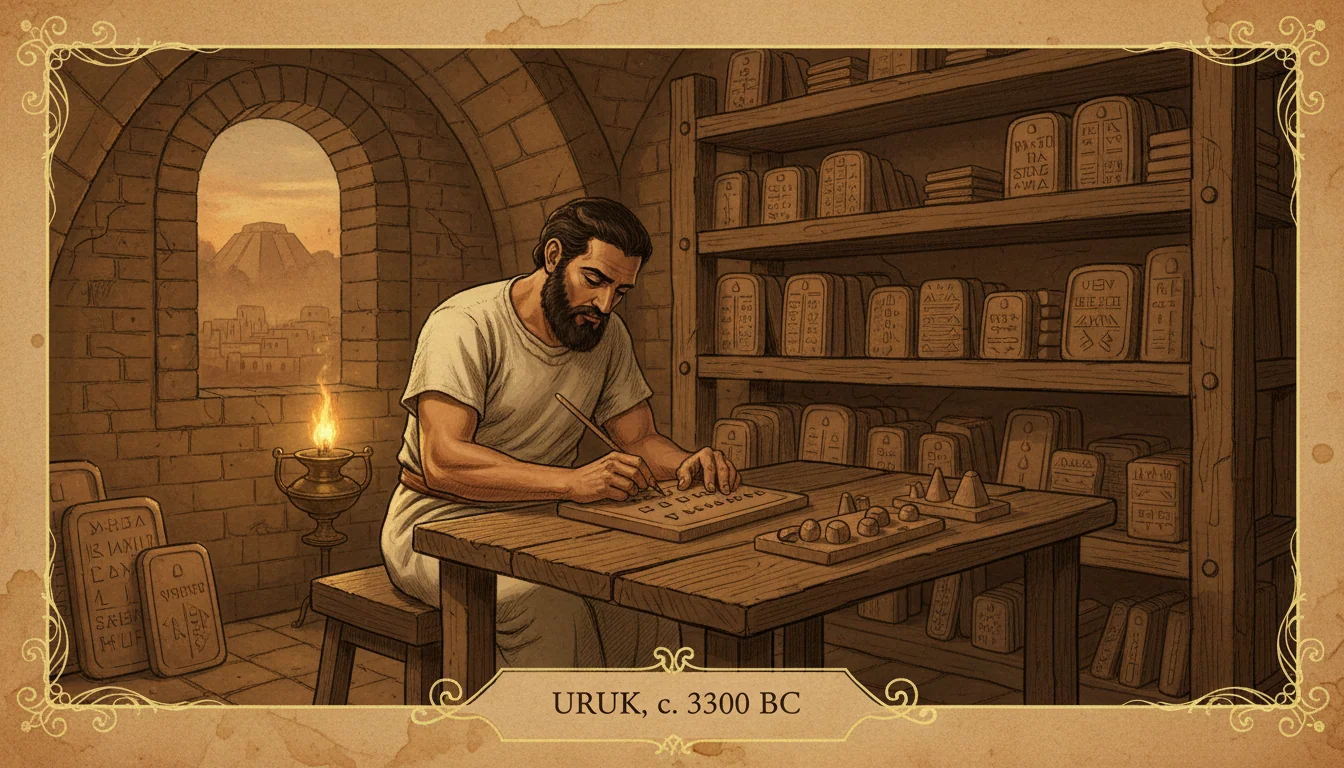
The oldest writing we can confidently date was produced in a city. Not by a prophet, not by a priest, not by a poet. By someone trying to keep track of how much barley was in a warehouse.
The tablets from ancient Uruk, pressed from soft clay and impressed with a reed stylus roughly 5,200 years ago, are not prayers or epics or laws. They are receipts. They record the arrival of grain, the distribution of rations to workers, the count of goats and sheep and jars of oil. They are, in every meaningful sense, the ancient world's equivalent of a spreadsheet. And they changed everything.
The problem writing solved
By around 3400 BCE, the Sumerian city of Uruk, located in what is now the Muthanna Province of southern Iraq, was one of the largest urban settlements in the world. Modern estimates of its population range from 25,000 to perhaps 80,000 people at its peak - a remarkable concentration for an era when most humans lived in small agricultural villages. That concentration created administrative problems that human memory could not solve.
A small village of a few hundred people can track its resources through remembered social obligation and informal accounting. When fifty families pool grain for the winter, each family knows roughly what it contributed and what it can claim. When you scale that problem to tens of thousands of people, hundreds of specialized trades, and a temple economy that managed the redistribution of food and labor across the entire city, memory fails. You need a record.
Scholars, particularly the French archaeologist Denise Schmandt-Besserat, have traced writing's origins to an even earlier recording technology: clay tokens. From at least 7500 BCE, across the Near East, small clay objects of specific shapes - spheres, cones, cylinders, discs - were used as counting tokens representing standardized quantities of specific goods. A sphere might represent a measure of grain; a cylinder might represent an animal. These tokens were stored in clay envelopes, called bullae, which were sealed. When you needed to verify a transaction, you broke the bulla open and counted the tokens inside.
The insight that turned tokens into writing was almost absurdly simple: if you press the token against the outside of the bulla before sealing it, you can read the count without breaking the seal. From there, it is a short conceptual step to replacing the token entirely with a pressed mark. The physical object becomes a symbol, and the symbol can be replicated without the object.
Uruk, 3300 BCE: the first tablets
The earliest confirmed writing appears on clay tablets from the Uruk IV period, dating to roughly 3300 to 3200 BCE. Excavations at Uruk, begun in the late 19th century and continuing into the 20th, recovered more than 5,000 proto-cuneiform tablets from a single administrative complex near the Anu ziggurat. The tablets are small, palm-sized, impressed with simplified pictures and numerical signs.
The signs are not yet a full writing system in the sense we usually mean. They represent objects and quantities, but they do not yet reliably represent the sounds of spoken Sumerian. You cannot read them aloud and hear the language. They are a notational system: sophisticated enough to track complex transactions but not yet capable of expressing grammar, narrative, or spoken discourse.
The content is overwhelmingly economic. Rations for workers at the temple complex. Counts of livestock belonging to the institution. Records of craft production: textiles, pottery, metalwork. The tablets were the filing system of an early bureaucracy, not the library of a civilization.
Most of the tablets record transactions so routine that they would have been discarded in a modern office. They were preserved by accident: when ancient buildings burned, their clay tablets, accidentally fired in the blaze, became harder and more durable. The administrative records of Uruk survived because the city burned.
From pictures to phonetics
The critical transition came gradually, over several centuries. As administrators used the pictographic symbols more extensively, two pressures forced them to evolve.
First, there are more things in the world than you can draw. Concrete objects, grain and animals and jars, lend themselves to pictographic representation. Abstract concepts, ownership, obligation, time, names, do not. As scribes needed to record who owned what grain, not just how much grain, they needed a way to write proper names. Names have sounds, not pictures.
Second, the pictographs became increasingly stylized with use. A scribe pressing a stylus into wet clay quickly learned that curved lines were time-consuming to execute; straight, angled strokes were faster. The pictograph of an ox head gradually became an arrangement of wedge-shaped impressions (cunei, from the Latin, which gives cuneiform its modern name). By around 2600 BCE, the signs looked almost nothing like the objects they originally represented. A reader who encountered the mature cuneiform script for the first time would not recognize it as descended from pictographs.
The phonetic system, where signs represent sounds rather than objects, emerged from a clever workaround. In Sumerian, as in many languages, there are homonyms: words with different meanings but the same sound. The Sumerian word for arrow and the word for life sound the same. A scribe who needed to write the concept of "life" could draw an arrow and trust the reader to understand from context that the meaning was phonetic, not pictographic. This rebus principle - using a picture for its sound rather than its meaning - was the gateway from notation to true writing.
By around 2500 BCE, Sumerian scribes could use cuneiform to record spoken language with reasonable fidelity. By 2000 BCE the system was recording the Epic of Gilgamesh, the Hymn to Inanna, the law codes of Ur-Nammu and Lipit-Ishtar. The accountant's inventory had become literature.
Egypt: a parallel invention?
Egyptian hieroglyphs appear in the archaeological record at almost exactly the same time as Sumerian proto-cuneiform, around 3200 to 3100 BCE. The Abydos labels, small ivory and bone tags found in the tomb of a predynastic ruler at Abydos in Upper Egypt, carry what appear to be phonetic signs alongside pictographic elements, and are dated to roughly 3250 BCE.
The near-simultaneity has generated long debate. Did Egyptian writing develop independently, or did the idea of recording language on clay spread from Mesopotamia to Egypt through the trade networks that connected the two civilizations? The current scholarly consensus leans toward a middle position: Egyptians probably knew that Mesopotamians had a system for marking meaning in a durable medium, but they developed their own specific signs and their own phonetic approach independently. The idea was borrowed; the execution was original.
Egyptian hieroglyphs from the beginning were a phonetic system as much as a pictographic one, and they evolved very differently from cuneiform. They were also, for most of their history, a prestige script used for monumental inscriptions; the administrative script used for everyday documents was the cursive Hieratic, which simplified hieroglyphs into flowing strokes that could be written quickly on papyrus.
The alphabet: the second revolution
Cuneiform and hieroglyphs shared a structural limitation. Both systems required hundreds or thousands of signs to be memorized, and professional training as a scribe took years. Reading and writing were specialist skills, confined to a small elite.
Around 1850 to 1700 BCE, in the turquoise mines of the Sinai peninsula, a different approach appeared. Semitic workers employed in Egyptian-run mines adapted Egyptian hieroglyphs to represent not pictures, not syllables, but individual consonant sounds. A hieroglyph that represented an ox head and the word for ox (aleph in their own language) was used to represent the consonant sound A. A hieroglyph of a house (beth) represented the sound B. The Proto-Sinaitic script, as archaeologists call it, used fewer than thirty signs to represent the entire sound inventory of a Semitic language.
This was a fundamentally different technology from cuneiform or hieroglyphs. Instead of hundreds of complex signs, you needed only a few dozen simple ones. Literacy was now achievable by ordinary people in ordinary time frames. The alphabetic principle spread: from Proto-Sinaitic to Phoenician, from Phoenician to Greek and Aramaic, from Greek to Latin, from Latin to every Western European script still in use. The Hebrew, Arabic, and Ethiopic scripts are all descendants of the same Sinai innovation. So is the Cyrillic alphabet, via Greek.
China and independent invention
Chinese writing, appearing on oracle bones and bronze vessels from the Shang dynasty around 1200 BCE, developed independently of the Mesopotamian and Egyptian traditions. It was fully phonetic from an early date, representing monosyllabic elements of Old Chinese, and its pictographic elements reflect a distinct visual vocabulary. Modern Chinese characters are descended from these Shang-period signs, making Chinese the only major ancient writing tradition to have survived into continuous modern use.
Mesoamerican writing, including the Zapotec script of Oaxaca dated to around 500 BCE and the later Mayan script, represents a third completely independent invention of the same fundamental technology. These scripts were developed with no contact with Old World writing traditions.
What writing did
The invention of writing did not merely preserve information that would otherwise be lost. It changed the nature of the information that was created. Before writing, knowledge existed in spoken form, in memory, in ritual. It was local, personal, mortal. When the person who held the knowledge died, the knowledge could die with them.
Writing allowed knowledge to travel. A Sumerian scribe's records could be read in a different city, a different century. The law codes of Hammurabi, carved in basalt around 1754 BCE, made the same legal principles enforceable in every corner of a kingdom rather than depending on the judgment of local officials. The Epic of Gilgamesh, copied for two thousand years by student scribes as a training text, preserved one of the oldest stories of human loss and human search for meaning across civilizations that barely knew each other.
The first writing was not literature. It was an invoice. What literature eventually became, what philosophy became, what science became, all of it traces back to someone in Uruk who needed to remember how much barley was in the storehouse and pressed a mark into wet clay to be sure they would not forget.
For related origins stories, see Origins: How the Alphabet Was Invented and Origins: How Numbers Were Invented.
Quick Answers
Common questions about this topic
Where was writing invented?
The earliest confirmed writing system emerged in the Sumerian city of Uruk, in what is now southern Iraq, around 3300 to 3200 BCE. This proto-cuneiform script used pictographic symbols pressed into clay tablets with a reed stylus. Egyptian hieroglyphs appeared at roughly the same time, and scholars debate whether Egyptian writing developed independently or was partly inspired by contact with Mesopotamia.
What was the first writing used for?
The earliest surviving tablets from Uruk are almost entirely administrative: lists of goods received or distributed, ration allocations for workers, counts of livestock and grain. The first writing was invented not to record stories, prayers, or history but to track transactions in a complex urban economy. It was a technology of bureaucracy before it became a technology of literature.
How did cuneiform writing develop?
Cuneiform began as a pictographic script in which simple drawings represented physical objects. Over centuries, the pictographs became more abstract, the strokes replacing curved lines with the wedge-shaped impressions that give the script its name (from the Latin cuneus, wedge). By around 2600 BCE, cuneiform had evolved enough to record grammar, syntax, and spoken language rather than just lists of things.
What is the oldest piece of writing ever found?
The Kish Tablet, discovered in modern Iraq and dated to approximately 3500 BCE, contains marks that some scholars interpret as proto-writing. The best-documented earliest tablets are the proto-cuneiform documents from Uruk, dated to around 3300-3200 BCE. The Uruk tablets are clearly writing; the Kish Tablet's status is still debated by specialists.

Ask the Inventors Themselves
Chat with the people who were there when familiar things began.
Create your free account →No card required. Some figures and features require a paid plan.
Join the HistorIQly Club
Get smarter about the past.
Weekly stories, deep dives, and exclusive content straight to your inbox.