Origins: How Paper Was Invented
The origins of paper trace not to Cai Lun in 105 AD but to anonymous craftsmen two centuries earlier. The real history of how paper changed the world.
Read Wikipedia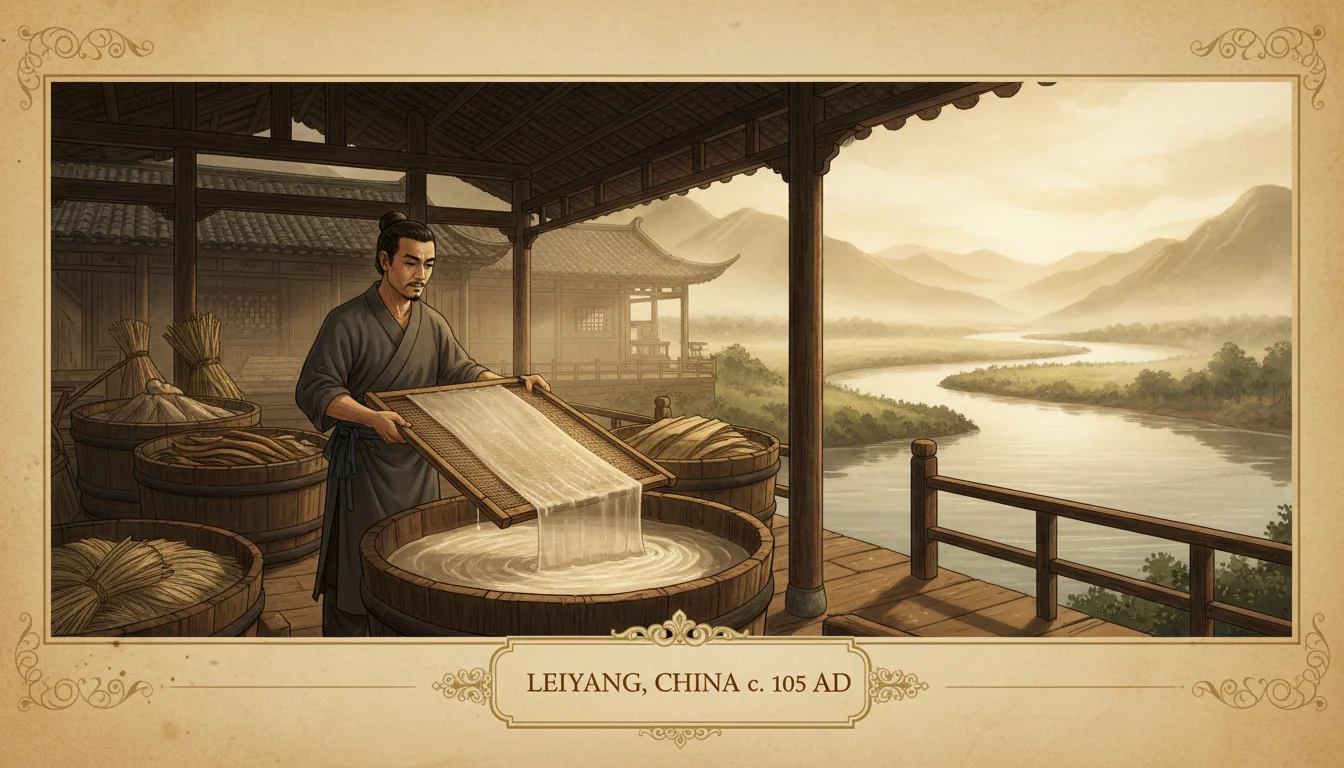
The standard story gives the credit to Cai Lun, a court official in the Han dynasty who in 105 AD reportedly presented Emperor He with a method of making writing material from bark, hemp, rags, and worn fishing nets. The story is in the official Han histories. The date is precise. The biography is detailed enough to include Cai Lun's later ennoblement and his subsequent execution for taking the wrong side of a palace intrigue - a trajectory so common in Chinese court history that it reads almost like a formula.
The standard story is approximately half true. Cai Lun did something important. He did not invent paper.
Before Cai Lun
Chinese scholars were writing centuries before 105 AD. The medium was bamboo: strips cut to a uniform size, bound together with silk cord, rolled into scrolls, scratched with a stylus, and carried in bundles heavy enough that a serious library required carts. First-century records note that officials were expected to read a defined quota of bamboo strips per day. A standard government document could weigh as much as the official receiving it.
The alternative was silk, which was light, durable, and absorbent enough to take ink well. Silk documents survive from the Warring States period (475-221 BC) and from the early Han dynasty. The problem was simple: it was silk. Writing on luxury fabric was reserved for the most important documents, the kind kept in archives rather than circulated through bureaucracies.
Bamboo was cheap and common. Silk was rare and expensive. The Han empire - one of the most administratively intensive states in the ancient world - needed something cheap, light, and writeable.
Archaeological evidence shows that paper existed before Cai Lun. The Fangmatan map, discovered in Gansu province in the 1970s, is a fragment of paper containing a sketch map of the Dunhuang region. It has been dated to the Western Han period, roughly the second century BC - somewhere between 150 and 200 years before Cai Lun's famous presentation to the emperor. Other paper fragments found at Han-era sites in northwest China also predate 105 AD. This early paper is crude - made from hemp, uneven in thickness, not always flat - but it is identifiably paper.
What Cai Lun did was standardize and improve. He used a wider and cheaper range of source materials: bark from paper mulberry and other trees, hemp waste, old rags, worn fishing nets. He refined or developed the production process to produce thinner, more uniform sheets. He then, critically, persuaded the imperial court to adopt the material across the administrative apparatus of the Han empire. Scale and official backing are what made his version matter in the way that earlier craft paper had not.
Cai Lun is the promoter and the standardizer. The actual invention belongs to unknown craftsmen in the northwest, probably several generations earlier, whose names have not survived.
The process
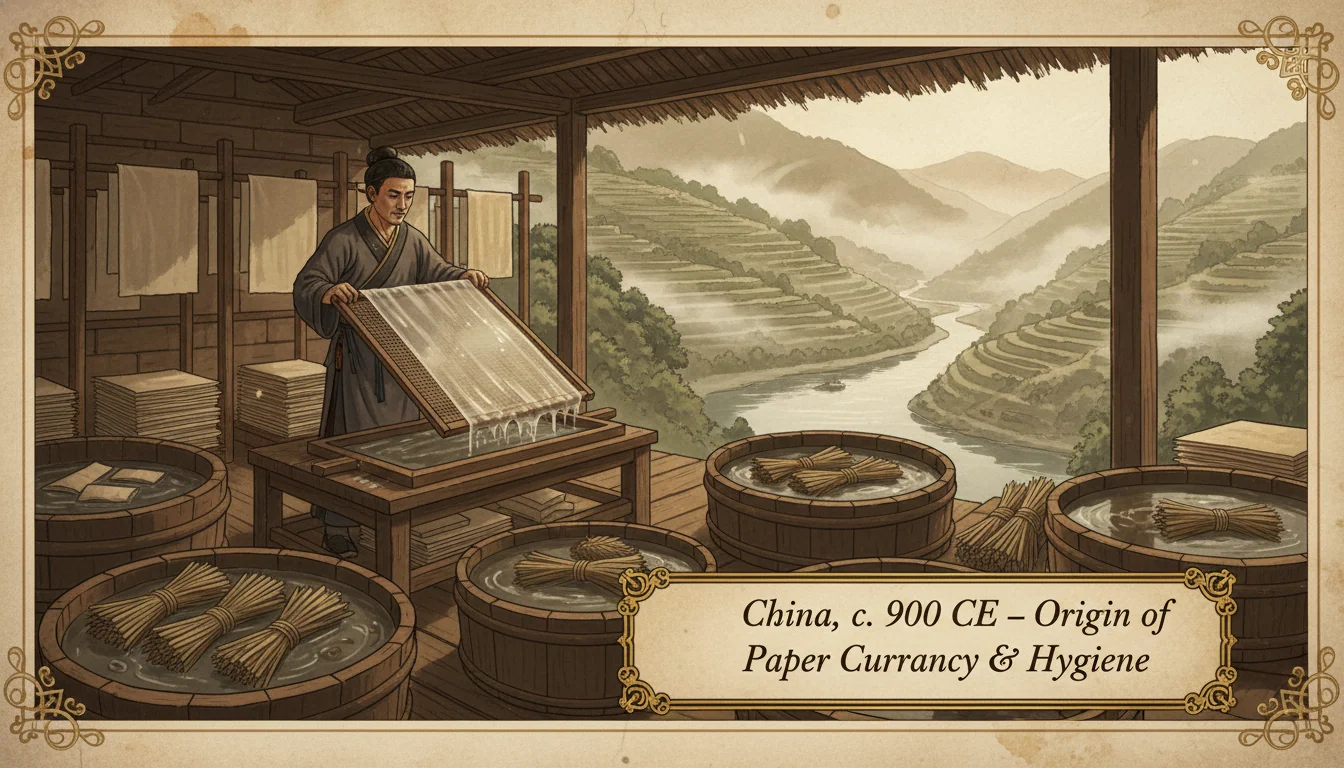
The papermaking method Cai Lun promoted is essentially the method still used in traditional paper workshops. The base material - in the early Chinese version, usually bark from the paper mulberry tree, or old hemp rope, rags, and worn cloth - is soaked in water and beaten, by hand or eventually by water-powered stamping mills, until it breaks into individual fibers suspended in water. This fiber slurry is poured into a shallow vat.
A rectangular mold covered with a woven screen - bamboo in China, wire mesh in later European versions - is dipped into the vat and lifted, trapping a thin, even layer of fibers on the screen surface. The water drains through. The mat of fibers is pressed to remove remaining water, carefully separated from the mold, and dried flat against a warm wall or surface. As it dries, the fibers bond together. The result is a sheet of paper.
The underlying logic has not changed in two thousand years. Every variable - the source material, the beating time, the mesh of the screen, the drying method - changes the quality, weight, and texture of the final sheet. The papermaking tradition is largely the history of craftsmen exploring those variables across centuries.
The Silk Road and the Battle of Talas
Chinese papermakers kept their methods largely internal for several centuries after Cai Lun. The technology spread east to Korea in the 4th century AD and to Japan in the 6th, carried by Buddhist monks and scholars copying texts. The westward diffusion was slower and more contested.
The decisive event was a battle. In 751 AD, the Tang dynasty army encountered the Abbasid Caliphate at the Talas River in what is now Kyrgyzstan. The Tang forces were defeated. Later accounts, written in the following century, claim that among the prisoners taken west to Samarkand were Chinese craftsmen including papermakers, whose knowledge of the technique was put to use in the Islamic world.
Whether the story of captured papermakers is literally accurate or a retroactive explanation for the timing is a question historians debate. What is not disputed is that papermaking arrived in the Islamic world through Central Asia in the second half of the 8th century, and that the timing fits the aftermath of the Talas battle precisely. By 793 or 794 AD, under the Abbasid caliph Harun al-Rashid, a paper mill was operating in Baghdad.
The Abbasid caliphate, with its systematic translation movement and its ambition to collect and copy the knowledge of every civilization it encountered, embraced paper with striking speed. Within fifty years of acquiring the technique, Islamic government offices had largely switched from papyrus and parchment to paper. Booksellers in Baghdad were trading paper manuscripts. Paper was cheaper than parchment, easier to produce in quantity, and better suited to the reed pens that Islamic scribal culture favored.
By the 9th century, paper had spread across the caliphate. By the 10th, it had reached Egypt. By the 11th, it was present throughout the Islamic Mediterranean.
Europe's reluctance
Paper entered Europe by two routes: through Islamic Spain, and through Sicily. The city of Xativa in the Valencia region of Spain, under Almoravid rule, had a paper mill by the mid-12th century. Italian mills followed, and Italian papermakers innovated significantly on the inherited technology. They introduced wire-mesh molds, which produced a finer, more consistent sheet than bamboo screens. They developed watermarks, designs pressed into the wet paper by raised wires on the mold surface, that identified the maker and were later used to authenticate documents. Water-powered stamping mills in the Italian valleys of Umbria and the Marche industrialized the beating process. Fabriano, in the Marche region, had sophisticated mills by 1283 and was exporting paper across Europe within a generation.
European parchment makers and the monasteries that depended on them resisted the new material. Several chancelleries banned paper for official documents in the 12th and 13th centuries on the grounds that parchment was more durable and more secure. Parchment, made from treated animal skin, genuinely did outlast paper under most conditions. But paper was roughly ten times cheaper to produce at scale, and the cost difference compounded as the volume of writing in European commercial and administrative life grew.
The argument was settled by a machine. Johannes Gutenberg's printing press, developed in Mainz between roughly 1438 and 1450, required cheap, abundant, flat material to print on. The existing supply of parchment in Europe was nowhere near sufficient to support a printing industry. Paper could scale. The interaction between Gutenberg's movable type and the established European paper trade was not coincidental - the paper mills and the printing shops grew together, each expanding the market for the other.
By 1500 there were printing operations in every major European city. By 1600, more books had been printed than had been hand-copied in the entire preceding millennium. Paper made the printing press viable. The printing press made paper indispensable. Paper was one of several Chinese innovations - alongside gunpowder - that reached the West through Islamic intermediaries and transformed European civilization.
What Cai Lun actually deserves
The origins of paper, then, belong to unnamed craftsmen in Han dynasty China, not to the official who promoted their work. Cai Lun did not invent paper. He does deserve credit for persuading an imperial bureaucracy to adopt it, for standardizing a process that had been regional and artisanal, and for using the Han empire's logistical reach to spread a useful technology across a continent. He is the figure who made paper matter in the way a promoter rather than an inventor makes something matter - less the originator than the person who scaled it until it could not be stopped.
The unnamed craftsmen who produced the Fangmatan map sometime in the second century BC are the actual inventors, in the sense that they produced the first identifiable paper. They left no record of their names and received no ennoblement.
This is how most of history's most consequential inventions work. The person who receives credit is rarely the first. They are usually the one who made enough people use it that the invention became impossible to uninvent. By the time it reached Gutenberg's workshop in Germany, the material those anonymous craftsmen first stretched across a bamboo screen in Han dynasty China had already passed through at least four civilizations and changed each one of them in ways that would not be undone.
Quick Answers
Common questions about this topic
Who invented paper?
Cai Lun, a court official in the Han dynasty, is traditionally credited with inventing paper in 105 AD and presenting it to Emperor He. But archaeological evidence, including the Fangmatan map fragment found in Gansu province, shows that paper existed in China at least two centuries earlier. Cai Lun most likely standardized and promoted an existing craft rather than invented it from nothing.
How was early Chinese paper made?
The traditional process involved soaking plant fibers - bark from paper mulberry trees, hemp rope, old rags, worn fishing nets - in water and beating them until the fibers separated. This slurry was spread in a thin layer on a woven bamboo screen, allowed to drain, then pressed and dried flat. The bonded fibers formed a sheet of paper. The basic method has remained largely unchanged for two thousand years.
How did papermaking spread from China to the Islamic world?
The most commonly cited event is the Battle of Talas in 751 AD, where Tang dynasty forces were defeated by the Abbasid Caliphate near present-day Kyrgyzstan. According to later accounts, captured Chinese craftsmen - including papermakers - were taken to Samarkand. Within a generation, Samarkand had a paper industry, and by the end of the 8th century Baghdad had paper mills operating under the Abbasid caliphate.
When did paper reach Europe?
Paper arrived in Europe primarily through Islamic Spain. The city of Xativa in Valencia had a paper mill by the mid-12th century, operating under Almoravid rule. Italian mills followed, with Fabriano in central Italy developing sophisticated papermaking by the late 13th century, including innovations like wire-mesh molds and watermarks. Paper's importance to Europe increased dramatically after Gutenberg's printing press in the 1440s made cheap, abundant paper essential.

Ask the Inventors Themselves
Chat with the people who were there when familiar things began.
Create your free account →No card required. Some figures and features require a paid plan.
Join the HistorIQly Club
Get smarter about the past.
Weekly stories, deep dives, and exclusive content straight to your inbox.