Origins: Where Beer Was First Brewed
The origins of beer are older than writing, older than cities, and possibly older than bread itself. Here's what the ancient evidence actually reveals.
Read Wikipedia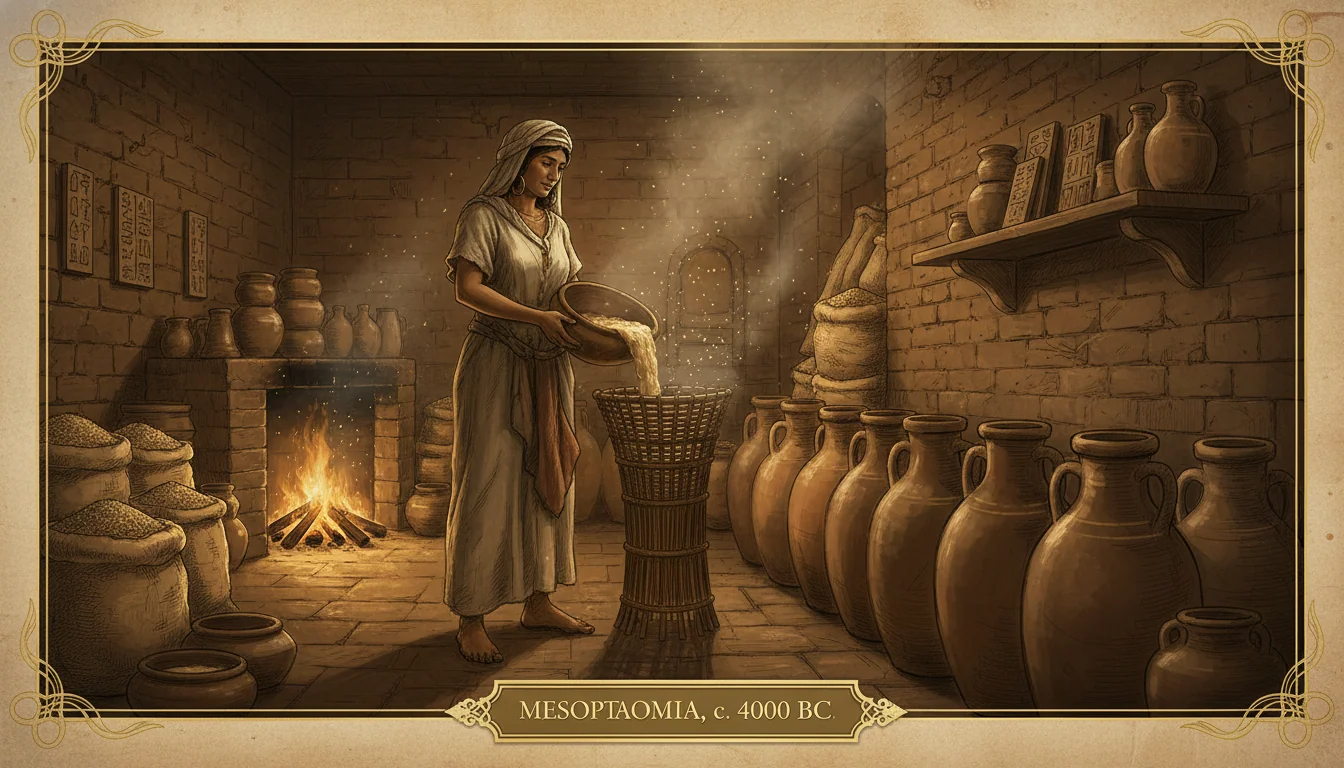
The comfortable story of beer involves accident. A forgotten batch of grain got wet, sat in a warm spot, and someone tasted the bubbling result and decided it was better than whatever they had been drinking before. From accident came discovery; from discovery came civilization.
It is a pleasant story. It is also almost certainly backward. The oldest evidence for brewing suggests that early humans did not stumble onto fermentation - they sought it deliberately, with considerable technical sophistication, thousands of years before anyone wrote anything down about the experience.
Beer is older than writing. It is older than cities. It may be older than settled agriculture, which would mean that the sequence most people learned in school - humans farm grain, then occasionally make it into beer - has the causality running the wrong direction.
The oldest evidence
The most striking recent finding in the archaeology of beer came in 2018 from Raqefet Cave on the slopes of Mount Carmel in northern Israel, where researchers from the University of Haifa and Stanford University examined stone mortars used by Natufian people roughly 13,000 years ago. Chemical analysis of residues in those mortars showed starch granules with characteristics consistent with malting and fermentation - the controlled biological processes that turn grain into an alcoholic beverage rather than simply into flour.
The Natufians were not farmers. They were a semi-sedentary forager culture that harvested wild cereals and had not yet made the transition to cultivation. The evidence from Raqefet Cave suggests they were brewing - or producing something functionally similar - for ritual feasting purposes long before agriculture began. The beer, if that is what it was, may have been produced seasonally in large batches for communal events rather than as a daily staple.
This finding does not stand alone. Gobekli Tepe in southeastern Turkey, the extraordinary ritual complex dating to roughly 9600-8000 BC and predating settled agriculture by at least a millennium, contains large T-shaped stone vessels with a capacity of hundreds of liters. Some researchers, including archaeologist Oliver Dietrich, have argued that these vessels were used to process fermented beverages for the feasting events that brought the builders of the site together. The evidence is interpretive rather than chemical, but the scale and shape of the vessels fits a brewing context.
The first confirmed chemical evidence of deliberate beer brewing in the sense of barley-based fermented beverage comes from Hajji Firuz Tepe in northwestern Iran. The biochemist Patrick McGovern, analyzing ceramic jars dated to roughly 5400-5000 BC, found calcium oxalate "beerstone" - a compound that forms on the interior walls of vessels used repeatedly for brewing grain-based beverages. This is not a suggestion or an analogy. It is a physical fingerprint of beer production.
Mesopotamia: where beer became culture
From the Iranian plateau, the documentary record expands dramatically as writing appears in Mesopotamia. By 3500 BC, evidence of beer production at Godin Tepe in the Zagros Mountains and at the Egyptian site of Hierakonpolis shows that large-scale, organized brewing was underway across a wide region. By 2500 BC, it was as fundamental to urban life as any other basic provision.
The Sumerian administrative tablets of the Ur III period, roughly 2100-2000 BC, record beer in the same bureaucratic registers as grain, oil, and silver - as a measurable commodity in institutional rations and trade. Workers at the royal weaving houses, laborers at temple construction sites, and soldiers on campaign all received beer allocations as a standard component of their wages. This was not luxury or recreation. Beer in this period was a calorie-dense, mildly alcoholic, slightly nutritious beverage produced from grain that had been soaked, germinated, dried, coarsely ground, mixed with water, and fermented. It was safer than untreated water and provided energy in a form that kept reasonably well.
The varieties were numerous. The Ebla tablets from Syria, dated around 2300 BC, list fifteen distinct types of beer. Mesopotamian brewing had by this point developed distinct styles based on different grains (barley, emmer wheat, and mixed grains), different filtration methods, and different fermentation times. Some were dark and thick, consumed through long filtering straws to strain out grain husks. Some were lighter and clearer. All were substantially lower in alcohol than modern beer - probably 2-4 percent - because the goal was a daily beverage rather than intoxication.
The most famous document in the history of beer is the Hymn to Ninkasi, a Sumerian text written down around 1800 BC. Ninkasi was the Sumerian goddess of beer - her name translates roughly as "the lady who fills the mouth" - and the hymn praises her by describing, in careful detail, the entire brewing process: the malting of grain, the making of bappir (a twice-baked fermented barley bread used as a starter), the addition of honey and wine, the filtering, and the fermentation. It is, embedded inside a religious poem, a recipe that modern brewers have used to reconstruct ancient Mesopotamian beer. The results are reportedly drinkable if unusual.
The beer-before-bread question
In 1953, the American anthropologist Robert Braidwood organized a symposium to debate what he called the "beer question" - whether grain cultivation in the ancient Near East had been motivated primarily by the desire to make bread or beer. Braidwood found the beer hypothesis implausible given what was then known about agricultural origins. He concluded for bread.
The question never went away. In the early 1990s, the archaeologist Brian Hayden renewed the hypothesis with new arguments from feasting theory: that status displays and communal feasting events, rather than simple caloric necessity, drove many early agricultural innovations. Fermented beverages were prestige goods in many early societies and plausible drivers of deliberate cultivation. The evidence from Raqefet Cave - Natufian brewing before agriculture - has given this argument renewed credibility.
The current scholarly consensus, if one can be identified, is probably that bread and beer developed in parallel and were not sequential. The same malted grain that produces beer starters also produces the leavening that makes bread rise. The microbiological processes overlap. Early Neolithic communities may not have distinguished clearly between "making beer" and "making bread" in the way that later language and taxonomy would suggest. Both were products of the same fermentation technology applied to the same grain.
What the evidence does suggest firmly is that fermentation was not an accident the Neolithic world stumbled into. It was a sought-after technology with practical applications - nutritional, ceremonial, and social - that communities invested real effort in mastering.
Egypt: beer as salary
The pyramid construction workers at Giza were a rotating workforce of skilled and semi-skilled laborers paid in rations, and those rations included a daily beer allocation of roughly two liters per person. Administrative records from the pyramid villages, excavated by Egyptologist Mark Lehner from the 1990s onward, document grain, bread, and beer moving through the work organization at industrial scale. A brewery capable of producing tens of thousands of liters per day has been excavated near the complex.
Egyptian beer was called heqet and was a thick, slightly sour, barely filtered fermented grain drink closer to liquid bread than to modern beer. It was a food, not a pleasure drink. The distinction matters: in a hot climate, with contaminated water sources and a workforce performing heavy physical labor, heqet was caloric delivery infrastructure.
The Code of Hammurabi and the tavern keeper
The role of beer in Babylonian urban life is illustrated precisely by its appearance in the Code of Hammurabi, the famous law code of the Babylonian king Hammurabi promulgated around 1754 BC. The code includes laws governing beer prices, which must not exceed the standard in grain exchange rates. A female ale-seller (sabitu) who overcharges must be thrown into the water. A sabitu who learns of conspirators meeting in her tavern and does not report them to the palace is also subject to death.
The laws tell us several things simultaneously. Beer was sold commercially by women who ran ale-houses as a recognized profession. The drink was common enough to be price-regulated by the king. And the tavern - the room where people gathered to drink beer - was considered a potential site of political organization worth monitoring.
This dynamic, the tavern as a space for seditious conversation, will reappear when coffeehouses emerge in the 15th century and again when Enlightenment coffee culture produces the meeting places of revolutionary politics. The thing that worries rulers is never the drink. It is the room.
What the history actually tells us
Beer was not an accident and it was not a late addition to human culture. It is, by the physical evidence, among the oldest deliberately produced beverages in human history - older than wine, older than distilled spirits, contemporary with or possibly older than settled agriculture itself.
The Kaldi-style "happy accident" story - the one that gets applied to beer just as it gets applied to coffee and tea and various other discoveries - is the kind of origin narrative that humans construct after the fact to explain practices they have inherited without witnessing. The actual record is less romantic and more interesting: beer was a technology that early Neolithic communities sought, refined over generations, embedded in religious practice, incorporated into wage systems, and regulated by law.
The goddess Ninkasi was not a metaphor. She was the institutional recognition that the person who understood fermentation was the most important person in the room. In Sumer, that person got a divine patron. In Mesopotamia they got administrative tablets. In Egypt they got a payroll line. In Babylonian cities they got their own laws.
The beer in your glass this evening is at least 5,000 years of continuous refinement. Probably more. The Natufians were doing something like it 13,000 years ago on the slopes of Mount Carmel, though they had not yet discovered hops or refrigeration or the small-batch craft premium. They had, however, discovered the important thing: that fermented grain produces something worth the trouble of making it again.
For the parallel origins stories of other staples, see Origins: Bread and Origins: Wine.
Quick Answers
Common questions about this topic
Where was beer first brewed?
The oldest physical evidence of deliberate beer brewing comes from Hajji Firuz Tepe in northwestern Iran, where ceramic jars dated to around 5400-5000 BC contained chemical residues consistent with fermented barley. Even older suggestive evidence has been found at Raqefet Cave in Israel, where Natufian mortars dated to roughly 13,000 years ago show starch residues consistent with brewing, likely for feasting rituals. Mesopotamia - modern Iraq and Iran - is the best-documented center of ancient beer culture.
What is the Hymn to Ninkasi?
The Hymn to Ninkasi is a Sumerian text dating to around 1800 BC that praises Ninkasi, the Sumerian goddess of beer. Embedded within the hymn is a detailed recipe for brewing beer from barley - describing the malting, mashing, and fermentation process. It is one of the oldest beer recipes in the world and confirms that Mesopotamian brewing had reached a sophisticated, standardized form by the early 2nd millennium BC.
Was beer really invented before bread?
This is a genuine scholarly debate, not a settled question. The 'beer before bread' hypothesis, associated with archaeologists including Patrick McGovern and Brian Hayden, argues that the cultivation of barley in the Neolithic Near East was motivated partly by the desire to produce fermented beverages, not only food. Evidence from sites like Gobekli Tepe and Raqefet Cave has given the hypothesis new traction. Most specialists now think fermentation and bread-making developed in parallel rather than one definitively preceding the other.
What role did beer play in ancient Egyptian and Mesopotamian societies?
In both societies, beer was a staple food, a wage payment, and a ritual offering. Workers on the pyramid construction sites at Giza received ration allocations that included daily beer. Mesopotamian administrative tablets from the Ur III period record beer distributions as part of institutional rations. The Code of Hammurabi included specific laws regulating the price and quality of beer sold in taverns, with severe penalties for overcharging.

Ask the Inventors Themselves
Chat with the people who were there when familiar things began.
Create your free account →No card required. Some figures and features require a paid plan.
Join the HistorIQly Club
Get smarter about the past.
Weekly stories, deep dives, and exclusive content straight to your inbox.