Origins: How Glass Was Invented
Who invented glass? Pliny's Phoenician campfire story is wrong. The real answer starts 5,000 years ago in Mesopotamian workshops - and ends with float glass on your phone.
Read Wikipedia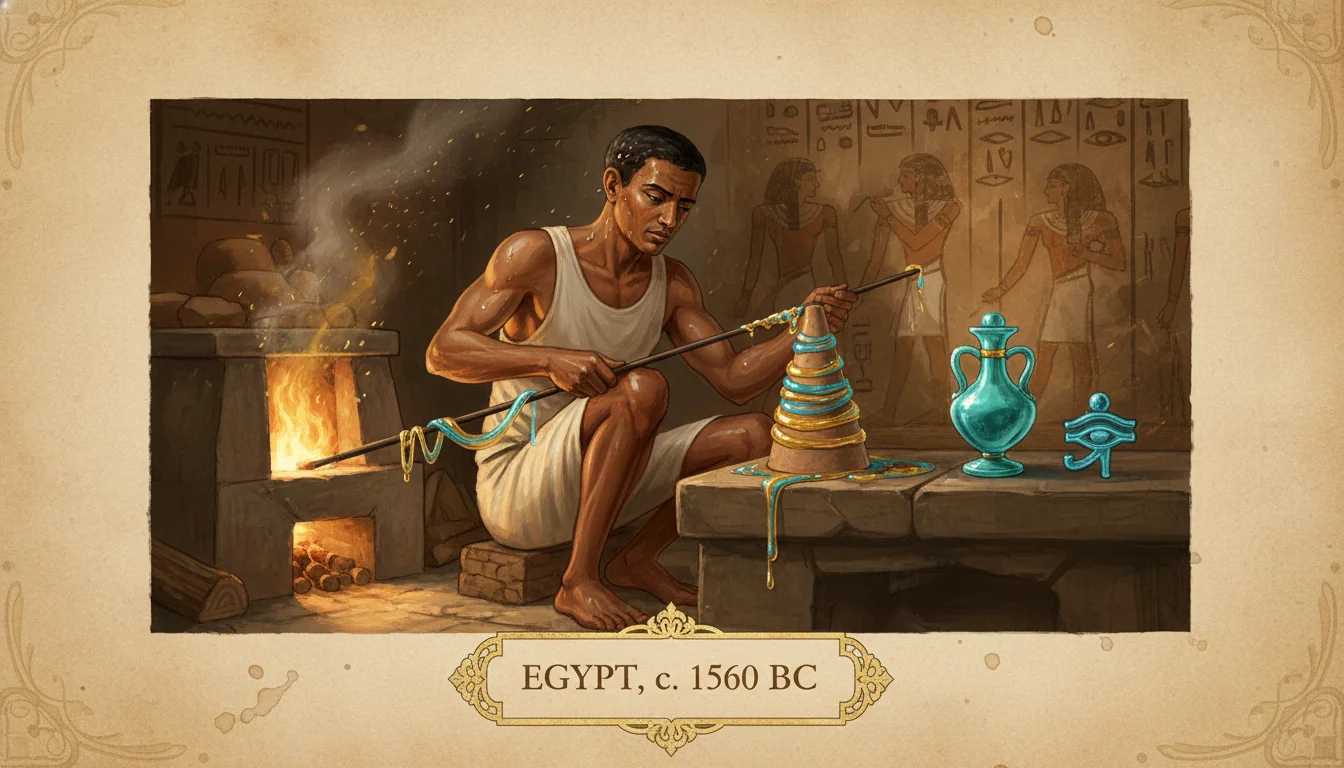
The best-known answer to who invented glass comes from Pliny the Elder's Natural History, written around 77 AD. In it, Phoenician merchants are sailing the Syrian coast with a cargo of natron, a naturally occurring sodium compound used for mummification and many other purposes. They stop on a sandy beach to cook. Unable to find stones to support their pots over the fire, they use blocks of natron instead. When the fire burns down, they find streams of an unfamiliar transparent material flowing from beneath the blocks. Glass, discovered by accident, on a beach, by merchants looking for something to rest their dinner on.
The story has been retold for nearly two thousand years. It appears in encyclopedias, school textbooks, and museum placards. It is also, from the perspective of basic chemistry and thermodynamics, essentially impossible. Melting silica - the primary ingredient in glass - requires temperatures around 1700 degrees Celsius. A beach campfire reaches roughly 600 to 900 degrees Celsius. Adding natron to sand does not close that gap. Pliny's merchants would have gone home with warm sand.
What actually happened is older, more incremental, and harder to tell as a campfire story.
The long prelude: glazed ceramics
The story of glass does not begin with a moment. It begins with a material.
Egyptian faience - a composite material made from quartz or sand coated with a copper-based glaze - was being produced in Egypt and Mesopotamia by at least 3500 BC. Faience is not glass; it lacks glass's continuous amorphous structure. But it was produced in furnaces at high temperatures, required skilled craftsmen who understood the behavior of silica under heat, and produced a hard, shiny surface used for jewelry, amulets, and decorative tiles.
This is the technical precursor. For roughly a thousand years after faience, practical knowledge of high-temperature silica work accumulated in the workshops of Egypt and Mesopotamia. By around 2500 BC, the first entirely glass objects appear in the Mesopotamian archaeological record: small beads and amulets, solid pieces of colored glass shaped by casting molten material in molds.
These are not vessels. They are ornaments. But they are glass - the real thing, amorphous, transparent in their colored way, produced by craftsmen who had learned to push their furnaces past the threshold where glaze becomes a flowing liquid that can be shaped independently of any ceramic support.
The colors are the giveaway about how knowledge developed. Early glass is almost always colored: deep cobalt blue from copper or cobalt compounds, turquoise, yellow, dark amber. Pure clear glass requires removing trace impurities from raw materials that furnace workers in 2500 BC had no method to eliminate. Colored glass was a byproduct of the glaze tradition, discovered by craftsmen who were already expert with ceramic glazes and found that under certain furnace conditions the material became something new.
Egypt and northern Mesopotamia: the first hollow vessels
The first hollow glass vessels appear in the archaeological record around 1550 to 1500 BC, in two regions simultaneously: New Kingdom Egypt and northern Mesopotamia, in the area of what is now northern Syria and northern Iraq.
The technique used to make them is called core-forming. A craftsman prepared a core of clay and organic material - the exact mix varied by workshop - shaped to the interior profile of the desired vessel, and fixed it to a metal rod. The core was then coated in molten glass by dipping or trailing. Additional trails of contrasting-colored glass could be dragged with a comb-like tool to create the feathered and zigzag patterns that characterize New Kingdom Egyptian glass vessels found in tombs across the empire.
When the glass cooled, the core was scraped out, leaving a hollow vessel. The result was small, fragile, and expensive. Core-formed glass bottles, kohl containers, and small unguentaria - vessels for precious oils and resins - were luxury objects. The finest examples found in Egyptian royal tombs show extraordinary craft control: vessels with complex surface patterns, perfect symmetry, and walls just a few millimeters thick.
New Kingdom pharaohs collected glass vessels and treated them as diplomatic gifts. Thutmose III established a glassmaking installation that supplied the royal court in the 15th century BC. The Amarna archive of the 14th century BC includes letters requesting shipments of colored glass alongside gold and lapis lazuli, confirming its status as a luxury material equivalent to precious stones.
The Bronze Age interruption
The Late Bronze Age collapse, which disrupted Mediterranean and Near Eastern civilizations between roughly 1200 and 1150 BC, interrupted glass production severely. The cobalt for blue glass came via long-distance trade. The tin for the bronze tools used in glassworking was similarly trade-dependent. When the sea routes and overland networks collapsed, the supply chains that fed the glass workshops collapsed with them.
Glass production in Egypt appears to have declined sharply after the New Kingdom's end. When serious glassmaking revived, the main centers had shifted westward. The Phoenician coast - modern Lebanon and the neighboring coasts - became the dominant zone of glass manufacture in the first millennium BC. Syrian and Phoenician craftsmen working around Sidon and other centers developed new techniques and distributed their products across the Mediterranean through commercial networks that extended from North Africa to the Greek world.
Glassblowing: the Levantine revolution
The invention of glassblowing, dated by archaeological evidence to approximately the 1st century BC, is the most consequential technical development in glass history between its initial discovery and the industrial era. Its origins appear to be the Syro-Palestinian coast, based on the distribution of the earliest blown glass finds.
The concept is straightforward but technically demanding to execute. A glassworker gathers a mass of molten glass on the end of a hollow iron tube, which keeps the glass plastic for a limited working time. Blowing air through the tube inflates the glass into a bubble, which can be shaped by rotating, swinging, pressing into molds, or pulling with tools. The speed advantage over core-forming was enormous: a vessel that took an Egyptian craftsman an hour to build up layer by layer could be blown in minutes.
The economic consequences were immediate and permanent. Roman entrepreneurs combined blowing with standardized molds and produced glass vessels in quantities that had previously been unimaginable. Within two centuries of the invention, glass had shifted from a luxury material available only to the wealthy to a common domestic one. Roman glass bottles, storage jars, tableware, and window panes have been excavated at sites from Roman Britain to the Persian Gulf.
Glass windows themselves were a Roman development. The earliest window panes - cast rather than blown, thick and imperfectly transparent by modern standards - appear in wealthy Roman buildings in the early 1st century AD. The technique spread through the empire. By late antiquity, glass windows were standard in public buildings and prosperous private homes across the Roman world.
Venice and the drive toward clarity
After the fall of the Western Roman Empire in the 5th century AD, glass quality declined across most of Europe, though the craft survived in the Byzantine Empire and flourished in the Islamic world. Islamic glassmakers built on the Syrian tradition and produced some of the most sophisticated enameled and gilded glass of the medieval period, reaching technical heights that European craftsmen would not match for centuries.
Venice developed a glass industry from at least the 10th century AD, drawing on trade connections with Constantinople and the Levant. In 1291, the Venetian Republic ordered all glass furnaces relocated to the island of Murano, officially to reduce the fire risk to the densely packed city on the lagoon. The practical effect was to concentrate the entire industry on a single island, where craftsmen shared furnaces, competed directly, traded techniques, and trained the next generation under conditions that produced rapid innovation.
The most important Venetian development was cristallo - a nearly colorless, highly transparent glass - developed in the 15th century, associated with a glassmaker named Angelo Barovier. Achieving colorlessness requires eliminating the iron and other trace impurities that give ordinary glass its greenish or brownish tint. Barovier's technique used controlled additions of manganese as a decolorizing agent - a method that required precise knowledge of raw material quality and furnace atmosphere.
Venetian cristallo became the most valuable glass in Europe. Murano glassmakers were granted extraordinary privileges by the Venetian Republic: the right for their daughters to marry into the Venetian nobility, and - enforced with lethal seriousness - a prohibition on practicing the craft outside Venice. The Republic understood cristallo as a strategic asset. Other European powers sent agents to Murano to attempt industrial espionage. Some Murano craftsmen defected regardless, spreading Venetian techniques to France, Bohemia, and England during the 16th and 17th centuries.
What the beach story cost us
Pliny's Phoenician merchants have obscured the actual history of glass for nearly two millennia. The real sequence is considerably more interesting: a thousand years of accumulated craft knowledge starting from Egyptian faience workshops, two independent early traditions developing hollow vessels in Egypt and northern Mesopotamia, a Bronze Age collapse that interrupted production and redistributed the technology, a Levantine invention of blowing that transformed the economics of material culture, and a Venetian concentration of craft that drove the final leap to optical clarity.
The real story ends not on a beach but in Alastair Pilkington's development of the float glass process in 1959 at Pilkington Brothers in Lancashire - a method of floating molten glass on a bath of molten tin to produce sheets of unprecedented flatness and clarity. Float glass covers every modern skyscraper and smartphone screen in the world.
The chain from a Mesopotamian bead-caster of 2500 BC to the glass in your hand runs through five thousand years of incrementally accumulated knowledge, multiple civilizations, and no single eureka moment. That is, of course, exactly how almost everything worth having was invented - and exactly why the campfire story, however charming, was always wrong.
To see the Levantine and Islamic worlds where so much of this glass tradition developed, see our time-travel guides to Seleucid Antioch in 200 BC and Abbasid Baghdad in 800 AD.
Quick Answers
Common questions about this topic
Who invented glass?
Glass was not invented by a single person. It emerged from accumulated craft knowledge developed by Mesopotamian and Egyptian artisans working with glazed ceramics from around 3500 BC. The first true glass objects - beads and amulets - appear in Mesopotamia around 2500 BC. The first hollow glass vessels appeared in Egypt and northern Mesopotamia around 1500 BC.
Is the Phoenician beach story true?
Almost certainly not. The story, told by Pliny the Elder in his Natural History around 77 AD, describes merchants accidentally making glass when natron blocks used to support cooking pots fused with sand on a beach. However, melting silica into glass requires approximately 1700 degrees Celsius - far beyond a campfire's reach. The story appears fifteen centuries after glass was actually invented.
When was glassblowing invented?
Glassblowing was invented on the Syro-Palestinian coast - in the area of modern Syria, Lebanon, or Israel - around the 1st century BC. It was a revolutionary technique: a worker could gather molten glass on the end of a hollow iron tube and inflate it like a bubble, creating thin-walled vessels far more quickly than earlier core-forming methods allowed.
How did Venice become the center of glass production?
Venice developed a major glass industry from at least the 10th century. In 1291, the Venetian Republic ordered all glassmakers to move their furnaces to the island of Murano to reduce fire risk. The concentration of craftsmen led to intensive innovation, including the development of cristallo - a nearly colorless clear glass - in the 15th century.

Ask the Inventors Themselves
Chat with the people who were there when familiar things began.
Create your free account →No card required. Some figures and features require a paid plan.
Join the HistorIQly Club
Get smarter about the past.
Weekly stories, deep dives, and exclusive content straight to your inbox.