Origins of Bread: How It Was Invented
Origins of bread: a 14,400-year-old flatbread from Jordan forced historians to rethink who invented it, when, and why it came before farming.
Read Wikipedia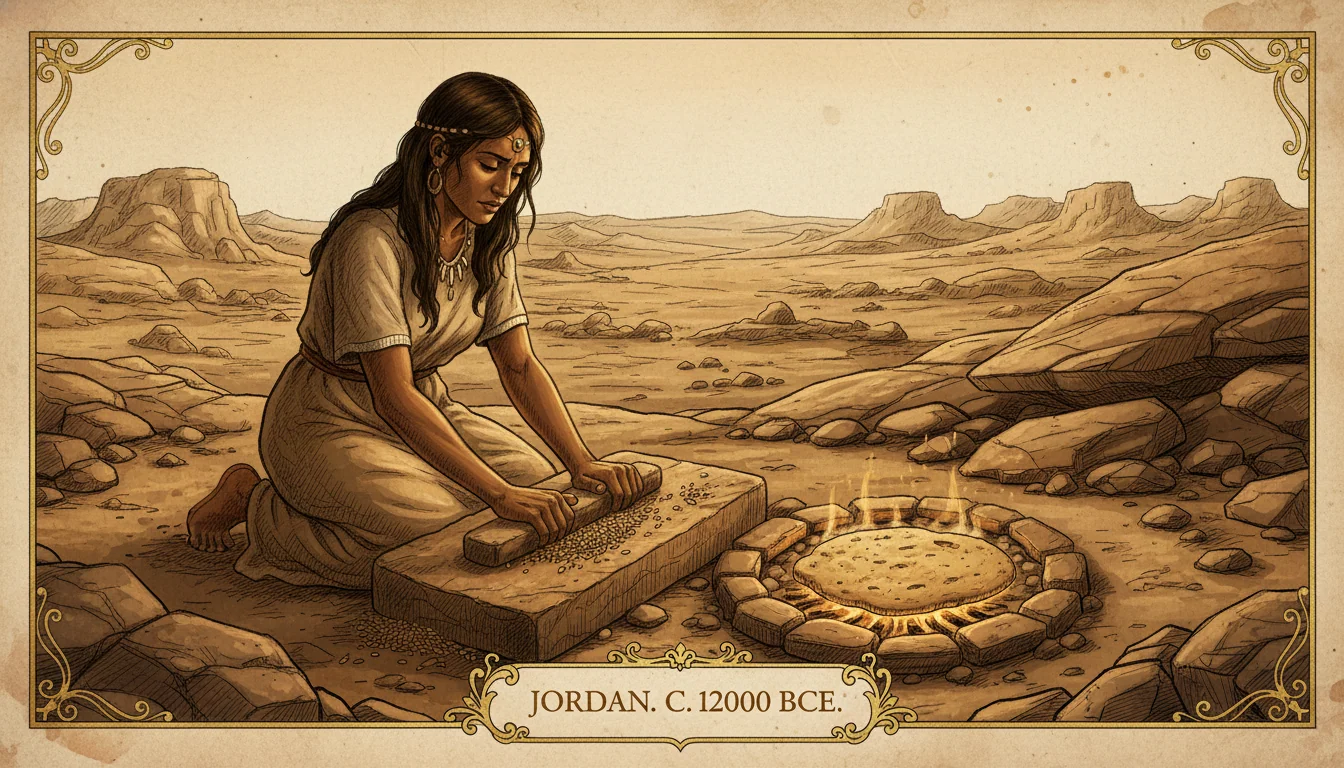
The oldest bread ever found was baked by people who had never heard of farming.
In 2018, archaeologists working at Shubayqa 1, a Natufian hunter-gatherer site in the Black Desert of northeastern Jordan, pulled charred fragments from a fireplace structure and sent them for radiocarbon dating. The results placed the material at approximately 14,400 years old, predating the earliest evidence of agriculture by roughly four thousand years. Analysis of the fragments revealed the presence of wild einkorn wheat, wild barley, and starchy root tissue from an aquatic plant. The team from the University of Copenhagen concluded they were looking at the remains of a flatbread.
This discovery overturned a comfortable assumption: that bread was an agricultural product, a consequence of farming rather than a cause of it. It is now at least possible that the desire to produce reliable grain for grinding and baking was one of the pressures that eventually pushed human communities toward deliberate cultivation. The bread came first. The farm may have come later, partly to support it.
The Natufian bakers
The Natufians were a Levantine hunter-gatherer culture who occupied a broad zone from the eastern Mediterranean coast to the margins of the Syrian Desert between roughly 15,000 and 11,500 years ago. They were sedentary or semi-sedentary by the standards of their time, building permanent stone structures, burying their dead with grave goods, and investing significant effort in food processing. Grinding stones and mortars found at Natufian sites are among the earliest intensive grain-processing equipment in the archaeological record.
The Shubayqa bread was not anything like a modern loaf. It was a flatbread, probably coarse-textured, made by grinding wild grains on stone, mixing the resulting flour with water, and placing the paste on or near a hot stone or in the embers of a fireplace. Unleavened and dense, gritty from the grinding process and from whatever organic material contaminated the millstone, it would have been nutritious and filling rather than pleasant by present-day standards.
What matters is that someone looked at a handful of wild grass seeds, ground them, mixed them with water, applied heat, and then repeated that process often enough that it became a technology worth passing down.
Agriculture and the Fertile Crescent
Agriculture developed in the Fertile Crescent - the arc of land running through modern Turkey, Syria, Iraq, and the Levant - beginning around 10,000 BC. The first domesticated plants were einkorn wheat, emmer wheat, and barley, all of which had been ground and eaten by hunter-gatherers for thousands of years before anyone was deliberately planting them. Domestication involved selecting and replanting the grain variants easiest to harvest: those whose seed heads did not shatter when ripe, retaining the seeds until they could be collected and stored.
The earliest farming settlements show bakery-scale food processing from their earliest layers. Clay ovens, grinding stones, and storage pits designed for grain appear together in the archaeological record at sites like Abu Hureyra in Syria and Ain Ghazal in Jordan. Bread was not a late addition to agricultural life - it was central to the reason people were farming in the first place, and the organizational complexity of growing, storing, grinding, and baking grain drove some of the earliest urban institutions.
Ancient Egypt and leavened bread
The decisive step from flatbread to risen bread - from a dense paste baked hard to a light, open-crumbed loaf - is generally credited to ancient Egypt, probably sometime between 3000 and 2500 BC. Leavened bread requires a fermented starter, a living culture of wild yeast that produces carbon dioxide as it consumes the sugars in wet dough. The carbon dioxide is trapped in the gluten network and expands in the heat of the oven, creating the air pockets that give risen bread its texture and keeping quality.
Wild yeast is everywhere. It is on grain husks, on the walls of flour-dusted workrooms, floating in the air of active bakeries. A wet paste of ground grain left in a warm place for a day or two will begin to ferment naturally. Some Egyptian baker - the event is undatable and certainly accidental - noticed that yesterday's grain paste behaved differently in the oven than today's fresh batch, and then noticed that the result was better, and then worked backward to preserve and feed the culture that produced the improvement.
The evidence for Egyptian bread-making is extraordinary in its detail. Tomb paintings at multiple Theban sites show workers grinding grain, forming loaves, and tending clay ovens with the professional routine of skilled tradespeople. Molds for standard loaf shapes have been excavated from bakery sites. Workers building the Giza pyramids received daily rations that included specific allocations of bread and beer, both produced at industrial scale in purpose-built bakeries adjacent to the construction camps. The Egyptians understood bread as a staple food, a wage unit, a religious offering, and a marker of civilized life in ways that would still be recognizable to a modern baker.
Rome's baking industry
The Romans systematized bread production at an urban scale that would not be matched in the Western world until the 19th century. By the 1st century BC, Rome had hundreds of professional bakeries called pistrina, and the city's poor received free or subsidized grain and eventually free bread through the annona, the state distribution system that was one of the pillars of Roman social peace.
The loaves preserved in the ruins of Pompeii, frozen by Vesuvius in 79 AD, are among the most vivid relics of ancient daily life. The panis quadratus, a round loaf scored into eight wedge sections so it could be broken by hand, was the standard form. Thirty bakeries have been identified in Pompeii's ruins, most with the same layout: a donkey-powered grain mill, a kneading trough, and a domed wood-fired oven. One bakery's floor carried a mosaic identifying its owner by name and trade - professional pride made permanent in tessellated stone.
Roman law took bread seriously. The Edict on Maximum Prices issued by Diocletian in 301 AD specified the price of bread by weight and quality with the same regulatory specificity applied to gold. The Assize of Bread and Ale codified in England in 1266 set minimum loaf weights and imposed severe penalties on bakers who sold short - penalties that included being dragged through the streets on a sledge with the underweight loaf tied around the offending baker's neck. The famous baker's dozen, giving 13 loaves when 12 were purchased, developed partly from bakers building in a surplus margin to guarantee the required total and avoid punishment.
Industrial bread and what it cost
The industrial revolution changed bread twice. The first change came in the 1870s with the widespread adoption of roller milling, which replaced millstones with steel rollers that could strip the bran and germ from wheat kernels efficiently and cheaply, producing refined white flour at industrial scale. White bread, previously a luxury affordable mainly to the wealthy, became the default product. The nutritional consequences were significant and not immediately understood: the bran and germ contain most of the wheat's vitamins, minerals, and fiber. Populations that shifted to refined white bread as a staple experienced vitamin deficiency problems that took decades to connect to the processing change.
The second industrial transformation came in Chillicothe, Missouri. Otto Frederick Rohwedder had spent years developing a machine capable of slicing a baked loaf uniformly without crushing it. His machine produced the first commercially sliced bread at the Chillicothe Baking Company on July 7, 1928. A local newspaper reported that it was "considered the greatest forward step in the baking industry since bread was wrapped." The phrase mutated quickly in popular usage into its current form. Within a generation, sliced bread was the default assumption, and buying an unsliced loaf required conscious choice.
Commercial yeast, developed and standardized through the 19th century by companies including Fleischmann's in the United States, replaced the old practice of maintaining a live fermented starter. Commercial yeast is reliable, fast, and produces consistent results. It also produces a simpler flavor profile and more uniform crumb structure than naturally fermented dough, because it contains a single yeast strain rather than the complex ecosystem of wild yeasts and lactic acid bacteria that a traditional starter carries.
The return of the starter
The sourdough revival of the past two decades is partly a response to the uniformity of commercial bread and partly the result of a growing understanding of gut microbiome complexity that has made fermented foods seem medically interesting rather than merely old-fashioned. A good sourdough starter, maintained and fed over years, carries hundreds of yeast strains and bacterial cultures that produce organic acids, esters, and flavor compounds no commercial yeast formulation can replicate. The bread it produces has depth that industrial bread lacks.
The Natufians were, in a sense, making something structurally closer to sourdough than to a modern sliced loaf. Their grain paste, sitting in clay vessels and on grinding stones exposed to the open air, would have been colonized by whatever wild fermentation was available in the local environment. They did not manage this deliberately, but it was happening.
They did not know they were inventing something that would still be the most universally consumed food on Earth fourteen thousand years later. They were hungry, they had grain, they had fire, and they had enough curiosity to see what the combination produced.
For other long histories of accidental invention, the origins of the calendar traces five thousand years of astronomers and politicians fighting the same arithmetic problem, and the origins of glass follows another discovery that began as a byproduct and became civilization's most useful material.
It produced bread. Everything that came afterward - the Egyptian bakeries, the Roman pistrina, the Viennese rolls, the French baguette, the sliced sandwich loaf, and the artisanal sourdough revival - was refinement of that first accidental achievement in a Jordan firepit at the end of the last Ice Age.
Quick Answers
Common questions about this topic
What is the oldest bread ever found?
The oldest known bread was found at Shubayqa 1, a Natufian archaeological site in the Black Desert of northeastern Jordan, radiocarbon dated to approximately 14,400 years ago. It predates the beginning of agriculture by roughly four thousand years. The material was an unleavened flatbread made from wild cereals and was found in a fireplace structure used by hunter-gatherers.
Did bread come before farming?
Yes, based on the Shubayqa evidence. Hunter-gatherers of the Natufian culture were grinding wild cereals and baking flatbreads at least 14,400 years ago, long before anyone was deliberately planting grain. Some researchers now argue that the desire for reliable grain supplies to make bread may have been one of the pressures that eventually pushed human communities toward agriculture around 10,000 BC.
Who invented leavened bread?
Leavened bread was almost certainly developed in ancient Egypt, probably by accident sometime around 3000-2500 BC. Wild yeast is present in the air and on grain husks; a wet grain paste left in warm conditions will naturally ferment. When an Egyptian baker placed this accidentally fermented paste in a hot oven, the carbon dioxide produced by the yeast created the first risen loaf.
When was sliced bread invented?
The first commercially sliced bread was produced by the Chillicothe Baking Company in Chillicothe, Missouri, on July 7, 1928, using Otto Frederick Rohwedder's mechanical bread-slicing machine. Rohwedder had been working on the machine for years; an earlier prototype was destroyed in a fire. The phrase 'greatest thing since sliced bread' entered everyday American speech within months of the product's launch.

Ask the Inventors Themselves
Chat with the people who were there when familiar things began.
Create your free account →No card required. Some figures and features require a paid plan.
Join the HistorIQly Club
Get smarter about the past.
Weekly stories, deep dives, and exclusive content straight to your inbox.