Origins: Who Invented Zero
The question of who invented zero has a complex answer: Brahmagupta formalized it in India in 628 CE, but the Maya and Babylonians got there first, in their own ways.
Read Wikipedia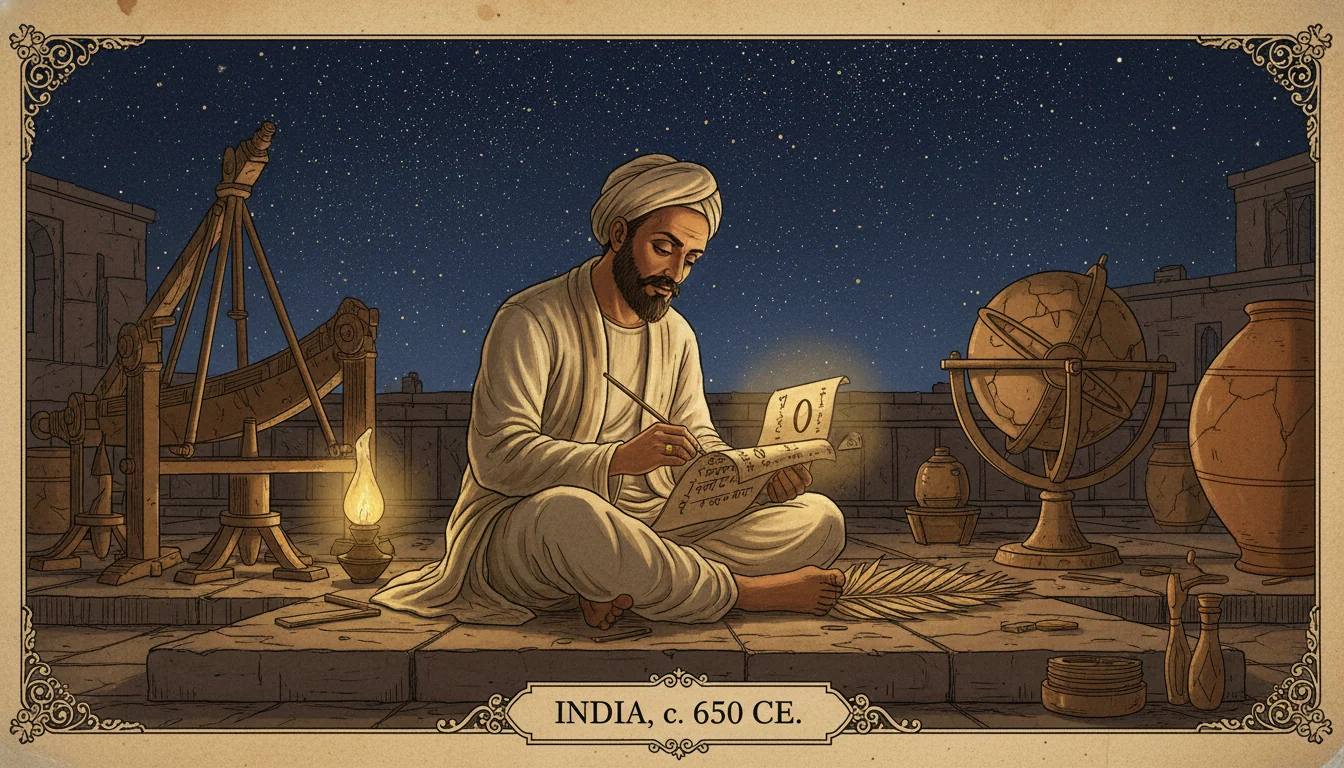
The ancient Greeks were brilliant mathematicians who built the foundations of geometry, proved theorems that still carry their names, and described the cosmos with impressive precision. They also had no zero. Aristotle argued that zero could not logically exist, because division by zero produced contradiction, and a thing that produced contradiction could not be real. This was philosophically coherent and mathematically catastrophic. It meant that the greatest mathematical civilization of the ancient Mediterranean was working with a permanent gap at the center of its number system.
The gap did not get filled in Greece. It got filled in India, by a mathematician named Brahmagupta, in 628 CE. That date is not the beginning of the story - the story is older and more complicated - but it is the moment when zero stopped being a vague concept and became a number with rules.
The placeholder and the number
Before getting to the invention, it is necessary to establish a distinction that most histories of zero blur: the difference between a placeholder zero and a number zero.
A placeholder zero marks an empty position in a positional number system. If you are writing 304 in a system where position determines value, you need something to show that the tens column is empty. Without a placeholder, 304 is indistinguishable from 34 or 30004 depending on spacing. Placeholder zeros solve a typographic problem. They do not participate in arithmetic.
A number zero is a value that can be added to other values, subtracted, and multiplied. It has properties: adding zero changes nothing, multiplying by zero produces zero. This zero is not a positional cue; it is a mathematical object. Discovering the placeholder is useful. Discovering the number is transformative.
Several ancient civilizations discovered the placeholder. Only a small number took the further step of discovering the number.
Babylon: the placeholder arrives
The Babylonians of ancient Mesopotamia developed the world's first positional number system, working in base 60. By around the 3rd century BCE, scribes began using a double-wedge cuneiform symbol to indicate an empty column in their tablets - to distinguish, say, 3,604 from 364. This is the earliest well-documented placeholder zero in the historical record.
But the Babylonian scribes did not perform arithmetic with this symbol. They did not ask what happened when you added it to itself, or multiplied another number by it, or subtracted it. The double-wedge was a spacing device. It appeared inside numbers to mark empty positions; it did not appear at the end of numbers, which would have required thinking of it as a number in its own right.
The Babylonian contribution was enormous - positional notation made complex calculation feasible in a way that non-positional systems like the Egyptian or Roman simply were not - but it was not zero as a number.
The Maya: an independent path
Somewhere in Mesoamerica, a civilization reached the same insight independently, through different means.
The Maya developed a sophisticated positional calendar system - the Long Count - for tracking time across vast periods. Their number system ran in base 20, with a modified base 18 adjustment for certain calendar cycles. To make this system work for recording dates, they needed a placeholder, and they invented one: a shell-shaped symbol that represented the concept of completion, of a cycle reaching its end.
The earliest confirmed Maya zero inscriptions date to around the 4th century CE, though the development may be somewhat earlier. What distinguishes the Maya zero from the Babylonian placeholder is that the Maya symbol represented not just an empty column but the idea of completion itself - the zero of a cycle that had run through all its values. Whether this amounts to treating zero as a number in the full mathematical sense is debated among scholars, but it was at minimum a conceptually richer placeholder than the Babylonian version.
The Maya zero had no influence on the development of Indian mathematics. These were independent inventions, separated by geography and time, reaching similar conclusions by different reasoning. The parallel development tells us something important: zero, once a positional system is in place, is an idea that eventually forces itself into existence.
India: the number is born
Among historians of mathematics, the question of who invented zero traces ultimately to the Indian subcontinent.
The Bakhshali manuscript, a mathematical text written on birch bark and discovered in Pakistan in 1881, contains a dot symbol used as a placeholder zero in calculations. The manuscript's dating has been contested for decades; analyses of different sections have returned dates ranging from the 3rd to the 10th century CE. It is clearly old and clearly uses a positional zero, but the question of exactly how old has not been definitively settled.
What is settled is the date of Brahmagupta's Brahmasphutasiddhanta: 628 CE. This text, written by a mathematician and astronomer from what is now Rajasthan, contains the first known explicit definition of zero as a number and the first systematic rules for arithmetic with it.
Brahmagupta's rules were specific. A number plus zero equals the number. A number minus zero equals the number. Zero times any number equals zero. A number plus its negative equals zero. These are the rules that make zero a number rather than a notation, and Brahmagupta stated them clearly.
He also attempted to divide by zero, which is where he stumbled. He declared that zero divided by zero equals zero, which is incorrect - division by zero is undefined, as Aristotle had sensed even without a concept of zero to work with. This error would take centuries to fully resolve. But the error does not diminish the achievement; it demonstrates that Brahmagupta was doing actual mathematics with zero, exploring its properties and reaching conclusions that could be checked and corrected.
The Gwalior inscription, a stone record from 876 CE in central India, contains what is considered the oldest zero in a clear number context, representing the number 270 in a form immediately recognizable to modern eyes. By the 9th century, zero in the Indian mathematical tradition was a fully integrated component of arithmetic.
The Arabic transmission
The Arab mathematical tradition absorbed Indian mathematics in the 8th and 9th centuries through a process of active translation and engagement. The Abbasid Caliphate, centered in Baghdad, supported a remarkable intellectual project: the translation of Greek, Persian, and Indian mathematical and scientific texts into Arabic. Indian numerals, including zero, traveled this route.
Muhammad ibn Musa al-Khwarizmi, working in Baghdad in the early 9th century, wrote texts on Indian arithmetic that made the Hindu-Arabic numeral system, including zero, accessible to Arabic-speaking scholars across the Islamic world. His name, Latinized, gives us the word "algorithm." The word "algebra" comes from the title of another of his works.
By the 10th century, the Hindu-Arabic numeral system - with zero - was the working system of mathematics from Central Asia to Spain. The zero had traveled from an Indian astronomer's manuscript in Rajasthan to the mathematical culture of the entire connected world in roughly two centuries.
Europe: the long resistance
Europe's encounter with zero was complicated. The Roman numeral system, which had no zero and no positional structure, had served Latin civilization for centuries. Its replacement required changing not just notation but a fundamental approach to how numbers worked.
The Italian mathematician Fibonacci, born in Pisa around 1170 and educated partly in North Africa where he encountered Arab mathematics, published Liber Abaci in 1202. The book introduced Hindu-Arabic numerals, including zero, to a European audience with systematic explanations of their use in commercial calculation. Fibonacci was not the first European to encounter these numerals, but he was the most effective at demonstrating their practical utility for merchants and accountants.
Adoption was not immediate. Florence briefly banned the Hindu-Arabic numerals in commercial bookkeeping in 1299, on the grounds that the use of zero made it too easy to falsify accounts by adding zeros to figures. The ban was eventually abandoned because the system was simply too useful to prohibit. German merchants fighting for commercial advantage over competitors who used the new system did not have the patience for philosophical objections to the concept of nothing.
By the 16th century, Hindu-Arabic numerals including zero were standard across educated Europe. The Gregorian calendar reform, the development of logarithms, the emergence of calculus in the 17th century - all of these depend on a positional number system with a functional zero. They would have been impossible with Roman numerals.
What zero made possible
The gap between a mathematics without zero and a mathematics with it is not a matter of notation. It is a matter of what questions can be asked.
Without zero as a number, there is no concept of negative numbers - there is nothing to be less than. Without zero and negative numbers, there is no number line, no coordinate system, no algebraic manipulation of equations with zero on one side. Without those tools, there is no calculus, no continuous mathematics, and eventually no modern physics.
The differential equations that describe the motion of planets, the flow of electricity, the behavior of quantum particles - these are written in a mathematical language that requires zero. The computers that run on binary code, a system where every value is either 0 or 1, require zero. The GPS system that triangulates your position using the mathematics of general relativity requires zero.
Brahmagupta, writing his rules for arithmetic in Rajasthan in 628 CE, could not have foreseen any of this. He was solving a problem that had bothered Indian mathematicians for generations: how to treat the result of subtracting a number from itself as a number you could work with. The problem seemed abstract. The solution turned out to be the load-bearing member beneath most of modern quantitative science.
That is the standard fate of genuinely important ideas: they appear to solve a narrow technical problem and turn out to have changed everything.
Zero's invention connects to other foundational breakthroughs in human thought. The number system zero belongs to has its own origin story, traced in Origins: Numbers. The calendrical pressures that drove the Babylonian placeholder are explored in Origins: The Calendar.
Quick Answers
Common questions about this topic
Who invented zero?
The concept of zero as a true number - not merely a placeholder - was first formally defined by the Indian mathematician Brahmagupta in his 628 CE text Brahmasphutasiddhanta. He established rules for arithmetic with zero, including addition, subtraction, and multiplication. Earlier civilizations used placeholder symbols to indicate an empty positional column, but did not treat zero as a number that could participate in calculations.
Did the Babylonians invent zero?
The Babylonians developed a positional number system and eventually used a double-wedge symbol to mark an empty column - a placeholder, not a number. They never treated zero as a value that could be added, subtracted, or multiplied. The placeholder and the number are two different concepts; the Babylonian contribution was the former.
Did the Maya independently invent zero?
Yes. The Maya developed a zero independently, using a shell symbol to represent the concept in their Long Count calendar. Maya zero is documented in inscriptions dating to around the 4th century CE, and may be somewhat earlier. This was a genuine mathematical zero used in positional calculations, developed entirely separately from the Indian tradition.
How did zero reach Europe?
Indian mathematical concepts, including zero, were transmitted to the Arab world through works including Al-Khwarizmi's 9th-century texts. European scholars encountered Hindu-Arabic numerals and zero through contact with Arab mathematics, particularly after the Italian mathematician Fibonacci popularized the system in his Liber Abaci in 1202. European resistance to zero lasted for centuries - Florence briefly banned its use in commercial bookkeeping in the 13th century on the grounds that it was too easy to falsify.

Ask the Inventors Themselves
Chat with the people who were there when familiar things began.
Create your free account →No card required. Some figures and features require a paid plan.
Join the HistorIQly Club
Get smarter about the past.
Weekly stories, deep dives, and exclusive content straight to your inbox.