Origins: Where Chess Actually Came From
The origins of chess trace back to 6th-century India, where a war game called Chaturanga traveled the Silk Road and transformed itself at every stop.
Read Wikipedia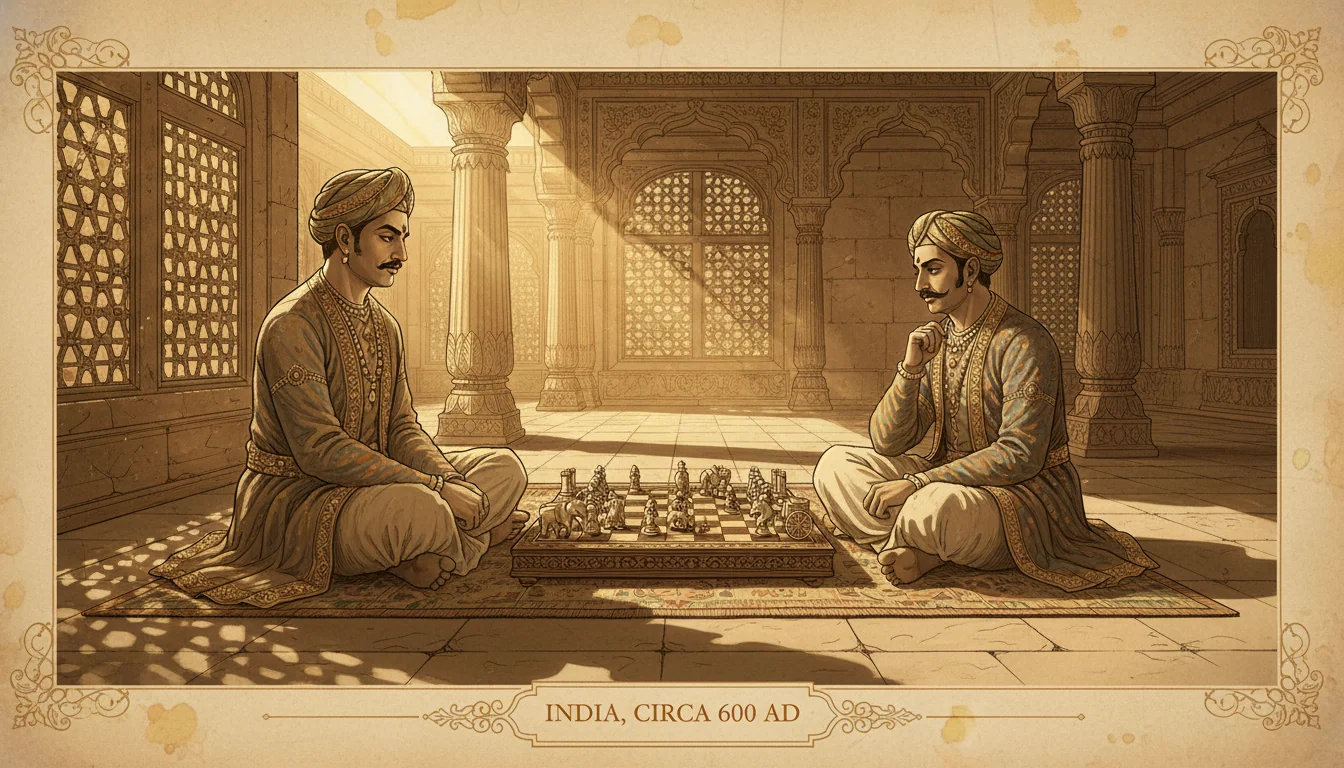
The comfortable version of the origins of chess has the game invented by a wise counselor in ancient Persia, brought to the caliph's attention and then to Europe by traveling merchants, arriving in the medieval courts of France and England fully formed. This version requires almost no facts. Chess was invented in India, traveled to Persia, was transformed by Arab players into something recognizable, and then underwent its most radical overhaul in 15th century Spain, when someone decided that the weakest piece on the board should become the most powerful one. That decision changed everything.
India: the original four armies
The earliest version of the game is called Chaturanga, a Sanskrit word meaning "four divisions," specifically the four branches of the Indian military: infantry, cavalry, war elephants, and war chariots. The pieces represented these forces. What we now call pawns were infantry. Knights on horseback are still knights. The bishop, which began as a war elephant, kept its diagonal movement from that origin. The rook, which moved in straight lines like a chariot, was originally exactly that.
The game is first mentioned in Sanskrit literature around the late 6th or early 7th century CE, placing its origins in the Gupta period of Indian history, one of the most productive eras of Indian art, mathematics, and philosophy. The specific date of invention cannot be pinned down: no surviving text says "this is when someone invented Chaturanga." What the sources give us is a game already established by the time writers first describe it.
Two details distinguish Chaturanga from the game that would follow. First, it was played by four players, each controlling one army in a corner of the board, with alliances and betrayals as part of the gameplay. Second, the outcome of some moves was determined by dice. The dice element connects it to older Indian board games and suggests Chaturanga evolved from earlier traditions rather than being invented from nothing by a single individual.
The two-player, no-dice version that we recognize as chess came later, probably as an Iranian adaptation. But the board, the 64 squares, and the fundamental hierarchy of pieces that is still recognizable today originated in India.
Persia: Shah mat
The game arrived in Persia - the Sassanid Empire - probably in the early 6th century CE, traveling along the established trade routes between India and the Iranian plateau. A Pahlavi text called the Wizishn ud nigirishn i chatrang, roughly translated as "The Explanation of Chess," describes an Indian delegation bringing the game to the court of the Sassanid king Khosrow I, around the mid-6th century. Whether this specific diplomatic episode is historical or legendary, the game's arrival in Persia around this time is well-attested.
The Persians called it Chatrang, which shifted into Shatranj. They removed the dice. They refined the game into a pure two-player contest of skill, with no random elements, which remains its defining characteristic. They kept the four-army structure of pieces but reorganized the game around a central tension: the survival or capture of the king.
The Persians gave chess its most enduring phrase. When the king cannot escape, players announced "Shah mat" - the king is helpless. In one Arabic transmission this became "checkmate." The word has been in continuous use for roughly fourteen centuries, carrying its Persian meaning unchanged through Arabic, Spanish, French, and English.
The Persian game also gave chess its culture of written analysis. Shatranj players composed problem positions, wrote theoretical texts about openings and endgames, and ranked players in something resembling formal competition. The intellectual infrastructure around chess - the idea that it could be studied, that patterns recurred and could be catalogued - began in Persia and was further developed after the Arab conquest.
The Islamic world: seven centuries of chess theory
When Arab armies conquered Persia in the 630s and 640s CE, they found a game deeply embedded in Persian court culture. Chess was adopted with enthusiasm across the Islamic world. Within a century of the conquest, Arabic chess manuals were being written, players were competing for prizes and reputations, and the game had spread from Baghdad to Cairo to the courts of Muslim Spain.
The 9th century player al-Adli al-Rumi is among the earliest whose work survives. His manual, written around 840 CE, is the first known comprehensive chess text and covers openings, endgames, and specific problem positions. Later players including al-Suli and others developed a corpus of chess theory that would not be surpassed in scope until the European game modernized in the Renaissance.
Arab players modified the pieces slightly. The war elephant became the al-fil, simply "the elephant," and its movement remained a short diagonal. The counselor became the firzan or vizier. The game's fundamentals were preserved, but the pieces shifted further from their military origins and toward abstract tokens.
Arabic chess also established a practical convention that shaped the game for centuries: the pieces were simplified or abstracted in design to avoid representing human or animal figures, which conflicted with Islamic interpretive traditions about images. The abstract chess piece - the stylized column, the knob, the forked top - comes from this period. When the game arrived in Europe, Europeans who wanted representational pieces were essentially reinventing what had been deliberately removed.
Europe: the queen takes over
Chess appears in European sources by at least the 10th century, arriving through Moorish Spain and through the Norman and Byzantine networks of the Mediterranean. The earliest European chess pieces are from the 10th and 11th centuries. By the 12th century, the game was firmly established in the courts of France, England, Italy, and the Holy Roman Empire.
The Lewis Chessmen, carved from walrus ivory in Norway around 1150 to 1200 CE and later deposited on the Isle of Lewis in Scotland, show the game as Europeans understood it: kings seated on thrones, queens seated beside them, bishops in ecclesiastical robes, knights on horseback, and rooks represented not as chariots but as armed soldiers - the guards of a castle. Every piece is human. Every piece has been re-imagined in European social terms.
The piece identities reflect European feudalism rather than Indian military structure. The elephant had no role in European warfare and no cultural resonance, so it became the bishop, acquiring its current name from its role in court ceremony. The chariot had been gone from European warfare for centuries, so the rook became associated with the castle towers of medieval fortification, which is why the piece still looks like a turret. The vizier of the Persian game became a queen, reflecting the importance of consorts in European royal courts.
For several centuries, the European game was slower and smaller than what it would become. The queen could move only one square diagonally. The bishop could jump exactly two squares diagonally and no further. Pawns could not advance two squares on the first move. Checkmate ended the game but so, in some versions, did stalemating the opponent's king - which counted as a win rather than a draw. These rules varied by region and by era, which meant that playing chess in an unfamiliar city sometimes required negotiating the local variant.
Spain, 1475: the modern game
The most dramatic change in chess history happened in late 15th century Spain, where the queen's movement was overhauled from a single diagonal step to unrestricted movement in all directions. The exact date and author of this rule change are not recorded. The new game appears in Castilian manuscripts around 1475 and spreads quickly. It was sometimes called "la dama" in reference to the powerful queen, or "the mad queen's chess" in Spanish - ajedrez de la dama.
The effect on gameplay was revolutionary. A piece that had been a minor nuisance became the board's dominant force. Openings that had taken dozens of moves to develop could now be resolved in five or six. The game's pace accelerated, new tactical patterns emerged, and the entire body of existing theory became partially obsolete. The first book on the modern game, a Spanish manual published in 1497, was also the first chess book printed with movable type.
The other modern rules followed within a generation. Castling, the pawn's initial two-square option, en passant, and the modern stalemate interpretation all stabilized across Europe by the early 16th century. By 1550, the game played in a Madrid coffeehouse and the game played in an Amsterdam merchant's parlor and the game played in a London inn were all recognizably the same game. The Indian Chaturanga of the 6th century would have been unrecognizable to any of those players.
The board had not changed. The 8x8 grid, the 32 pieces, the fundamental objective - eliminate the king - had survived intact from India through Persia through the Arab world to Europe. Everything around those constants had been reinvented to fit whoever was playing. That combination of stable structure and adaptable surface is probably why chess outlasted every other board game of its era and most of the civilizations that produced them.
For more Origins stories about how everyday things spread across civilizations, read our pieces on the origins of coffee and how bread was invented.
Quick Answers
Common questions about this topic
Where did chess originate?
Chess originated in India, almost certainly during the Gupta period, around the 6th century CE. The earliest form of the game was called Chaturanga, Sanskrit for 'four divisions,' referring to the four branches of the Indian army: infantry, cavalry, war elephants, and chariots. These became the pieces we now call pawns, knights, bishops, and rooks.
How did chess reach Europe?
Chess traveled from India to Persia, where it was called Shatranj. After the Arab conquest of Persia in the 7th century CE, it spread across the Islamic world and arrived in Europe through multiple routes: through Moorish Spain, through Sicily, and through the Byzantine Empire. The game was well established in European courts by the 10th and 11th centuries.
When did chess get its modern rules?
The most significant change in chess history was the transformation of the weakest piece on the board into its most powerful one. In the original game, the counselor or vizier could move only one square diagonally. In late 15th century Spain, this piece became the queen with unrestricted diagonal, horizontal, and vertical movement. Other modern rules including castling, the pawn's initial two-square move, and en passant developed gradually across Europe between roughly 1475 and the early 16th century.
What are the Lewis Chessmen?
The Lewis Chessmen are a collection of 93 medieval chess pieces discovered in the 19th century on the Isle of Lewis in Scotland, carved from walrus ivory and whale teeth, probably in Norway around 1150-1200 CE. They are among the most famous chess sets in existence and provide a vivid picture of the pieces as Europeans of the 12th century understood them: kings, queens, bishops, knights on horseback, rooks depicted as armed guards, and pawns.

Ask the Inventors Themselves
Chat with the people who were there when familiar things began.
Create your free account →No card required. Some figures and features require a paid plan.
Join the HistorIQly Club
Get smarter about the past.
Weekly stories, deep dives, and exclusive content straight to your inbox.