Origins: How Gunpowder Was Discovered
The gunpowder origin story: Tang dynasty alchemists searching for immortality accidentally invented the most destructive compound in history, and changed warfare forever.
Read Wikipedia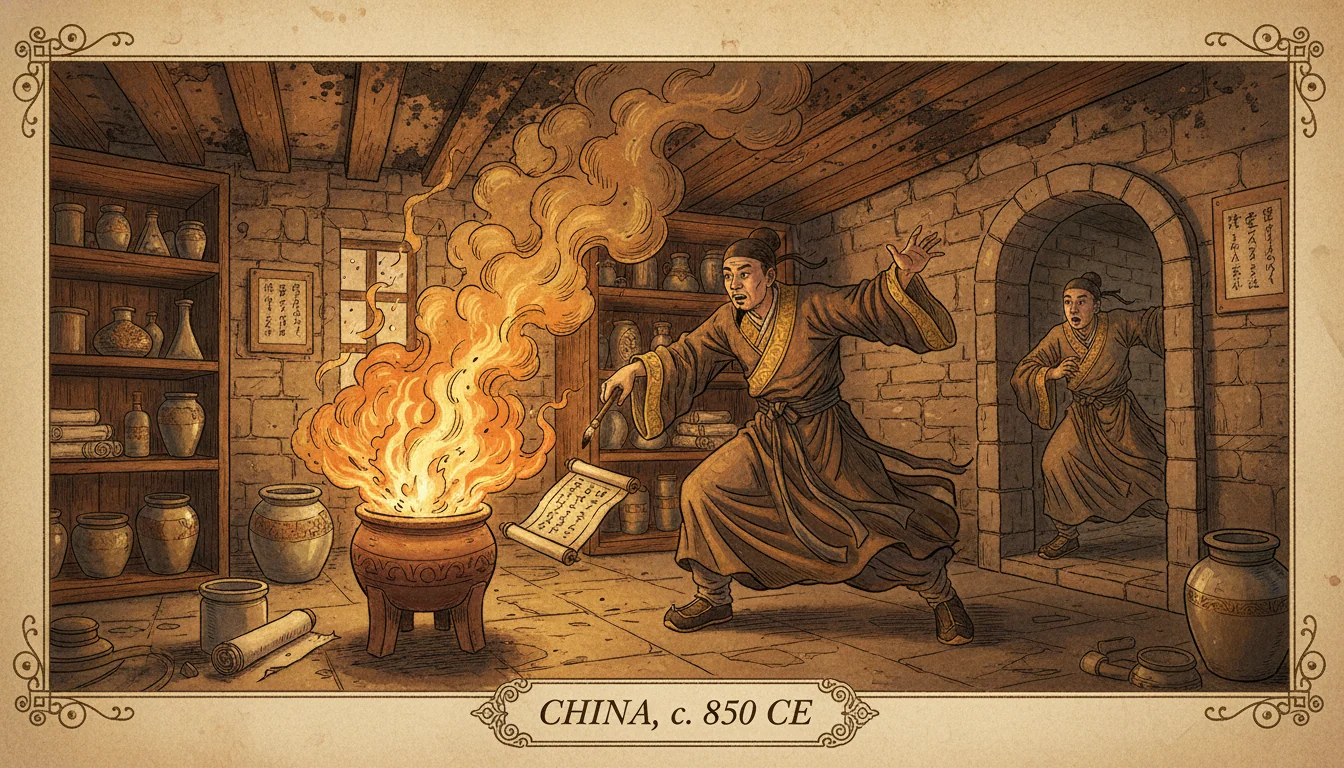
The Tang dynasty alchemists were not trying to blow anything up. They were trying to live forever.
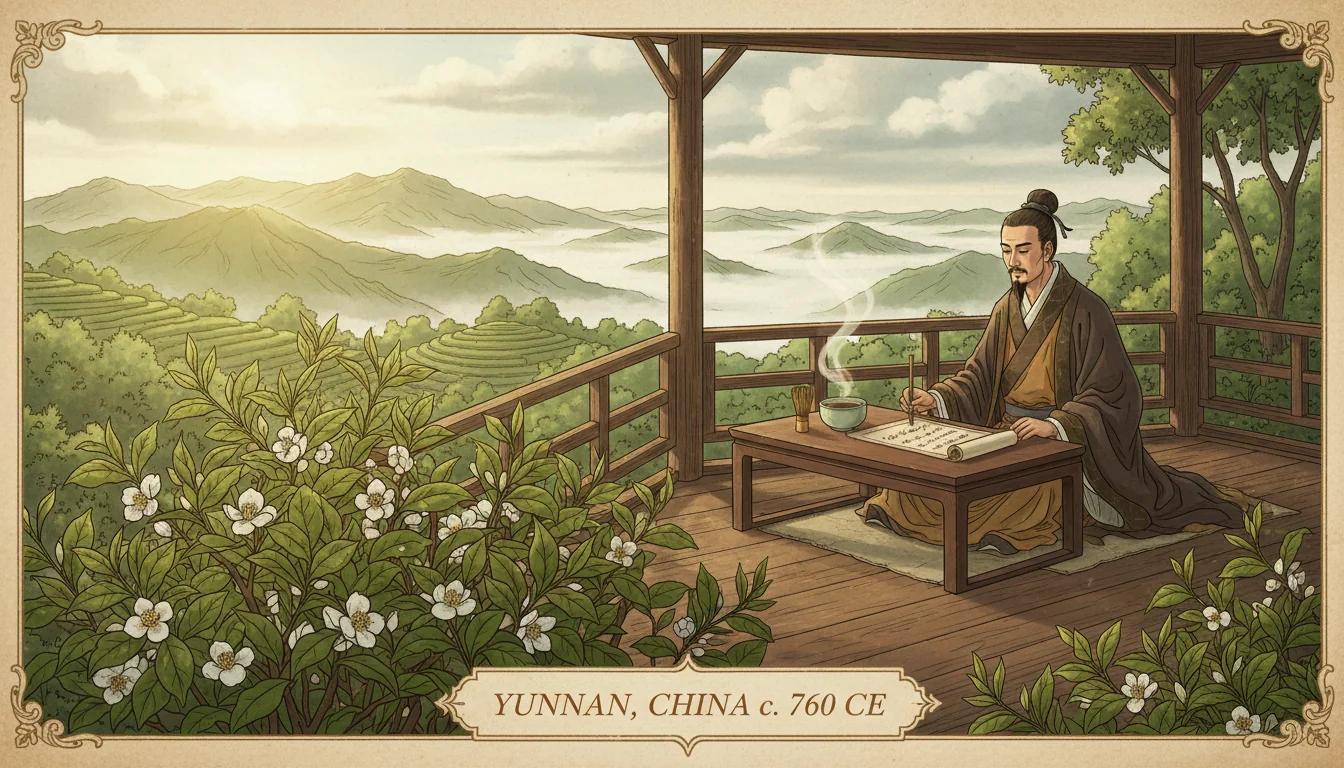
In the imperial courts and mountain hermitages of 9th-century China, Taoist alchemical practice centered on the search for the elixir of immortality, a substance that would halt the body's decay and allow the cultivated adept to transcend death. The ingredients they combined were drawn from a long tradition of Chinese pharmacopoeia: sulfur, mercury, arsenic compounds, lead, and saltpeter, the white crystalline mineral that appeared at the surface of damp soil near dung heaps and cave walls and had been known in China for centuries as a medicine and a cleansing agent.
At some point in the mid-9th century, in circumstances no single source records, someone combined sulfur, charcoal, and saltpeter in the wrong proportions and produced fire where no fire was expected. The discovery went into the records not as a triumph but as a warning.
The warning that launched a revolution
The earliest surviving written formula for gunpowder appears in a Taoist text known to scholars as the Classified Essentials of the Mysterious Tao of the True Origins of Things, dating from around 850 CE. The relevant passage is, appropriately, a safety notice. It warns alchemists against combining sulfur, realgar (arsenic sulfide), and saltpeter with honey (as a carbon source) because three practitioners had already set their faces and hands on fire by doing so, and one had burned down his house.
This was not a recipe for a weapon. It was a recipe for "do not do this." The compound was already understood as dangerous before anyone thought to deploy it militarily.
The three components work together through a specific chemical logic that Chinese alchemists discovered empirically centuries before the underlying science was understood. Potassium nitrate is an oxidizer: it contains bound oxygen that it releases when heated, which sustains rapid combustion even in the absence of ambient air. Charcoal is the primary fuel. Sulfur lowers the ignition temperature and stabilizes the burn rate. Mixed correctly, the three form a compound that ignites easily, burns extremely fast, and produces a large volume of hot gas almost instantaneously. Mixed incorrectly, or carelessly, it detonates on your face.
The Song dynasty, which followed the Tang in 960 CE, was the era in which the compound moved from alchemical curiosity to military asset.
Song dynasty weaponization
The transformation of gunpowder from a dangerous alchemical nuisance into a military tool was gradual and took several forms before anyone pointed a tube at an enemy soldier and asked the powder to launch a projectile.
The first military applications were incendiary. Fire arrows tipped with a paste of gunpowder could be launched by standard bows, burning on impact and setting fires in enemy fortifications or ships. Fire bombs, pottery or metal containers packed with the mixture and ignited by fuse, were catapulted over walls. These were improvements on existing incendiary weapons, not revolutionary departures from them.
The next step was the fire lance, the huochong, which emerged in the early 10th century. A bamboo tube packed with gunpowder was attached to a spear. When ignited, it produced a sustained jet of fire from the tube's open end for several seconds, functioning as a crude short-range flamethrower. Later versions added shrapnel, ceramic shards, or small pellets behind the powder charge, making them something close to a primitive shotgun. The fire lance is the conceptual ancestor of the gun, and the Chinese made the connection explicitly: the next development was the metal-barreled gun.
By the 13th century, the Song military was deploying bronze and iron-barreled hand-cannons and artillery pieces that launched stone or metal projectiles with powder charges. The earliest securely dated archaeological gun, now in the Museum of Chinese History, is a bronze hand-cannon dated to 1288. This is a real gun, not a fire lance; it has a chamber, a barrel, and was designed to propel a projectile by contained explosion.
The Mongols and the westward flow
The Mongol empire's expansion across Asia in the 13th century was both a disaster for civilization and one of the most effective technology-transfer mechanisms in history. The Mongols absorbed the military expertise of every people they conquered, and when they fought the Song dynasty, they fought the most gunpowder-sophisticated military in the world. Mongol forces incorporated Chinese gunpowder engineers into their armies.
As the Mongol empire expanded westward into Persia and the Islamic world, gunpowder knowledge went with it. Arab military texts from the late 13th and early 14th century, following the Mongol period, describe gunpowder formulas that are clearly derived from Chinese practice, though they also include significant improvements in the refinement of saltpeter, the most variable and difficult component to produce at high purity.
Hasan al-Rammah, an Arab military writer of the late 13th century, produced a technical treatise on military devices that includes some of the most detailed early gunpowder formulas outside China. He describes the purification of saltpeter by dissolution and recrystallization, a processing step that substantially increases the oxidizing power of the compound and was necessary for making powder that was reliable enough for firearms rather than just for fire-starting.
Roger Bacon and the European mystery
The English friar and natural philosopher Roger Bacon referenced a gunpowder formula in his writings around 1267, encoding it as an anagram to prevent irresponsible use. When the anagram was solved in the 20th century, the formula was recognizable as a relatively low-potency gunpowder. Whether Bacon had encountered the formula through Islamic texts, through travelers, or through some other source remains uncertain. His writings suggest genuine familiarity with the compound's properties, not just secondhand rumor.
Albertus Magnus, the German Dominican scholar and scientist, also referenced incendiary mixtures in his writings from the same period. The knowledge was circulating in European learned circles by the second half of the 13th century, even if Europeans had not yet turned it into a military system.
The German friar Berthold Schwarz appears in later tradition as the European "inventor" of gunpowder, but he is almost certainly a mythological figure rather than a historical one, a legend that grew up to give Europe a local discoverer for something that obviously arrived from elsewhere. The documentary record supports no such person.
Cannons at Crecy and after
The first documented use of gunpowder weapons in European battle is generally placed at the Battle of Crecy in August 1346, where English forces used a small number of cannons against the French. The accounts are brief and the weapons were primitive, but the principle was established: a tube, a charge, a projectile, and a detonation that made warfare permanently different.
The first cannons were made of iron or bronze, breech-loaded or muzzle-loaded depending on the design, and deeply unreliable. They exploded on their crews, misfired in wet weather, and required laborious reloading that made them militarily marginal in their earliest decades. But they were improving every generation, and the direction of improvement was one-way.
By the late 14th century, large siege guns were reducing castle walls that had previously been impregnable. By the 15th century, the Ottoman cannon that broke the walls of Constantinople in 1453 after a fifty-three day siege had effectively ended the era of the fortified stone castle as a decisive military asset. By the 16th century, the handgun had replaced the crossbow in most European armies.
The formula's secrets
What made early gunpowder development so difficult in Europe and the Islamic world was the saltpeter problem. Potassium nitrate is produced biologically, in soil enriched by decaying organic matter and animal waste, where certain bacteria convert nitrogen compounds into nitrates. In 9th-century China, saltpeter was abundant and well-understood. In medieval Europe, it had to be laboriously scraped from barn floors, stable walls, caves, and dung heaps, or produced in specially constructed nitraries where organic matter was layered to encourage bacterial production.
Saltpeter refiners, called saltpetermen in England, had the legal right to dig up stable floors and barn walls in search of the mineral, a privilege that made them profoundly unpopular with anyone who kept horses or cattle. The saltpeter shortage limited European gunpowder production for centuries and drove a constant search for new sources, including the large natural saltpeter deposits in India that the British East India Company eventually controlled in the 18th century.
The quality of the powder also mattered enormously. Early black powder was mixed by hand as a fine dust, which was dangerous to handle and inconsistently distributed in the barrel. By the 15th century, European producers had developed "corned" powder, in which the mixture was moistened into a paste, dried, and broken into small granules. Corned powder was safer, more consistent, and burned faster than dust powder, producing more propulsive force and making firearms substantially more powerful.
What got lost in the retelling
The popular narrative of gunpowder begins with medieval European cannon and imagines the Chinese as inventors who somehow failed to develop what they invented. This is the wrong frame. The Chinese developed guns, rockets, bombs, land mines, and naval fire-weapons over several centuries before European armies had their first primitive cannon. What changed with the Mongol transfer of knowledge was not the invention itself but the direction of subsequent development.
European metallurgy in the 14th through 16th centuries was capable of producing increasingly reliable and powerful gun barrels faster than East Asian metallurgy could in the same period, partly because of different fuel supplies (Europe had abundant charcoal from cleared forests; China's forests were more depleted), partly because of different economic incentives driven by the particular nature of European warfare among states of comparable power.
The Tang alchemist who first saw his paste catch fire unexpectedly was trying, in the most direct sense, to cheat death. He did not cheat his own. But the compound he and his colleagues identified, refined over centuries and passed westward through one of history's most violent empires, killed more human beings than any other single technological discovery until the 20th century produced its own answer to that record.
The immortality project, on balance, did not go as planned. For the weapons this discovery made possible, the flintlock musket history traces the technology from Chinese powder to 18th-century European warfare. The origins of the printing press is the other medieval technology transfer story that runs parallel to this one.
Quick Answers
Common questions about this topic
Who invented gunpowder?
Chinese Taoist alchemists in the Tang dynasty, active roughly in the 9th century CE, are credited with discovering gunpowder. The earliest surviving written formula appears in a Taoist alchemical text from around 850 CE, which describes the accidental discovery that combining sulfur, charcoal, and saltpeter (potassium nitrate) produced a violently flammable mixture. The discovery was made while searching for the elixir of immortality.
How did gunpowder reach Europe?
Gunpowder knowledge traveled westward along the Silk Road through the Islamic world, where scholars like Hasan al-Rammah described formulas in the 13th century. The English friar Roger Bacon referenced a gunpowder formula in coded writing around 1267. The first documented use of gunpowder weapons in European battle was at the Battle of Crecy in 1346, where English forces deployed primitive cannon against the French.
What is gunpowder made of?
Black powder, the original gunpowder, is a mixture of potassium nitrate (saltpeter), charcoal, and sulfur, in proportions that vary slightly by formula and application. The potassium nitrate provides oxygen to sustain rapid combustion even without air; the charcoal is the primary fuel; the sulfur lowers the ignition temperature and speeds the burn rate. Standard military black powder settled around 75 percent saltpeter, 15 percent charcoal, and 10 percent sulfur.
Did Islamic scholars independently discover gunpowder?
The current historical consensus is that gunpowder knowledge reached the Islamic world from China via the Mongol expansion and Silk Road trade, rather than through independent discovery. Early Islamic texts on the subject appear after the Mongol conquests of the 13th century and show familiarity with Chinese formulas. However, Islamic scholars significantly improved the refinement of saltpeter, a critical step in making high-quality black powder.

Ask the Inventors Themselves
Chat with the people who were there when familiar things began.
Create your free account →No card required. Some figures and features require a paid plan.
Join the HistorIQly Club
Get smarter about the past.
Weekly stories, deep dives, and exclusive content straight to your inbox.