Origins: Where Coffee Was Actually Invented
The origins of coffee trace not to an Ethiopian goatherd but to 15th-century Sufi mystics in Yemen, who first roasted, ground, and brewed the bean into a drink.
The popular story of coffee involves a 9th-century Ethiopian goatherd named Kaldi who watched his flock dance after nibbling red cherries from a wild bush, sampled the berries himself, and ran to a local monastery with the discovery. It is a charming origin story. It is also almost certainly fiction.
The Kaldi tale was first written down by a Maronite scholar named Antoine Faustus Nairon in 1671, nearly a thousand years after it supposedly happened. By that point coffee was already a fixture in Ottoman cities, Italian ports, and London chophouses, and Europe was hungry for an origin story exotic enough to match the drink. Kaldi appears in no earlier Ethiopian, Arabic, or Persian source. He is souvenir mythology, retrofitted to a global commodity.
The actual origins of coffee are older, stranger, and more interesting.
Ethiopia: the plant, not the drink
Coffea arabica, the species responsible for nearly all premium coffee today, is native to the highland cloud forests of southwestern Ethiopia, especially the historical region of Kaffa, which gave the drink its name. The wild plant grew, and still grows, in the understory of cloud forests at altitudes between 1,500 and 2,200 meters. Genetic studies confirm Ethiopia as the single point of domestication for arabica.
But Ethiopians did not, as far as anyone can document, brew coffee for most of human history. The Oromo people of the region appear to have chewed the raw cherries, sometimes pounded together with animal fat as a high-energy field ration. There is no Ethiopian text describing coffee as a beverage before the 18th century. The plant was theirs. The drink was not.
That gap, the millennium between the plant being known and the drink being invented, is the part the Kaldi legend papers over. For roughly a thousand years, humans walked past coffee shrubs and did not think to brew them.
Yemen, 1454: the first cup
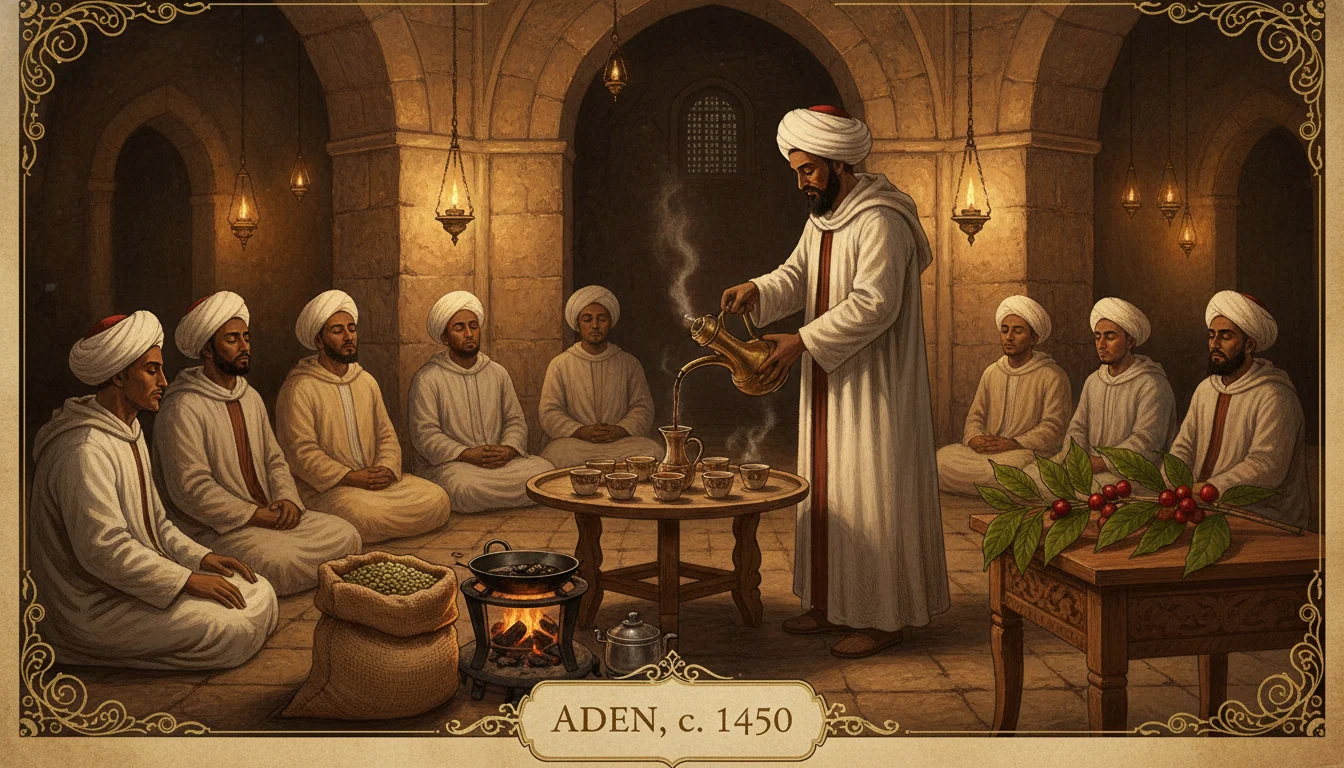
The earliest documented account of coffee being drunk as a beverage comes from Yemen in the middle of the 15th century. The historian Abd al-Qadir al-Jaziri, writing in Mecca around 1587, traced the practice to a Sufi master named Sheikh Jamal al-Din al-Dhabhani, who was active in Aden around 1454. Al-Dhabhani had traveled to Ethiopia, observed people chewing the berries, and brought the seeds back to Yemen. There he, or his students, did something nobody seems to have done before: they roasted the green seeds, ground them, and steeped them in hot water.
The reason was practical and devotional. Sufi orders in Yemen practiced long nighttime sessions of dhikr, rhythmic chanting and prayer that could last until dawn. Coffee was discovered to keep the mystics awake without the drowsiness or queasiness of other stimulants. By the 1470s, the drink was a fixture of Sufi ritual life across Yemen. By the 1490s, it had spread to Mecca itself, where pilgrims encountered it during Hajj and carried it home.
The Arabic word for the drink, qahwa, originally meant "that which prevents sleep." It had previously been a poetic term for wine. In a culture where wine was forbidden, qahwa became the wine that was permitted. The name traveled with the drink: Turkish kahve, Italian caffè, French café, English coffee. They all start in a Yemeni mosque.
Mocha: the world's first coffee port
The port of al-Mukha, which Europeans rendered as Mocha, sits on the Yemeni coast of the Red Sea. By the early 16th century it was the only place in the world where coffee was exported in commercial quantity. Yemeni growers and Mocha merchants held a deliberate, century-long monopoly: green beans were boiled or partially roasted before export so they could not germinate abroad. Foreign visitors were forbidden from the cultivation areas in the highland terraces of Bayt al-Faqih.
The monopoly held until around 1600, when an Indian Sufi named Baba Budan reportedly smuggled seven fertile beans out of Yemen strapped to his chest, and planted them in the hills of Chikmagalur in southern India. Within a generation, coffee was being grown in India, then Java (by the Dutch in 1696), then the Caribbean, then Brazil. The Yemeni monopoly ended. The word "Mocha" survived as a marker of the original.
The bans
Wherever coffee went, somebody tried to ban it. The first attempt came in 1511, when the governor of Mecca, Khair Beg, convened a panel of jurists and physicians to declare coffee intoxicating and therefore forbidden. Coffeehouses in Mecca were shuttered, beans burned in the streets, and customers beaten. The ban lasted months. The sultan in Cairo overruled it.
The pattern repeated. Cairo banned coffee in 1532. The Ottoman sultan Murad IV banned it in Istanbul in 1633 and made coffee drinking a capital offense; he reportedly walked the city in disguise, beheading violators on the spot. King Charles II of England issued a proclamation suppressing London's coffeehouses in 1675, calling them seminaries of sedition. The ban was withdrawn within eleven days after merchant outrage.
What every banner sensed correctly was that coffeehouses were not really about coffee. They were about the room. A space where men sat for hours, sober, talking. That had no analogue in earlier cultural life. Wine houses produced fights and singing. Coffeehouses produced conversation, news, conspiracy, business, and politics. Rulers found this far more disturbing than they had expected.
Europe: Venice, Oxford, London
Coffee reached Europe by sea, not by land. Venice, with its long Levantine trade, was the first major European port to receive bulk shipments, around 1615. According to a popular and probably embellished story, advisors to Pope Clement VIII urged him to denounce the Muslim drink, but the pope tasted it, declared it too delicious to leave to the infidels, and symbolically baptized it.
The first documented English coffeehouse opened in Oxford in 1650, run by a Lebanese Jewish entrepreneur named Jacob. London followed in 1652, when Pasqua Rosée, an Armenian or Greek servant of a Levant Company merchant, opened a stall in St Michael's Alley. By 1700, London had more than two thousand coffeehouses, roughly one for every hundred adult men in the city.
These coffeehouses, nicknamed "penny universities" because admission cost a penny, became the operating system of the early Enlightenment. Lloyd's of London began as a Tower Street coffeehouse where shipping merchants met to trade insurance contracts. The Royal Society scientists frequented Garraway's. Newspapers were read aloud at Will's. Stock prices were posted at Jonathan's, which would later become the London Stock Exchange. The coffeehouse was where information went to be priced.
Vienna, 1683: the siege windfall
The other founding myth of European coffee involves the Battle of Vienna. When the Ottoman army besieging the city was routed in September 1683, the retreating soldiers left behind tents, weapons, and large stocks of unfamiliar green beans. A Polish-born soldier and translator named Franciszek Jerzy Kulczycki, who had spent time as a captive in Ottoman territory and recognized the beans, claimed the haul as part of his battle reward and used it to open one of Vienna's earliest coffeehouses.
Recent Austrian historians have argued that an Armenian merchant named Johannes Diodato actually opened Vienna's first licensed coffeehouse in 1685, and that Kulczycki's role has been retroactively inflated. Either way, the beans came from the abandoned Ottoman camp, and Viennese café culture, the melange, the kipferl, the unhurried newspaper-reading tradition, traces directly to the post-siege windfall.
What got remembered, what got forgotten
The Kaldi legend stuck because it offered Europe a tidy, exotic, pre-Islamic origin for a drink Europe wanted to claim. The Sufi mystics of 15th-century Yemen, the Mocha export monopoly, the Ottoman coffeehouses of Istanbul, and the Indian smuggler Baba Budan all got reduced, in the popular telling, to flavor notes and place names on a bag.
The actual sequence is harder to romanticize but easier to defend with sources. Coffee the plant came from Ethiopia. Coffee the drink was invented in Yemen. Coffee the social institution was perfected in the Ottoman world. Coffee the global commodity was forced open by Indian smuggling and Dutch and Portuguese colonial agriculture. By the time it reached the European coffeehouse, it had passed through at least four civilizations, each of which left a fingerprint.
The next time someone tells you coffee was discovered by an Ethiopian goatherd, you can answer that the goatherd is a 17th-century European invention, and the real inventor was a tired Sufi master in Aden who needed to stay awake for prayer.
For more stories about how everyday things got their start, read our explorations of the origins of chess and how bread was invented.
Quick Answers
Common questions about this topic
Where did coffee originally come from?
The Coffea arabica plant is native to the highland cloud forests of southwestern Ethiopia, especially the historical region of Kaffa, which gave the drink its name. But Ethiopians did not brew coffee as a beverage. The earliest documented use was as a chewed cherry mixed with animal fat. Coffee as a drink was invented later, in 15th-century Yemen.
Who really invented coffee?
Sufi mystics in 15th-century Yemen are the first people documented to have roasted, ground, and brewed coffee beans as a beverage. The historian Abd al-Qadir al-Jaziri credited Sheikh Jamal al-Din al-Dhabhani of Aden, active around 1454, with introducing the practice to Sufi orders, who used it to stay awake during long nighttime prayer sessions.
Why was coffee banned in so many cities?
Coffeehouses, not the drink itself, were what worried rulers. Mecca banned coffee in 1511, Cairo in 1532, Istanbul in 1633, and London in 1675. Every ban targeted the social space where men sat sober for hours discussing news, politics, and business. Wine houses produced singing. Coffeehouses produced conversation, and conversation produced sedition.
When did coffee first reach Europe?
Bulk shipments arrived in Venice around 1615 through long-standing Levantine trade routes. The first English coffeehouse opened in Oxford in 1650, and London followed in 1652 with a stall run by Pasqua Rosée. By 1700, London had more than two thousand coffeehouses, nicknamed 'penny universities' because admission cost a penny.

Ask the Inventors Themselves
Chat with the people who were there when familiar things began.
Trace It to the SourceJoin the HistorIQly Club
Get smarter about the past.
Weekly stories, deep dives, and exclusive content straight to your inbox.