Origins of Pizza: Where It Was Actually Invented
The origins of pizza trace to 18th-century Naples, not 1889. The Margherita story is myth. We trace pizza's history from ancient flatbreads to Neapolitan street food.
The origins of pizza are tangled up in a perfectly designed myth. The Margherita story is perfectly designed. A royal visit to Naples in June 1889. The queen, weary of French haute cuisine, asks to taste the local street food. The pizzaiolo Raffaele Esposito of Pizzeria Brandi prepares three varieties, and the queen's favorite is the one topped with tomato, mozzarella, and fresh basil - the colors of the Italian flag. She writes a thank-you note. He names the pizza after her. A national dish acquires its founding myth.
There is even a letter. A letter does exist in the Brandi pizzeria's archives, attributed to Galli Camillo, chief of the Royal Household, thanking Esposito for the three pizzas he prepared for the queen. It is dated June 1889.
And yet, every serious food historian who has looked at the Margherita story has arrived at the same conclusion: the pizza existed before the queen arrived, the story was assembled to serve Esposito's commercial interests, and the founding myth of the world's most popular food is, at best, an opportunistic recasting of a much longer history. The letter itself has been questioned, with some historians noting that Brandi's own records about the visit changed over time.
The actual story of pizza is older, stranger, and more interesting than a royal endorsement.
The ancient flatbread
Before there was pizza, there was flat bread with things on it - a culinary category so obvious and so universal that every civilization around the Mediterranean, and most beyond it, arrived at it independently.
The ancient Romans ate a disk of baked flatbread they called panis focacius, which they topped with olive oil, herbs, garlic, and sometimes cheese. The word focacius survives in focaccia, which is still eaten in Liguria and Tuscany in forms not dramatically different from the Roman original. Greek settlers in southern Italy in the centuries before Rome brought their own tradition of plakous, a flatbread with toppings. The Etruscans had something similar.
The word "pizza" itself appears in a Latin document from the town of Gaeta, in southern Italy, dated 997 AD. A tenant farmer is required to deliver to the bishop, on certain feast days, a specified number of "pizze." The document does not describe what they contain, which makes 997 a landmark for the word but not for the food as we know it.
None of these ancient or medieval flatbreads had tomatoes. The tomato is a plant of Central America, in the nightshade family, cultivated by the Aztecs and brought to Europe by Spanish colonizers in the early 16th century. The first documented tomato in Europe appears in a Seville botanical record in 1523. For most of the following century, Europeans regarded the tomato with deep suspicion: it was related to nightshade and belladonna, it was red, and it came from the New World, which was reason enough to distrust it. The English called it the "love apple" and generally looked at it sideways. Many physicians believed it was poisonous.
Naples and the poor man's food
The city where the tomato stopped being suspicious and started being eaten was Naples. Naples in the 17th and 18th centuries was one of the largest cities in Europe and one of the most unequal. The lazzaroni, the vast urban poor of the Neapolitan streets, needed food that was cheap, filling, portable, and edible without cutlery or a table. Flatbread with toppings fit all four criteria perfectly.
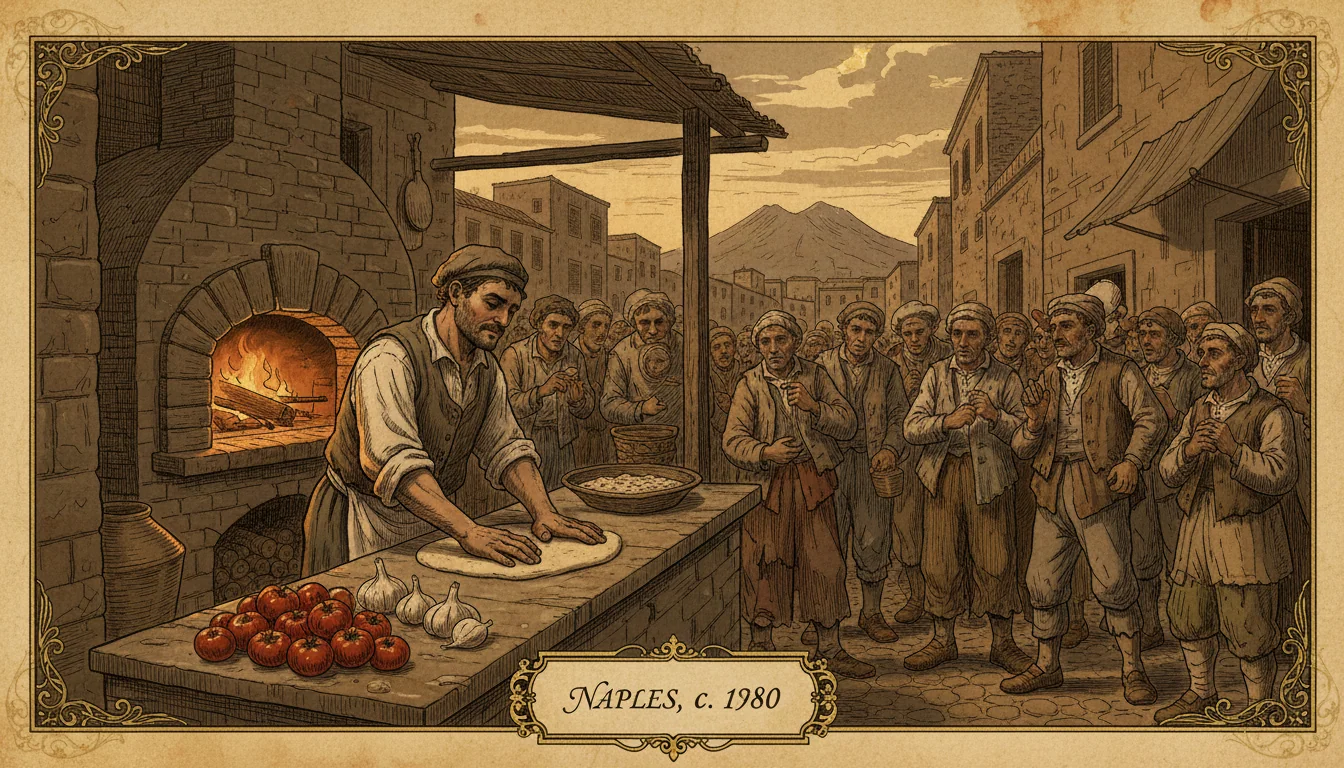
Neapolitan street vendors - the pizzaioli - sold pizza from stalls and trays on the street, cut into portions for a copper coin or two. The toppings were whatever was cheap: pork fat, anchovies, garlic, fresh cheese from the dairy farms in the hinterland. And increasingly, through the 18th century, tomatoes. The Neapolitan poor adopted the tomato before any other European population, partly because they were too hungry to be selective about food that was freely available and entirely edible, and partly because tomatoes grew easily in the volcanic soil of Campania and were effectively free.
By around 1730 to 1750, travelers to Naples were describing pizza as a distinctive street food of the city's poor. In 1773, the Neapolitan writer Vincenzo Corrado published "Il Cuoco Galante," which describes pizza as a popular food topped with oil and herbs but does not yet describe tomato toppings. By the early 19th century, the tomato version was well established.
The first description of pizza in approximately its modern form - yeasted dough, tomato, oil - appears in the 1831 work of the Italian politician Emmanuele Rocco, who wrote about Neapolitan street food with anthropological interest and mild class-inflected unease. It was, he made clear, what poor people ate.
The pizzeria as institution
The street food evolved into something more fixed when the first genuine pizzerias - establishments where you sat down or stood at a counter to eat pizza - opened in Naples in the early 19th century. By 1850 there were several well-established pizzerias in the city. Port'Alba, which opened in some form around 1830, is sometimes cited as the oldest surviving pizzeria. Esposito's establishment, which later became Brandi, was one of a dozen or more operating by the 1880s.
Mozzarella from the water buffalo herds of Campania had been part of the local dairy economy for centuries. Its combination with tomato on pizza was a natural convergence of two regional ingredients. Basil, abundant in Italian kitchen gardens, was added for flavor and freshness. The combination that would become the Margherita was in circulation before any queen arrived to taste it.
What Esposito may have done, in 1889 or around that time, was to formalize the combination, give it a name, and promote it with notable commercial intelligence. A pizza named after the queen was a story. A pizza that had existed for decades on the streets of Naples without a name was just lunch.
The letter helped. Whether or not it is authentic, and whether or not Esposito's establishment staged the encounter with the royal household, the story traveled. By the turn of the 20th century, the Margherita was the reference pizza against which all others were measured.
America and the transformation
The pizza that spread across the world in the 20th century was not quite the Neapolitan original. It was the American adaptation, built by Italian immigrants in New York, Chicago, New Haven, and New Jersey, modified by American ingredients and American appetites.
Gennaro Lombardi, a Neapolitan immigrant, opened what American food historians generally designate as the first U.S. pizzeria at 53 1/3 Spring Street in Manhattan around 1905. The pizza sold there was coal-fired and close to the Neapolitan model, but the cheese was American, the mozzarella more abundant, and the portions larger.
After World War II, American soldiers who had been stationed in Italy returned home craving the food they had eaten there. Pizza spread from Italian-American neighborhoods into the broader American market through the 1950s. Chains like Pizza Hut (1958) and Domino's (1960) industrialized it, thickening the crust, adding more cheese, loading on toppings that would have baffled a Neapolitan pizzaiolo. The result was a distinctly American food that retained the name and the basic concept while diverging from the original in almost every measurable dimension of preparation.
By the 1980s and 1990s, pizza had become one of the most globalized foods on earth, available in some form in virtually every country. The global pizza market today generates revenues in the hundreds of billions of dollars annually. The Neapolitan original, meanwhile, was granted protected traditional specialty status by the European Union in 2009. The Associazione Verace Pizza Napoletana, founded in 1984, certifies establishments that meet its strict standards for dough preparation, wood-fired ovens, and approved toppings.
The queen's letter, real or fabricated, turns out to have been the most valuable piece of marketing in food history. The food it described had already been feeding the poor of Naples for a century before she reportedly tasted it.
The myth's function
The Margherita story did something useful even if it was invented. It gave a street food of the Neapolitan lazzaroni a respectable origin story at a moment when Italy was newly unified and intensely interested in constructing a shared national culture. A royal endorsement, even a possibly staged one, elevated pizza from the food of the urban poor to something a whole country could claim as its own. The myth did for pizza what the Kaldi goatherd story did for coffee: it provided a memorable, flattering narrative for a food whose actual origin was too gradual and too unglamorous to be easily celebrated.
The real story - tomatoes arrive from the Americas and are adopted by the hungry poor of an overcrowded southern Italian port city, who put them on cheap flatbreads and sell them in the street - is more interesting and considerably less royal. It is also, as origin stories go, a reasonably honest portrait of where most great foods actually come from.
For more on how everyday foods got their unlikely starts, see the origins of pasta and the origins of bread - both of which share the same humble trajectory from ancient staple to global phenomenon.
Quick Answers
Common questions about this topic
Where was pizza actually invented?
The pizza recognizable today - a yeasted flatbread with tomato sauce - originated in Naples, Italy, and emerged as a documented street food by the late 18th century. Earlier flatbreads with oil, cheese, or vegetables existed throughout the ancient Mediterranean, but the tomato component, essential to what most people mean by pizza, was not possible until tomatoes arrived from the Americas in the 16th century and were adopted by Neapolitan cooks a century or more later.
Is the Margherita pizza story true?
The story - that pizzaiolo Raffaele Esposito created the tomato-mozzarella-basil pizza in 1889 for Queen Margherita of Savoy during her visit to Naples - is partially documented and largely mythologized. A letter of thanks from the queen's household does exist. But Neapolitan pizza with tomato, mozzarella, and basil was already well established before 1889. Esposito's innovation, if there was one, was the marketing story, not the recipe.
Did ancient Romans eat pizza?
Romans ate flatbreads topped with olive oil, cheese, herbs, and honey - a dish called placenta or panis focacius (from which focaccia descends). These are ancestors of pizza in the same way that a Latin sentence is an ancestor of Italian. The key ingredient missing from every ancient and medieval version is the tomato, a plant from the Americas that did not exist in Europe until the 16th century. Roman flatbread and Neapolitan pizza share a concept, not a recipe.
When did pizza come to America?
Italian immigrants, primarily Neapolitan and southern Italian, brought pizza to the United States in the late 19th and early 20th centuries. Gennaro Lombardi opened what is considered the first American pizzeria at 53 1/3 Spring Street in Manhattan around 1905. Pizza remained largely a regional Italian-American food until after World War II, when American GIs returning from Italy created widespread demand and the pizza industry expanded nationally through the 1950s and 1960s.

Ask the Inventors Themselves
Chat with the people who were there when familiar things began.
Trace It to the SourceJoin the HistorIQly Club
Get smarter about the past.
Weekly stories, deep dives, and exclusive content straight to your inbox.