Origins of the Internet: How the Network That Changed Everything Began
The origins of the internet trace to 1969 - not nuclear war fears. ARPANET was built to share computing resources, and the first message sent was just two letters: LO.
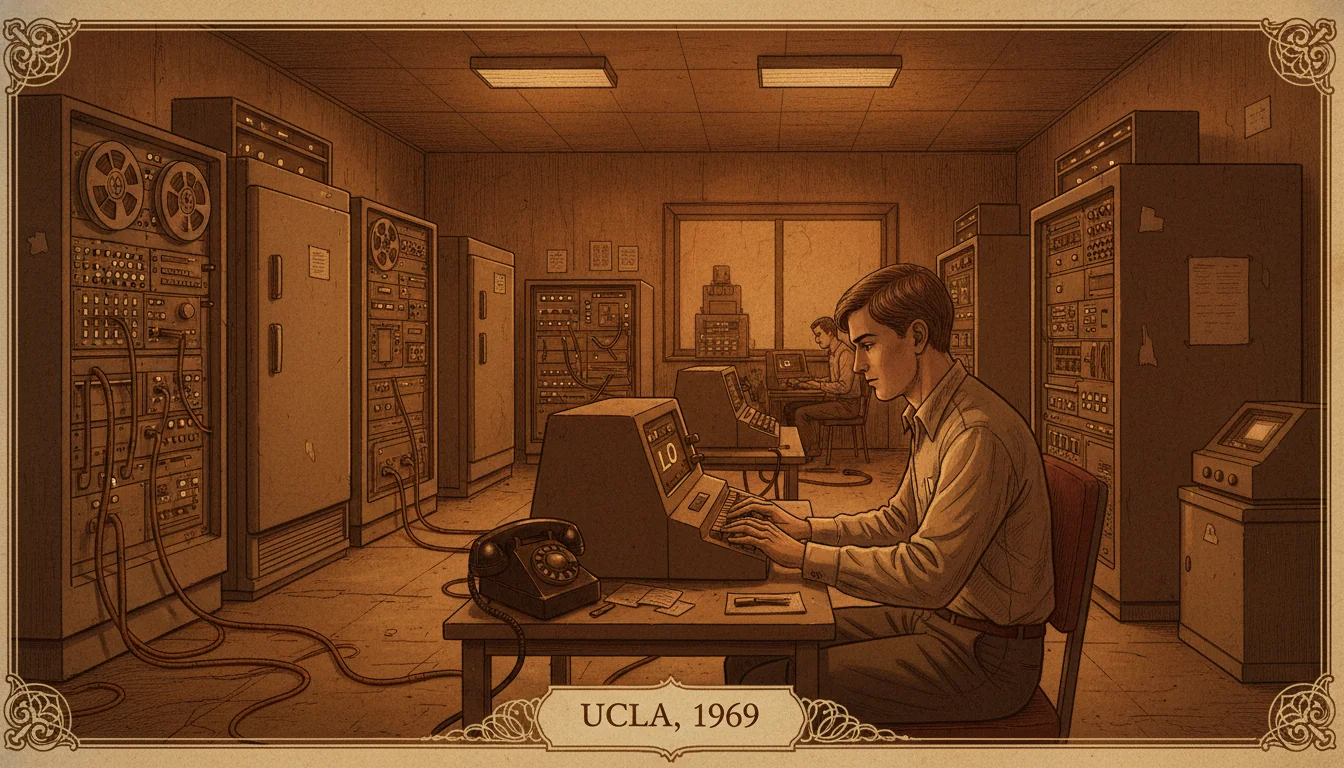
On the evening of October 29, 1969, a UCLA programmer named Charley Kline sat at a terminal and typed the letters L, O, G, I, N. He was trying to connect to a computer at the Stanford Research Institute 560 kilometers to the north. On the phone, Bill Duvall at SRI confirmed that he could see each character arrive as Kline typed it. At the letter G, the SRI machine crashed.
The first message ever transmitted over what would become the internet was LO.
It is an appropriately accidental beginning for a technology whose development has always involved more collision than design, and whose origin story has been buried under decades of mythology, competing priority claims, and the retrospective inflation that attaches to anything that turned out to matter enormously.
The problem that started everything
In the early 1960s, computing power was scarce, expensive, and geographically fixed. A university or research lab might have one large mainframe computer, costing millions of dollars, that researchers booked time on in advance. If you were at MIT and needed to run a calculation that only the machine at Stanford could handle efficiently, your options were limited to traveling there, mailing magnetic tapes, or going without.
The Defense Department's Advanced Research Projects Agency, ARPA (later DARPA), had funded a network of research labs and universities across the United States and was acutely aware of this inefficiency. In 1966, ARPA program manager Bob Taylor, having just used three separate terminals in his office to connect to three separate computers at three separate locations, proposed building a network that would let researchers share computing resources remotely. Taylor secured funding with a meeting that lasted approximately twenty minutes. The project that resulted was ARPANET.
The popular story that ARPANET was designed to survive a nuclear attack is a partial conflation. Paul Baran, working at the RAND Corporation in 1964, had independently designed a theoretical distributed communications network motivated explicitly by nuclear survivability. Baran's concept of packet switching, breaking messages into small discrete units that could each find their own route through a network and be reassembled at the destination, was brilliant and profoundly influential. But Baran's RAND network was never built. ARPANET borrowed his conceptual framework, but its institutional purpose was resource sharing, not survivability.
Donald Davies at the UK's National Physical Laboratory arrived at packet switching independently in 1965, and the name "packet switching" itself comes from Davies rather than Baran. The two men were working in parallel on opposite sides of the Atlantic without knowledge of each other's work until 1966. This kind of simultaneous independent invention, the same solution emerging from the same problem in different places, is a recurring pattern in the history of the internet.
Building ARPANET
The physical construction of ARPANET was contracted to Bolt Beranek and Newman (BBN), a Cambridge, Massachusetts consulting firm, in 1968. BBN built the Interface Message Processors, the dedicated minicomputers, later called simply nodes or routers, that would manage traffic at each connected site.
The first four nodes were UCLA, the Stanford Research Institute, UC Santa Barbara, and the University of Utah. They were connected in late 1969. By December 1969, all four were operational and communicating. By 1971, fifteen sites were connected. By 1973, the network had expanded to include nodes in the United Kingdom and Norway, making it, for the first time, international.
The technology worked. Messages broke into packets, traveled independently through whatever path was available, and reassembled correctly at the destination. The network could route around a broken connection without human intervention. Baran's theoretical insight was borne out in practice.
But ARPANET was still a single network with a single set of protocols, and the protocols of 1969 were not designed with the expectation that the network would grow beyond a few dozen research nodes. As ARPANET expanded, and as other networks with different protocols began to appear, a problem emerged: the networks could not talk to each other. They were islands.
TCP/IP: the language that made everything one thing
Vint Cerf and Bob Kahn published a paper in May 1974 titled "A Protocol for Packet Network Intercommunication." It described a system called the Transmission Control Protocol, later split into two distinct protocols: TCP (Transmission Control Protocol) and IP (Internet Protocol). The paper was dense with technical detail and immediately recognized by those who read it as something important.
TCP/IP provided a universal language that any computer network could use to communicate with any other, regardless of its underlying architecture. The network running TCP/IP became, by definition, part of the internet - the network of networks. No single entity owned it. No central computer controlled it. Each network could be built and managed independently, and if it spoke TCP/IP, it was part of the same system.
The transition from the older ARPANET protocol to TCP/IP was not gradual. On January 1, 1983, every machine on ARPANET was required to switch to TCP/IP simultaneously. The day was called Flag Day in the technical community. Networks that did not make the switch were cut off. Networks that did were, for the first time, part of something that could reasonably be called the internet.
Email and the @ symbol
Ray Tomlinson, working at BBN, sent the first email over ARPANET in 1971. He needed a way to address messages to specific users on specific computers. The @ symbol, then largely unused on typewriter keyboards, became his solution: username@computername. The choice was almost arbitrary - Tomlinson later said he picked @ partly because it appeared on the keyboard and was unlikely to appear in anyone's name.
Tomlinson sent the first email between two computers sitting next to each other in the same room, using ARPANET as an intermediary. He later said he did not remember what the message said. By 1973, email accounted for roughly 75 percent of all traffic on ARPANET. The network designed for resource sharing had been taken over by a new primary use almost immediately after it was switched on.
The Domain Name System
By the early 1980s, the practice of mapping numerical IP addresses to human-readable names was breaking down. The master list of hostnames and their corresponding addresses, kept in a single file called HOSTS.TXT maintained at the Stanford Research Institute and distributed periodically to every computer on the network, had grown unmanageable as the network expanded. Updating it required central coordination. It was a bottleneck, and it would not scale.
Paul Mockapetris at USC's Information Sciences Institute published the design for the Domain Name System in 1983. DNS created a hierarchical, distributed database of domain names that any DNS server could query. No single central file was needed. The system automatically propagated updates across the network. The familiar structure of web addresses, with their .com, .org, .edu suffixes, emerged from Mockapetris's design.
Tim Berners-Lee and the web
By the late 1980s, the internet existed as a functional global network. Physicists, researchers, and government agencies were using it for email, file transfer, and remote computing. What it did not have was a system for organizing and linking documents in a way that non-specialists could navigate.
Tim Berners-Lee, a British physicist working at CERN in Geneva, submitted a proposal in March 1989 titled "Information Management: A Proposal." His manager wrote "Vague but exciting" on the cover and returned it. Berners-Lee spent two years refining the idea and in 1991 deployed the first version of the World Wide Web: a system of hypertext documents linked by URLs (Uniform Resource Locators), transferable over the internet using a protocol called HTTP, and readable using a software client called a browser.
The first website in history went live on August 6, 1991. It described the World Wide Web project itself. It is still online.
Berners-Lee made a decision that determined the web's trajectory: he and CERN explicitly declined to patent the web's core technologies or charge royalties. The protocols were open. Anyone could build a web server, a browser, or a website using them without permission or payment. The web spread accordingly.
The first graphical browser, Mosaic, was released by the National Center for Supercomputing Applications in 1993. The number of websites grew from a few dozen to tens of thousands in a year. By 1995, commercial internet service providers were offering dial-up access to consumers. The internet had escaped the research community.
What got misremembered
The popular origin story of the internet conflates several things that happened separately. ARPANET and the nuclear-war survivability narrative belong to Paul Baran's theoretical work at RAND, not to the actual institutional history of ARPANET. The World Wide Web and the internet are not the same thing, and the confusion between them understates the twenty years of technical infrastructure that made the web possible. The single-inventor narrative fails completely: no version of events with one inventor is compatible with the historical record.
What the history actually shows is a network of independent problems, independently solved, whose solutions happened to be compatible with each other in ways that no one fully anticipated. Packet switching, TCP/IP, email, DNS, and the web were each invented to solve specific, bounded problems. They did not look, when invented, like components of a single system that would eventually connect most of the people on earth.
The first message was LO. The system crashed before LOGIN could complete. The next attempt worked. The pattern has been consistent ever since. For other technologies whose origins are routinely misunderstood, see our accounts of the origins of the printing press and the origins of the clock.
Quick Answers
Common questions about this topic
Who invented the internet?
No single person invented the internet. The foundational packet-switching concept was developed independently by Paul Baran at RAND in 1964 and Donald Davies at the UK's National Physical Laboratory in 1965. The first packet-switched network, ARPANET, was built by DARPA and went live in 1969. The protocols that define the modern internet, TCP/IP, were designed by Vint Cerf and Bob Kahn and published in 1974. Tim Berners-Lee invented the World Wide Web in 1989, which is distinct from the internet itself.
Was ARPANET really designed to survive a nuclear war?
This is a popular myth. ARPANET was funded by the Department of Defense's Advanced Research Projects Agency, and Paul Baran's separate work at RAND on distributed communication was motivated partly by nuclear survivability. But ARPANET itself was designed primarily to allow researchers at different universities to share computing resources, which were extremely expensive in the 1960s. The nuclear-war narrative came later, partly from RAND documents being associated with ARPANET in popular memory.
What was the first message ever sent over the internet?
The first message transmitted over ARPANET was sent on October 29, 1969, from a computer at UCLA to a computer at the Stanford Research Institute (SRI). The intended message was 'login.' The system crashed after the first two letters. The first message successfully transmitted over the internet was therefore 'lo.' Charley Kline at UCLA and Bill Duvall at SRI were on the phone when it happened.
What is the difference between the internet and the World Wide Web?
The internet is the global network of interconnected computers that communicate using TCP/IP protocols. It carries email, file transfers, video calls, and many other types of data. The World Wide Web is a system of hyperlinked documents that runs on top of the internet, invented by Tim Berners-Lee at CERN in 1989-1991. When most people say 'the internet,' they usually mean the web, but the internet existed for two decades before the web was invented.

Ask the Inventors Themselves
Chat with the people who were there when familiar things began.
Trace It to the SourceJoin the HistorIQly Club
Get smarter about the past.
Weekly stories, deep dives, and exclusive content straight to your inbox.