Origins of Hindu-Arabic Numerals: How the Digits 0-9 Conquered the World
The origins of Hindu-Arabic numerals span a thousand years: invented in India, refined in Baghdad, and carried to Europe by a Pisan merchant's son named Fibonacci.
Read Wikipedia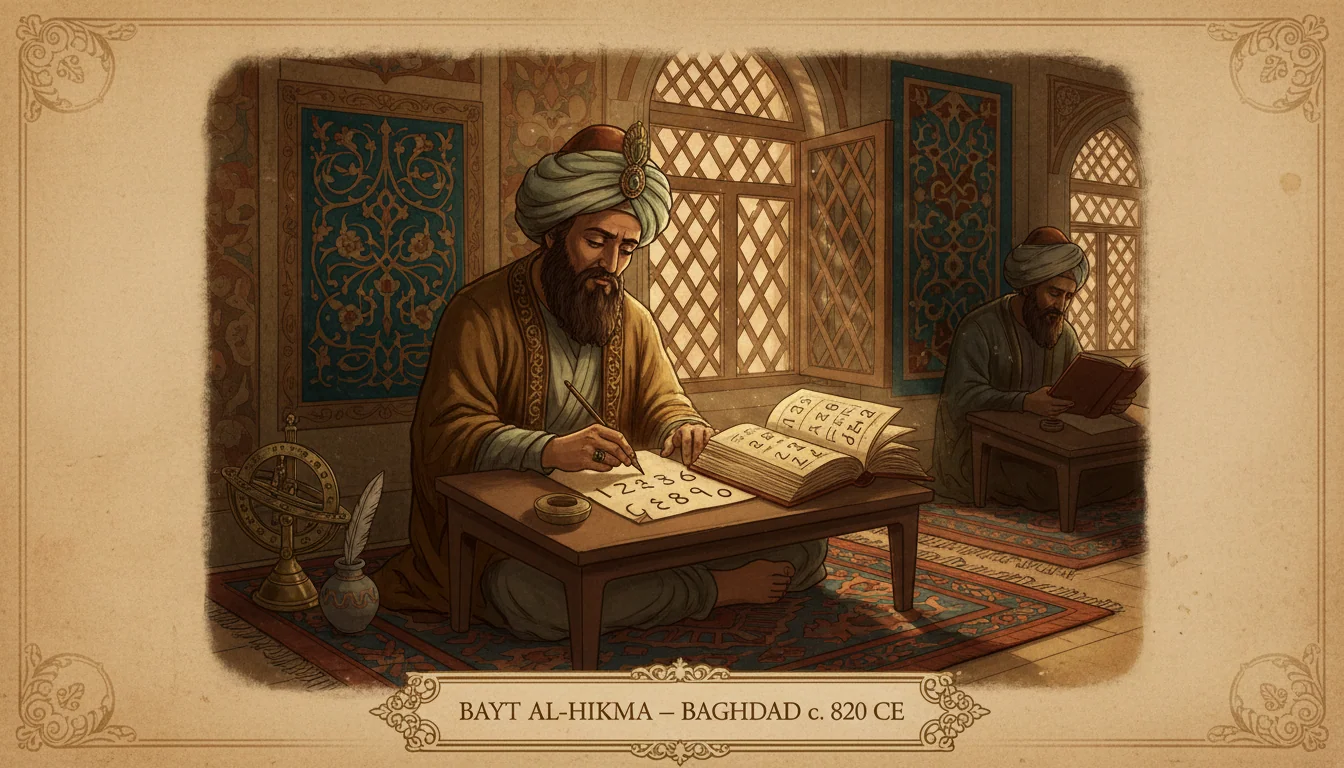
The numerals on a 2026 receipt - 0, 1, 2, 3, 4, 5, 6, 7, 8, 9 - look so universal that most people assume they have always existed and always looked roughly the way they do. Neither is true. These ten shapes were invented in India over a span of roughly a thousand years, traveled through the Islamic world for another four centuries, were resisted by European authorities for three centuries more, and only became the global standard in the 16th century. The story is one of the longest sustained intellectual transmissions in recorded history, and the people who carried it from one civilization to the next were not usually trying to reshape the world. They were just trying to do better arithmetic.
What numerals were before
Every literate civilization before the Hindu-Arabic system had a way of writing numbers, and almost all of them shared a fatal limitation: their notation was good for recording but bad for calculating.
Roman numerals are the example a modern reader knows best. The system worked perfectly well for inscribing dates on monuments or noting sums in a ledger. It worked very badly for actually doing arithmetic. Adding XLVII to CDXCII is not a computation you can perform by writing the numerals one above the other and carrying digits, because Roman numerals are not positional. There is no column structure, no zero, no place value. Roman arithmetic was done on a counting board or an abacus, with the results then transcribed for the written record. The notation and the computation were separate technologies.
Egyptian numerals had a similar problem. So did Greek alphabetic numerals, where letters did double duty as digits, and most pre-Columbian systems with the partial exception of the Maya, who developed an independent positional system but did not export it.
The Indian foundation
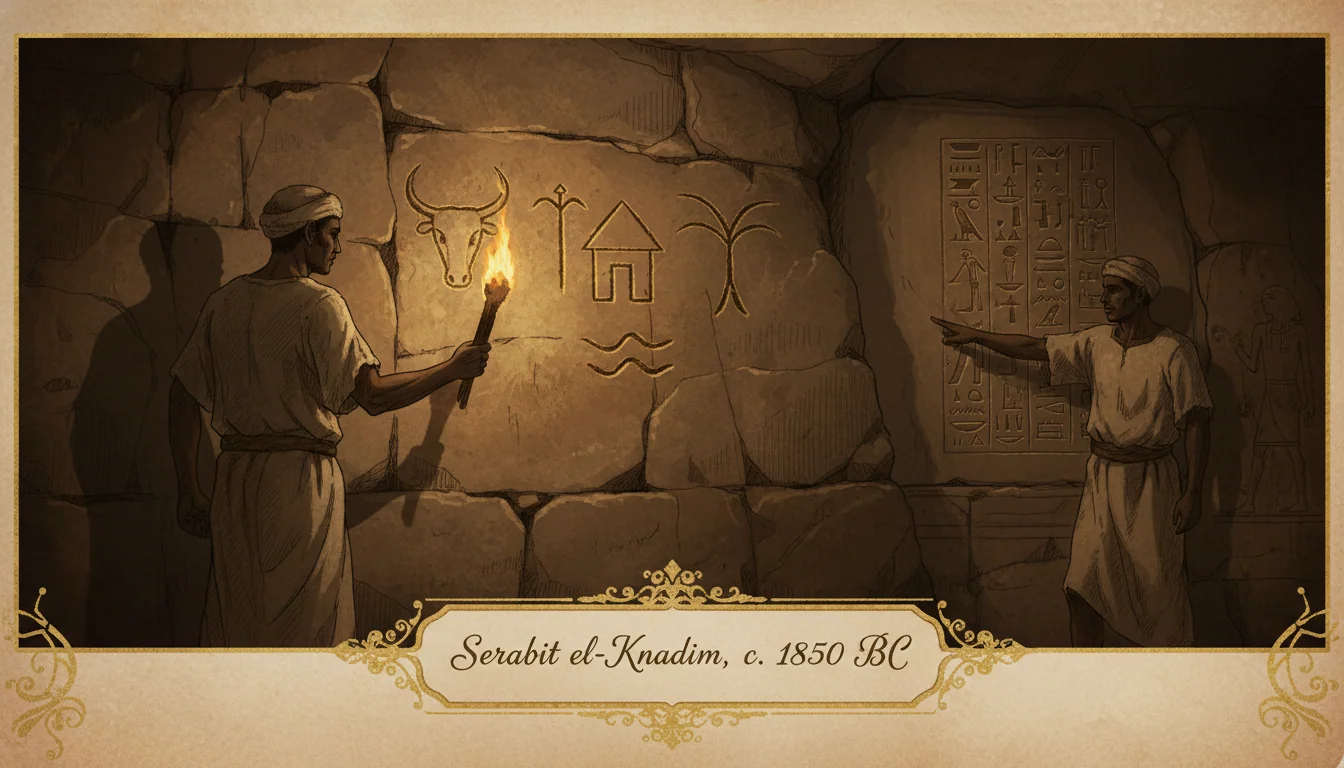
The numerals we now use trace their visual ancestry to the Brahmi script of ancient India. Brahmi inscriptions from the 3rd century BCE, including the famous edicts of the emperor Ashoka, contain numerical symbols for the digits 1 through 9 that bear a recognizable family resemblance to their modern descendants, though the resemblance is not always obvious to a casual viewer.
What Brahmi numerals did not yet have was the place-value principle. The earliest Brahmi number system used separate symbols for ten, twenty, thirty, hundred, and so on. It was an additive system in the same family as Roman numerals, just with different shapes. The leap that made the modern system possible came later, when Indian mathematicians began using only the symbols for 1 through 9, plus a placeholder, and letting position carry the meaning that had previously required separate symbols for each magnitude.
This shift unfolded over centuries and the documentation is fragmentary. The Bakhshali manuscript, written on birch bark and discovered in 1881 in what is now Pakistan, contains the use of a dot as a placeholder zero in calculations. The manuscript has been dated to various periods between the 3rd and 10th centuries depending on the section analyzed, and the question of how old its earliest layers actually are remains contested.
What is not contested is that by the 7th century CE, Indian mathematicians had a fully functional decimal place-value system with the digits 1 through 9 and a zero that participated in calculation. The mathematician Brahmagupta, writing in Rajasthan in 628 CE, gave the first explicit rules for arithmetic involving zero. By his time, the system was producing results good enough for the astronomical and astrological computations that drove much of Indian mathematical activity.
The Abbasid transmission
The Indian system would have remained an Indian achievement if not for the Abbasid Caliphate, the Islamic dynasty that ruled from Baghdad starting in 750 CE and presided over one of history's great translation projects.
The Abbasid court actively sought out Greek, Persian, and Indian mathematical and scientific texts and had them translated into Arabic at the House of Wisdom in Baghdad. Indian astronomical works, including the Brahmasiddhanta tradition that descended from Brahmagupta, reached the Arab world in the late 8th century. By the early 9th century, Arab mathematicians were not merely translating Indian methods but extending them.
The crucial figure is Muhammad ibn Musa al-Khwarizmi, a mathematician and astronomer at the House of Wisdom who was born in what is now Uzbekistan around 780 CE and died in Baghdad around 850 CE. Al-Khwarizmi wrote a short treatise, titled something like Kitab al-jam'a wa al-tafriq bi-hisab al-Hind - "Book of Addition and Subtraction According to the Indian Reckoning" - that explained the Indian decimal system to an Arabic readership. The original Arabic text has not survived, but Latin translations of it produced in the 12th century preserved its content. He also wrote a separate book on equation-solving whose Arabic title, al-jabr wa al-muqabala, gave us the English word "algebra," and whose author's name, Latinized through medieval European transcriptions, gave us "algorithm."
Al-Khwarizmi was not the only Arab mathematician working with Indian numerals. Al-Kindi and Al-Uqlidisi wrote on the same system. By the 10th century, the Hindu-Arabic system - as scholars now call it to credit both stages - was the operational mathematics of the entire Islamic world, from Central Asia to Andalusia. Arab mathematicians refined it substantially: methods for extracting square roots, working with decimal fractions, and handling negative numbers. They also stabilized the visual shapes of the digits into the two main branches that survive today, Eastern Arabic forms used in Persian and Urdu and Western Arabic forms much closer to the modern European shapes.
Across the Mediterranean
European contact with the Hindu-Arabic system happened in pieces and over time. Gerbert of Aurillac, who became Pope Sylvester II in 999 CE, encountered Arabic mathematics during his studies in Catalonia in the 960s and reportedly introduced a counting board with Arabic-shaped numerals to monastic mathematics. The system did not catch on. Gerbert's counters were a curiosity, not a working notation.
The breakthrough came with Leonardo of Pisa, known to history as Fibonacci, born around 1170. His father Guglielmo was a customs official representing Pisan merchants at the port of Bugia in modern Algeria, and Fibonacci spent his adolescence there learning Arabic commercial mathematics from local teachers. He returned to Pisa with the conviction that the Hindu-Arabic system was simply superior to the Roman-and-abacus combination still standard in Europe, and that he could prove it.
In 1202, he published Liber Abaci - "The Book of Calculation," despite the name not actually about the abacus but about replacing it. The book opens with a clear introduction to the ten digits and the place-value system, then proceeds through hundreds of worked commercial examples: currency conversions between Pisan, Florentine, and Bolognese coinage, problems of mixing alloys for the assayer, calculations of profit and loss, the famous problem about breeding rabbits that gives us the Fibonacci sequence almost as a footnote.
Within two generations, abacus schools - reckoning schools for the sons of merchants - were teaching Hindu-Arabic numerals in Italian cities. By the end of the 13th century, the new system was clearly winning among merchants who could see that calculating a multi-currency invoice in Hindu-Arabic took a fraction of the time it took on an abacus.
The long resistance
Adoption was not universal or immediate. In 1299, the city of Florence passed an ordinance restricting the use of Hindu-Arabic numerals in official accounts on the grounds that they were too easily altered. The objection was technically valid: a zero could be added at the end of a number, a 1 turned into a 7. Roman numerals were more verbose and harder to falsify in casual ways. Several other Italian and German cities passed similar restrictions through the 14th century.
The resistance was not only about fraud. There was also a guild dimension. The professional reckoners trained on the abacus had a vested interest in the old system. So did the universities, where Roman numerals carried prestige and Hindu-Arabic numerals carried a faint association with the commercial classes who were learning them.
The shift won anyway, because the productivity gap was simply too large to sustain a regulatory wall against it. By the 16th century, Hindu-Arabic numerals were standard for both commercial and scholarly mathematics across Europe, and Roman numerals had been pushed back to their modern decorative role on clock faces, monumental inscriptions, and the front matter of books.
The printing press, which began producing books in volume from the 1450s, accelerated the convergence on a small number of digit shapes. Type founders settled on forms that descended from the Western Arabic tradition, and within a century the visual shapes of 0 through 9 in printed European books had stabilized into something very close to what a 2026 reader sees on a page.
What the system actually does
The reason Hindu-Arabic numerals are still here, eight hundred years after Fibonacci, is that they make calculation possible in a way that other systems do not. Multiplication of two large numbers, performed by hand using the standard algorithm taught in elementary schools, takes roughly twice as many steps as there are digits in the answer. The same operation performed on an abacus takes longer and produces no written record of the intermediate steps. Performed with Roman numerals, it is not really a meaningful operation at all.
What the Indian mathematicians of the 7th century invented, the Baghdad scholars of the 9th century refined, and the Italian commercial mathematicians of the 13th century transmitted, was not just a notation. It was an interface between human thinking and the operations of arithmetic that made every subsequent mathematical advance easier. Modern computers run in binary internally but render their output as those ten shapes. Programming languages, scientific notation, financial software, GPS coordinates - all of it ultimately renders the same way.
Nobody planned the system as a global standard. It became one because it was simply better than the alternatives, and the gap was visible to anyone who tried both. That is how technologies actually win. Not by decree, not by prestige, but by saving a clerk two hours a day until enough clerks have switched that no employer can afford to keep using the old method. The same pattern of slow adoption followed by rapid displacement appears in the histories of the printing press and the calendar.
Quick Answers
Common questions about this topic
Who invented Hindu-Arabic numerals?
The numerals 0 through 9 used worldwide today originated in India, evolving from the Brahmi script numerals between roughly the 3rd century BCE and the 7th century CE. They were transmitted to the Arab world during the Abbasid Caliphate, refined by mathematicians including Al-Khwarizmi in 9th-century Baghdad, and eventually carried to Europe via North Africa and Andalusia. No single person invented them; the system is the product of about a thousand years of incremental work across multiple civilizations.
Why are they called Arabic numerals if they came from India?
Europeans encountered the digits through Arabic mathematical texts, and the medieval Latin tradition labeled them numeri arabici based on that immediate source. The Arabs themselves called them al-arqam al-hindiyya - 'the Indian numerals' - acknowledging their actual origin. Modern scholarship usually compromises with 'Hindu-Arabic' to credit both stages of transmission.
Who brought Hindu-Arabic numerals to Europe?
The Italian mathematician Leonardo of Pisa, better known as Fibonacci, published Liber Abaci in 1202. Fibonacci had learned the numeral system as a young man in Bugia in modern Algeria, where his father served as a customs official. His book systematically demonstrated how Hindu-Arabic numerals made commercial arithmetic faster and more reliable than Roman numerals. Earlier European exposure existed but Fibonacci's text is the one that triggered widespread adoption.
Did Europe resist Hindu-Arabic numerals?
For roughly three centuries, yes. The city of Florence formally banned them from official bookkeeping in 1299, arguing that the round shapes of digits like 0 and 9 could be easily altered to commit fraud. Several other cities passed similar restrictions. Roman numerals remained common in formal contexts well into the 16th century. The new system won through sheer commercial utility rather than royal decree.

Ask the Inventors Themselves
Chat with the people who were there when familiar things began.
Create your free account →No card required. Some figures and features require a paid plan.
Join the HistorIQly Club
Get smarter about the past.
Weekly stories, deep dives, and exclusive content straight to your inbox.