The Patty Hearst Kidnapping: From Heiress to Bank Robber to Convict
The Patty Hearst kidnapping of 1974 shocked America as the heiress became armed bank robber Tania - then one of the strangest criminal cases of the 20th century.
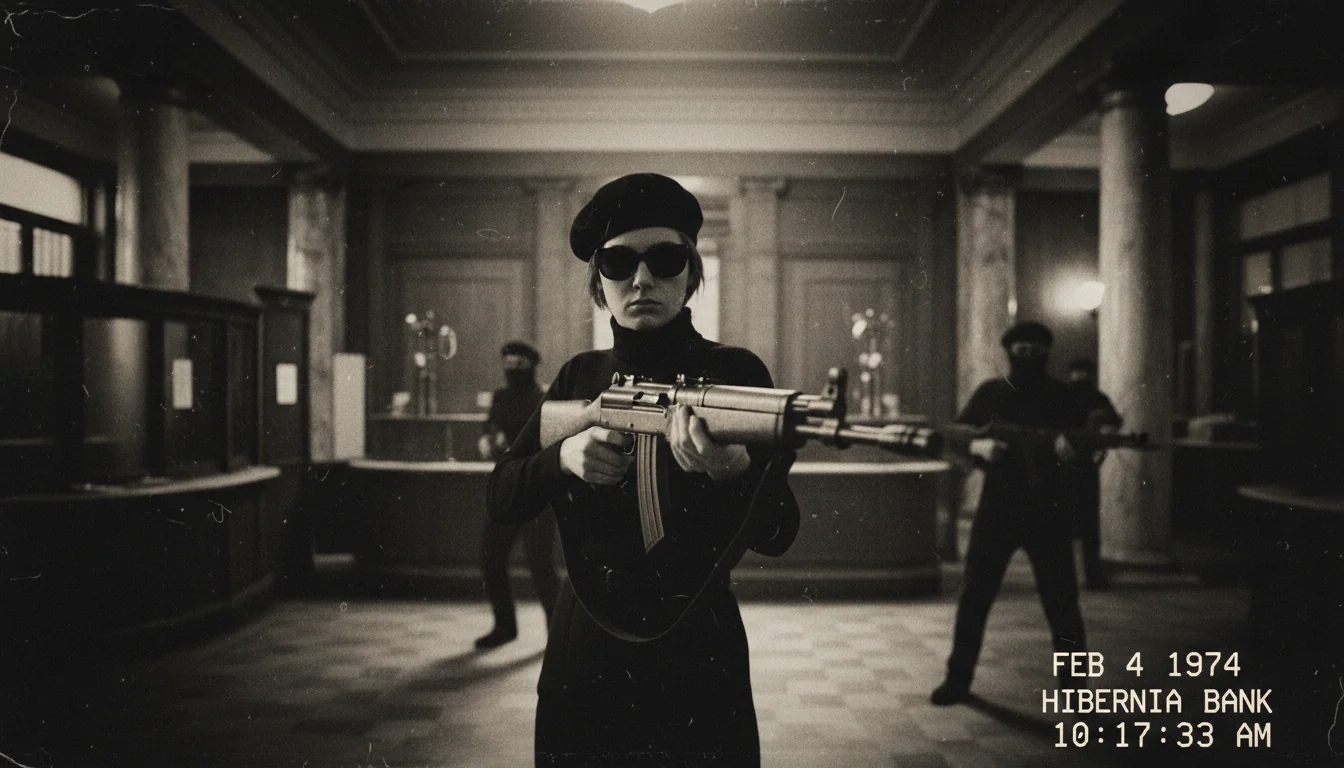
On the night of February 4, 1974, a 19-year-old University of California Berkeley student was beaten and dragged from her apartment by armed strangers and pushed into the trunk of a car. She was Patricia Campbell Hearst, granddaughter of newspaper magnate William Randolph Hearst, heir to one of the largest media fortunes in the United States. Two months later, she was photographed by a security camera holding an M1 carbine inside the Hibernia Bank in San Francisco, helping to commit an armed robbery on behalf of her captors.
The Patty Hearst case is one of the strangest American kidnappings of the 20th century. It generated a 19-month FBI manhunt, a televised criminal trial, a national debate about the limits of psychological coercion, and a vocabulary, including the popularized term "Stockholm syndrome," that continues to shape how the public understands captivity, indoctrination, and consent.
The Symbionese Liberation Army
The group that kidnapped Hearst was called the Symbionese Liberation Army, abbreviated SLA. It was a tiny radical organization based in the San Francisco Bay Area, with approximately a dozen members. Most were young white middle-class graduates of Berkeley or other Bay Area campuses. Their nominal leader was Donald DeFreeze, an escaped convict from California's Soledad Prison who had adopted the African name Cinque.
The SLA's ideology mixed Black liberation rhetoric, Marxist-Leninist theory, and an apocalyptic anti-government posture. Their seven-headed cobra logo, their printed manifestos, and their grandiose self-presentation as a "liberation army" exceeded by orders of magnitude their actual numbers and capabilities. They were not a serious paramilitary force. They were a charismatic ex-convict and a small group of self-radicalized students.
Before kidnapping Hearst, the SLA had committed one major crime: the November 1973 assassination of Marcus Foster, the popular Black superintendent of Oakland public schools, whom the SLA falsely believed had supported a school identification program they viewed as fascist. The killing horrified Bay Area progressive communities and was condemned across the political spectrum.
The kidnapping
On the evening of February 4, 1974, Patty Hearst was at home in her Berkeley apartment with her fiancé Steven Weed. SLA members Donald DeFreeze, William Harris, and Emily Harris broke down the door. Weed was beaten and Hearst was dragged out, screaming, in her bathrobe. She was forced into the trunk of a car and driven to a safe house in Daly City, south of San Francisco.
The kidnapping was a sensation immediately. Hearst's identity made the story international news within hours. Her father Randolph and her mother Catherine, in Hillsborough, California, became the focus of intense media attention. The FBI launched a massive search. The SLA began issuing recorded communications.
Their initial demand was unusual. They demanded that the Hearst family pay for a free food distribution to poor people in California, organized as a kind of public ransom. Randolph Hearst eventually committed approximately $2 million to a program called People in Need. The food distribution was chaotic, marked by riots and accusations of poor management. The SLA refused to release Hearst.
The conversion
Over the following weeks, the SLA held Hearst in a series of safe houses, mostly confined to a closet measuring approximately 6 feet by 2 feet. According to her later accounts, she was blindfolded for extended periods, threatened with death, and subjected to what defense psychiatrists later described as a deliberate program of psychological breaking. She has alleged that she was sexually assaulted by William Wolfe, an SLA member who used the alias Cujo.
On April 3, 1974, two months after the kidnapping, the SLA released a recorded statement from Hearst. In it, she announced that she had chosen to remain with her captors and join their struggle. She had taken the alias Tania, a name borrowed from Tamara Bunke, a fighter who had served with Che Guevara in Bolivia. She denounced her parents and her fiancé. She declared her commitment to revolutionary armed struggle.
Twelve days later, on April 15, 1974, security cameras at the Hibernia Bank on Noriega Street in San Francisco captured Hearst holding an M1 carbine, helping the SLA carry out an armed robbery in which two civilians were shot. She appeared to be a willing participant.
The Los Angeles shootout
For the next year, Hearst lived underground with the SLA. The group moved between safe houses, generated propaganda, planned further attacks, and gradually disintegrated under the pressure of the FBI search.
On May 17, 1974, a major SLA safe house in South Central Los Angeles was surrounded by hundreds of LAPD officers and FBI agents. A shootout erupted. The house was set on fire. Six SLA members died inside, including Donald DeFreeze, William Wolfe, Camilla Hall, Patricia Soltysik, Angela Atwood, and Nancy Ling Perry. The shootout was televised live and became one of the largest urban firefights in American police history.
Hearst was not in the house. She had been at a nearby motel with William and Emily Harris when the shootout began and watched the burning house on television.
After the Los Angeles shootout, Hearst and the surviving SLA members went deeper into hiding. They moved across the country, eventually returning to the Bay Area. Hearst was finally arrested by the FBI on September 18, 1975, in a San Francisco apartment. She gave her occupation as "urban guerrilla."
The trial
Hearst's federal trial for the Hibernia Bank robbery began in January 1976 in San Francisco. She was represented by F. Lee Bailey, the celebrity criminal defense attorney best known for his earlier representation of Sam Sheppard. Bailey's defense centered on the argument that Hearst had been coerced, brainwashed, and effectively forced into participation in the robbery.
Defense psychiatrists, including Robert Jay Lifton, Louis Jolyon West, and Margaret Singer, testified that Hearst had been subjected to a deliberate program of indoctrination similar to techniques used on prisoners of war during the Korean War. They described the psychological mechanism by which a kidnapping victim, isolated and threatened, may come to identify with captors as a survival response. The Stockholm bank robbery of 1973, which had given rise to the term Stockholm syndrome, was discussed extensively.
Prosecution psychiatrists rejected this analysis. They argued that Hearst's behavior, including her continued involvement after the Los Angeles shootout in which most of the SLA died, indicated voluntary commitment rather than coerced compliance. They pointed to recorded statements, planning sessions, and other evidence that she had retained agency throughout her time underground.
The jury convicted Hearst on March 20, 1976. She was sentenced to seven years in federal prison.
The aftermath
Hearst served two years before President Jimmy Carter commuted her sentence in 1979. She was pardoned by President Bill Clinton on his last day in office in 2001.
After her release, Hearst returned to private life. She married Bernard Shaw, a former San Francisco police officer who had been part of her security detail. They had two daughters. She acted in occasional film and television roles, including in several John Waters films, and lived a low-profile life in Connecticut.
Most of the surviving SLA members were eventually captured, prosecuted, and sentenced to varying terms in prison for crimes including the Hibernia Bank robbery, the 1975 Carmichael bank robbery in which Myrna Opsahl was killed, and assorted weapons offenses. The Carmichael case in particular took decades to resolve, with several SLA members not being prosecuted until the 2000s.
What the case has come to represent
The Patty Hearst case has become a touchstone in several distinct conversations. In legal terms, it shaped American jurisprudence on coercion, capacity, and the evidentiary status of brainwashing. The court's decision to reject the coercion defense as a basis for acquittal established a precedent that has been followed in similar cases since.
In psychological terms, the case popularized the concept of Stockholm syndrome and brought the experience of long-term captivity into public discussion in ways that earlier cases had not. Subsequent kidnap victims, including Elizabeth Smart and the Cleveland women held by Ariel Castro, have been discussed in part through the framework the Hearst case helped to establish.
In political terms, the case marked the strange end of the New Left era of the late 1960s and early 1970s. The SLA represented one of the most extreme outcomes of campus radicalization combined with charismatic ex-convict leadership. The group's destruction in Los Angeles and its members' subsequent prosecutions effectively ended a particular kind of small-cell American radical politics.
In personal terms, the case remains a difficult question about agency, captivity, and the limits of what we can know about another person's interior life. Patty Hearst was kidnapped against her will. She participated in armed robbery. She lived as a fugitive. She was tried and convicted. She was eventually pardoned. Whether she became Tania, then unbecame her, or whether she was Tania throughout, or whether neither name fits her experience, is a question that the case never finally answered.
Fifty years later, the Patty Hearst kidnapping remains one of the most strange and consequential criminal episodes in American history.
For other cases where captivity, identity, and criminal liability intersected in unresolved ways, Charley Ross - America's first kidnapping is a century earlier but raises similar questions about ransom and justice. The Sharon Marshall case is a modern instance where identity itself was the crime.
Quick Answers
Common questions about this topic
Who kidnapped Patty Hearst?
Patty Hearst was kidnapped on February 4, 1974 by members of the Symbionese Liberation Army (SLA), a small radical leftist group based in the San Francisco Bay Area. The SLA was led by Donald DeFreeze, an escaped convict who used the alias Cinque, and included approximately a dozen members, mostly young white middle-class radicals.
Did Patty Hearst really join her kidnappers?
Yes. After approximately two months of captivity, during which she was held in closets, threatened, and reportedly assaulted, Hearst announced via taped recording that she had joined the SLA and adopted the alias Tania. She participated in the April 15, 1974 Hibernia Bank robbery in San Francisco, captured on security cameras holding an automatic weapon.
Was Patty Hearst convicted?
Yes. Hearst was arrested on September 18, 1975, after 19 months as a fugitive. She was tried for the Hibernia Bank robbery and convicted on March 20, 1976, despite a defense centered on coercion and the psychological effects of captivity. She was sentenced to seven years in prison. President Jimmy Carter commuted her sentence in 1979 and President Bill Clinton pardoned her in 2001.
What was Stockholm syndrome and was it relevant?
Stockholm syndrome is the term coined in 1973 to describe the psychological bond hostages sometimes form with their captors. The Hearst case was one of the first major American cases in which the concept was widely discussed. Defense psychiatrists argued she had been coerced and indoctrinated. Prosecutors and the jury rejected this argument as a legal defense, although it remained a public framework for understanding her behavior.

Want to Interrogate the Suspects?
Chat with historical figures and uncover the truth behind history's greatest mysteries.
Start Your InvestigationJoin the HistorIQly Club
Get smarter about the past.
Weekly stories, deep dives, and exclusive content straight to your inbox.