Public Enemies vs. History: How Accurate Is the John Dillinger Movie?
Public Enemies accuracy check: Michael Mann's 2009 John Dillinger film gets the jailbreaks and Biograph Theatre ambush right but romanticizes Dillinger's character and softens his violence.
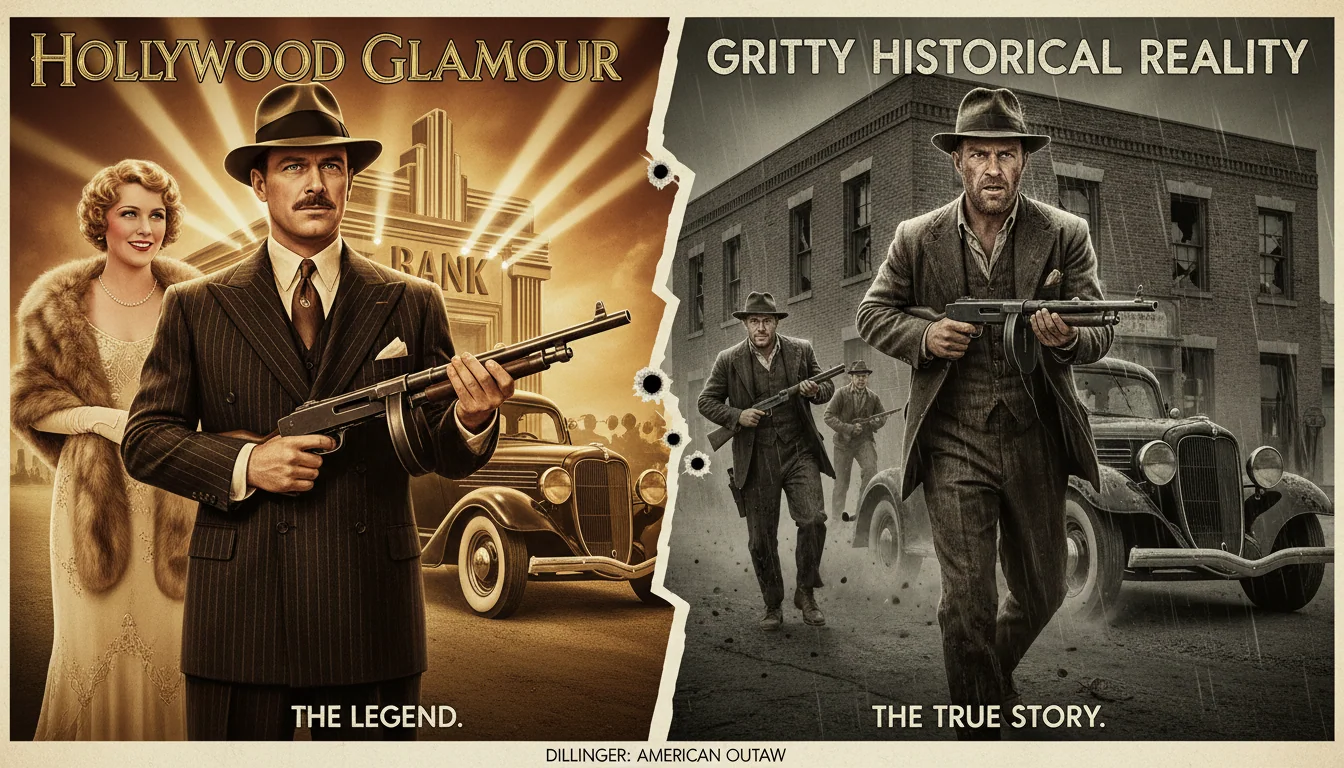
When Public Enemies opened in July 2009, Michael Mann brought his trademark fast-cutting realism to the story of America's most famous bank robber. Johnny Depp played John Dillinger as a charming, romantic, almost monastic outlaw. Christian Bale played Melvin Purvis as a haunted federal agent. Marion Cotillard played Billie Frechette, Dillinger's girlfriend. The film tracked Dillinger's final 13 months, from the October 1933 escape from Lima, Ohio jail to the July 1934 ambush outside the Biograph Theatre.
Public Enemies accuracy is worth examining closely, because the film's source material is one of the most thoroughly researched accounts of the era. So how close does Public Enemies stay to the actual record? The film's source material, Bryan Burrough's authoritative 2004 nonfiction account, is one of the most thoroughly researched studies of the 1933-34 Midwestern crime wave. Mann's screenplay diverges from Burrough's book in specific places, mostly to compress timelines and to elevate Dillinger's romanticism above the more transactional reality of his criminal partnerships. The major events are real. The mood is partially manufactured.
What Hollywood Got RIGHT
The October 1933 jailbreak
The film opens with the spectacular October 12, 1933 jailbreak from the Allen County Jail in Lima, Ohio. Dillinger himself was not in the jail at the moment of escape; rather, his confederates Harry Pierpont, Charles Makley, Russell Clark, and others, led a raid that freed Dillinger. The film's depiction of the raid, including the killing of Sheriff Jess Sarber, is accurate. Sarber was indeed shot during the breakout.
The political consequences of the killing were significant. Sarber's death produced national outrage and helped accelerate the political momentum that gave the FBI new authority and resources in 1934.
The bank robberies
Dillinger's gang robbed at least 24 banks during their 14-month run, plus several police arsenals and other targets. The film correctly captures the tactical elements: the use of the Thompson submachine gun, the seizing of hostages to deter pursuit, the careful timing relative to bank opening hours, and the fluid movements between Indiana, Illinois, Wisconsin, Iowa, and Minnesota.
The Greencastle, Indiana robbery of October 23, 1933, in which the gang stole over $74,000, is depicted with reasonable accuracy. The Mason City, Iowa robbery of March 13, 1934, in which Dillinger was wounded, is also broadly accurate, although the film compresses some events for clarity.
The Crown Point escape
The film's depiction of Dillinger's March 3, 1934 escape from the Crown Point, Indiana jail using a fake wooden gun is accurate. Dillinger had been held in what was advertised as an inescapable jail, surrounded by National Guard troops, while awaiting trial for the killing of an East Chicago police officer. He used a small hand-carved wooden gun, possibly assisted by inside contacts, to take guards hostage and walk out.
The escape was a national humiliation for Indiana law enforcement and, indirectly, helped consolidate federal jurisdiction over interstate crime. It also produced one of the most famous press photographs of the 1930s: Dillinger smiling alongside Sheriff Lillian Holley, who had publicly assured the country that the jail was secure.
The Little Bohemia ambush
The film's depiction of the disastrous April 22, 1934 FBI raid on the Little Bohemia Lodge in Wisconsin is one of its most historically accurate sequences. FBI agents under Melvin Purvis surrounded the rural lodge believing Dillinger and his associates were inside. They opened fire on three innocent civilians who had been guests at the lodge, killing one and wounding the other two.
Inside the lodge, Dillinger's gang escaped through windows and slipped past the FBI cordon. Baby Face Nelson killed Special Agent W. Carter Baum during a separate exchange of fire that night. The botched raid was one of the worst operational failures in early FBI history and seriously damaged the bureau's reputation.
The Biograph Theatre ambush
The climactic sequence on July 22, 1934 is the film's most fact-grounded passage. Dillinger, now using the alias Jimmy Lawrence and undergoing minor facial surgery, was living in Chicago. Anna Sage, a 42-year-old Romanian-born brothel keeper facing deportation, contacted federal authorities through East Chicago police officer Martin Zarkovich. She agreed to identify Dillinger in exchange for help with her immigration case.
On the night of July 22, Dillinger, Sage, and Polly Hamilton attended a screening of Manhattan Melodrama, a Clark Gable gangster film, at the Biograph Theatre in Chicago. Sage wore a bright orange dress, which appeared red under the streetlights, giving her the nickname "the Lady in Red."
As Dillinger left the theater, FBI agents including Charles Winstead, Clarence Hurt, and Herman Hollis closed in. Dillinger reached for a gun, and three agents opened fire. He died at the scene from gunshot wounds. The ballistics analysis credited Winstead with the fatal shot.
Sage was deported to Romania despite her cooperation. The Department of Justice's deal had been informal, and the formal immigration process did not protect her. She died in Romania in 1947.
What Hollywood Got WRONG
Dillinger's romanticism
The film's most consistent distortion is its romantic presentation of Dillinger himself. Johnny Depp's Dillinger is gentle, monogamous, almost monkish in his focus on Billie Frechette. The historical Dillinger was charming, opportunistic, and unfaithful. His relationship with Frechette was significant but not exclusive, and he had multiple other female associates throughout the period the film depicts.
The film also softens his violence. Dillinger personally killed at least one police officer (William O'Malley, in East Chicago, January 1934) and was complicit in several other shootings. The cinematic Dillinger fires only when cornered and seems reluctant to harm anyone. The historical Dillinger was more violent than the film acknowledges.
Pretty Boy Floyd's death
The film shows Pretty Boy Floyd being shot by Melvin Purvis personally in an Ohio cornfield. Floyd was indeed killed in East Liverpool, Ohio on October 22, 1934, but the actual shooting was a group action involving multiple FBI agents and local police officers. Purvis was present and oversaw the operation, but he did not fire the fatal shot.
Floyd died saying his name and partly disputing his alleged role in the Kansas City Massacre, although the surviving accounts of his last words vary substantially.
Baby Face Nelson's killing
Baby Face Nelson is depicted in the film as one of Dillinger's main associates throughout 1933-34. In reality, Nelson joined Dillinger's gang only briefly in 1934 and was a fundamentally different kind of criminal: more violent, more impulsive, and far less interested in the celebrity Dillinger cultivated.
Nelson was killed in a shootout with FBI agents Herman Hollis and Samuel Cowley near Barrington, Illinois on November 27, 1934. Both Hollis and Cowley were killed in the exchange of fire. The film depicts Nelson's death less precisely than the historical record allows, partly because the actual incident occurred after Dillinger's death and outside the film's principal timeline.
Melvin Purvis's role
Christian Bale's Purvis is depicted as a tortured, principled federal agent at the heart of the manhunt. The historical Purvis was indeed central to the Chicago operations, but his career was complicated. He was overshadowed within the FBI by J. Edgar Hoover, who was deeply jealous of Purvis's celebrity. After the Dillinger case, Purvis was effectively pushed out of the bureau in 1935. He died by his own hand in 1960.
The film's portrayal of Purvis as a thoughtful protagonist is sympathetic but somewhat over-elevated. The historical Purvis was a competent regional agent who happened to be in charge during one of the most consequential cases in FBI history.
The texture of FBI operations
The film makes the FBI look more competent and professional than it actually was in 1934. The bureau in this period was small, undertrained, poorly equipped, and frequently embarrassed by tactical failures. The Little Bohemia raid was one of several disasters. The successful resolution of the Dillinger case owed as much to luck and informants as to investigative skill.
The film's style of professional federal pursuit is more 1990s FBI than 1930s. The actual bureau was figuring out interstate crime fighting almost from scratch in this period.
What the film captures even when it bends facts
Public Enemies gets one specific thing exactly right: the cultural meaning of Dillinger as a Depression-era folk hero. In a year when banks were closing on millions of Americans, a man who robbed banks and gave the press his charming smile became a popular figure in ways that genuinely worried federal officials. The film's depiction of crowds cheering Dillinger, of newspapers running flattering profiles, and of ordinary people occasionally helping him escape, all reflects historical reality.
The film also captures the operational shift between the lone-county-sheriff era and the federal-bureau era. In 1933, interstate crime was managed by a patchwork of local police forces. By 1935, the FBI had emerged as the central American law enforcement agency. The Dillinger case was one of the events that made this happen.
Historical Accuracy Score: 7/10
Public Enemies is faithful to the broad facts: the jailbreaks, the bank robberies, the Little Bohemia raid, the Biograph Theatre ambush. It romanticizes Dillinger's personal life, slightly mythologizes Purvis, and oversimplifies the relationships between gang members and federal agents. The major dates, places, and outcomes are accurate.
What the film gets most right: the Biograph Theatre ambush and the Crown Point escape.
What it gets most wrong: softening Dillinger's violence and overstating his monogamous loyalty to Frechette.
The bottom line is that Public Enemies is one of the better fact-based crime films of its decade, even if it leans into Hollywood romanticism in ways the actual record does not support. If you want the chase, watch the film. If you want the man, read past the credits. For other FBI-focused crime films from different eras, see our fact-checks on The Untouchables and Goodfellas.
Quick Answers
Common questions about this topic
Is Public Enemies based on a true story?
Yes. The 2009 film, directed by Michael Mann, is based on Bryan Burrough's nonfiction book Public Enemies: America's Greatest Crime Wave and the Birth of the FBI, 1933-34. It tracks the final 13 months of John Dillinger's life, from his October 1933 prison escape to his death outside the Biograph Theatre in Chicago on July 22, 1934.
Was Dillinger really betrayed by the Lady in Red?
Yes. Anna Sage, a Romanian-born brothel madam in Chicago, alerted federal agents to Dillinger's plan to attend a movie at the Biograph on July 22, 1934. She was facing deportation and hoped to trade information for permission to remain in the United States. The film's depiction of her betrayal, while compressed, is essentially accurate.
How did John Dillinger die?
Dillinger was shot dead by federal agents as he left the Biograph Theatre on the night of July 22, 1934. He was 31 years old. Three agents, including Charles Winstead, opened fire as Dillinger drew a gun. He died from gunshot wounds at the scene. The official ballistics report credits Winstead with the fatal shot.
Was Pretty Boy Floyd really killed by Melvin Purvis?
The film shows Charles 'Pretty Boy' Floyd being shot by Melvin Purvis in an Ohio cornfield. Floyd was indeed killed in October 1934 in East Liverpool, Ohio, but the actual shooting involved multiple FBI agents and local police. Purvis was present and oversaw the operation, but Floyd's killing was a group action and Purvis did not personally fire the fatal shot.

Debate the Accuracy with the Real Figures
Ask the real people what Hollywood got wrong about their lives.
Chat with HistoryJoin the HistorIQly Club
Get smarter about the past.
Weekly stories, deep dives, and exclusive content straight to your inbox.