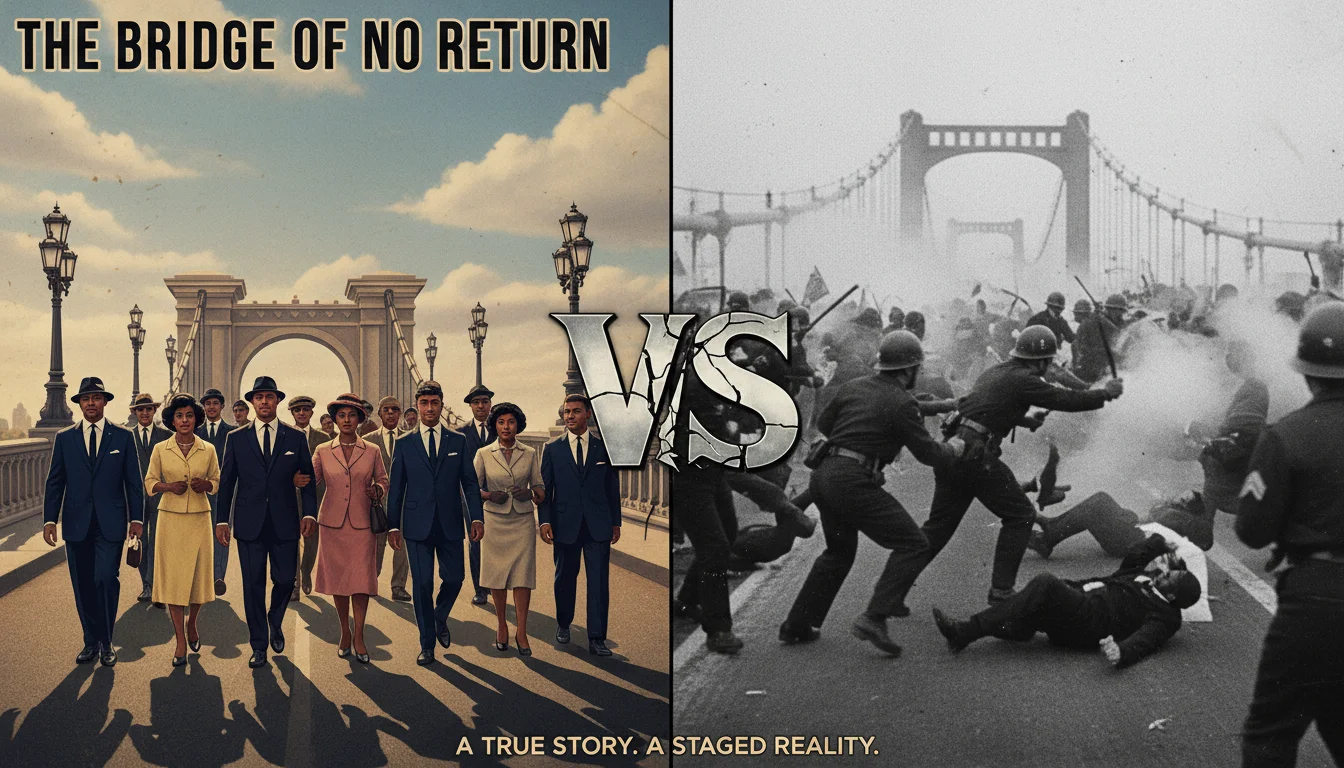
Rustin vs. History: How Accurate Is the Bayard Rustin Civil Rights Biopic?
Rustin (2023) accuracy fact-checked: Colman Domingo's portrayal of Bayard Rustin gets the March on Washington right, but skips thirty years of the man's remarkable life.
Read Wikipedia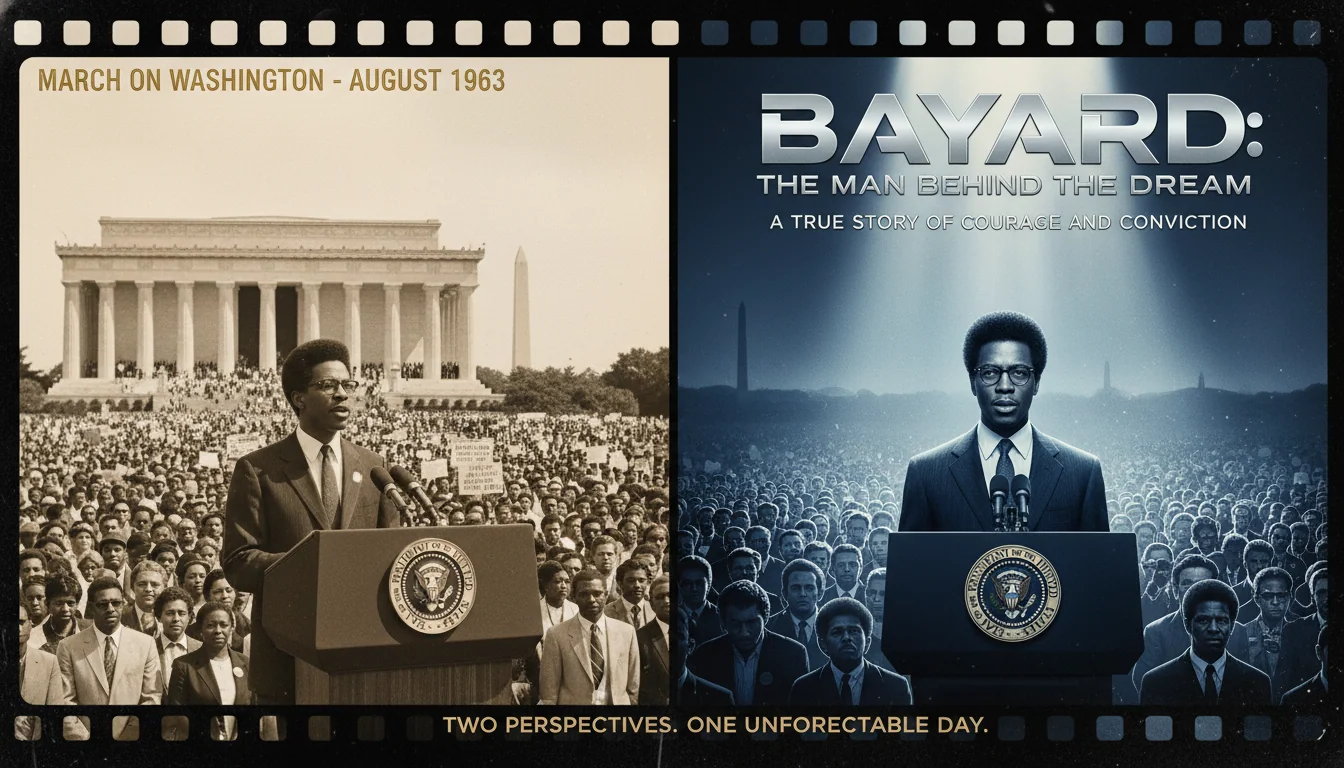
Netflix's Rustin, released in late 2023 and directed by George C. Wolfe, is one of the most overdue historical reclamations in recent film. Bayard Rustin was the principal architect of the March on Washington for Jobs and Freedom, one of the most significant demonstrations in American history, and yet for decades he was almost entirely absent from public memory. He was pushed to the margins of the civil rights movement by colleagues who considered his homosexuality a political liability. The film is the most visible attempt yet to put him back at the center of the story.
Colman Domingo, who received an Academy Award nomination for the role, carries the film with unusual grace. The question is whether what surrounds him holds up.
What Hollywood Got RIGHT
Rustin really did organize the March on Washington
The film's core claim - that Bayard Rustin was the operational mastermind behind the August 28, 1963 March on Washington for Jobs and Freedom - is one of the better-documented facts in civil rights history.
A. Philip Randolph, president of the Brotherhood of Sleeping Car Porters and one of the most respected Black labor leaders in America, chose Rustin as his deputy director for the event. Rustin took over the actual logistics. In under two months he organized transportation for roughly 250,000 people from cities across the country, recruited and briefed an army of volunteer marshals, coordinated the program with the Lincoln Memorial, arranged the sound system, set up feeding stations, managed a media operation, and produced a printed schedule that ran, by most accounts, nearly on time. It remains one of the most efficiently executed large-scale demonstrations in American political history. The film treats this as the remarkable achievement it was.
The opposition from within the movement was real
Rustin places heavy weight on the political struggle inside the march's organizing committee, particularly the resistance of Roy Wilkins of the NAACP and the threat issued by New York Congressman Adam Clayton Powell Jr. The film gets both of these accurately.
Wilkins was uncomfortable with Rustin's prominent role for two reasons: Rustin's homosexuality and a 1953 California arrest on charges of sexual perversion, which Powell subsequently used as ammunition. Powell threatened to tell the press that Rustin was having a homosexual affair with Randolph unless Rustin was removed from his position. The threat was made explicitly and reached Randolph directly.
Randolph did not capitulate. He backed Rustin throughout and Rustin remained in charge of the march's organization. The film captures the texture of this standoff with reasonable accuracy, including the calculation Randolph made that the threat was a bluff Powell would not follow through on with the march just weeks away.
The scale of the logistics
The film shows Rustin's team working in a small Harlem office, managing maps, bus routes, train schedules, and a volunteer network with no modern communication tools and a budget that arrived in pieces. That is an accurate picture. Contemporary accounts and the memories of march veterans describe an operation held together by Rustin's obsessive attention to detail and his ability to keep enormous numbers of people pointed in the same direction. The 250,000 who came to Washington on August 28 did not arrive and stand in the right place by accident.
Randolph's consistent support
Chris Rock's portrayal of Roy Wilkins captures the man's political caution without turning him into a villain. The film's most thoughtful choice is showing that the resistance to Rustin was not pure bigotry but also a calculated fear about political optics - about what ammunition opponents of civil rights legislation would find in Rustin's past. That fear was real and that calculation was actually being made, even by people who had no personal animus toward Rustin.
What Hollywood Got WRONG
The film largely erases Rustin's earlier life
The most significant inaccuracy in Rustin is not a mistake but an omission so large it distorts the portrait. The film opens with Rustin already established as a known figure in the movement and moves immediately to the march preparation. Everything that made him who he was - the years that led to 1963 - is reduced to quick references.
Rustin had been a member of the Young Communist League in the late 1930s, a membership he renounced. He was imprisoned as a conscientious objector during World War II and spent time in federal prison. He traveled to India in 1948 specifically to study Gandhian nonviolence and brought those methods back to America. He was a founding influence on the Congress of Racial Equality (CORE). He advised Martin Luther King Jr. directly after the Montgomery Bus Boycott in 1955 and 1956, helping King understand and implement nonviolent discipline. He was then pressured away from King's side in 1960 - by congressman Adam Clayton Powell and others who threatened to exploit his 1953 arrest - and spent years working from the War Resisters League rather than the front rank of the movement.
That is twenty years of biography. It explains why Randolph trusted him, why Wilkins feared him, and why the march succeeded. The film mentions some of this in passing. It does not inhabit it.
The romantic subplot is fictional
The film introduces a love interest - a younger organizer who becomes involved with Rustin during the six-week preparation period. There is no clear historical record of a specific romantic relationship of this kind during this period. Rustin had a long-term partner, Walter Naegle, whom he met in 1977 - years after the events depicted. The decision to invent a romance is a standard Hollywood convention, but it fills screen time that could have been spent on the actually extraordinary story of how Rustin got to 1963.
The political geography is simplified
The film presents the march's opposition largely through Wilkins and Powell. The full picture was more complicated. Some labor leaders and liberal allies who privately supported Rustin were also nervous about his visibility, for reasons that had as much to do with fear of Southern Democratic senators as with personal prejudice. J. Edgar Hoover's FBI was actively watching the march organizers and Rustin specifically. The film's version of the political environment is accurate in its central facts but simplified in its peripheral ones.
Historical Accuracy Score: 7.5/10
Rustin is a well-intentioned film that gets the most important things right. The march was Rustin's creation. The internal opposition was real. Randolph's support was real. The logistics were staggering and the success was genuine.
What the film gets most right: the organizational feat and the political threat Rustin faced from within the movement he was serving.
What it gets most wrong: a biographical scope so narrow that it makes Rustin seem to have appeared from nowhere in 1963, rather than as the product of thirty years of radical pacifism, nonviolent theory, labor organizing, and personal risk.
The man's full life was remarkable enough to power three films. The one Netflix made covers six weeks of it. Those were important weeks, and the film treats them honestly. But the Bayard Rustin who organized the March on Washington was formed by everything before the Harlem office, and that formation is largely what Rustin leaves on the floor.
For more civil rights era fact-checking, see Selma vs. History and All the President's Men vs. History.
Quick Answers
Common questions about this topic
Was Bayard Rustin really the chief organizer of the March on Washington?
Yes. A. Philip Randolph appointed Rustin as the deputy director and lead organizer of the March on Washington for Jobs and Freedom. Rustin coordinated the logistics for roughly 250,000 people arriving in Washington on August 28, 1963, managing transportation, marshals, sound systems, and schedules in under two months. It was the largest demonstration in American history at the time.
Did Roy Wilkins and Adam Clayton Powell really try to sideline Rustin?
Yes. Roy Wilkins of the NAACP was uncomfortable with Rustin's homosexuality and criminal record and preferred to limit his public role. Adam Clayton Powell Jr. threatened to tell the press that Rustin and Randolph were having a homosexual affair if Rustin was not removed. Randolph refused to capitulate and Rustin remained in charge. The film depicts this core dynamic accurately.
What does Rustin (2023) get wrong?
The film's most significant departures are biographical. It largely skips Rustin's 1930s political history, his WWII imprisonment as a conscientious objector, his 1948 trip to India to study Gandhian nonviolence, and his foundational role advising Martin Luther King Jr. during the Montgomery Bus Boycott. The film also introduces a fictional romantic subplot with no clear historical basis. The narrow focus is not inaccurate so much as steeply partial.
Who was Bayard Rustin?
Bayard Rustin (1912-1987) was a civil rights activist, pacifist, and organizer from West Chester, Pennsylvania. He was a lifelong advocate of nonviolent resistance, a central figure in importing Gandhian methods to the American civil rights movement, and openly gay at a time when that carried criminal risk. He organized the March on Washington in 1963 and was posthumously awarded the Presidential Medal of Freedom by President Obama in 2013.

Debate the Accuracy with the Real Figures
Ask the real people what Hollywood got wrong about their lives.
Create your free account →No card required. Some figures and features require a paid plan.
Join the HistorIQly Club
Get smarter about the past.
Weekly stories, deep dives, and exclusive content straight to your inbox.