Selma vs. History: How Accurate Is Ava DuVernay's Civil Rights Masterpiece?
A look at Selma's historical accuracy: David Oyelowo's portrayal of Martin Luther King Jr. earned acclaim and controversy, but how much did Ava DuVernay's film get right?
Ava DuVernay's 2014 film Selma arrived during a period of renewed civil rights activism in America, offering a visceral portrayal of the 1965 voting rights campaign that changed the nation forever. David Oyelowo delivered a career-defining performance as Martin Luther King Jr., capturing both the public orator and the private doubts of a man carrying the weight of a movement.
But the film ignited fierce debate about historical accuracy - particularly regarding President Lyndon B. Johnson. Was Selma a faithful recreation of one of America's most pivotal moments, or did it reshape history for dramatic effect? For other civil-rights era films we've audited, see our breakdowns of 12 Years a Slave and Hidden Figures.
What Hollywood Got RIGHT
The Brutal Reality of Bloody Sunday
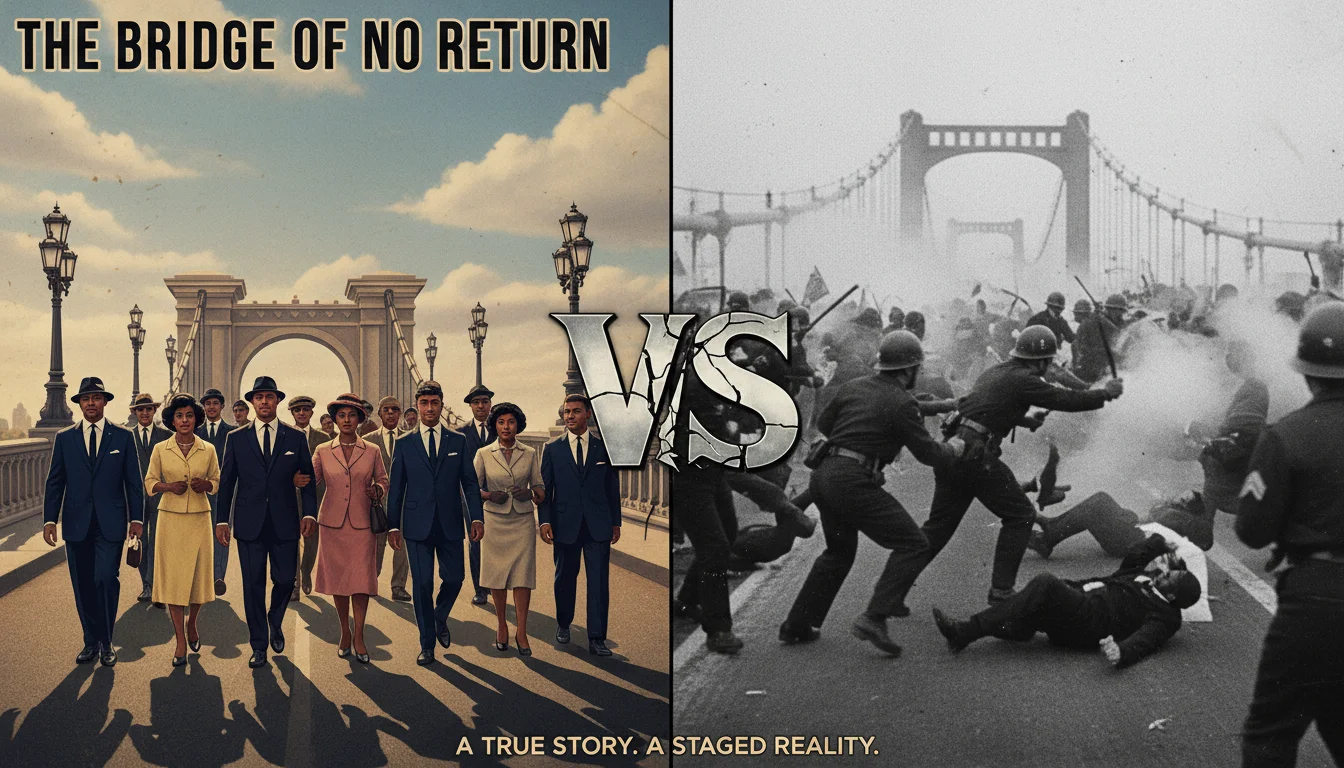
The film's depiction of "Bloody Sunday" on March 7, 1965, remains one of cinema's most harrowing recreations of racial violence. When peaceful marchers attempted to cross the Edmund Pettus Bridge, Alabama state troopers and local deputies attacked them with billy clubs, tear gas, and bullwhips.
The film accurately captures the specific horrors: Amelia Boynton Robinson beaten unconscious, John Lewis suffering a fractured skull, marchers trampled by horses. The footage shocked the nation when it aired on ABC that evening, interrupting Judgment at Nuremberg - a grim irony the film acknowledges. Within 48 hours, demonstrations erupted in 80 cities.
King's Complex Relationship with Violence
DuVernay wisely portrayed King's strategic calculation about provoking violent responses. The historical record confirms that SCLC leaders deliberately chose Selma because Sheriff Jim Clark was known for his violent temper - unlike the more restrained Bull Connor, who had learned to control his public displays of brutality.
The film shows King's agonizing moral calculus: using nonviolent marchers to expose the ugliness of segregation, knowing some would be hurt. This was real. King wrote from his Birmingham jail cell about the "creative tension" necessary to force change. In Selma, he knew Clark would provide the violent response that would galvanize national opinion.
The FBI's Surveillance and Harassment
The film's portrayal of FBI Director J. Edgar Hoover's obsessive campaign against King represents one of the most shameful chapters in American law enforcement history. The surveillance was even worse than depicted.
Hoover's COINTELPRO operation bugged King's hotel rooms, recorded his extramarital affairs, and sent him an anonymous letter suggesting he commit suicide. The film shows Coretta Scott King receiving tapes of her husband's infidelities - this happened. The FBI mailed them to the King home 34 days before he received the Nobel Peace Prize, hoping to destroy him on the world stage.
The Internal Movement Tensions
Selma accurately portrays the friction between King's Southern Christian Leadership Conference (SCLC) and the Student Nonviolent Coordinating Committee (SNCC). SNCC organizers had been working in Selma for two years before King arrived, and some resented the "celebrity" approach that would swoop in for national attention and then leave.
The film shows James Forman and other SNCC members questioning King's tactics and timeline. This tension was real and would eventually splinter the movement in the years following Selma.
The Turnaround Tuesday Decision
One of the film's most compelling sequences shows King's controversial decision to turn marchers around at the Edmund Pettus Bridge on March 9th - "Turnaround Tuesday." The historical record confirms King's agonizing position: a federal judge had issued an injunction against marching, and President Johnson had personally asked him to wait.
King led 2,500 marchers to the bridge, prayed, and then turned back - infuriating SNCC activists who saw it as capitulation. The film captures his reasoning: violating a federal injunction could have cost the movement precious judicial support. That same night, white supremacists murdered James Reeb, a white minister from Boston who had come to support the march.
What Hollywood Got WRONG
The LBJ Controversy
The film's most contentious departure from history involves President Lyndon B. Johnson. Selma portrays LBJ as resistant to voting rights legislation, viewing King as a political nuisance pushing too fast. Several scenes suggest Johnson directed the FBI's harassment of King.
The historical reality is more nuanced - and more favorable to Johnson. By early 1965, LBJ was already committed to voting rights legislation. His hesitation wasn't about whether to pass a bill but about congressional timing. He had just spent his political capital on the Civil Rights Act of 1964 and Medicare; he worried that pushing voting rights immediately would alienate Southern Democrats whose support he needed for his broader agenda.
Johnson's own recordings reveal a president who saw King as an ally, not an adversary. "Those goddamned bills have got to come out of Congress," Johnson told King in January 1965. The film suggests an adversarial relationship that doesn't match the historical record.
Most egregiously, there's no evidence Johnson ever directed FBI surveillance of King. That was Hoover's personal crusade, which he largely concealed from the White House. While Johnson didn't stop the surveillance, the film's suggestion of presidential direction goes too far.
George Wallace's Screen Time
Governor George Wallace receives surprisingly little attention in the film, despite being the architect of Alabama's resistance to civil rights. The real Wallace was far more central to the Selma story - his state troopers carried out Bloody Sunday, and his political manipulation of the crisis shaped national coverage.
The film reduces Wallace to a few scenes of sneering villainy, missing an opportunity to explore the political machinery of segregation. Wallace's meeting with Johnson - a masterpiece of political theater where LBJ reportedly physically intimidated the smaller governor - deserves more than its brief mention.
The Voting Rights Act's Journey
The film compresses and simplifies the legislative process that produced the Voting Rights Act. Johnson's famous "We Shall Overcome" speech to Congress is presented as a direct response to Selma, which is partly true - but the speech came after weeks of additional political maneuvering, not as the immediate emotional response the film suggests.
The actual bill faced months of congressional debate and amendment. By ending with Johnson's speech, the film implies the victory was won, when in reality the political battle was just beginning.
The Missing Women
While Selma includes important female figures like Diane Nash and Annie Lee Cooper, it underrepresents women's roles in the movement. The film focuses heavily on male SCLC leadership, despite women comprising the majority of local organizers and foot soldiers.
Amelia Boynton Robinson, who was nearly killed on Bloody Sunday, had been organizing in Selma for decades before King arrived. Her work and the work of countless other women deserve more than supporting roles.
King's Sermons and Speeches
Due to rights issues with King's actual speeches (controlled by his estate), the filmmakers had to write original dialogue. Oyelowo's speeches capture King's rhythms and themes beautifully, but they're not King's actual words. Some historians argue this fundamentally changes the film's historical value - we're watching a performance of King, not hearing the man himself.
Historical Accuracy Score: 7/10
Selma succeeds as emotional truth while taking liberties with political history. The brutality of Jim Crow, the courage of ordinary marchers, and the moral urgency of the voting rights cause come through powerfully. The film's recreation of Bloody Sunday should be required viewing.
But the LBJ controversy represents a meaningful historical distortion. Johnson was many things - often crude, sometimes cynical, capable of great cruelty in Vietnam - but on civil rights, he was genuinely committed to King's cause. Turning him into an obstacle makes for cleaner drama but poorer history.
The film's greatest achievement may be reminding audiences that voting rights required blood sacrifice. The John Lewis shown taking a beating on that bridge went on to serve 33 years in Congress, fighting for the same principles until his death in 2020 - just as state legislatures were again restricting voting access.
History may be messier than Hollywood's version, but Selma captures something essential: the courage required to march into violence, the faith required to believe America could change, and the terrible price paid for freedoms many now take for granted.

Debate the Accuracy with the Real Figures
Ask the real people what Hollywood got wrong about their lives.
Chat with HistoryJoin the HistorIQly Club
Get smarter about the past.
Weekly stories, deep dives, and exclusive content straight to your inbox.