The Sodder Children: The Five Kids Who Vanished in a Christmas Eve Fire
The Sodder children disappeared on Christmas Eve 1945 when their West Virginia home burned - but no remains were ever found. Were they really in the fire?
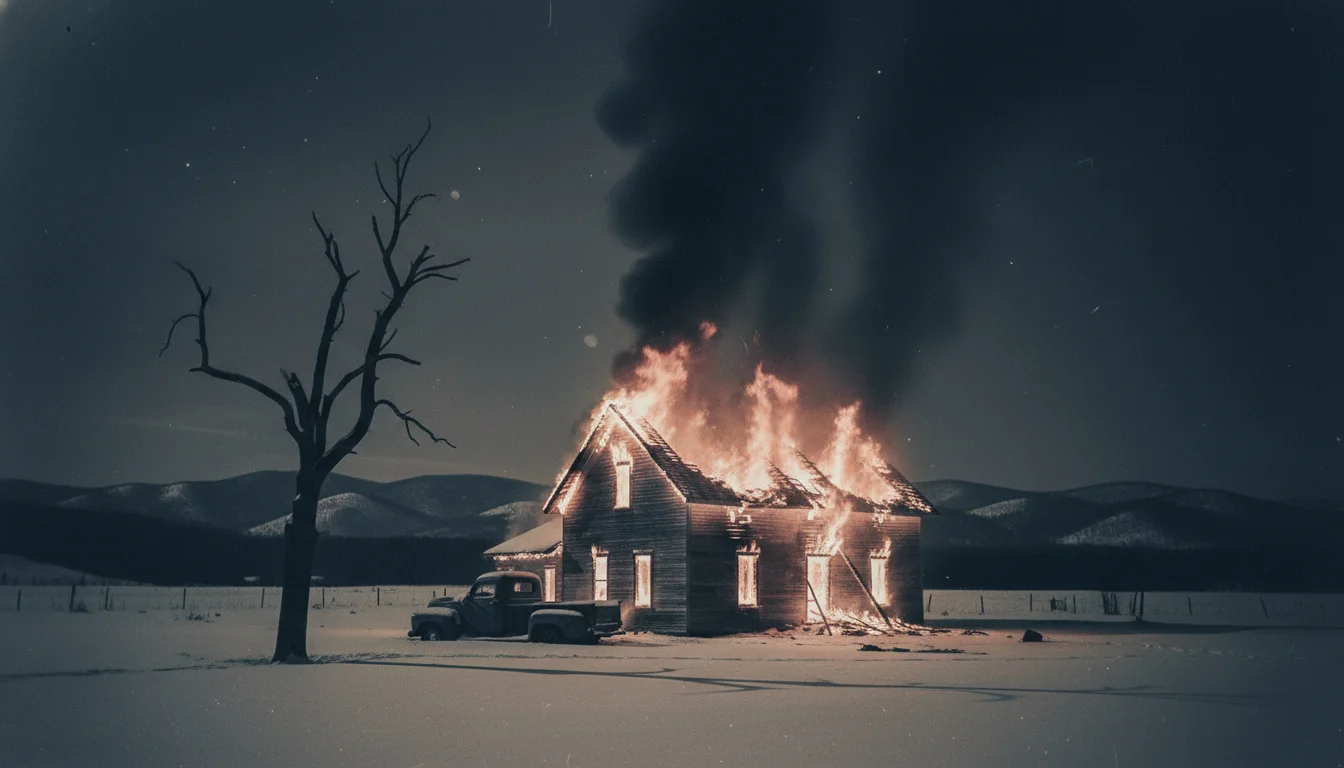
On the night of December 24, 1945, George and Jennie Sodder put their ten children to bed in their farmhouse in Fayette County, West Virginia. By morning, the house was a smoldering ruin. Five of their children - Maurice (14), Martha (12), Louis (9), Jennie (8), and Betty (5) - were gone. No bodies. No bones. No trace.
For the next forty years, their parents refused to believe their children died in that fire. The evidence suggests they may have been right.
A Fire Full of Questions
The blaze started around 1:00 AM. George Sodder was awakened by what he thought was something hitting the roof, followed by the smell of smoke. He tried to reach the upstairs bedrooms where the five younger children slept, but the staircase was already engulfed. He ran outside to grab a ladder he kept against the house, but it was missing. His two coal trucks, which he could have used to reach the second-story windows, wouldn't start - despite working perfectly the day before.
The local fire department didn't arrive until 8:00 AM, a full seven hours after the alarm was raised. By then, the house had collapsed into the basement. The fire chief, F.J. Morris, conducted a brief search of the debris and declared the children dead. No bones, no teeth, no remains of any kind were recovered.
This was the first of many contradictions. A house fire hot enough to completely incinerate five human bodies - bones and all - would need to sustain temperatures above 1,500 degrees Fahrenheit for hours. Yet household appliances were found in the rubble, largely intact. Other objects in the basement survived. The fire, by all physical evidence, was not hot enough to destroy human remains.
The Strangest Details
In the weeks and months before the fire, disturbing events had occurred. A life insurance salesman had visited the Sodder home and, after George declined his offer, reportedly threatened him: "Your house is going to go up in smoke, and your children are going to be destroyed."
A few months before Christmas, a stranger was spotted watching the children from the highway. Another witness saw a man steal the ladder from beside the house on the afternoon of December 24th. The phone lines to the property had been cut - not burned, cut - which explained why calls for help never went through.
After the fire, multiple witnesses came forward claiming they had seen the children. A woman at a Charleston hotel said she saw all five kids the morning after the fire, accompanied by two men and two women who spoke Italian. When she tried to approach them, one of the adults told her to mind her own business and they drove away.
George Sodder was an Italian immigrant who had been vocally critical of Mussolini's fascist regime. Some investigators later theorized that the fire was a targeted attack connected to Italian organized crime or wartime political grudges, and that the children were kidnapped rather than killed.
A Father's Relentless Search
George and Jennie Sodder never stopped looking. They erected a billboard along Route 16 featuring photos of the five children and a $5,000 reward for information. That billboard stood for decades, becoming one of the most recognizable landmarks in West Virginia.
In 1949, George hired a private investigator who uncovered troubling facts about the fire investigation. The original coroner's inquest had been suspiciously brief. Fire Chief Morris, who'd declared the children dead, later moved away from the area. The state fire marshal's investigation was cursory at best.
George had the site excavated in 1949, four years after the fire. Workers dug several feet into the basement and found... nothing. No bone fragments. No dental remains. Nothing that would indicate five children had perished there.
Then, in 1967, Jennie Sodder received an envelope postmarked from Kentucky. Inside was a photograph of a young man, approximately 30 years old. On the back was written: "Louis Sodder. I love brother Frankie. Ilil Boys. A90132 or 35." The handwriting was never identified. The man in the photo was never found. The return address led nowhere.
The Investigation That Never Was
What makes the Sodder case so maddening is the cascade of institutional failure. The fire department took seven hours to respond to a blaze visible for miles. The initial investigation lasted less than a day. Key evidence - the cut phone line, the missing ladder, the non-starting trucks - was never forensically examined.
A pathologist later examined small bone fragments found at the site (discovered during a second search) and determined they were not from fire victims and likely belonged to a young adult, not children. Some researchers believe these bones were planted to close the case.
The West Virginia State Police officially classified the children as dead in the fire. George and Jennie fought this ruling for the rest of their lives. George died in 1969, still searching. Jennie died in 1989, the billboard still standing outside her new home.
What Really Happened?
Several theories persist. The kidnapping theory is the most widely supported by circumstantial evidence: the pre-fire threats, the cut phone lines, the sabotaged vehicles, the missing ladder, the hotel sighting, and the total absence of remains all point toward a planned operation to remove the children under cover of an arson fire.
Others suggest the Italian-American community connection. George Sodder had publicly denounced Mussolini and refused to support fascist organizations in West Virginia's Italian community. Retribution through his children, while extreme, was not without precedent in the era's organized crime.
The simplest explanation - that the children died in the fire and their remains were completely consumed - contradicts the physical evidence. Appliances survived. The fire wasn't hot enough. And not a single tooth or bone fragment from five children was ever found.
The Sodder billboard came down in 1989 when Jennie passed away. But the case remains open. The West Virginia State Police have never officially solved it. The five Sodder children, if they survived, would be in their 80s and 90s today.
Somewhere, perhaps, they lived entire lives under different names, never knowing a family in West Virginia never stopped looking for them.
Or perhaps the fire took them after all, and the evidence that says otherwise is simply the cruel randomness of a terrible night.
Either way, Christmas Eve 1945 in Fayette County remains one of America's most haunting unsolved mysteries.
For other family disappearances where the evidence pointed in too many directions at once, see The Jamison Family Mystery and The Yuba County Five.

Want to Interrogate the Suspects?
Chat with historical figures and uncover the truth behind history's greatest mysteries.
Start Your InvestigationJoin the HistorIQly Club
Get smarter about the past.
Weekly stories, deep dives, and exclusive content straight to your inbox.