Spartacus vs. History: How Accurate Is Stanley Kubrick's Epic Slave Rebellion?
Checking the Spartacus historical accuracy: Kubrick's 1960 epic gets the rebellion's scale and crucifixion finale right but invents the death scene, Varinia, and the political subplot.
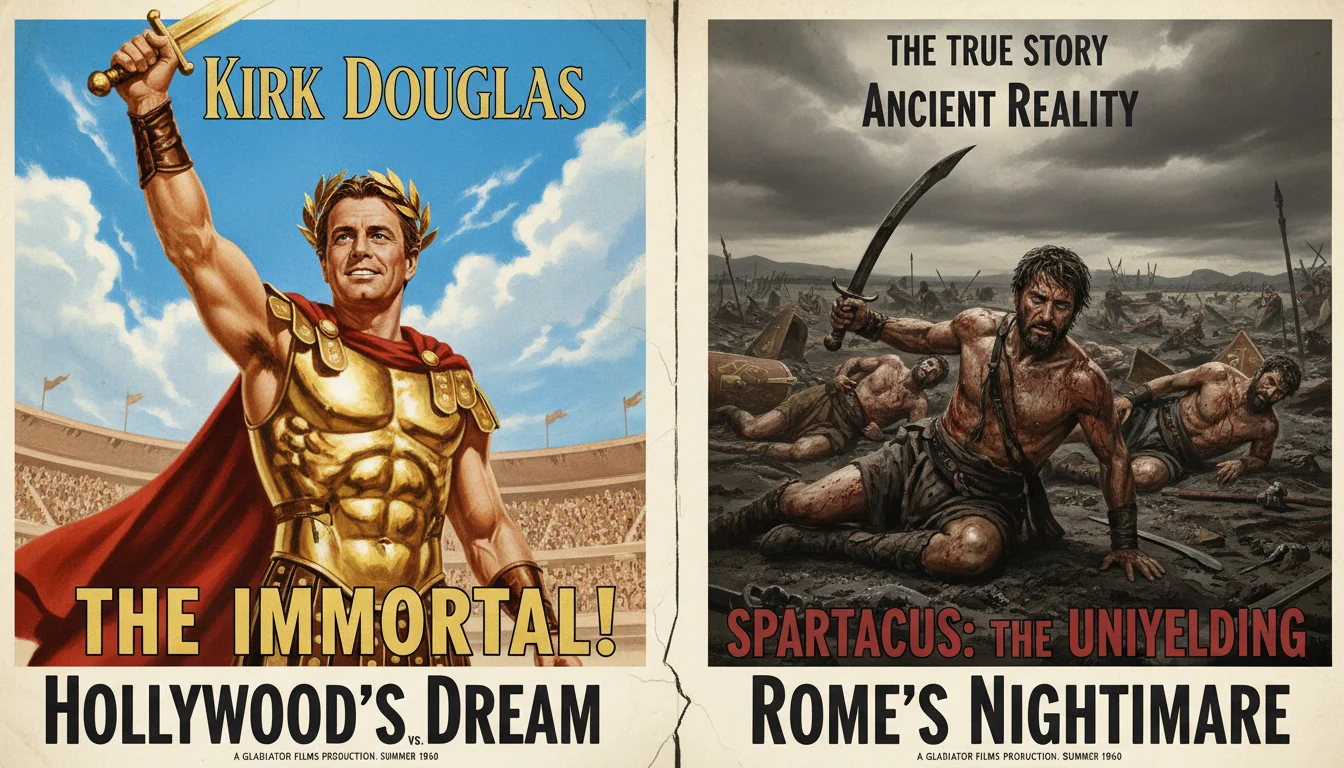
Stanley Kubrick's 1960 epic "Spartacus" remains one of cinema's most influential historical dramas. Kirk Douglas stars as the Thracian gladiator who led history's most famous slave rebellion against the Roman Republic from 73-71 BCE. With an all-star cast including Laurence Olivier, Peter Ustinov, and Charles Laughton, the film became a cultural touchstone that still shapes how we imagine ancient Rome.
But how much of this Hollywood spectacle reflects actual history? Let's separate the gladiatorial fact from the cinematic fiction.
What Hollywood Got RIGHT
The Scale of the Rebellion
The film accurately portrays the rebellion as a massive, existential threat to Rome. Historical sources confirm that Spartacus's army grew to between 70,000 and 120,000 escaped slaves and impoverished free men - a force that repeatedly crushed Roman legions sent to destroy it.
The movie correctly shows Rome's initial dismissal of the revolt. The Senate sent poorly equipped militia forces expecting an easy victory. Instead, Spartacus defeated them handily. This pattern repeated several times before Rome finally took the threat seriously enough to deploy full consular armies.
Spartacus's Origins
The film gets the basics right: Spartacus was indeed a Thracian (from modern-day Bulgaria) who had served as an auxiliary in the Roman army before being enslaved. Ancient sources including Plutarch and Appian confirm he was trained as a gladiator at the ludus of Lentulus Batiatus in Capua - exactly as shown in the film.
His natural leadership ability was recognized early. Plutarch describes him as "more Greek than Thracian" in character, intelligent, and possessing unusual dignity for a slave. The film's portrayal of Spartacus as an educated, principled leader has historical support.
The Gladiatorial School Uprising
The film's depiction of the initial escape from the ludus is largely accurate. In 73 BCE, approximately 70 gladiators broke out of their training school using kitchen implements as weapons. They armed themselves from a wagon of gladiatorial equipment and seized Mount Vesuvius as their initial base.
The movie's showing of brutal gladiatorial training conditions reflects reality. These were death factories where men were worked to exhaustion and fought for entertainment. The desperation that drove the escape was very real.
Crassus's Role
The film accurately identifies Marcus Licinius Crassus as the Roman general who ultimately defeated Spartacus. One of Rome's wealthiest men, Crassus took command after other generals failed. He was indeed known for his ruthlessness and political ambition - character traits the film captures well through Laurence Olivier's portrayal.
The rivalry between Crassus and other Roman leaders is also historically grounded. The Republic's politics were cutthroat, with men like Crassus, Pompey, and later Caesar constantly maneuvering for power.
The Crucifixions
The film's haunting finale - showing crucified slaves lining the Appian Way from Capua to Rome - is historically accurate. Ancient sources confirm that Crassus ordered 6,000 captured rebels crucified along the road as a warning. This was Roman terror tactics at their most brutal, and the film doesn't flinch from showing it.
What Hollywood Got WRONG
Spartacus's Death
The film shows Spartacus dying on a cross, reaching poetically toward his wife Varinia as she escapes to freedom with their child. It's beautiful cinema - and completely fictional.
According to historical accounts, Spartacus died in the final battle against Crassus's legions. Appian writes that he charged directly toward Crassus himself, fighting so ferociously he killed two centurions before being overwhelmed. His body was never found among the dead, leading to centuries of speculation about his fate.
The romantic death scene was pure Hollywood.
Varinia and the Child
Speaking of Varinia - she's almost entirely fictional. While some ancient sources mention Spartacus had a female companion who was a priestess of Dionysus, we know virtually nothing about her. The character of Varinia, her love story with Spartacus, and their child are dramatic inventions by screenwriter Dalton Trumbo.
This doesn't diminish the emotional power of Jean Simmons's performance, but it's historical fiction designed to humanize the story.
The Political Intrigue
The film's elaborate Roman political subplot - with Crassus scheming against Gracchus (played by Charles Laughton) for control of the Republic - is largely invented. While Roman politics were indeed brutal, the specific characters and conflicts portrayed don't match historical records.
Gracchus, as presented, is a composite character representing populist Roman politicians. The film uses him to create a good-vs-evil dynamic that oversimplifies Rome's complex political landscape.
Antoninus and the Poetry Scene
Tony Curtis plays Antoninus, a cultured slave who becomes Spartacus's close companion. The famous "snails and oysters" scene (censored from original releases) used food preferences as a metaphor for sexuality in a way that, while dramatically interesting, has no historical basis.
More importantly, there's no evidence Spartacus had a particularly close relationship with any individual follower named Antoninus or otherwise.
The Rebellion's Goals
The film presents Spartacus as fighting for freedom and human dignity - essentially a proto-abolitionist. While this makes for inspiring cinema, ancient sources suggest the rebels' goals were more limited: escape from Italy, possibly to return to their homelands.
The movie's grand speeches about freedom reflect 1960s ideals more than ancient reality. Spartacus likely wanted to get his followers out of Rome's reach, not fundamentally transform Roman society.
The Pirate Deal
A crucial plot point involves Spartacus negotiating with Cilician pirates for transport across the Mediterranean. The film shows Crassus bribing the pirates to betray the slaves.
While pirates were indeed involved historically, the details differ. Some ancient sources suggest Spartacus made a deal with pirates who then abandoned him, but others question whether large-scale naval transport was ever a real possibility for such a massive army.
Historical Accuracy Score: 6/10
Spartacus historical accuracy is a genuine mixed verdict. "Spartacus" succeeds as historical drama while taking significant liberties with the facts. The broad strokes are accurate: a Thracian gladiator really did lead Rome's most dangerous slave rebellion, defeat multiple Roman armies, and terrorize the Republic for two years before being crushed by Crassus.
The film captures authentic details of Roman military tactics, gladiatorial culture, and the brutality of slavery. The crucifixion finale is one of cinema's most historically accurate mass execution sequences - which is an odd thing to praise, but there it is.
However, the romantic subplot, political intrigue, and Spartacus's noble death are Hollywood fabrications. The real Spartacus died fighting, not reaching toward the woman he loved. His rebellion was probably motivated more by survival than ideology.
What makes "Spartacus" endure isn't its historical accuracy but its emotional truth. The film captures something real about the human desire for freedom, even if it bends facts to tell that story. Kirk Douglas saw the project as his response to the Hollywood blacklist (hiring blacklisted screenwriter Dalton Trumbo), and that spirit of resistance permeates every frame.
The ancient slave rebellion became a lens for examining 20th-century injustice - and that transformation from history to myth is exactly what great historical films do. Just don't use it as a study guide for your Roman history exam.
The Third Servile War (73-71 BCE) remains one of antiquity's most dramatic events - a reminder that even the mightiest empires can be shaken by those they've trampled. For another look at Rome on film, see our Alexander vs. History fact-check, and for a film that gets the Roman military machine right in a different era, Gladiator movie accuracy is worth the comparison.

Debate the Accuracy with the Real Figures
Ask the real people what Hollywood got wrong about their lives.
Chat with HistoryJoin the HistorIQly Club
Get smarter about the past.
Weekly stories, deep dives, and exclusive content straight to your inbox.