Titanic vs. History: James Cameron's Epic Gets the Details Right - But Not the Romance
Titanic historical accuracy: Cameron's epic nails the ship design and real passengers but invents Jack, Rose, and the Heart of the Ocean. Here's what really happened.
James Cameron spent four years obsessing over every rivet, deck chair, and china pattern on the RMS Titanic. He made 12 dives to the wreck. He built a 90% scale replica. The result? A film that's both historically meticulous and completely fictional where it matters most.
Let's separate what really happened from what Cameron invented.
What Hollywood Got RIGHT ✅
The Ship Design Is Almost Perfect
Cameron's attention to detail borders on obsessive. The grand staircase, the Turkish baths, the Marconi wireless room - all painstakingly recreated from original blueprints and survivor accounts. Even the china pattern matches White Star Line's actual dinnerware.
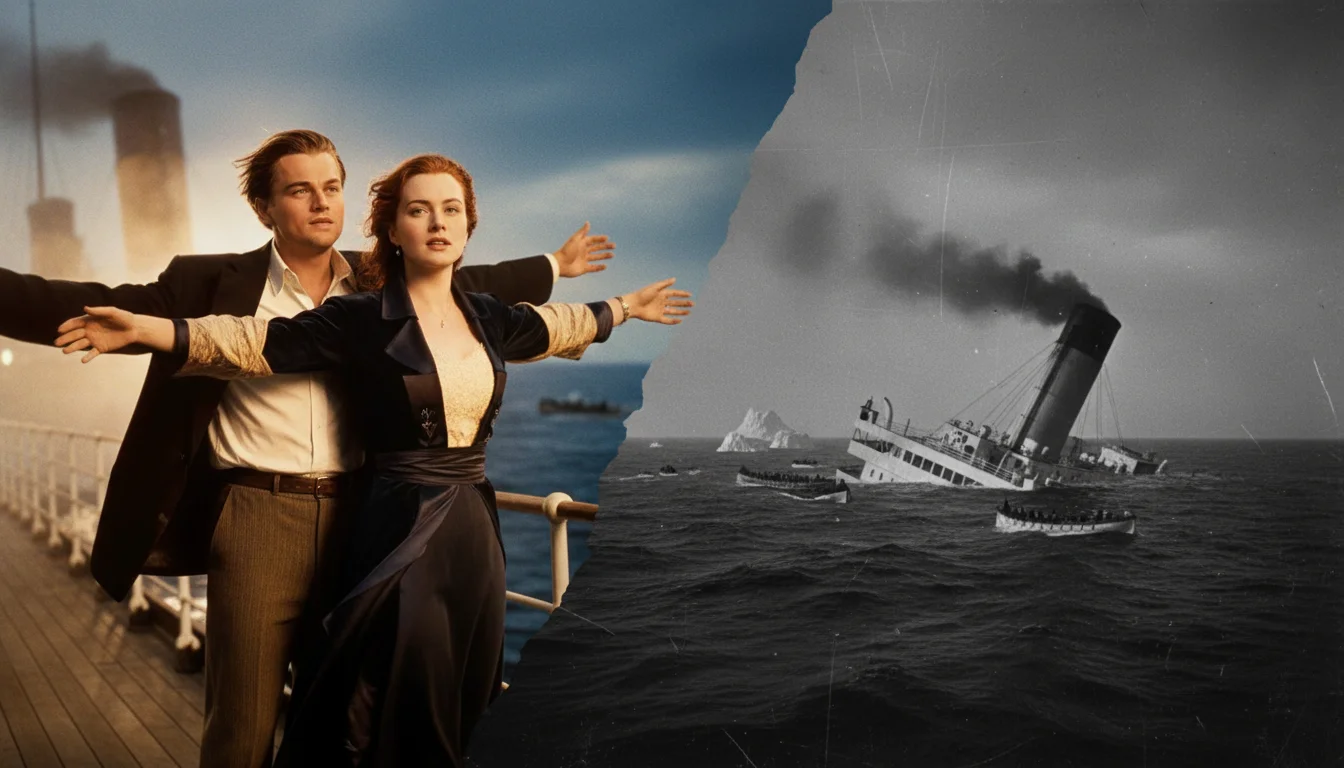
The ship splits in two during the sinking, exactly as eyewitnesses reported (though this was controversial in 1997 - many "experts" claimed it sank intact). Cameron's depiction matches what we now know from the wreck.
Real People, Real Actions
Many background characters are real:
- Captain Edward Smith goes down with his ship, as reported
- Thomas Andrews (the ship's designer) quietly accepts his fate in the smoking room
- "Unsinkable" Molly Brown really did take charge of Lifeboat 6 and demand they row back for survivors
- Benjamin Guggenheim and his valet really did change into evening dress to "die like gentlemen"
- Wallace Hartley and the band really played until the end (though probably not "Nearer My God to Thee")
The Class Divide Was Real
The film's portrayal of third-class passengers being locked below decks? Mostly accurate. Gates separating classes were locked per immigration regulations, and stewards initially prevented third-class passengers from reaching the boat deck.
First-class men really did have a higher survival rate (34%) than third-class children (34%). Money literally bought you a spot in the lifeboats.
Lifeboat Shortage
The film shows lifeboats launching half-empty while hundreds watch from the deck. Happened. Titanic had lifeboats for only 1,178 people - less than half the 2,224 aboard. Early boats left with as few as 12 people (capacity: 65) because officers feared the davits couldn't handle the weight.
The Water Temperature
When Jack says "That water is freezing and there's too many of them," he's not exaggerating. The North Atlantic was 28°F (-2°C). Most victims died of hypothermia within 15-30 minutes. The film's depiction of frozen bodies and Jack's death is medically accurate.
What Hollywood Got WRONG ❌
Jack and Rose Never Existed
The central romance that made teenage girls weep and rewatch the film 47 times? Complete fiction. No scrappy artist from Cherbourg, no society girl fleeing an arranged marriage, no "I'm flying" scene.
Cameron invented them to create an emotional anchor for a disaster that killed 1,500 people. Smart filmmaking, zero history.
First Officer Murdoch Didn't Shoot Himself
The film shows First Officer William Murdoch shooting a passenger, then himself, as boats launch. This enraged Murdoch's hometown of Dalbeattie, Scotland. There's no evidence Murdoch shot anyone or himself. He was last seen helping launch Collapsible Lifeboat A and likely went down with the ship.
Cameron later apologized to Murdoch's surviving family members and donated to a memorial fund.
The "Heart of the Ocean" Is Fantasy
The giant blue diamond Rose wears? Invented. There was no "Heart of the Ocean" aboard Titanic. The real inspiration might be the Hope Diamond, but that never went near the ship.
J. Bruce Ismay Wasn't That Villainous
The film portrays White Star Line chairman J. Bruce Ismay as a scheming coward who pressures Captain Smith to break speed records, then sneaks into a lifeboat while women and children die.
Reality: Ismay did survive (which ruined his reputation), but there's no evidence he pressured Smith about speed. He helped load lifeboats for over an hour before boarding Collapsible C - which had empty seats and no women or children nearby.
He wasn't a hero, but he wasn't the mustache-twirling villain Cameron depicts.
The "I'm the King of the World" Scene
Jack standing at the bow yelling "I'm the king of the world!"? Never happened (obviously, since Jack is fictional). But it's become one of cinema's most iconic moments and was parodied for decades.
Fun fact: The line was improvised by Leonardo DiCaprio.
Lovejoy's Pursuit Through the Flooding Ship
Cal's bodyguard Lovejoy chasing Jack and Rose through E-deck as water floods in? Pure Hollywood thriller logic. No one was running armed manhunts during the evacuation. Everyone was trying to survive, not settle personal scores.
Rose's Survival
Rose floating on the wooden panel while Jack freezes? Controversial. The panel looks large enough for both, sparking decades of debate. MythBusters tested it and concluded: yes, both could have survived if they'd maneuvered correctly.
But here's the thing: Cameron didn't care. He wanted Jack to die for maximum emotional impact. "The script says Jack dies," he later said. "Could he have lived? Who cares."
The Sinking Sequence: Mostly Accurate
The 40-minute sinking sequence is stunning - and remarkably accurate:
✅ Timeline: The film shows Titanic sinking at 2:20 AM, exactly when it did
✅ Angle: The stern rises to near-vertical before the ship splits
✅ Chaos: People falling, jumping, clinging to rails - all reported by survivors
✅ Suction: The film shows bodies being pulled underwater as the ship sinks (debated, but some survivors reported it)
❌ Breaking: The ship breaks cleanly. In reality, it was messier - the keel bent and tore before separating.
Historical Accuracy Score: 7/10
What bumps the score:
- Obsessive attention to ship design, interiors, and real historical figures
- Accurate timeline, lifeboat shortage, and class dynamics
- The sinking sequence matches survivor accounts
What hurts it:
- The central characters are invented
- First Officer Murdoch's death is fabricated and offensive
- J. Bruce Ismay is unfairly villainized
- The treasure-hunt framing device is pure fiction
The Verdict
Titanic is a masterclass in blending fact and fiction. Cameron built a historically accurate ship, then filled it with an invented love story. He nailed the details - the china, the staircase, the freezing water - but ignored historical figures like Isidor and Ida Straus (the elderly couple who died holding hands) in favor of Jack and Rose.
It's not a documentary. It's a disaster movie with a romantic core, wrapped in painstaking historical recreation. And it worked: Titanic became the highest-grossing film of all time (until Cameron topped himself with Avatar).
If you want historical accuracy, read Walter Lord's A Night to Remember. If you want to ugly-cry while Celine Dion belts "My Heart Will Go On," watch Titanic.
Just know: Jack and Rose are as fictional as the giant diamond - and First Officer Murdoch deserved better.
For more maritime and disaster film fact-checks, see our breakdowns of Master and Commander and Apollo 13.
The RMS Titanic sank on April 15, 1912, killing approximately 1,500 people. It remains one of history's most famous maritime disasters - and proof that even "unsinkable" ships can meet their end.
Quick Answers
Common questions about this topic
Did the Titanic really split in two as shown in the film?
Yes. Cameron's depiction of the ship splitting in two during the sinking matches eyewitness accounts and what we now know from examining the wreck. This was controversial when the film was released in 1997, with many experts claiming the ship sank intact, but the split has since been confirmed by submersible dives to the wreckage.
Did First Officer Murdoch really shoot himself?
William Murdoch was a real First Officer aboard the Titanic, but there is no evidence he shot a passenger or himself as depicted. He was last seen helping launch Collapsible Lifeboat A and likely went down with the ship. Cameron later apologized to Murdoch's surviving family members and donated to a memorial fund in his Scottish hometown.
Why did so few third-class passengers survive?
Gates separating classes were locked per immigration regulations of the era, and stewards initially prevented third-class passengers from reaching the boat deck. Combined with limited lifeboats and a confusing maze of corridors, this meant third-class passengers - many of whom didn't speak English - faced huge barriers to reaching the upper decks. Class effectively determined survival odds.
How cold was the water the night the Titanic sank?
The North Atlantic was 28 degrees Fahrenheit (minus 2 degrees Celsius). Most victims died of hypothermia within 15 to 30 minutes of entering the water, not from drowning. The film's depiction of frozen bodies and Jack's death is medically accurate to the actual conditions that night.

Debate the Accuracy with the Real Figures
Ask the real people what Hollywood got wrong about their lives.
Chat with HistoryJoin the HistorIQly Club
Get smarter about the past.
Weekly stories, deep dives, and exclusive content straight to your inbox.