The Favourite vs. History: How Accurate Is Yorgos Lanthimos's Royal Drama?
Queen Anne, Sarah Churchill, and Abigail Masham battled for power in early 18th-century England. We fact-check what The Favourite got right and wrong.
Read Wikipedia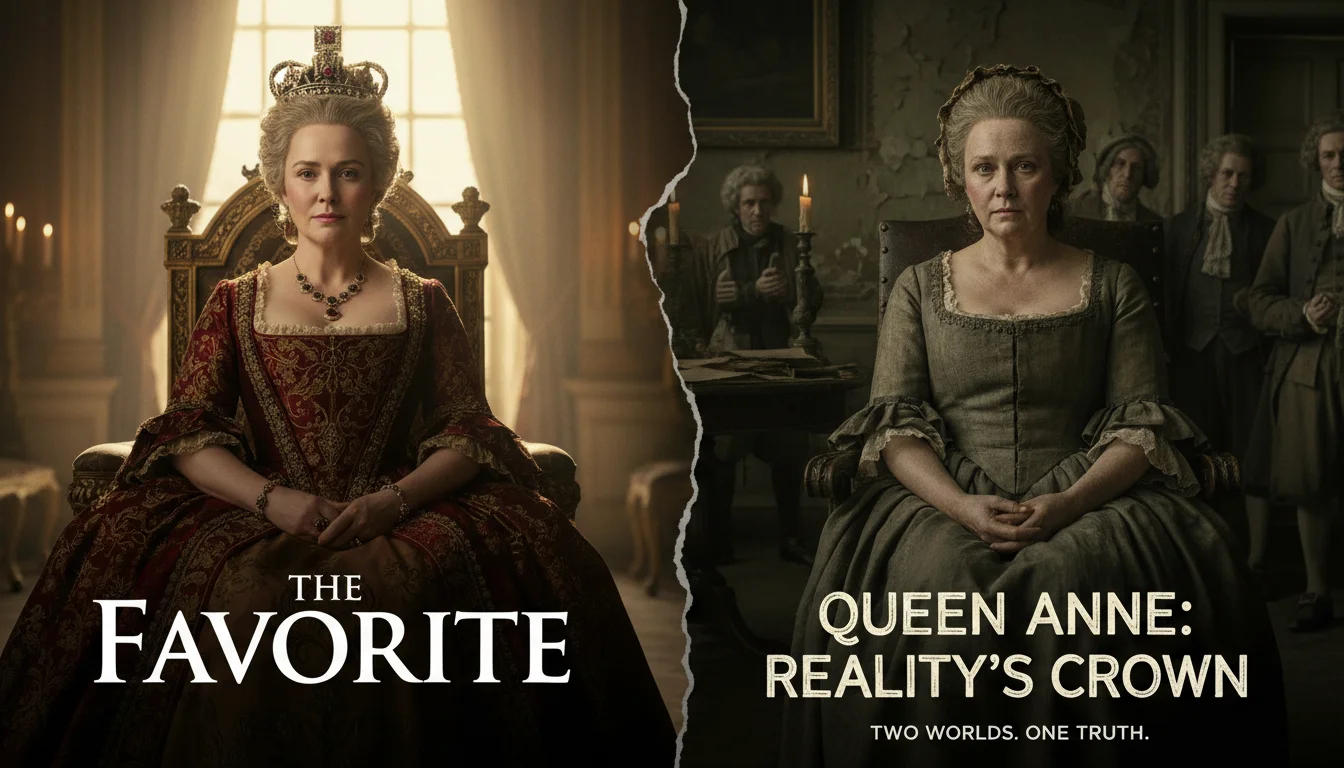
Yorgos Lanthimos's 2018 film The Favourite is a sharp, darkly funny portrayal of the power struggle at the court of Queen Anne. Olivia Colman won an Oscar for her performance as the ailing monarch, while Rachel Weisz and Emma Stone played the two women fighting for influence over her. But beneath the fish-eye lenses and deadpan humor, how much of this story actually happened?
What Hollywood Got RIGHT
The Core Power Triangle
The central dynamic of the film is historically accurate. Queen Anne (reigned 1702-1714) was genuinely close to Sarah Churchill, Duchess of Marlborough. Their friendship stretched back decades to when Anne was a princess and Sarah was her lady of the bedchamber. They even used private names for each other: Anne was "Mrs. Morley" and Sarah was "Mrs. Freeman."
Abigail Masham (nee Hill) really was Sarah's impoverished cousin who entered court service through Sarah's patronage, and she really did gradually replace Sarah in the queen's affections. This is one of the best-documented court rivalries in English history.
Queen Anne's Health
The film depicts Anne as physically wrecked, and this is painfully accurate. Anne suffered from gout so severe she sometimes couldn't walk or stand. By her later years, she was often carried in a sedan chair or pushed in a wheelchair. She endured at least 17 pregnancies, with most ending in miscarriage or stillbirth. Only one child, Prince William, Duke of Gloucester, survived infancy, and he died at age 11 in 1700. The film's portrayal of Anne as a woman in constant physical and emotional pain is grounded in reality.
The War of the Spanish Succession
The political backdrop is correct. England was fighting the War of the Spanish Succession (1701-1714), with the Duke of Marlborough - Sarah's husband - commanding the allied forces. The Whigs generally supported continuing the expensive war, while the Tories pushed for peace. Sarah was firmly in the Whig camp, and this political alignment became a genuine source of friction between her and the queen.
Sarah's Blunt Personality
Rachel Weisz plays Sarah as brutally direct, sometimes to the point of cruelty. Historical sources confirm this. Sarah was famously outspoken and had little patience for flattery. She once told Anne to her face that she was being foolish about a political matter. Multiple contemporaries noted that Sarah seemed incapable of softening her opinions, even when speaking to the queen. This bluntness, which had once been refreshing to Anne, eventually became unbearable.
Abigail's Political Maneuvering
Abigail really did become a secret ally of Robert Harley (later Earl of Oxford), the Tory politician working to undermine the Whigs and end the war. Her marriage to Colonel Samuel Masham in 1707 was indeed kept secret from Sarah, and when Sarah discovered it, the betrayal deepened their rivalry. Abigail used her quiet access to the queen to advance Tory interests while Sarah was often away from court.
What Hollywood Got WRONG
The Sexual Relationships
The film portrays both Sarah and Abigail as having sexual relationships with Anne. While historians have debated Anne's sexuality for centuries, the evidence is ambiguous. Anne and Sarah exchanged intensely affectionate letters, but such language was common between female friends in the early 18th century. Some historians like Anne Somerset argue the relationships were platonic, while others see the letters as suggestive of something more. The film presents the sexual dimension as established fact, which goes beyond what the historical record can confirm.
Abigail's Scheming Villainy
Emma Stone's Abigail is portrayed as a calculating social climber who poisons Sarah and manipulates everyone around her. The real Abigail appears to have been far less dramatic. She was certainly politically useful to the Tories, but contemporary accounts describe her as genuinely kind and gentle. Her rise likely owed as much to Anne's growing exhaustion with Sarah's hectoring as to any masterful scheming on Abigail's part. The poisoning scene is pure fiction.
The Timeline Compression
The film compresses events that took place over roughly a decade (1704-1714) into what feels like a single year. Sarah's fall from favor was a gradual process, not a sudden collapse. The real timeline saw years of slowly deteriorating relations, political arguments conducted through letters, and multiple attempts at reconciliation before the final break in 1711 when Sarah was formally dismissed from all her offices.
The Duck Racing and Lobster Racing
Those bizarre scenes of courtiers racing ducks and lobsters? Pure Lanthimos invention. While the early 18th-century English court had its eccentricities, there is no historical evidence for these particular entertainments. They serve the film's satirical vision of aristocratic absurdity rather than any historical reality.
Harley's Portrayal
Robert Harley is a relatively minor figure in the film, but the real Harley was one of the most significant politicians of Anne's reign. He was a masterful parliamentary operator who engineered the fall of the Whig ministry and eventually became Lord Treasurer. The film underplays his role and makes the political machinations seem driven almost entirely by the personal rivalry between Sarah and Abigail, when in reality, the political dimensions were far more complex.
The Ending
Without spoiling too much, the film's final scenes suggest a particular power dynamic between Anne and Abigail that doesn't match historical accounts. In reality, Abigail maintained her position until Anne's death in 1714. After that, the Whigs returned to power under George I, and Abigail retired quietly to private life. She didn't suffer any dramatic comeuppance.
Historical Accuracy Score: 6/10
The Favourite captures the emotional truth of the Anne-Sarah-Abigail triangle remarkably well. The core story of a queen caught between two competing influences, one forceful and one subtle, is historically sound. But Lanthimos deliberately chose style and dark comedy over strict accuracy. The sexual content, the compressed timeline, the invented set pieces, and the caricatured portrayals of secondary characters all serve the film's artistic vision rather than historical fidelity.
It's a brilliant film about power, dependency, and manipulation. As a history lesson, treat it as a starting point, not a textbook. The real story is just as compelling, if somewhat less surreal. For other royal-court dramatizations, see our checks on Elizabeth and The King's Speech.
Want to explore more historical figures? Chat with Queen Anne and hundreds of other historical figures on HistorIQly - where history comes alive through AI conversation.

Debate the Accuracy with the Real Figures
Ask the real people what Hollywood got wrong about their lives.
Create your free account →No card required. Some figures and features require a paid plan.
Join the HistorIQly Club
Get smarter about the past.
Weekly stories, deep dives, and exclusive content straight to your inbox.