Zulu vs. History: How Accurate Is the 1964 Classic About Rorke's Drift?
The 1964 film Zulu depicts Rorke's Drift with solid zulu historical accuracy on tactics, but reshapes characters and softens the colonial context of the war.
Few historical war films have a reputation quite like Zulu (1964). Directed by Cy Endfield and starring Stanley Baker and a very young Michael Caine, it turned the defense of Rorke's Drift into one of the most famous last-stand movies ever made.
The film is gripping for a reason. The real event was dramatic enough without much embellishment: around 150 British and colonial defenders held off several thousand Zulu warriors on January 22-23, 1879, just hours after the British disaster at Isandlwana.
So did Zulu get history right?
More than many epics of its era, honestly. It captures the scale of the danger, the exhaustion of the defenders, and the professionalism and courage on both sides. But it also bends reality in ways that make the story cleaner, more heroic, and more British than the real event actually was.
What Hollywood Got RIGHT
The basic situation is remarkably accurate
The film's core setup is true. Rorke's Drift really was a small mission station in Natal. A tiny garrison really was left exposed after the destruction of the British force at Isandlwana. And a large Zulu force really did descend on the station, forcing the defenders to improvise barricades and fight for survival through the afternoon, night, and early morning.
That alone is enough for a great film, and Zulu wisely trusts the real scenario.
The defenses look close to the real thing
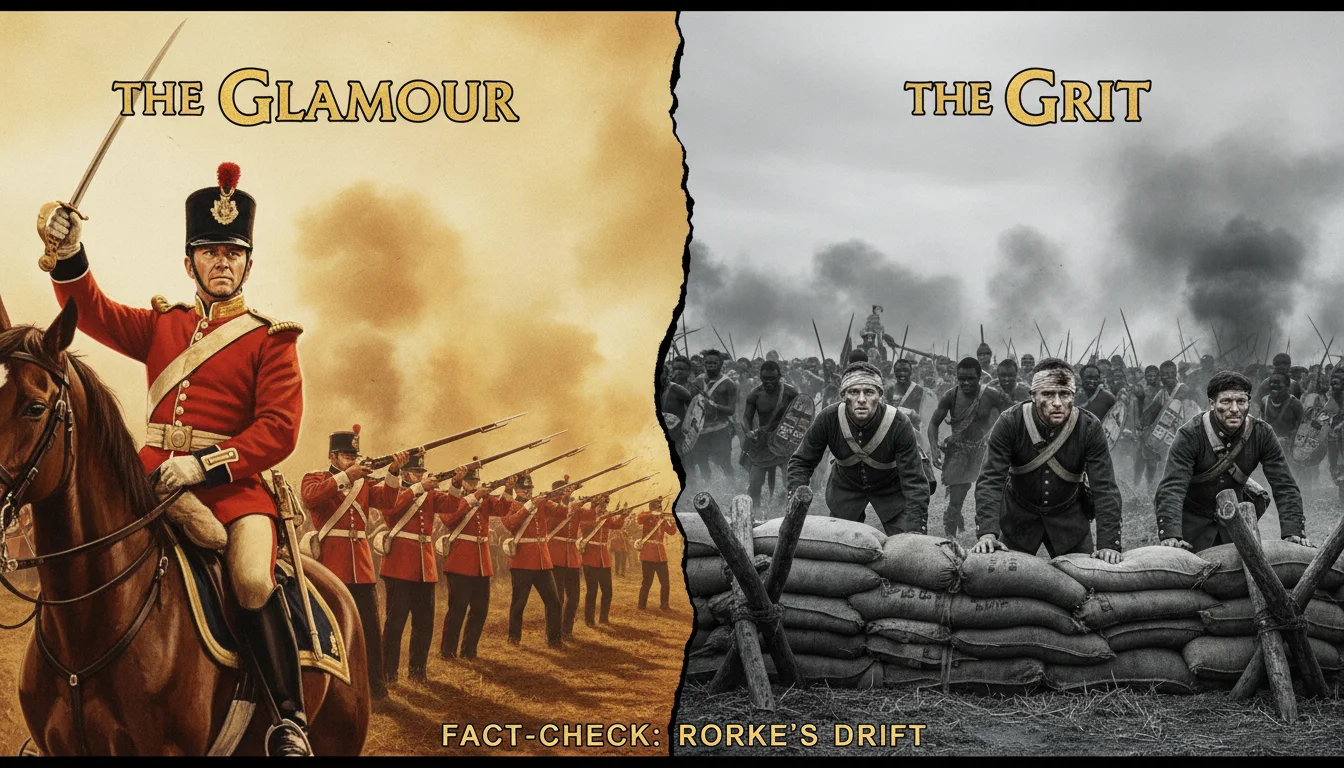
The famous barricades made from mealie bags and biscuit boxes are not a Hollywood invention. The defenders really did throw up crude fortifications using whatever was available. The film also gets the shrinking perimeter right: as casualties mounted and positions became untenable, the defenders fell back into a smaller inner line.
That tactical realism is one reason military historians still have respect for the movie.
Chard and Bromhead were real, and they did lead the defense
Lieutenants John Chard of the Royal Engineers and Gonville Bromhead of the 24th Regiment really were the key British officers during the battle. The film correctly presents Chard as the more engineering-minded officer and Bromhead as the regular army man with the harder edge. Their awkward relationship is dramatized, but the chain of command issue was real because they came from different branches and had to work it out quickly under pressure.
The defenders were heavily outnumbered
The exact number of Zulu attackers remains debated, but the film is right about the overall imbalance. The garrison was tiny, and the attacking Zulu force was huge by comparison, probably around 3,000 to 4,000 men. The sense of mounting dread, of a thin red line staring at a sea of spears, is not cinematic exaggeration. That was the reality.
The Zulu army is shown as disciplined and formidable
One of the film's strengths is that it does not portray the Zulu as a faceless mob. They are shown as brave, organized, and dangerous. That matters, because the Zulu army of 1879 was a serious military force with doctrine, regimental structure, and battlefield experience. The British victory at Rorke's Drift only looks impressive because the enemy was formidable, and the film mostly understands that.
What Hollywood Got WRONG
Private Henry Hook is almost completely reinvented
The movie's most famous distortion is Private Henry Hook, played by James Booth as a surly malingerer and drunk who finds redemption in battle.
The real Hook was almost the opposite. He was by most accounts a sober, reliable soldier and one of the men who helped defend the hospital under horrific conditions. He later received the Victoria Cross for his actions. The film turned a brave professional into a disciplinary problem because it made for a better character arc.
It is great drama, but deeply unfair to the real man.
The missionary's daughter romance is fictional
The Swedish missionary Otto Witt was real, and there were civilians at the station. But the subplot involving his daughter and the tension around her is invented. There was no such romantic element at the heart of the battle. It is one of those classic Hollywood additions meant to humanize the story and provide emotional contrast, but historically it has no real foundation.
The movie softens the colonial context
This is probably the film's biggest omission.
Zulu presents Rorke's Drift as a noble defensive action, which in a narrow tactical sense it was. But it mostly avoids the larger political truth: the Anglo-Zulu War began because the British Empire invaded Zululand on a flimsy pretext. The Zulu were not randomly attacking peaceful outsiders. They were fighting in a war triggered by imperial aggression.
The film does not exactly deny this, but it pushes that reality to the margins. Viewers can easily leave thinking they watched a simple civilization-versus-savagery story, which badly distorts the broader history.
The famous singing scene is shaky as history
One of the film's most memorable moments is the defenders singing "Men of Harlech" while the Zulu chant in response. It is wonderful cinema. It is also probably not what happened.
There are accounts of singing during the battle or afterward, and the regiment did have Welsh associations, but historians are skeptical that this iconic musical face-off unfolded in the neat, emotionally satisfying way the film depicts it. It feels true because it captures morale and defiance. Factually, it is much murkier.
Some characters and tensions are simplified or combined
Like many historical films, Zulu compresses personalities to make the story easier to follow. Social tensions between officers, engineers, infantry, and patients existed, but the movie sharpens them into cleaner dramatic oppositions. Some secondary figures are also reduced to types rather than portrayed with the messier detail found in eyewitness accounts.
That is not unusual, but it does mean the film feels more psychologically orderly than the actual chaos of the station probably was.
The aftermath is more mythic than messy
The ending gives the battle an almost ceremonial grandeur, especially in the Zulu withdrawal and mutual respect between opponents. There is truth in the idea that both sides recognized each other's courage. But the movie packages that into a polished legend. Real battlefields are uglier, more confused, and less symmetrical than movies want them to be.
Historical Accuracy Score: 7/10
Zulu gets the big things right. There really was an extraordinary defense at Rorke's Drift. The defenders really were desperately outnumbered. The barricades, the hospital fighting, the exhaustion, and the respect due to the Zulu warriors are all grounded in history.
Where the film stumbles is in the way it reshapes people and politics. Henry Hook's character is the clearest example of Hollywood sacrificing truth for a stronger arc. More broadly, the film turns a colonial war into a cleaner legend about courage under siege, which is emotionally powerful but historically incomplete.
That still leaves Zulu as one of the better historical war movies ever made. It understands tactics, tension, and atmosphere far better than most films in the genre. But if you want the full truth, you have to look beyond the stirring final image and remember what kind of war this actually was.
As cinema, it is superb. As history, it is solid on the battle and shakier on the meaning. For other British war films that grapple with the gap between military heroism and imperial context, 1917 vs. History and Bridge on the River Kwai vs. History both show how the genre handles that tension with varying degrees of honesty.

Debate the Accuracy with the Real Figures
Ask the real people what Hollywood got wrong about their lives.
Chat with HistoryJoin the HistorIQly Club
Get smarter about the past.
Weekly stories, deep dives, and exclusive content straight to your inbox.