Time Traveler's Guide to Aksum, 350 AD
Survive the East African kingdom of Aksum at its height: royal etiquette, market food, stelae, incense, and how to avoid trouble with elephants.
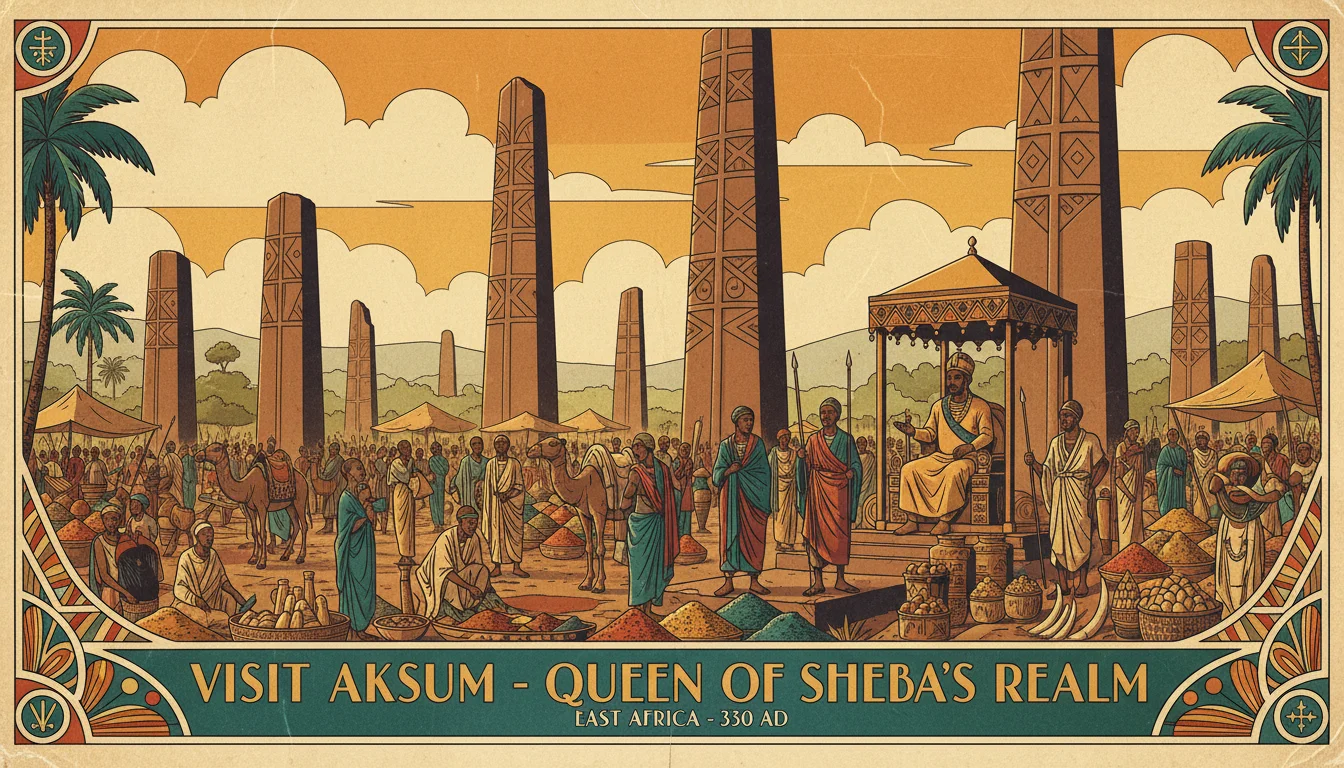
So you've decided to visit Aksum in 350 AD. Excellent choice. You are heading to one of the great powers of the ancient world, a kingdom in the northern Horn of Africa that traded with Rome, Arabia, India, and probably that one merchant who swears he has a cousin everywhere. At its peak, Aksum was wealthy, ambitious, deeply connected to the Red Sea trade, and full of enough stone monuments to make you wonder whether every public project was funded by a royal obsession with verticality.
This is a superb destination for the historically adventurous traveler. The air is highland-cool rather than desert-brutal, the markets are lively, the elite are rich, and the city projects confidence. It is also not a place where you want to improvise your manners. Arrive prepared, show respect, and do not say anything foolish about religion, kingship, or someone else's imported luxury goods.
First Things First: Where and When Are You?
Aksum sits in what is now northern Ethiopia and Eritrea. In 350 AD, the kingdom is a major regional power. Its rulers control trade routes linking inland Africa to the Red Sea port of Adulis, and from there to Egypt, Arabia, and beyond. Centuries later, that same Indian Ocean network would carry Swahili Kilwa to similar wealth on the coast farther south. Expect a courtly capital with monumental stelae, busy merchants, farmers bringing grain and livestock, and officials who take status very seriously.
This is also a fascinating religious moment. Christianity is spreading under royal patronage in the fourth century, especially after King Ezana's conversion, but older beliefs have not vanished overnight. In short, this is not the era to stroll in and announce that religion is "a personal journey." In Aksum, religion is public, political, and tied to legitimacy.
What to Wear
Aim for clean, practical, modest clothing in natural fabrics. A lightweight linen or cotton tunic is your safest choice, ideally belted. Add a mantle or shawl for cooler evenings in the highlands. Sandals are fine, but sturdy leather footwear is wiser if you plan to walk beyond the city center. Dust happens. Stones happen. Dignity slips quickly on uneven ground.
Avoid anything too bright, synthetic-looking, or suspiciously well tailored. If your outfit looks like it came from a futuristic capsule wardrobe, people may not call you a wizard, but they will stare like they are considering it.
Jewelry should be minimal unless you can convincingly pass as a wealthy foreign merchant. Flashy accessories invite attention, and not always the admiring kind. Also, leave wristwatches behind unless you enjoy becoming a theological problem.
What to Eat and Drink
Aksum is fed by a mix of local agriculture and long-distance trade. Expect barley, wheat, millet, legumes, honey, dairy, and meat in households that can afford it. Bread and porridges are common staples. Stews and roasted meats appear at better tables, and if you are lucky, you may encounter dishes flavored with local aromatics and imported luxuries.
Honey wine is a smart bet if offered. Water is more complicated. Drink from trusted household sources, and when in doubt, choose fermented or boiled beverages. Time travel is thrilling. Intestinal collapse is not.
Market food can be excellent, but use judgment. Go where turnover is high. If a stall has a line, that is a good sign. If flies seem to own the place, keep moving.
A polite traveler praises the generosity of the host, accepts food with gratitude, and does not ask whether there are vegan options. There are sometimes accidental vegan options, which is different.
How to Behave Without Causing an Incident
Aksum is hierarchical. Rank matters. Ceremony matters. Public respect matters.
A few rules will save your life, or at least your afternoon:
- Show deference to officials and priests. You do not need to grovel, but casual irreverence is a terrible strategy.
- Do not touch sacred or royal property. This includes monuments, ceremonial items, and probably anything guarded by men holding spears.
- Greet politely and let locals set the tone. A confident foreigner is acceptable. An overly familiar foreigner is exhausting.
- Do not boast about your homeland. Aksum already thinks it is important, and frankly, it has a case.
- Avoid arguments about theology. The kingdom is in a real period of religious change. This is interesting for historians and risky for tourists.
If invited into an elite household, compliment the hospitality, the quality of the bread, and the reach of Aksumite trade. Every prosperous civilization enjoys hearing that its trade network is impressive.
Money and Shopping
Aksum is famous for its coinage, one of the few African kingdoms of the ancient world to mint coins widely in gold, silver, and bronze. This is excellent news because it means the economy has recognizable money rather than forcing you to barter three chickens for a dinner and a cloak.
If you need to blend in, acquire small local coinage quickly. Trying to pay with strange foreign metal is a good way to start a conversation you are not linguistically prepared to finish.
Popular goods include:
- ivory
- incense and aromatics
- worked metal goods
- textiles
- glassware from trade networks
- fine pottery
Yes, I noticed the typo danger there. No, do not ask the merchant whether the ivory is ethically sourced.
Must-See Sights
The Stelae Field
This is the headline attraction. Aksum's enormous carved stone stelae are among the most striking monuments in the ancient world. Some mark elite burials, and all communicate the same message: this kingdom has money, labor, ambition, and absolutely no fear of large stone engineering projects.
Stand back and admire them respectfully. Do not climb one. If you survive the fall, the locals may finish the job on principle.
The Royal Quarter
Access will vary depending on your status, charm, and ability to look harmless. Even from the outside, elite compounds tell you a lot about the kingdom's power. Watch the traffic of servants, petitioners, guards, and merchants bearing gifts. Court politics are everywhere, even when nobody says the quiet part out loud.
The Markets
For the full Aksum experience, spend time in the markets. This is where you will hear multiple languages, see imported goods, and appreciate just how connected this kingdom is. You are not at the edge of the ancient world here. You are in one of its trading hubs.
A Roadside View Toward Adulis Trade Routes
If you can safely travel with a caravan or reputable guide, observing goods moving toward the Red Sea is worth it. Aksum's wealth comes from these arteries of commerce - the same trans-Saharan and Red Sea routes that would later feed Mali's Timbuktu. Just remember that bandits also understand trade economics.
Dangers, Annoyances, and Avoidable Disasters
The biggest dangers are not exotic curses. They are very ordinary historical problems.
Disease: Bring your strongest immune system and your weakest assumptions. Choose food and drink carefully.
Language barriers: Ge'ez dominates official culture, though trade zones are multilingual. Learn a few phrases or hire a guide. Mime is less effective than modern movies suggest.
Political sensitivity: Do not gossip about the king. Do not speculate about succession. Do not ask whether taxes are fair. Ancient states rarely enjoy audience participation.
Travel hazards: Roads can be rough, weather can shift, and caravans are not protected by customer service policies.
Animals: Oxen, camels, goats, and the occasional larger beast all have one thing in common: they do not care that you are a time traveler.
Final Verdict
Aksum in 350 AD is an outstanding destination for the traveler who wants grandeur without the chaos of a collapsing empire. It is rich, cosmopolitan, ceremonially impressive, and plugged into the wider world. You will see monumental architecture, active long-distance trade, and a kingdom defining itself in real time.
Come dressed simply, speak respectfully, eat cautiously, and keep your curiosity just one notch below offensive. Do that, and you will return with marvelous stories, excellent market gossip, and a renewed appreciation for the fact that one of antiquity's great powers stood in East Africa, minting coins and minding global trade while much of the modern world still forgets to put it on maps.
And if anyone asks where you are from, smile vaguely and say, "Far away." In Aksum, that will probably sound impressive instead of suspicious. Probably.

Need Advice from Someone Who Lived There?
Get firsthand accounts from people who actually lived through these moments in history.
Ask Them YourselfJoin the HistorIQly Club
Get smarter about the past.
Weekly stories, deep dives, and exclusive content straight to your inbox.