A Time Traveler's Guide to Yuan Beijing (Khanbaliq), 1280
Khanbaliq is Yuan dynasty Beijing - Kublai Khan's capital and the largest, richest city on earth in 1280. Here is how to survive arriving without a plan.
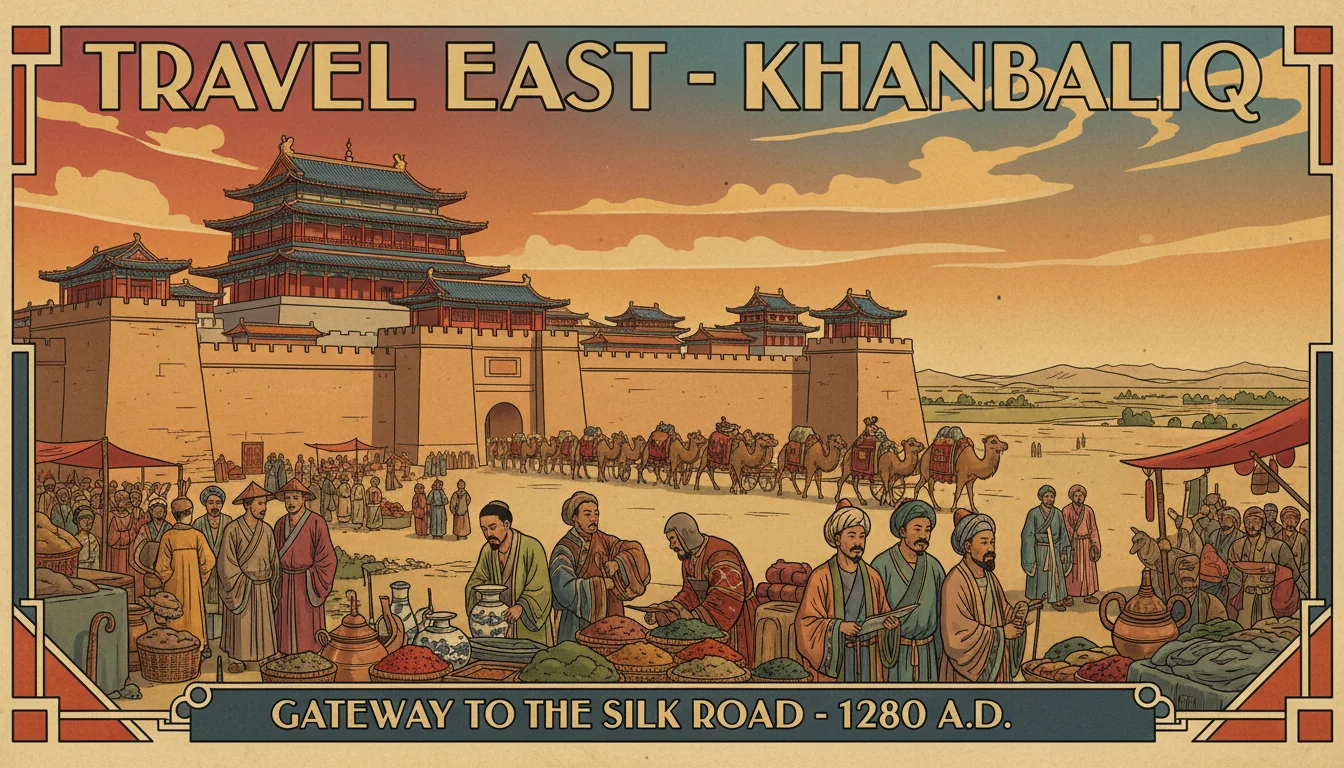
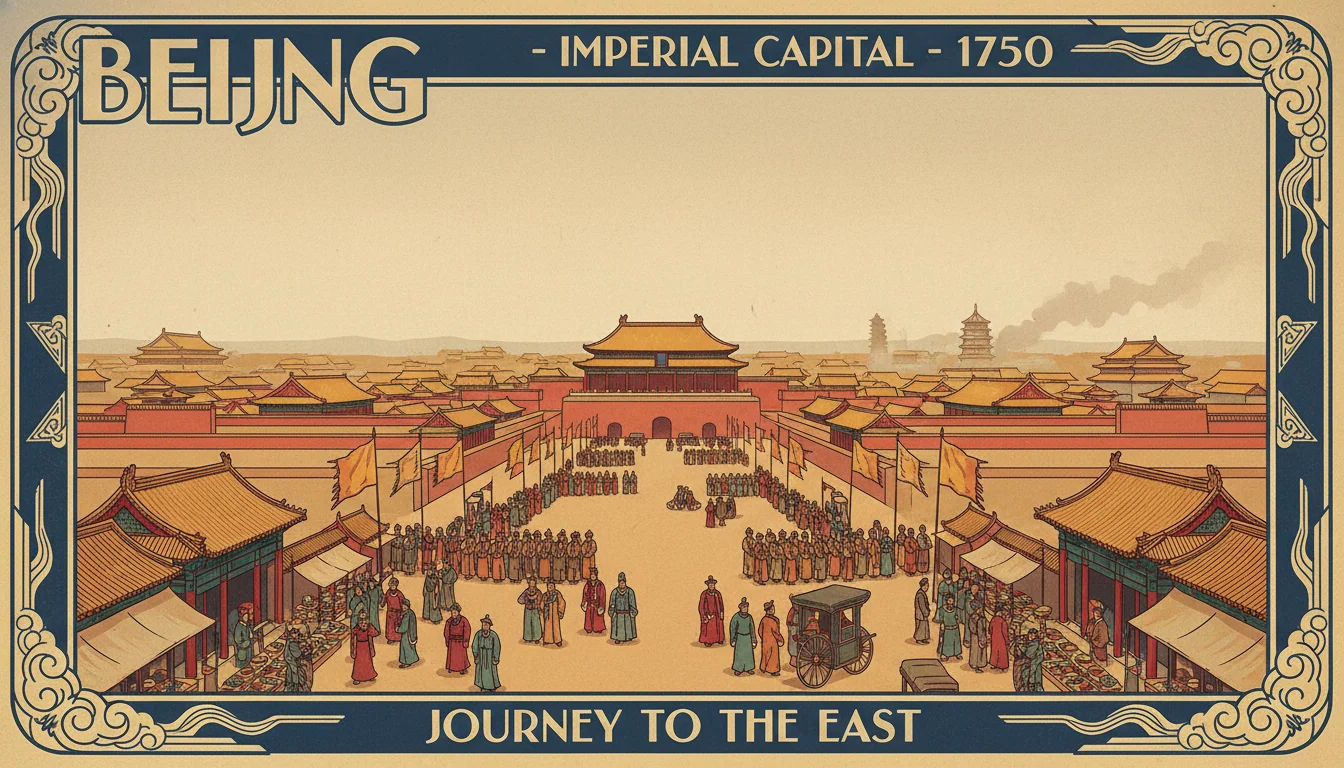
Khanbaliq (Yuan dynasty Beijing) in 1280 is the capital of the known world, or at least of the largest empire the world has ever seen, and it knows it. The city stretches across the flat plain south of the mountains at a scale nothing in medieval Europe or the Islamic world comes close to matching. Marco Polo, who claims to have been there, described it as a place where the streets were so long and straight you could see from one gate to the next. He was not exaggerating. This is a city laid out according to a plan, on a grid, with a rational geometry that reflects a government that has recently conquered most of the planet and intends to administer it properly.
Before you arrive, understand what you are entering. Khanbaliq is simultaneously a Mongolian court, a Chinese imperial capital, a Silk Road terminus, a Muslim commercial hub, and a Buddhist religious center. It is governed by a people who, two generations ago, burned most of it to the ground. The tension between conqueror and conquered is present in every institution, every street, and every transaction you will have there.
First: who are you supposed to be?
This is not optional. The Yuan government is among the most administratively sophisticated in the world and it tracks people. The dynasty maintains a passport system, a nationwide postal network of relay stations called yam, and a census apparatus inherited from the Song administration and greatly expanded. Strangers are noticed.
Your safest cover is as a foreign merchant - specifically, as someone associated with the Silk Road trade networks arriving through the western corridor. The Yuan empire actively encourages foreign commerce, and Kublai Khan had a personal and political interest in demonstrating that his court was cosmopolitan. Merchants from Persia, Arabia, Central Asia, and India were a normal sight in Khanbaliq. A traveler from farther west - Italy, perhaps, or the Crusader states - would be unusual but not impossible to explain. Marco Polo managed it.
You will need a paiza, the official tablet that served as a Yuan imperial passport and travel document. Without one, you are undocumented in a city full of checkpoints. The gold paizas were issued to high officials; silver to important merchants. Bronze to everyone else. Find a way to acquire or borrow the appropriate level for your story. Merchants traveling with established trade companies would typically have one issued by a Silk Road house that maintained relations with the Yuan court.
Do not claim to be Han Chinese unless you actually are. The Yuan dynasty operates a formal four-tier ethnic hierarchy: Mongolians at the top, then the Semu ren (western foreigners, primarily Central Asian Muslims), then the Hanren (former subjects of the Jin dynasty in the north), then the Nanren (former subjects of the Southern Song, recently conquered). A foreigner trying to pass as Han will be placed at the bottom of a stratified system they do not understand. Better to be obviously foreign and enjoy the relatively tolerant treatment reserved for Semu ren.
What the city looks like
Khanbaliq is actually two adjacent cities. The outer city, called Dadu, is the new grid-planned capital Kublai ordered constructed beginning in 1267. It is eleven kilometers from east to west and slightly less from north to south, enclosed by earthen walls thirty feet high with eleven gates. Inside those walls, the streets run at right angles and the wards are organized into regular blocks. The population by 1280 is somewhere between half a million and one million people, roughly five times the size of London in the same decade.
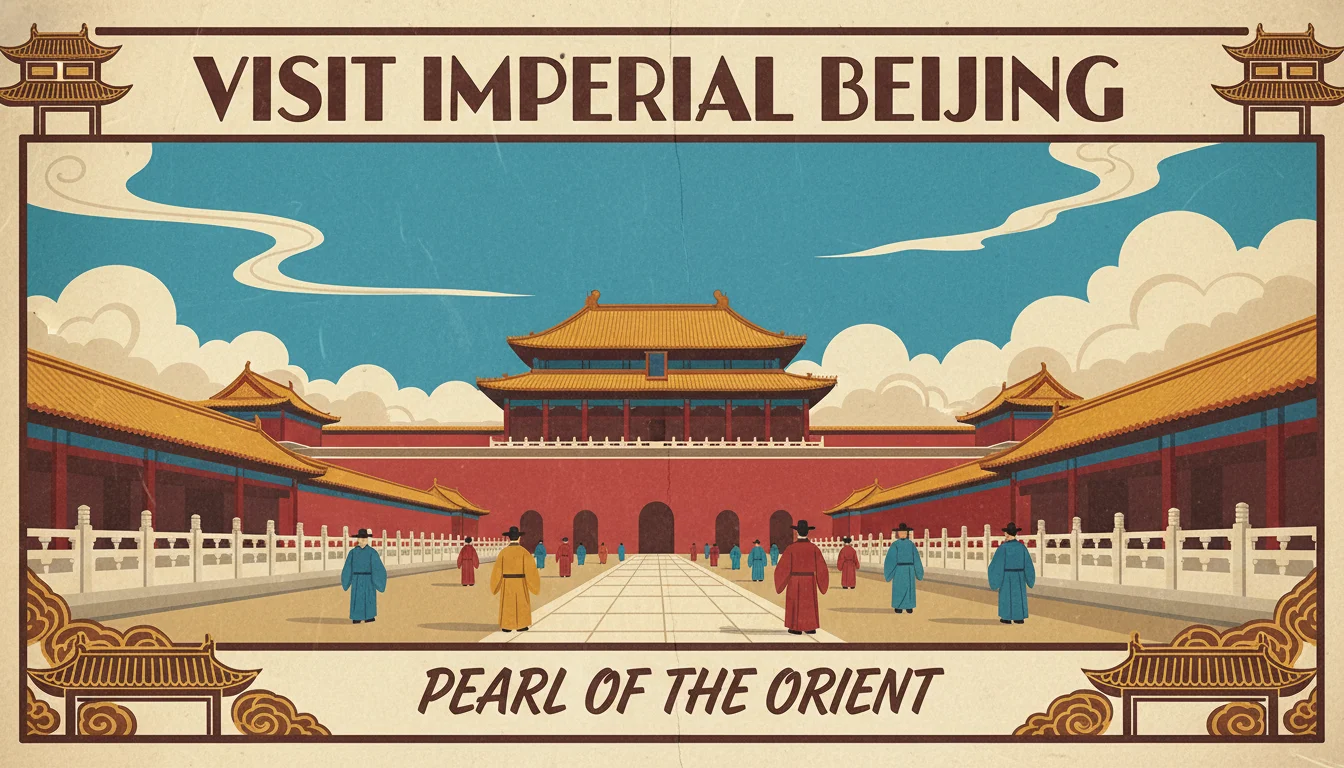
At the center of Dadu sits the Imperial City, and at the center of that sits the Forbidden City precinct of the palace complex itself. You will not get into the inner palace without exceptional circumstances, but the Imperial City's lakeside parks and the areas around the outer palace gates are accessible to credentialed visitors and traders with business to conduct.
Just to the southwest of Dadu lie the ruins of Zhongdu, the Jin dynasty capital that Genghis Khan's forces destroyed in 1215. Its burned-out walls and foundations are still visible and actively scavenged for building materials. The Mongols did not rebuild it. They built new, on a slightly different alignment, to make the point that this was not a continuation of the Jin dynasty but something altogether different.
Getting around and getting paid
The streets of Dadu run straight and are paved in the main commercial arteries, though mud is universal once you leave them. Most travel within the city is on foot. Horses are for officials and the wealthy. Sedan chairs carried by bearers are available for hire if you want to signal status.
Money is the first practical challenge. The Yuan government has banned the use of gold and silver coinage as currency and replaced it with paper notes called jiaochao. This is not negotiable. You must exchange any metallic currency you have at an official exchange office and accept paper in return. The exchange rate is set by the state. The notes are backed by a reserve of silk, and the government has the power to cancel or devalue old issues and require exchange to new ones.
The good news is that the paper system works in 1280. The bad news is that the government has been issuing more paper than the reserves strictly support, which means the purchasing power of the notes is already declining. Secure your provisions quickly rather than holding large amounts of paper for extended periods.
The main market district runs along the central north-south avenue south of the Imperial City. It is open from before dawn until well into the evening. You can buy silk, ceramics, lacquerware, spices from Southeast Asia, cotton from India, horses from the steppe, coral from the Persian Gulf, and food from every corner of the empire. The smell is extraordinary: coal smoke, spices, horse manure, open-air cooking fires, and the river mud from the canal system that brings goods into the city from the south.
Eating and drinking without consequences
Food in Khanbaliq reflects the city's plurality. The Mongolian dietary core - mutton, beef, mare's milk fermented into airag - is present everywhere the ruling class congregates. The Han Chinese majority eats millet, rice, noodles, vegetables, pork, and a vast variety of fermented and preserved foods. Muslim merchants have established their own food networks operating under halal restrictions, concentrated in certain wards near the mosque.
For a visiting foreigner, the safest and most socially legible option is to eat at establishments catering to the Semu ren merchant class: Persian-influenced food, familiar spice profiles, and hosts accustomed to dealing with people from outside the empire. The great commercial teahouses near the market district are loud, crowded, and functional.
Drink boiled water or tea. Fermented drinks are generally safer than unboiled water. Airag, the fermented mare's milk of the Mongolians, is an acquired taste but safe. Huangjiu, the Chinese fermented grain wine, is widely available and not dangerous. Avoid raw vegetables and fruit that cannot be peeled.
The dangers
The obvious danger is political. The Yuan court in 1280 is still adjusting to the conquest of the Southern Song, which was completed in 1279 - just the previous year. There are active resistance movements in parts of southern China, and the court is alert to potential conspiracies. Expressing sympathy for the Song dynasty in any context is not survivable.
Less obvious is the danger from disease. Khanbaliq sits at the center of Silk Road trade routes that connect China to the steppes, Central Asia, and the Middle East. The movement of goods and people along those same routes will, within 60 to 70 years, carry the Black Death westward. In 1280 that catastrophe has not yet begun, but the city's sanitary infrastructure - open drainage channels, dense population, close contact between humans and animals - is exactly the environment where respiratory and intestinal disease thrives year-round. Your immune system is from a different century. Be conservative about what you eat, drink, and touch.
The winter is genuinely cold. The North China plain in January and February drops well below freezing. The court and the wealthy heat their palaces with underfloor heating systems adapted from the northern Chinese and Korean traditions. Foreigners in market lodgings are heating with coal braziers in small rooms. Bring or buy proper winter clothing immediately.
What you must see before you leave
The palace complex at dusk, when the glazed roof tiles catch the last of the light and the whole city seems to be rendered in gold and blue. The view from the top of the Coal Hill (Jingshan, the artificial hill north of the palace built from the earth excavated for the palace moats), where on a clear day you can see the full grid of the city laid out below you.
The main market on a busy morning: the sheer quantity of goods moving through the greatest commercial hub in the medieval world is worth the visit alone.
The yam relay station at the north gate, where messengers arrive and depart continuously, a horse changed every twenty or thirty miles across the entire breadth of the empire. Marco Polo called this the best postal system in the world. He was right.
If you have letters of introduction to a Silk Road merchant house, attend one of their dinners. The conversation will be in three or four languages simultaneously, and the guests will include people who have traveled from Baghdad, Samarkand, Calicut, and Hangzhou. Khanbaliq in 1280 is, for all its brutalities and tensions, a city that knows the world is large and takes that knowledge seriously.
Quick Answers
Common questions about this topic
What was Khanbaliq?
Khanbaliq, meaning 'City of the Khan' in Mongolian, was Kublai Khan's imperial capital, located on the site of modern Beijing. Construction began in 1267 on the ruins of the Jin dynasty capital Zhongdu, which Genghis Khan's forces had burned in 1215. By 1280 it was the seat of the Yuan dynasty and, by most estimates, the largest and most prosperous city in the world.
Did Marco Polo really visit Khanbaliq?
Marco Polo claimed to have arrived at Kublai Khan's court around 1275 and to have stayed in his service for roughly 17 years. His account, dictated to a writer named Rustichello in a Genoese prison around 1298, describes Khanbaliq in detail including its markets, postal system, paper money, and palace. Historians debate whether Polo physically visited or compiled his account from Persian and other merchants' reports. The specific detail he provides about the city is broadly consistent with Chinese sources.
What language did people speak in Khanbaliq in 1280?
The city's working languages were Mongolian (the language of the ruling class and the court), Chinese (the language of the bureaucracy and the majority population), and a Persian-inflected Turkic used by Muslim merchants and administrators from Central Asia. Arabic was useful in trading contexts. Kublai Khan used a new script called Phags-pa, designed by the Tibetan monk Drogon Choegyal Phagpa, for official documents across all languages.
How did Kublai Khan's paper money system work?
The Yuan dynasty operated one of the world's first large-scale paper money systems. The central government issued notes backed by state reserves of silk and silver. Merchants were required to exchange metallic coins for paper currency, and the use of gold and silver as direct currency was banned. Marco Polo was astonished by a system where the Great Khan could, as he wrote, 'cause as much treasure as he likes to be produced' simply by issuing paper. Sustained over-issuance of currency eventually contributed to serious inflation and the dynasty's economic problems in the following century.

Need Advice from Someone Who Lived There?
Get firsthand accounts from people who actually lived through these moments in history.
Ask Them YourselfJoin the HistorIQly Club
Get smarter about the past.
Weekly stories, deep dives, and exclusive content straight to your inbox.