Time Traveler's Guide to Amarna, Egypt, 1340 BC
Akhenaten's Amarna, Egypt was the world's first purpose-built city for a single god. Survive a visit to 1340 BC's most baffling, sun-drenched experiment in monotheism.
Every pharaoh in Egyptian history built monuments. Akhenaten built a city.
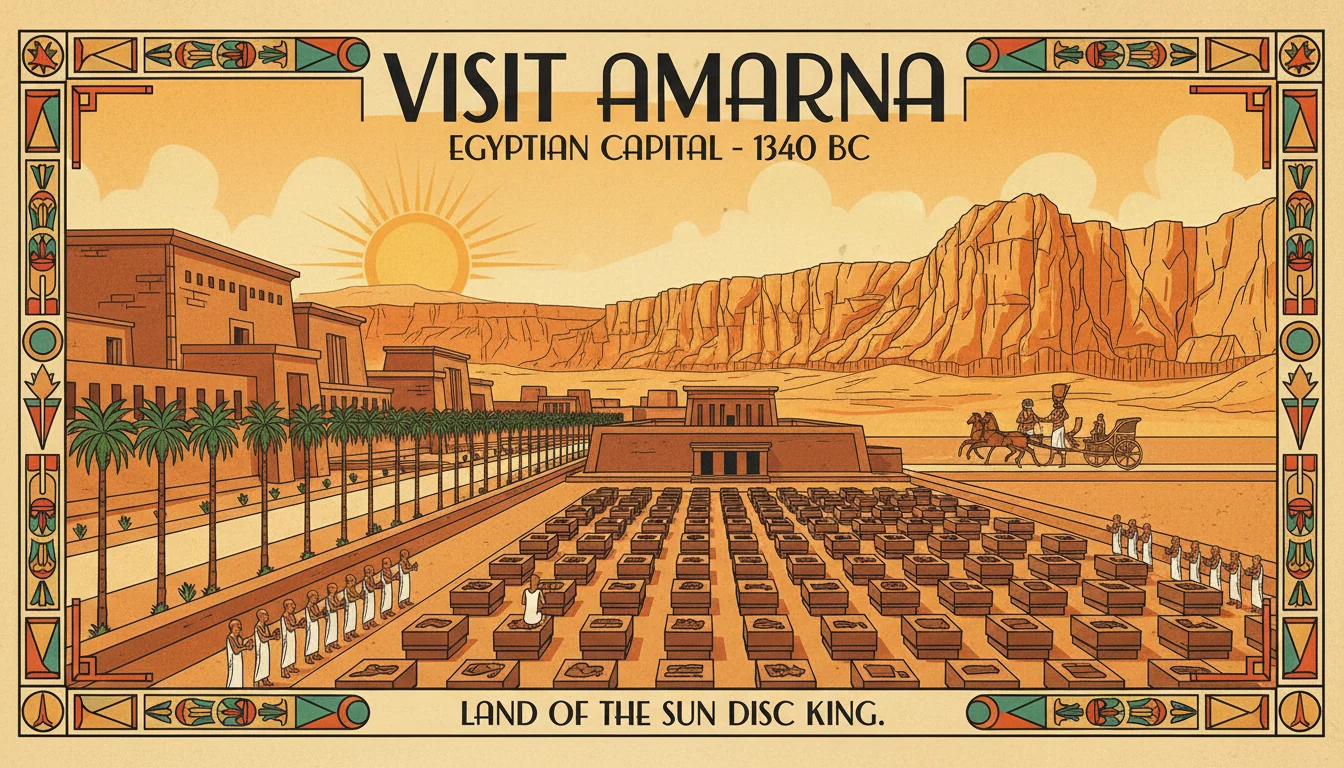
Not an addition to an existing capital, not a temple complex bolted onto a functioning city. A complete city, summoned from a blank stretch of desert on the east bank of the Nile between Memphis and Thebes, planned and occupied in the space of a few years. He called it Akhetaten, Horizon of the Aten, after the solar disk that he had declared the only legitimate god in Egypt. By 1340 BC the city has been occupied for about six years and is approaching its peak. The Great Aten Temple is still expanding. The royal road is full of officials. Nefertiti appears on every wall.
It is one of the strangest places in the ancient world, and you have approximately twenty years before it is abandoned forever.
Getting there and getting in
Amarna sits on a bend of the Nile about 300 kilometers south of Memphis and 280 north of Thebes, on the east bank. A semicircle of limestone cliffs behind the city forms a natural boundary that Akhenaten interpreted as divine confirmation of the site's purpose. He staked out the city's boundaries with a series of boundary stelae carved into the cliff face, and the text on those stelae is explicit: no future pharaoh shall move the city, expand it beyond its marked borders, or bury their body anywhere else.
You arrive by river. The Nile is the highway and arrival by boat is both logistically correct and diplomatically sensible. Approaching from the water you will see the low profile of a carefully planned city stretching north to south along the floodplain, with the Royal Road, a wide formal avenue, running parallel to the river. The cliffs behind glow reddish at sunset.
The city does not have walls in the traditional sense. This is a city that believes no enemy can threaten it, which is partly a theological claim and partly wishful thinking. There are checkpoints, however, and you will be questioned. The correct response to questions about your religious affiliation is enthusiastic devotion to Aten. Any mention of Amun, Osiris, Ptah, or any other god will complicate your visit considerably.
What you see and what to say about it
The first thing visitors remark on is the temples. Every major temple in Egypt before Akhenaten was designed on the same principle: a sequence of progressively narrower, darker courts leading to a small inner sanctuary where the god's statue lived in deep shadow. The priests controlled access. Ordinary Egyptians never saw the inner shrine.
The Great Aten Temple in Amarna has no inner sanctuary. It is open to the sky. The entire point is the open sky. The complex stretches roughly 760 meters north to south and consists of a series of open courts containing hundreds, possibly thousands, of offering tables laden with bread, fruit, and meat. Priests in white linen circulate among the tables. The offering tables catch the light directly. The Aten is everywhere and visible, which is the theological statement.
This is considered advanced theology. Agree with it.
The attached smaller temple, the Mansion of the Aten, is somewhat less overwhelming in scale but equally austere in design. Both complexes are still under active construction and expansion in 1340. Construction dust is everywhere. Workers from the Nile floodplain haul limestone blocks on sledges while officials supervise with the harried energy of people managing a project that is always slightly behind schedule.
The Royal Road and the court
The Royal Road is where you want to be. It is the main artery connecting the Northern Palace at the top of the city to the Southern City at the bottom, and it is the corridor through which the royal family moves in the daily ceremony called the Window of Appearances. Akhenaten and Nefertiti appear in a chariot, or standing above a great window in the palace wall, to receive tribute and distribute gifts to loyal officials. Crowds gather. The mood is festive, compulsory, and religiously charged in equal measure.
You will note that the royal art style is disconcerting by any standard. Akhenaten is depicted with an elongated skull, a protruding chin, narrow shoulders, and wide hips. The same features, in muted form, appear on Nefertiti and the couple's daughters. Whether this represents an actual physical condition, a deliberate artistic theology suggesting the divine androgyne, or simply an artistic convention adopted during this reign is a question Egyptologists still argue about. Do not stare at the pharaoh's chin.
Nefertiti is everywhere. Reliefs throughout the city show her in roles traditionally reserved for pharaohs, smiting enemies, worshipping Aten, riding in the royal chariot. At this point, around 1340 BC, she appears at roughly equal prominence to Akhenaten in official imagery. This is unusual. It means something about her actual power, though exactly what is one of the more contested questions in Egyptology.
Food, drink, and staying alive
The standard diet in Amarna is bread, beer, fish from the Nile, onions, and occasional meat from the offering-table distributions. The city is well-supplied because the royal court requires it, and there is a lively market quarter in the central city. You can eat acceptably if you avoid the street food near the workers' village, which is prepared in conditions that even the 14th-century-BC residents would acknowledge are imperfect.
Beer is the standard drink for everyone, including children. The Nile water is not safe without fermentation as a buffer. Wine is available in the palace quarter for those of sufficient status. The palace quarter is not available to most visitors.
Two things will try to kill you that are not religious. The first is the heat. Amarna sits on a desert floodplain in a natural bowl formed by the cliffs, and in summer the city functions essentially as a brick oven. The second is the Nile. The river and its irrigation channels carry schistosomiasis, an infection from parasitic flatworms that causes chronic debilitating illness. Do not wade in water near the floodplain.
The workers' village
At the southern edge of the city, a planned settlement houses the craftsmen and artisans who decorate the royal tombs being cut into the cliffs. This is where some of the most interesting people in Amarna live. The craftsmen who designed and carved the distinctive Amarna art style, with its extraordinary experiments in naturalism, family portraiture, and soft sunlit landscapes, work here. The reliefs in the private tombs of officials, showing picnics by the Nile and musicians in garden pavilions, are the most relaxed and human artwork Egypt has produced in centuries.
The workers' village has been studied extensively by modern archaeologists because its scale and layout survived relatively intact. In 1340 BC it is a functioning community with its own small shrine, modest houses, and a population largely descended from generations of royal craftsmen. They are highly skilled, proud, and somewhat suspicious of strangers.
What to know before you leave
You should understand three things about Amarna that the official version does not advertise.
First, the skeletal evidence from the workers' cemetery, which archaeologists excavated in the 20th century, shows high rates of stress injury, anemia, spinal damage, and premature death among the construction laborers who built the city. The monumental achievement that visitors admire was produced at significant human cost.
Second, the city's health record is mixed even by ancient standards. Studies of the skeletal population suggest elevated childhood mortality and widespread evidence of malnutrition, particularly among workers. A boom city built fast on a desert floodplain with an uncertain water supply is not an easy place to grow up.
Third, this city will be thoroughly destroyed. Within two decades of your visit, Akhenaten will be dead, his son will have changed his name from Tutankhaten to Tutankhamun, and the court will have returned to Thebes. Within decades after that, Amarna's temples will be dismantled stone by stone, their blocks shipped across the Nile and reused in Hermopolis. Akhenaten's name will be hacked from every monument. Subsequent pharaohs will refer to this period only as the time of the heretic, and will not name the heretic.
The city you are visiting will become a blank. The desert will cover it. When European travelers rediscover it in the 18th century, they will find the boundary stelae still in the cliffs and the outline of the Great Aten Temple still readable beneath the sand, but nothing standing. The Royal Road is grass and rubble. The palace is foundation stones.
Enjoy the temples while the paint is still fresh.
For related guides to the ancient Near East, see Time Traveler's Guide to Babylon, 1750 BC and Time Traveler's Guide to Old Kingdom Memphis, 2500 BC.
Quick Answers
Common questions about this topic
What was Amarna and why was it built?
Amarna, known to its builders as Akhetaten (Horizon of the Aten), was a brand-new capital city founded around 1346 BC by Pharaoh Amenhotep IV, who had renamed himself Akhenaten. He built it on a virgin stretch of desert on the east bank of the Nile to serve as the sole center of worship for Aten, the solar disk. The city replaced Memphis and Thebes as the seat of royal power and was abandoned within twenty years of its founding, shortly after Akhenaten's death.
Was Akhenaten's religion really monotheistic?
Scholars debate this. Akhenaten dismantled the cults of Amun and other major gods, defaced their names and images across Egypt, and declared Aten the sole divine source. However, Akhenaten and Nefertiti themselves functioned as divine intermediaries between Aten and ordinary people, which complicates a strict monotheism label. Many Egyptologists prefer the term 'henotheism' or 'monolatry' - the exclusive elevation of one deity above all others.
Who lived in Amarna?
At its peak, Amarna had a population of perhaps 20,000 to 30,000 people. The court, administrators, priests of Aten, military officers, artisans, and construction workers all inhabited the city. A substantial workers' village occupied the southern edge of the settlement. Foreign diplomats from Assyria, Babylon, Mitanni, and Canaan also maintained presence in the city, as documented by the Amarna Letters archive discovered in 1887.
What happened to Amarna after Akhenaten died?
The city was abandoned rapidly after Akhenaten's death around 1336 BC. His successors, including the young pharaoh who became Tutankhamun, moved the court back to Memphis and Thebes and began dismantling Amarna's temples and monuments. Stones from the city's buildings were later reused in construction at Hermopolis across the river. The city sank beneath the sand and was largely forgotten until 18th-century European explorers rediscovered it.

Need Advice from Someone Who Lived There?
Get firsthand accounts from people who actually lived through these moments in history.
Ask Them YourselfJoin the HistorIQly Club
Get smarter about the past.
Weekly stories, deep dives, and exclusive content straight to your inbox.