A Time Traveler's Guide to Crusader Jerusalem, 1100
Your guide to Crusader Jerusalem in 1100: what to wear, who not to talk to, and why the Latin garrison is still jumpy nine months after the slaughter of July 1099.
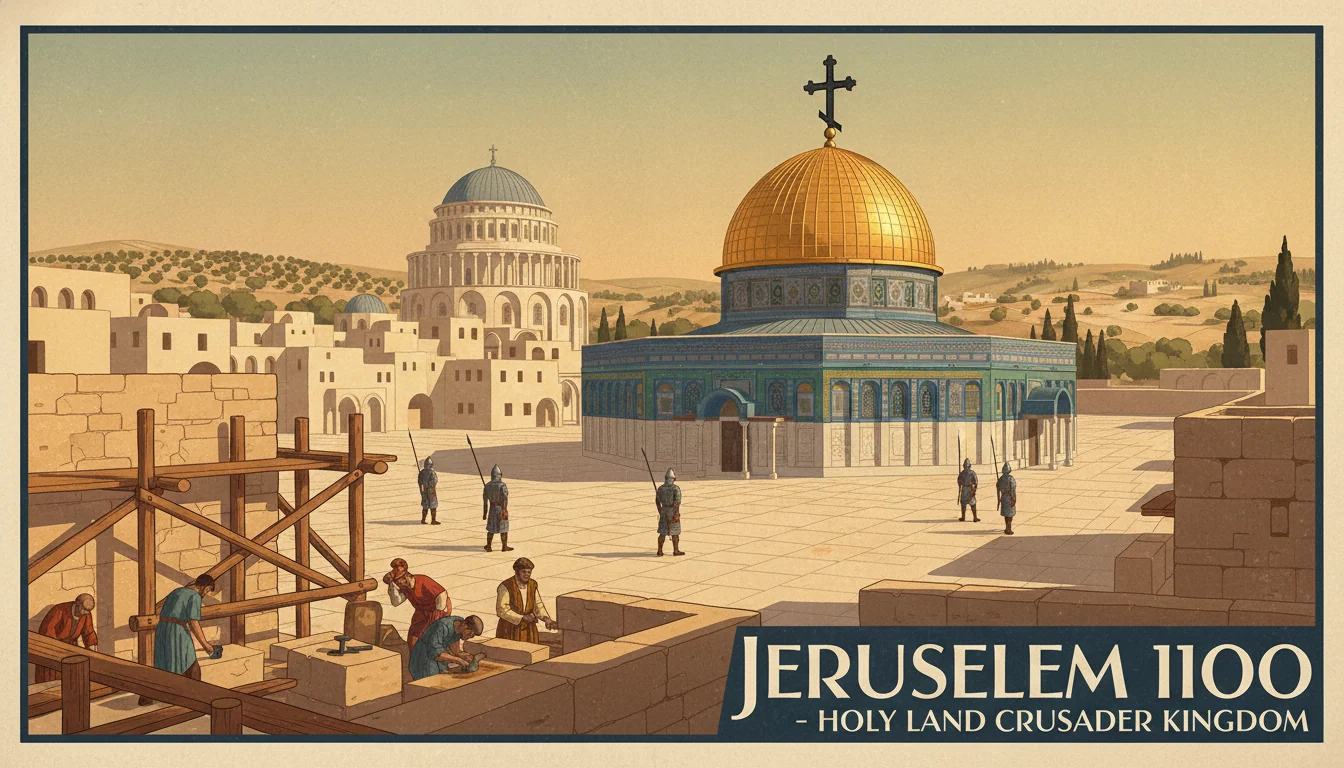
If you want to walk the most contested city on earth at one of its most dangerous moments, set your time machine for Jerusalem in the spring of 1100. The First Crusade has just concluded its conquest. The garrison has been slaughtering, looting, and consolidating for nine months. Godfrey of Bouillon, the Frankish nobleman elected to rule the city, lies dying of an unidentified illness. His brother Baldwin is racing south from Edessa to claim the throne. The Egyptian Fatimids are massing on the coast. Half the city's pre-conquest population is dead, deported, or in hiding.
It is one of the most psychologically intense years in the entire 11th century. So before you click your watch into 1100, here is your practical guide to surviving, blending in, and not getting killed in Crusader Jerusalem.
First, know what kind of place you're entering
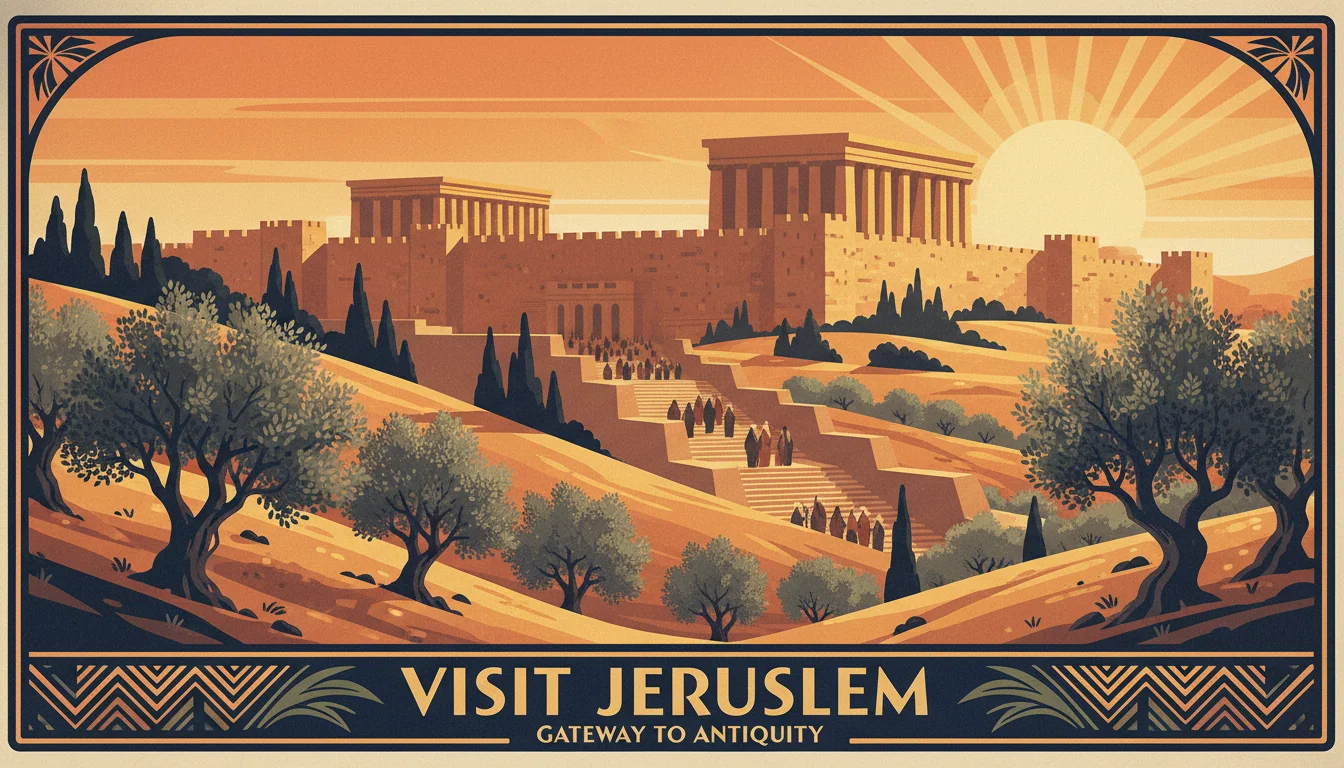
Jerusalem in 1100 is a small city by medieval standards, perhaps 20,000 people inside its rebuilt Roman and Fatimid walls, occupying an area roughly the same as the Old City of today. The streets are stone-paved, the houses are stone-built, and the public spaces are dominated by the great religious buildings: the Holy Sepulchre, the al-Aqsa Mosque (now called the Templum Salomonis by the Franks), the Dome of the Rock (the Templum Domini), and the rebuilt Hospital of St. John.
The political situation is unstable in every direction. The conquest of July 15, 1099 produced a massacre that contemporary chroniclers, Christian and Muslim alike, describe in nearly hallucinatory terms. The Frankish garrison that holds the city is small, no more than three hundred knights and perhaps a thousand foot, in a region surrounded by hostile Muslim emirates and an angry Fatimid Egypt. Most of the original Crusaders went home after Easter 1100. Those who stayed are exhausted, broke, and jumpy.
Your safest cover story is that you are a Latin pilgrim from somewhere distant enough to be plausible but obscure enough to discourage follow-up questions. Burgundy, the Auvergne, southern Lombardy, or the lower Rhine all work. Pretending to be Norman, Provençal, or Lotharingian invites cross-examination from veterans of those contingents. Avoid claiming to be Pisan or Genoese unless you actually know which family fleet brought you east.
Do not pretend to be Greek. The relationship between the Latin garrison and Constantinople has collapsed. Do not pretend to be Armenian. The Armenian community has been cooperative with the Crusaders and is therefore watched. Do not, under any circumstances, claim to be a converted Muslim. The garrison hangs people for less.
Dress like you belong
Latin Crusader dress in 1100 is still recognizably Western European, modified for the Levantine climate. The full chivalric hybrid look, with kaftans worn over mail and turbans wrapped over helmets, will develop over the next thirty years. In 1100 the men in charge are still wearing what they wore at Antioch.
For a male pilgrim:
- a long linen undertunic to mid-calf
- a wool overtunic, hitched at the belt
- coarse wool hose tied with garters
- leather shoes with rough soles
- a wide-brimmed felt hat for the road, hood for the city
- a pilgrim's scrip (leather pouch) and a wooden staff
- a small cloth cross sewn to the right shoulder if you mean to be taken seriously
For a female pilgrim:
- a long linen chemise to the ankle
- a wool gown with long sleeves
- a cloth veil covering the hair
- leather shoes with sturdy soles
- a long wool cloak for the cold nights
Avoid bright colors. The fashionable Crusader palette is unbleached linen, undyed wool, and the occasional faded blue or red. Expensive Eastern silks are worn only by the highest nobility and the surviving native Christian elite. Wearing silk as a pilgrim invites either suspicion of theft or the assumption that you are a wealthy donor and therefore a target.
Do not wear jewelry. Do not wear perfume. The garrison reads both as signs of having been east too long, which raises the question of why.
Get used to the smell and the sound
Crusader Jerusalem in 1100 is a city in active reconstruction. The siege of 1099 damaged walls, gates, and several major buildings. Through 1100 you will hear hammer on stone every daylight hour. The Hospital of St. John, which will become one of the great institutions of the Latin East, is being expanded. The Templum Domini is being reroofed. Mason scaffolding leans against half the buildings on the inner streets.
The smell is different from a Western European city of similar size. There is more dust. There is less sewage in the streets, because the Roman drainage system, repaired by the Fatimids in the 11th century, mostly still works. There is more livestock, because the Frankish garrison is grazing animals on terraces inside the walls in case of siege. The air carries lamp smoke, frankincense from the churches, leather from the saddlers' lanes, and a steady undertow of decay from the still-uncleared killing grounds near the Temple Mount.
By spring 1100, the worst of the corpses from the conquest have been removed. The smell of them has not entirely gone.
How the day works
The city wakes before dawn. Pilgrims and clergy attend matins in the Holy Sepulchre well before sunrise. By the time the gates open at first light, the markets in the Quarter of the Patriarch are already alive with bread, oil, fruit, and the few vegetables the garrison can spare. The main meal of the day is taken around the sixth hour, roughly noon, with a lighter supper after vespers.
The four city gates, the Gate of David (now Jaffa Gate), the Gate of the Pillar (Damascus Gate), the Gate of St. Stephen (Lions Gate), and the Sion Gate, close at sunset and reopen at dawn. After dark the streets are patrolled by Frankish men-at-arms with torches and mastiffs. Anyone caught outside without a clear errand is detained at the nearest tower. Repeat detentions can produce floggings.
Three places you absolutely must visit
The Church of the Holy Sepulchre
The reason any of you came. The Holy Sepulchre in 1100 is not yet the unified Crusader cathedral that Queen Melisende will rebuild in the 1140s. It is a complex of older Byzantine chapels, the rebuilt rotunda over the tomb of Christ, the chapels of Calvary and the Finding of the Cross, and a cluster of side chapels controlled by various Eastern Christian communities.
The Latin Patriarch, Daimbert of Pisa, has just been installed and is engaged in a fierce political contest with Godfrey of Bouillon over who controls the holy sites and their revenues. Pilgrims like you are caught in the middle. Pay your offering at the door. Walk the route from Calvary to the Tomb. Do not engage in any conversation about which clergy of which rite has the right to celebrate which mass at which altar. Latins, Greeks, Armenians, Georgians, Syrians, Copts, and Ethiopians are all jockeying for position, and any opinion you offer will be wrong with at least four of them.
The Templum Domini (Dome of the Rock)
The 7th-century Umayyad masterpiece on the Temple Mount has been converted into a Christian church and renamed the Templum Domini, the Temple of the Lord. The Frankish garrison genuinely believes it is the original Temple of Solomon, or at least a building on its site. The cross has been mounted on the dome. The interior mosaics, which to the Crusaders are decorative gold, are still intact. They will remain so for another eighty-seven years until Saladin retakes the city.
Walk the Mount slowly. The Franks have planted a garden of date palms in the courtyard. The al-Aqsa Mosque on the south side of the Mount, now called the Templum Salomonis or Solomon's Temple, has been requisitioned as Godfrey's residence. Within twenty years it will be the headquarters of the Knights Templar. In 1100 it is just a confused royal palace.
The Pool of Bethesda and the Quarter of the Patriarch
Walk north from the Holy Sepulchre into the Quarter of the Patriarch, which the Crusaders are rebuilding into the new Frankish residential center of the city. Most of the previous Muslim and Jewish populations of these blocks were killed or expelled in 1099. The houses are being reassigned to Latin settlers. The result is a strange mixture of fresh occupants in lived-in houses, with Muslim and Jewish furniture, cooking equipment, and books still inside.
Continue to the Pool of Bethesda, north of the Temple Mount near the Gate of St. Stephen. The site is identified with the miracle of the paralytic and is one of the more peaceful corners of the city. The Crusaders are beginning the construction of the Church of St. Anne nearby. It is a calm place to sit and think about whether you really want to stay another day.
How to talk to people without causing trouble
Latin in 1100 Jerusalem is the language of the church and the chancellery. The Frankish soldiers and settlers actually speak Old French, with regional dialects mixing into a rough lingua franca that scholars later call Crusader French. The native population speaks Levantine Arabic, Aramaic-derived dialects, Greek, Armenian, and Hebrew, in roughly that order of frequency. Most market exchanges happen in Arabic and a polyglot pidgin.
A few rules help:
- bow lightly to any knight in mail
- never speak first to a member of the secular clergy
- always remove your hat in a church courtyard
- never raise a hand toward an Eastern Christian monk
- never, ever cross yourself the wrong way in front of a Greek
If you are introduced to a Frankish lord, give a short and modest account of your pilgrimage, your route east, and the relics you intend to acquire. Crusader society in 1100 is intensely status-conscious, and exact rank determines how everyone speaks to you, but it is also welcoming to pilgrims because pilgrims bring offerings and serve as evidence that the conquest is divinely approved.
What to eat, what to avoid
Crusader Jerusalem food in 1100 is a hybrid in transition. The Western European arrivals are still eating bread, cheese, salt fish, and roasted meat when they can get it. The local agricultural economy supplies olives, dates, citron, almonds, lentils, chickpeas, lamb, goat, and the local wine of the surrounding villages, which the Franks find drinkable but thin.
Safe choices for a visitor:
- bread from the bakeries of the Patriarch's Quarter
- olive oil and za'atar with bread (newly fashionable among the Latins)
- lamb stewed with chickpeas
- roasted goat from a respectable inn
- watered local wine at every meal
Things to avoid:
- water from any well except those inside the Templum precinct
- pork, which is rare and frequently spoiled
- shellfish, brought up from the coast and almost always bad by arrival
- exotic spiced dishes from unknown cooks
- anything described as "from the old kitchens," which is salvage from before the conquest
Sugar exists but is rare. Dates are common. Honey is widely used. Coffee will not arrive for another four hundred years.
Politics you should know about, briefly
In April 1100, Godfrey of Bouillon is gravely ill and will die in July. He is the elected ruler of Jerusalem with the title Defender of the Holy Sepulchre, having declined the crown that his successor will accept. His brother Baldwin of Boulogne, currently Count of Edessa, will arrive at Christmas to be crowned the first King of Jerusalem.
The Egyptian Fatimid Caliphate is preparing a major invasion of Palestine and will be defeated by Baldwin at Ramla in 1101. The northern Crusader states of Antioch and Edessa are in their own crises, with Bohemond of Antioch captured by the Danishmend Turks in August 1100 and held for ransom for three years. The cities of Tyre, Sidon, Acre, and Ascalon remain in Muslim hands and are being held with help from the Fatimid navy.
If you must discuss politics, repeat conventional praise of the conquest and the rights of the Holy Sepulchre, avoid all opinions on the dispute between Patriarch Daimbert and Godfrey, and never speak well of the Greek Emperor Alexios I.
What not to do under any circumstances
Let me save you from the classic mistakes.
Do not:
- speak Arabic too well in a Frankish street
- speak any language too well in front of a Latin clerk who does not know it
- visit the Western Wall (the area is a ruined garbage dump in 1100, and a Latin lingering there draws suspicion)
- enter the al-Aqsa Mosque without an explicit invitation from a royal officer
- pick up any object you find unattended in a private house
- ask about the events of July 15, 1099 in any detail
- defend a Muslim merchant in any commercial dispute
- defend a Jew in any dispute whatsoever
- predict the fate of the city in any direction
Most importantly, do not predict that the Latins will lose the city. They are extremely sensitive about their tenuous hold, and the suggestion is treated as either bad faith or witchcraft.
The experience you should not miss
If you have one moment in Crusader Jerusalem, take it at the Holy Sepulchre on the Friday before Easter. The Frankish garrison, the Eastern Christian communities, and the pilgrim crowds all converge for the Holy Fire ceremony. Tapers are lit from the flame in the Tomb. The sound of half a dozen liturgies in different languages overlays itself in the rotunda. For one afternoon, the polyglot, jealous, exhausted population of the conquered city behaves like the Christian capital of the world that the Crusaders believed they had built.
You are watching the most contested square mile in medieval geography on the day it most resembles its own propaganda. Almost everyone in that crowd will be displaced, killed, or replaced within the next two generations.
Bring a hat to remove, a handful of small silver coins, and a willingness to keep your mouth shut about politics, theology, and the recent past. Crusader Jerusalem in 1100 is one of the most thrilling and terrifying destinations on any time-travel itinerary.
If the early Crusader period leaves you wanting more, our guide to Fatimid Cairo in 970 picks up the story across the desert with the dynasty whose late successors Baldwin's heirs spent the next century fighting. The time traveler's guide to Jerusalem in 33 AD returns to the same streets a thousand years earlier, when the city was still part of the Roman province of Judaea.

Need Advice from Someone Who Lived There?
Get firsthand accounts from people who actually lived through these moments in history.
Ask Them YourselfJoin the HistorIQly Club
Get smarter about the past.
Weekly stories, deep dives, and exclusive content straight to your inbox.