A Time Traveler's Guide to Antebellum New Orleans, 1850
Everything you need to know before visiting antebellum New Orleans in 1850: yellow fever, slave markets, Creole culture, and how to survive all three.
Read Wikipedia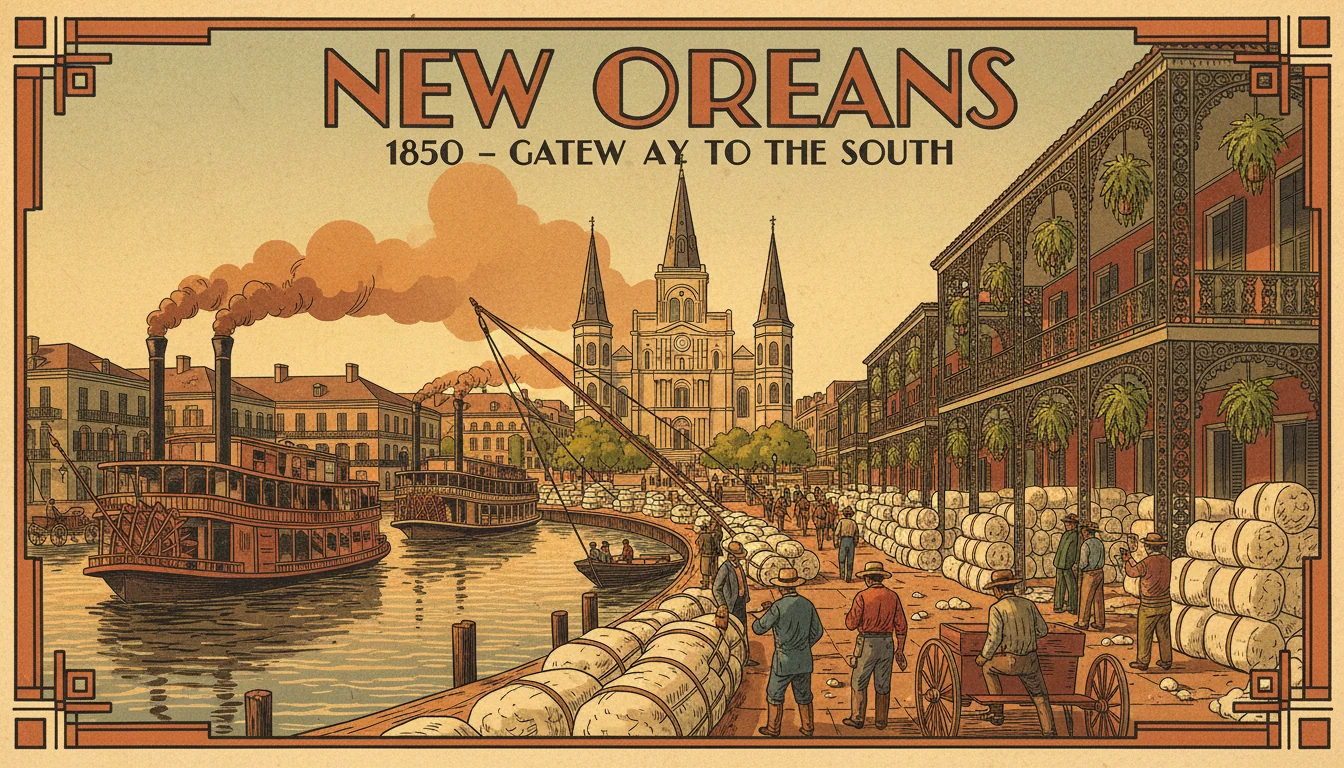
New Orleans in 1850 is not the New Orleans of jazz clubs and Bourbon Street tourism. It is not the post-Katrina city of survival narratives. It is something older, stranger, and harder to romanticize once you understand its full structure: the third-largest city in the United States, a genuine port metropolis at the mouth of the Mississippi River, and one of the most racially stratified and morally freighted urban environments in the Western Hemisphere. If you are going to visit, go in with clear eyes.
There is no benign tourist version of New Orleans in 1850. The city's wealth is built on enslaved labor. Its culture is fascinating precisely because it sits at the intersection of French, Spanish, African, and Anglo-American traditions in ways that produced genuinely original architecture, cuisine, and social organization. Both things are true simultaneously and cannot be separated. The city's beauty and its horror share the same foundation.
Here is what you need to know.
What kind of city you are entering
New Orleans in 1850 has a population of roughly 116,000, making it the third-largest American city after New York and Baltimore. It is the dominant export point for the entire American South. Cotton grown in Mississippi, Alabama, and Georgia arrives by flatboat and steamboat, is warehoused on the waterfront, and is loaded onto oceangoing ships bound for Liverpool, Le Havre, and New York. Sugar grown on Louisiana plantations moves through the same system. The city is physically built on this trade and cannot be understood without it.
The city is divided, both geographically and socially, in a way that will confuse you if you try to apply a simple binary. There are four rough population groups that matter for your visit.
The original Creole establishment - descendants of French and Spanish colonists who have been in Louisiana for up to four generations - controls much of the old wealth, speaks French as a first language, attends Catholic mass, and regards the influx of Anglo-Americans since the Louisiana Purchase of 1803 with polite but permanent suspicion. They live in the Vieux Carre, the French Quarter, and they are deeply conscious of their difference from the American newcomers.
The Anglo-American commercial class, centered in the American sector upriver from Canal Street and concentrated in the Garden District, has brought aggressive Northern commercial energy and Protestant social norms. They are building the sugar and cotton fortunes of the era and constructing Greek Revival mansions at a pace the old Creoles find alarming. They speak English, bank in English, and regard the Creoles as charming anachronisms.
The free people of color - gens de couleur libres - form a third group unique to Louisiana by its size and legal standing. Some are themselves slaveholders. Some are highly educated artisans, businesspeople, and intellectuals. Some are of mixed French and African ancestry going back to the French colonial period. Their legal status is precarious and depends on a system of racial documentation that the city enforces with bureaucratic seriousness.
Roughly one-third of the city's population is enslaved. The domestic slave trade runs through New Orleans on a scale that has no equivalent anywhere else in North America.
How to survive arriving
Your cover story should be that you are a foreign visitor, ideally from France, Britain, or one of the German states. New Orleans in 1850 has enough foreign-born residents and visitors that a European accent draws less scrutiny than a suspicious American outsider might receive. If you speak French even moderately well, use it in the French Quarter. You will be treated considerably better.
Do not arrive in summer if you can possibly help it. Yellow fever season runs from roughly June through October, and in epidemic years it kills thousands. The 1853 epidemic will kill over 11,000 people in a single season - you will be three years ahead of that disaster, but the 1850 summer is not safe. The disease was not yet understood to be mosquito-borne, so no one will be able to tell you how to protect yourself beyond the useless advice to avoid night air and miasma. Your best strategy is to arrive in winter, complete your visit, and leave before April.
Carry cash in silver coin. American dollars are accepted everywhere, but the city runs on fractional currency and coin-based transactions. Do not display large bills ostentatiously on the waterfront. The Faubourg Marigny and the docks are genuinely dangerous after dark, and pickpocketing in the French Quarter is well-organized.
Dress and presentation
The heat and humidity of New Orleans demand lighter clothing than almost anywhere else in the American South. In summer, linen or lightweight cotton is what the city actually wears regardless of formal dress codes. In winter, a wool suit is appropriate but will feel heavy. Men should wear a hat outdoors at all times.
If your appearance is not clearly that of a white person, you face a direct safety risk from Louisiana's slave codes. Any person of ambiguous racial classification can be stopped and required to produce documentation of free status. If you cannot produce papers, the consequences can be severe. Free people of color traveling without their freedom documents were regularly subjected to detention. This is not a theoretical risk.
Three places you must see
The French Quarter and Jackson Square
The Vieux Carre - the original French colonial grid between Canal Street and Esplanade Avenue - is in 1850 a working neighborhood of iron-lace balconies, ground-floor commercial spaces, second-floor residences, and narrow interior courtyards planted with banana trees and jasmine. The St. Louis Cathedral and the Cabildo on Jackson Square are the formal civic heart. The market on the downriver side of the square operates from before dawn. Buy coffee and beignets there in the morning before the heat sets in.
The waterfront levee
The levee along the river between Canal Street and the French Market is one of the most extraordinary commercial spectacles in the Americas in 1850. Hundreds of flatboats and steamboats are moored or moving at any given time, loading and unloading cotton bales, sugar barrels, corn, salt pork, hides, and manufactured goods from the North and Midwest. The steamboat captains treat their schedules with professional seriousness. The dockworkers, many of them enslaved, work in conditions you will find difficult to witness. Go anyway. This levee is the economic engine of the American South made visible, and it looks exactly the part.
What to eat and drink
Creole cuisine in 1850 is not yet the fully codified tradition it will become by the 20th century, but it is already a genuinely original food culture. French technique has absorbed African vegetables - okra, field peas, sweet potatoes - Native American ingredients including file powder from sassafras leaves, and Spanish influences from the colonial period. Red beans and rice on Mondays, laundry day when no one wanted to tend a long-cooking pot, is already a city institution.
Safe choices for a visitor: coffee at any established cafe in the French Quarter, gumbo or a plate meal at a restaurant serving regular midday meals, bread from the French Market in the morning.
Politics and what not to say
New Orleans in 1850 is three years before the Kansas-Nebraska crisis and a decade before secession, but the question of slavery is not an open debate here. It is a settled fact of economic and social organization, enforced with laws and with violence. Expressing abolitionist opinions in any public setting carries real risk. Even in the French Creole establishment, where attitudes toward free people of color are sometimes more nuanced than in the Anglo-American sector, any public challenge to the slave economy will be treated as a threat rather than a philosophical position.
If you are asked your opinion on any of this, claim to be a foreigner who does not follow American politics. It is the safest answer available.
Do not attempt to observe the slave auction rooms on Chartres Street with visible discomfort. The trading houses operate openly and legally, and their owners are prominent citizens who will not appreciate scrutiny. The Faubourg Marigny at night is genuinely dangerous; do not go without a local guide.
The experience worth having
If you can arrange your visit for the days before Ash Wednesday, you will catch the pre-Lenten celebrations that have not yet hardened into the structured Mardi Gras tourism industry of later generations. In 1850 the celebrations are still relatively informal: street processions, small private balls and rented-hall dances, the social mixing across class lines that the season briefly permits. The Catholic calendar still governs the city's rhythms in ways that will largely disappear within a generation as the Anglo-American Protestant population grows.
Find the French Market at five in the morning. Buy coffee the color of mud from a vendor who has been there since before you arrived. Eat a beignet that has been fried in lard. Watch the flatboats come in from upriver with the first light. This is 1850 New Orleans at its clearest: a city built on a river, dependent on trade that costs human lives, producing something beautiful and dangerous in roughly equal measure.
Leave before the summer. The city is extraordinary in winter. In summer it kills people.
For other 19th-century city guides, compare the Gilded Age New York time travel guide or the very different atmosphere of Belle Epoque Paris, 1900.
Quick Answers
Common questions about this topic
What was New Orleans like in 1850?
New Orleans in 1850 was the third-largest city in the United States, with a population of about 116,000. It was the dominant export port for the American South's cotton and sugar economy, home to one of the largest slave markets in North America, a city of genuine cultural complexity, and one of the most lethal places in the country - yellow fever killed thousands of residents almost every summer.
What language was spoken in antebellum New Orleans?
New Orleans in 1850 was genuinely bilingual. French was the language of the original Creole establishment - descendants of French and Spanish colonial settlers - while English dominated the American sector that had grown after Louisiana's purchase in 1803. You would also hear Louisiana Creole (a French-based creole language), Spanish, and a range of African languages among the enslaved population.
How dangerous was New Orleans in 1850?
Extremely dangerous in multiple ways. Yellow fever struck the city almost every summer, killing between 1,000 and 8,000 people per season in epidemic years. Crime along the waterfront and in the Faubourg Marigny was severe. Streets flooded regularly. And Louisiana's slave codes meant any person of ambiguous racial classification could be stopped and required to produce documentation of free status.
What was the slave market in antebellum New Orleans?
New Orleans hosted the largest domestic slave market in the United States in 1850. The main trading houses were concentrated along Chartres Street and the surrounding blocks of the French Quarter. Enslaved people were shipped from the Upper South after the international trade was banned in 1808, sold primarily to sugar and cotton plantations in Louisiana and Mississippi. Roughly one-third of the city's population was enslaved.

Need Advice from Someone Who Lived There?
Get firsthand accounts from people who actually lived through these moments in history.
Create your free account →No card required. Some figures and features require a paid plan.
Join the HistorIQly Club
Get smarter about the past.
Weekly stories, deep dives, and exclusive content straight to your inbox.