Time Traveler's Guide to Prohibition New York, 1925
Prohibition New York 1925 in practice: 30,000 illegal bars, jazz in Harlem, and distilled spirits that could blind you. A survival guide to the city at its most defiant.
Read Wikipedia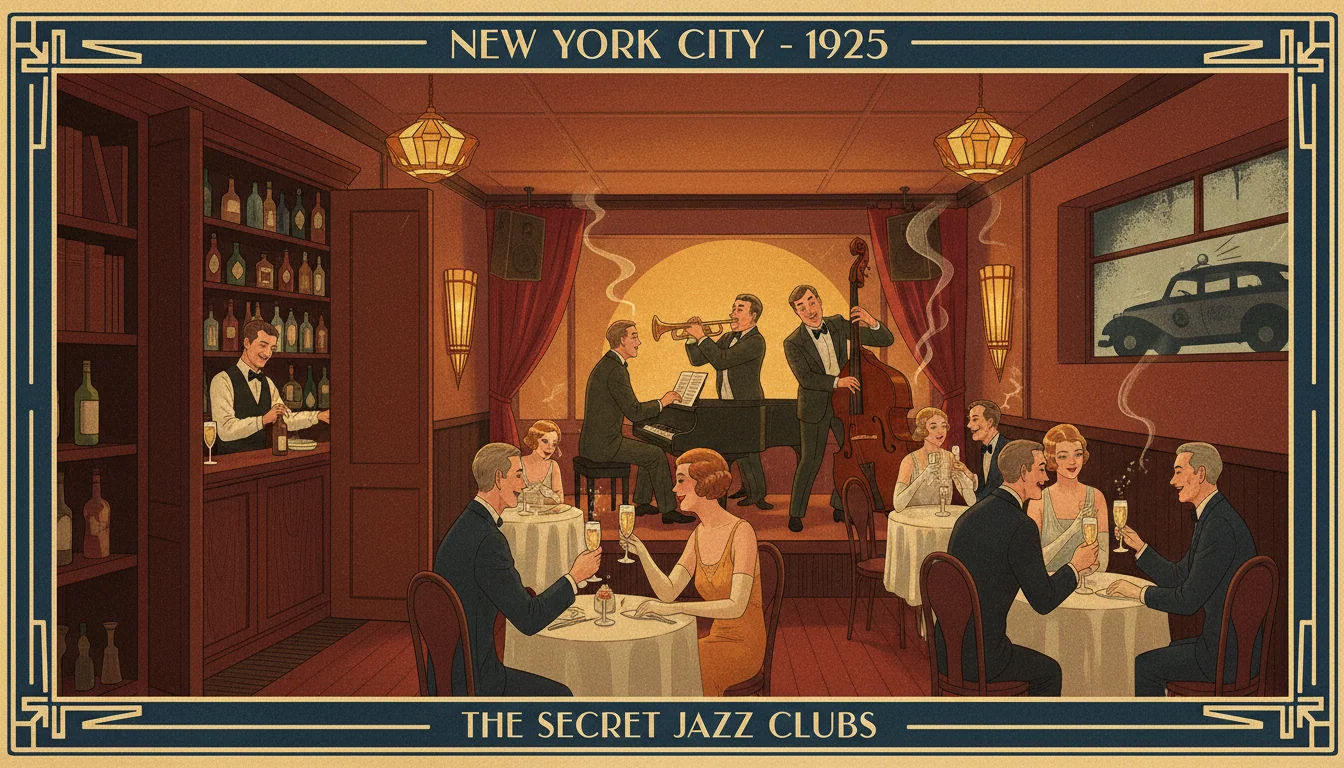
The Eighteenth Amendment went into effect on January 17, 1920, and New York City's response was immediate, creative, and almost completely defiant. Within two years the number of illegal bars in the five boroughs had surpassed the number of legal ones that had existed before the ban. By 1925, when you are arriving, the city has refined the art of the speakeasy to a degree that would be genuinely impressive if it were not also occasionally fatal.
Welcome to Prohibition New York. Pack carefully. Tip generously. And for reasons that will become clear later, drink the beer rather than the gin.
What you are arriving into
The city in 1925 is at the center of a genuine cultural explosion. The Roaring Twenties is not a retrospective term applied to a dull decade; the decade is actually roaring. Jazz has migrated north from New Orleans and Chicago and found a second home in Harlem, where a concentration of musicians, writers, and artists is producing work that will outlast the century. Skyscrapers are going up. Radio broadcasts have been running for a few years. Women have had the national vote for five years and are enjoying it in ways that alarm the newspapers.
Mayor John Hylan runs the city from City Hall. He is a Democrat of the Tammany Hall variety, which means he is pragmatic about enforcement and has strong opinions about the subway fare. You will not personally need to worry about him. What you need to worry about is navigation - and navigation here is social as much as geographic.
The city runs on introductions. Know someone, or know someone who knows someone, and most of what you want to do is accessible. Arrive cold with no connections, and the good stuff is hidden behind doors that look like warehouse walls.
Finding a speakeasy
The first rule is that you will not have trouble finding one. There are more than thirty thousand illegal drinking establishments in this city, from plush midtown clubs with matre d's in white jackets to basement operations in the outer boroughs where the furniture consists of three chairs and a wooden crate. The challenge is finding one that will admit you and not poison you.
The better establishments - places like the 21 Club on West 52nd Street, which has been operating since 1922 under various arrangements - require either a referral from an established member or a sufficiently confident manner at the door. The peephole is real: someone examines you through a slot in the door before admitting you. The correct response to being peered at through a slot is to say a name - the name of the person who told you about the place - and wait.
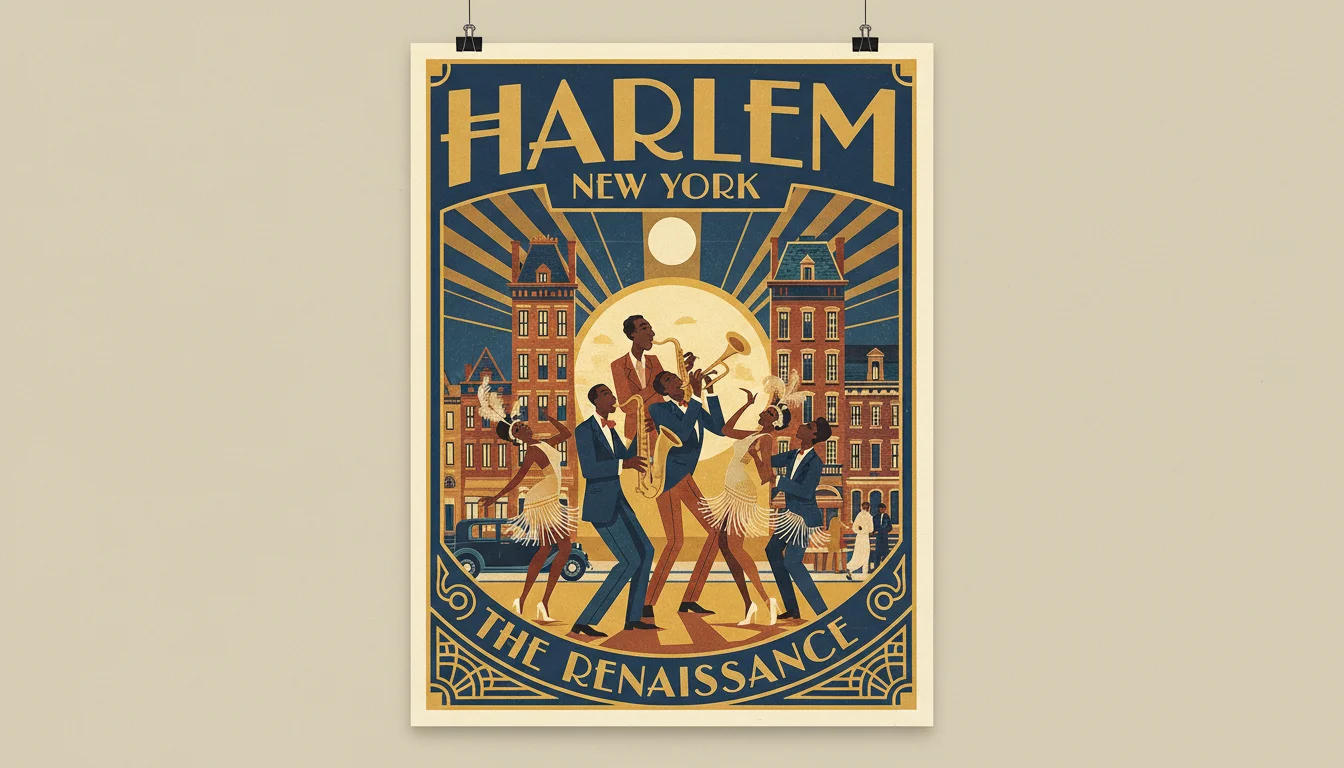
Midtown Manhattan has the densest concentration of the higher-end operations. East 52nd Street and the surrounding blocks are sometimes called "Swing Street" in this period, though that name will become more common in the 1930s. Harlem, above 110th Street, offers a different kind of venue: the rent parties, jazz clubs, and informal gathering places of the Harlem Renaissance. These are sometimes more accessible to outsiders than midtown's exclusive clubs, and the music is considerably better.
The liquor question
This is where your survival depends on paying attention.
Beer is generally safe. The large bootleg operations, including several run by organizations you do not want to know the names of, produce beer that is weaker than pre-Prohibition lager but unlikely to harm you. Order beer when in doubt.
Wine, similarly, is usually what it claims to be. Home winemaking was explicitly permitted under the Volstead Act for personal consumption, which produced a boom in Italian and Eastern European immigrant households making wine for themselves and, discreetly, for others.
Distilled spirits are where the danger lives. Legitimate pre-Prohibition whiskey is available but expensive and increasingly scarce. What fills the gap is a range of products with a range of quality: genuine smuggled Canadian whisky at the top, reasonably competent domestic bathtub gin in the middle, and at the bottom, industrial alcohol redistilled or simply diluted and flavored. The federal government, in its infinite wisdom, has mandated that industrial alcohol be adulterated with increasingly toxic substances - including methanol - to discourage its consumption. This has not discouraged consumption; it has killed people instead.
Methanol poisoning produces symptoms that can be mistaken for ordinary intoxication until it is too late. Blindness is an early sign that something is very wrong. Death follows in severe cases. Stick to beer. If you must drink spirits, order only at an establishment that clearly has money invested in its reputation, and do not drink from an unlabeled bottle.
Harlem
Take the subway uptown. The IRT runs to 125th Street, which puts you in the center of Harlem in twenty minutes from midtown. What you arrive into is unlike anything else happening in American culture in 1925.
The Harlem Renaissance is not a movement anyone has named yet - that label comes later. What it is, right now, is a neighborhood producing an extraordinary density of creative work. Langston Hughes, who published his first major poem "The Weary Blues" in 1926, is already working in the city. Zora Neale Hurston is at Columbia, studying with Franz Boas. The Cotton Club at Lenox Avenue and 142nd Street has been open since 1923; it features top-line jazz performers including, on the right night, Duke Ellington's orchestra. The audience is, in 1925, almost exclusively white - the Cotton Club operates a segregated admissions policy that lets Black musicians perform while admitting only white patrons. This is one of the grosser ironies of the era, and you should know it going in.
For integrated or Black-owned venues, there are rent parties - social gatherings in private apartments where guests pay a small admission that helps cover the host's rent, and the music runs until morning. Getting into one requires exactly the kind of social introduction described above.
Dress
Do not show up looking like you arrived from another century. Men in 1925 New York wear suits. Not jackets and trousers - suits, with waistcoat, collar, and hat. The fedora or homburg is standard; going bareheaded marks you immediately as unusual. Your shoes should be polished.
Women's fashion in 1925 is in the middle of a genuine revolution. The dropped waistline, shorter hem, and flapper silhouette are current and fashionable, particularly among younger women and in entertainment districts. The older generation of women wear longer skirts and more conservative blouses. Both are acceptable, but the flapper dress will cause less comment in a speakeasy than a Victorian-era construction.
Fur is present at every level of the economic range, from rabbit trim on a working-woman's coat to full-length mink on the wives of men who are not asking too many questions about where the money comes from.
The law
The official position of the city of New York is that the Volstead Act is federal law and technically its problem. The practical position of the New York Police Department is that Prohibition enforcement is a nuisance, a source of supplemental income from speakeasy operators who pay for protection, and occasionally an opportunity for a high-profile raid when political pressure demands one.
Federal Prohibition agents - Treasury Department employees, theoretically incorruptible, practically underpaid and understaffed - operate independently of the NYPD and are slightly more dangerous. They conduct raids without warning, typically in the late evening when patronage is highest. If you are in a speakeasy when a raid begins, the established protocol is to stay calm, do not run, give a false name if asked, and accept that you will probably spend a few hours at a precinct before being released with a fine. The fine, for a first-time patron, is modest. Violence during speakeasy raids is rare but not impossible.
The more serious organized crime networks - Arnold Rothstein's gambling and bootlegging operation, the various Italian and Jewish gangs managing liquor supply in different boroughs - are not your concern unless you go somewhere you should not. Stay in the better establishments, do not ask questions about supply chains, and this particular layer of the city will remain background scenery.
The city itself
Outside the drinking question, New York in 1925 is beautiful in ways that are easy to miss because you are probably looking for the parts you recognize. The skyline is shorter than you are used to; the Chrysler Building and the Empire State Building do not exist yet and will not for another several years. Grand Central Terminal, finished in 1913, is a decade old and already the grandest train station in the Western Hemisphere.
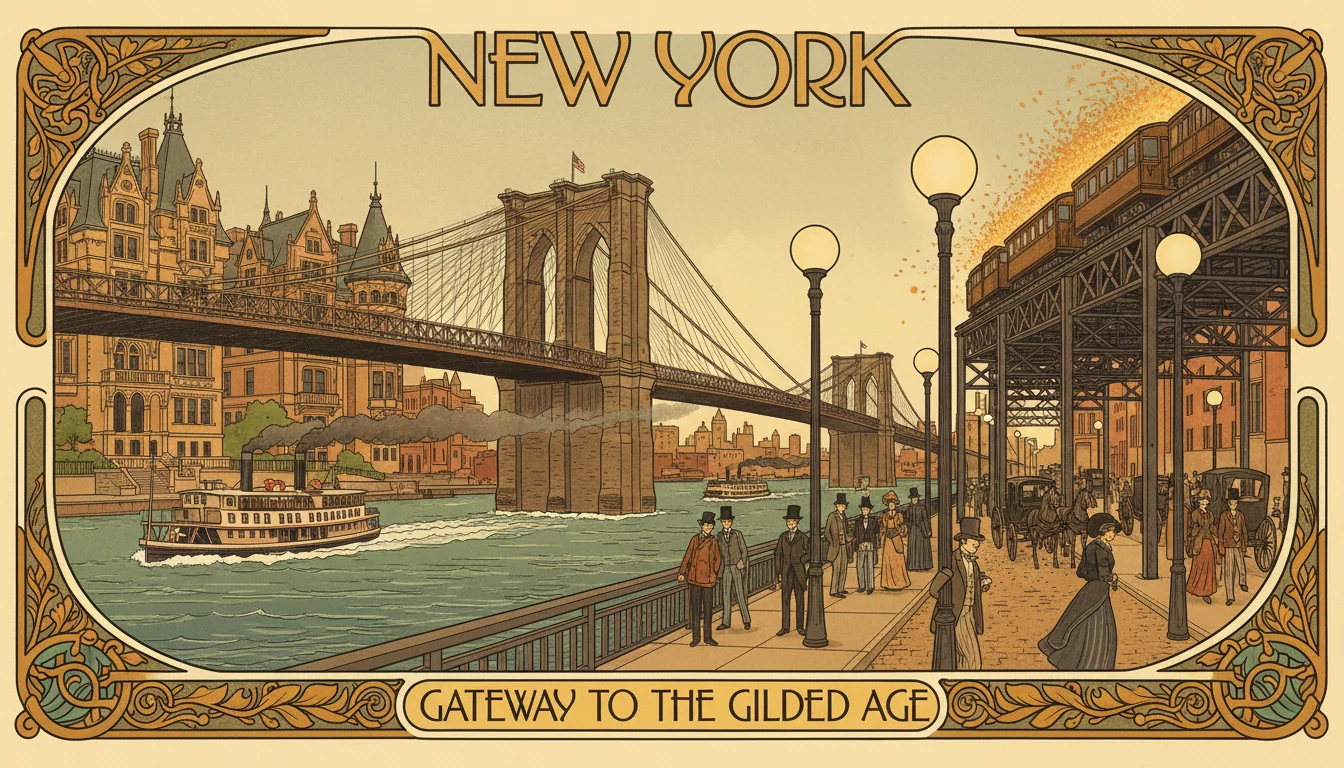
The subway is overcrowded and functional. The elevated railways on Second and Third Avenues still run and cast the streets below into alternating strips of shadow and afternoon light. The city smells of horses in some neighborhoods - automobiles have not fully won yet - and of garment-district fabric and food-cart food in others.
Broadway is producing the work that will define American musical theatre for the next generation. George Gershwin, who premiered Rhapsody in Blue at Aeolian Hall in February 1924, is at the center of a musical culture that is absorbing jazz rhythms into the mainstream with remarkable speed.
Go to the theatre. Drink the beer. Take the subway uptown at least once. And do not, under any circumstances, let anyone pour you a drink from an unlabeled bottle.
For more Roaring Twenties time travel, see the guide to Chicago in 1925. For an earlier chapter of American city life, visit Antebellum New Orleans in 1850.
Quick Answers
Common questions about this topic
How many speakeasies were in New York City during Prohibition?
Estimates vary, but by the mid-1920s, police and federal agents put the number of illegal drinking establishments in New York City at between 30,000 and 32,000. That is roughly twice the number of legal bars that existed before Prohibition. The city's approach to enforcement ranged from indifferent to actively complicit.
Was Prohibition actually enforced in New York City?
Barely. New York's police commissioner in the early 1920s, Grover Whalen, later acknowledged that the city was never serious about enforcement. Many precinct captains supplemented their income through arrangements with speakeasy owners. Federal Prohibition agents operated independently but were too few and too poorly paid to make a serious dent. City politicians including Mayor John Hylan were openly skeptical of the Volstead Act.
What was the Harlem Renaissance?
The Harlem Renaissance was a flowering of African American art, literature, and music centered in Harlem that peaked roughly between 1920 and 1935. By 1925, figures including Langston Hughes, Zora Neale Hurston, Claude McKay, Duke Ellington, and Louis Armstrong were either already working in Harlem or about to arrive. It was one of the most concentrated outbursts of creative talent in American history.
How dangerous was bootleg liquor in the 1920s?
Dangerously variable. Beer and wine were relatively safe if you knew the source. Distilled spirits were the hazard: unscrupulous bootleggers added industrial alcohol to stretch supplies, and industrial alcohol was frequently denatured with methanol. Methanol poisoning caused blindness and death. The federal government, attempting to discourage illegal drinking, deliberately required that industrial alcohol be made more toxic - a policy that killed thousands.

Need Advice from Someone Who Lived There?
Get firsthand accounts from people who actually lived through these moments in history.
Create your free account →No card required. Some figures and features require a paid plan.
Join the HistorIQly Club
Get smarter about the past.
Weekly stories, deep dives, and exclusive content straight to your inbox.